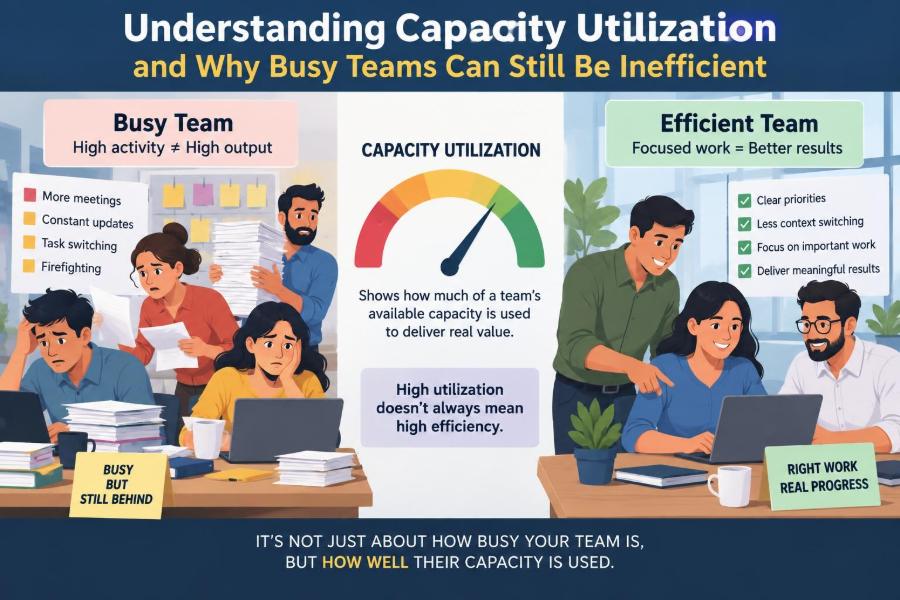

It is late afternoon, and everyone on the team is busy. Messages are arriving, meetings are full, dashboards show a long list of completed tasks, and people are staying late to catch up. From the outside, the department appears highly productive.
Yet customers are waiting longer than expected. Mistakes are being corrected, priority work keeps getting delayed, and no one seems to have time to improve the process that creates the pressure. The team is active, but the results are uneven.
This is a common management puzzle: why can a team work at full speed and still perform poorly? The answer often lies in the difference between being busy and using capacity well.
Capacity utilization helps managers examine how much available capability is being used. Used thoughtfully, it reveals bottlenecks, hidden overload, and opportunities to deliver better outcomes without simply asking people to work harder.
📌 What Capacity Utilization Means
Capacity utilization compares the output a team, machine, service operation, or business actually produces with the output it could reasonably produce over the same period.
In simple terms, it asks: How much of our usable capacity are we using? A factory may compare units produced with its practical production capability. A consulting team may compare client hours delivered with available client-facing hours. A support desk may compare cases handled with the volume it can handle while maintaining service standards.
The word usable matters. Capacity is not merely every hour on a calendar or the theoretical maximum speed of a machine.
🧮 The Basic Capacity Utilization Formula
A common calculation is:
Capacity utilization = Actual output ÷ Practical capacity × 100
Suppose a packaging line can practically produce 800 boxes during a shift, allowing for normal setup, checks, and breaks. If it produces 600 boxes, utilization is 75%.
For knowledge work, output is harder to define. A design agency might use completed, approved client work rather than hours spent at a computer. A team should choose a measure that reflects valuable output, not just visible activity.
🧱 Practical Capacity Is Not Theoretical Maximum
Theoretical capacity is the highest output possible under ideal, uninterrupted conditions. It assumes equipment never fails, materials always arrive, and people never need breaks, training, coordination, or quality checks.
Practical capacity reflects normal operating conditions. It includes reasonable allowances for routine downtime and necessary work that supports delivery.
Using theoretical capacity as the denominator can make a healthy operation look underutilized. It can also encourage managers to treat essential activities, such as maintenance and coaching, as waste rather than as part of reliable performance.
🚦 Why Being Busy Is Not the Same as Being Efficient
Busy teams may spend substantial time switching tasks, responding to avoidable requests, waiting for approvals, correcting errors, or attending meetings with no clear decision. These activities consume capacity without necessarily creating customer value.
Efficiency concerns how well resources are converted into useful output. A team can have high utilization of people’s time while showing low efficiency if much of that time is consumed by rework and coordination.
A full restaurant kitchen that repeatedly remakes dishes is busy. It is not operating efficiently.
🎯 Output Must Be Defined Before It Is Measured
Capacity metrics become misleading when they count whatever is easiest to count. Tickets closed, calls answered, lines of code written, or emails sent may be useful operational indicators, but they are not automatically measures of value.
Good output measures are connected to the team’s purpose. For example, an accounts-payable team may track invoices processed accurately and on time. A software team may consider working features that meet agreed requirements, not merely tasks marked complete.
When output is poorly defined, people can improve the metric while making the service worse. This is often called metric gaming.
🔄 The Hidden Cost of Rework
Rework occurs when work has to be corrected, redone, clarified, or completed again because it was not right the first time. It is one of the clearest reasons a visibly busy team can fall behind.
Imagine a recruitment team rushing job offers through an approval process with incomplete salary details. Each correction may require new documents, additional approvals, and more candidate communication. The original task appears completed, but capacity is consumed again.
Tracking recurring corrections can reveal whether apparent high workload is actually a quality problem upstream.
⏳ Queues Turn Full Utilization Into Delay
When demand approaches or exceeds the capacity of a process step, work begins to queue. A queue may be physical, such as orders waiting for packing, or digital, such as requests waiting in an approval inbox.
At very high utilization, even small variations in demand or task duration can create large waiting times. A reviewer who is continuously assigned work has little room to absorb an urgent case, an unexpected absence, or a complex request.
This is why a team can be working intensely while customers experience slow service. The work is moving, but too much of it is waiting.
🧠 Knowledge Work Has Capacity Constraints Too
Capacity utilization is often associated with factories, but it applies to offices, hospitals, professional services, and digital teams. The constraints simply look different.
A legal team may be limited by the availability of experienced reviewers. A marketing team may be limited by brand approval. A product team may be limited by research, engineering expertise, or the number of decisions leaders can make promptly.
Human attention is also finite. Concentrated work, problem-solving, and sound judgment deteriorate when people are continuously interrupted or overloaded.
🏭 Machine Capacity and Human Capacity Differ
Machines can often operate close to a stable designed rate when properly maintained and supplied. People require recovery, learning, collaboration, and discretion. Treating human capacity as if it were identical to machine time can harm both quality and retention.
This does not mean that human capacity cannot be planned. It means plans should account for the type of work involved, its complexity, the experience of the employee, and the coordination required.
| Capacity type | Useful planning consideration |
|---|---|
| Machine or equipment | Setup time, maintenance, material availability, operating speed |
| Frontline service staff | Demand patterns, breaks, case complexity, service standards |
| Knowledge workers | Focus time, review cycles, collaboration, decision delays |
| Specialists | Scarce expertise, handoffs, training needs, single points of failure |
🔍 Find the Real Constraint
A process is usually limited by its narrowest point, often called a bottleneck or constraint. Increasing capacity elsewhere may add cost without improving total output.
For instance, a sales team might generate more qualified leads, but if only one solutions engineer can prepare technical proposals, the proposal stage limits the entire system. More leads may simply create a larger queue.
Managers should map the end-to-end workflow and ask where work waits, where errors return, and where demand consistently exceeds capability.
🗺️ Map Work, Not Just Departments
Functional reports can hide delays because each department may appear productive within its own boundaries. A purchasing team can meet its internal target while production still waits for a critical component.
A simple workflow map follows work from request to outcome. It identifies steps, owners, handoffs, waiting periods, approvals, and feedback loops.
The goal is not to create a perfect diagram. It is to see the system customers experience rather than the separate activities each team performs.
📥 Demand Variability Changes the Picture
Average demand is useful, but averages can conceal sharp peaks. A customer support team receiving a steady flow of requests needs a different staffing plan from one that receives most requests immediately after a product release.
Variation also comes from task complexity. Ten routine requests may take less capacity than two unusual cases requiring investigation and senior review.
Planning capacity only around an average can leave teams either idle at quiet times or overwhelmed when demand rises. Historical patterns, upcoming events, and known deadlines improve forecasting.
📊 Measure Workload Alongside Utilization
Utilization alone cannot tell managers whether people are overloaded. A team may show moderate utilization but face a severe backlog because the work is complex, poorly prioritized, or dependent on another team.
Useful companion measures include:
- work waiting in each stage of the process;
- time from request to completion;
- first-time-right quality or error rates;
- urgent work entering the system;
- work-in-progress, meaning tasks started but not finished.
Together, these indicators show whether capacity is producing flow or merely keeping people occupied.
🧾 Distinguish Productive, Necessary, and Avoidable Work
Not all non-customer-facing work is wasteful. Training, safety checks, documentation, maintenance, planning, and quality review can protect long-term performance.
It helps to classify activities into three broad categories: value-creating work, necessary support work, and avoidable work. Avoidable work may include duplicate data entry, unclear approvals, repeated status meetings, or requests caused by preventable defects.
This distinction prevents a simplistic push to eliminate everything that is not direct production. The better question is whether an activity contributes to dependable delivery.
🔀 Multitasking Reduces Effective Capacity
When people move frequently between tasks, they lose time rebuilding context. The effect is especially strong when the work requires analysis, writing, design, or judgment.
Consider a project manager interrupted throughout the day by status queries, urgent fixes, budget requests, and meeting invitations. Their calendar may show full utilization, but their ability to complete important planning work may be limited.
Reducing unnecessary task switching can increase effective capacity without adding staff. Shared priorities, protected focus periods, and clearer escalation routes are practical starting points.
📚 Work in Progress Can Become a Trap
Work in progress, often shortened to WIP, is work that has started but is not yet complete. Starting more tasks can make a team look active, but excessive WIP creates queues, competing priorities, and forgotten details.
A content team that begins twenty articles but completes only two cannot deliver value from the other eighteen. Similarly, a project portfolio filled with partially funded initiatives may consume management attention without producing usable results.
Limiting WIP encourages teams to finish important work before beginning more. This improves visibility and often shortens delivery time.
⚖️ High Utilization Has a Useful Range, Not a Universal Target
There is no single ideal utilization rate for every operation. A predictable, automated process may safely run closer to its practical limit than an emergency service, innovation team, or customer-facing operation that must respond to unpredictable demand.
Some capacity buffer is intentional spare capacity. It allows a system to handle variation, maintenance, urgent requests, and improvement work.
Too much unused capacity can be costly. Too little buffer can produce long queues, stress, errors, and missed opportunities. The appropriate balance depends on the consequences of delay and the variability of demand.
🚑 Service Operations Need Responsiveness
A call center, repair service, hospital department, or IT incident team may need spare capacity because demand cannot be scheduled perfectly. The cost of a delay can be far greater than the cost of some idle time.
For example, a maintenance team assigned fully to planned work may be unable to respond quickly when a critical asset fails. Reassigning people at the last minute disrupts planned tasks and can create a backlog.
Managers should decide which work requires rapid response and deliberately reserve enough flexibility to handle it.
💼 Billable Utilization Can Create Tension
Professional-service firms often track billable utilization: the share of available time spent on client work that can be billed. This can be useful for financial planning, but it is not the only measure of a healthy firm.
Employees also need time for learning, mentoring, business development, process improvement, and internal coordination. If every hour must be billable, these activities may disappear until a future problem makes them unavoidable.
A balanced approach connects billable work with quality, client outcomes, employee development, and the firm’s longer-term capability.
🧑🤝🧑 Skills Matter as Much as Headcount
Ten available employees do not necessarily equal ten interchangeable units of capacity. Work may require certification, product knowledge, language ability, system access, or experience handling exceptions.
A team can appear adequately staffed overall while one specialist becomes a persistent bottleneck. This is particularly risky when critical knowledge sits with a single person.
Cross-training, documented procedures, and planned succession can broaden useful capacity. These measures take time initially, but they reduce fragility when demand shifts or someone is absent.
🛠️ Improve the Constraint Before Adding Resources
Hiring, overtime, and new equipment can be appropriate responses to genuine shortages. However, adding resources before understanding the constraint may simply move the problem or increase cost.
If a review step is delayed by unclear criteria, another reviewer may not solve the issue. Improving the intake form, defining decision rights, or standardizing routine cases could release more capacity than adding headcount.
Start by testing the cause of the delay. Is it insufficient capacity, unpredictable demand, poor information, unnecessary handoffs, lack of skills, or a policy that creates waiting?
🤖 Automation Can Free Capacity—Or Shift the Problem
Automation can reduce repetitive work, shorten processing time, and improve consistency. Examples include routing routine requests, validating data fields, or generating standard reports.
But automation does not automatically improve the whole process. If it creates more work for an already constrained approval team, the queue may simply move downstream. Poorly designed automation can also create new exceptions that require manual repair.
Evaluate automation through end-to-end outcomes: speed, quality, workload, customer experience, and the effort required to manage exceptions.
🧭 Prioritization Protects Scarce Capacity
When everything is labeled urgent, teams cannot make sensible trade-offs. They may spend their best capacity on the loudest request rather than the most valuable one.
Clear prioritization should define which work matters most, who can change priorities, and what lower-priority work will pause when urgent work enters. This turns interruption from an informal habit into a visible decision.
A short weekly review of demand, current capacity, and major risks can prevent a long series of daily firefights.
📈 Use Leading and Lagging Indicators
Lagging indicators show what has already happened, such as missed deadlines, overtime, customer complaints, or a rising backlog. They are essential, but they may reveal problems after service has deteriorated.
Leading indicators provide earlier warning. Examples include a growing queue at a key approval stage, a rising number of incomplete requests, repeated interruptions, or a schedule with no available response capacity.
A good management review uses both. It asks not only whether last month’s output met expectations, but also whether the system is likely to meet them next month.
🗣️ Ask Employees What Consumes Their Time
Operational data rarely captures every source of lost capacity. Employees often know which reports are unused, which requests arrive incomplete, and which software steps create duplicate work.
Structured conversations can uncover valuable detail. Ask people what work they repeat, what they wait for, what prevents a task from being completed correctly the first time, and what demand arrives unexpectedly.
This should not become a search for someone to blame. It is an opportunity to understand the conditions that make good work difficult.
🚫 Common Misuses of Capacity Metrics
Capacity utilization becomes harmful when it is treated as a simple score for judging effort. Employees may then avoid helping colleagues, delay training, inflate activity counts, or continue low-value work to appear fully occupied.
Watch for these mistakes:
- using one target for roles with very different demand patterns;
- counting hours as output without checking quality;
- penalizing necessary downtime, learning, or maintenance;
- ignoring queues and handoffs outside one team’s boundary;
- setting utilization targets without explaining the business purpose.
Metrics should support better decisions, not replace managerial judgment.
🧪 Run Small Improvement Experiments
Large redesigns are sometimes necessary, but many capacity problems can be explored through small, controlled changes. A team might trial a clearer request form, limit active tasks, group similar work, or create a dedicated daily review window.
Before changing the process, define what improvement would look like. This could be fewer returns, shorter wait time, more completed work, or fewer urgent escalations.
Then review unintended effects. A faster intake process is not a success if it transfers errors to another team.
🗓️ Build Capacity Planning Into Regular Management
Capacity planning should not happen only during an annual budget cycle or after a crisis. It is a recurring management practice that connects expected demand with the people, skills, equipment, and time available.
A practical review can cover upcoming demand, existing backlog, planned absences, major projects, known constraints, and work that may be deferred. The exact level of detail should suit the pace of the business.
Regular planning makes trade-offs explicit. It gives leaders a chance to reduce commitments early rather than discovering overload after deadlines have already been promised.
🌱 Make Room for Improvement Work
Teams operating at constant maximum pressure rarely have time to fix the causes of that pressure. They may continue using inefficient templates, manual workarounds, or unclear processes because stopping to improve feels impossible.
Protected time for process improvement is a form of capacity investment. It may temporarily reduce short-term output, but it can reduce future rework, delays, and dependence on heroic effort.
The strongest case for improvement comes from a specific operational problem: repeated errors, a growing queue, frequent handoffs, or work that must be performed twice.
🏁 The Core Principle: Optimize Flow, Not Fullness
The aim of capacity management is not to ensure every person and machine looks busy every minute. It is to create a reliable flow of valuable work through the system at an appropriate cost and quality level.
That requires managers to see beyond individual utilization. They need to understand demand, variation, skills, bottlenecks, queues, quality, and the work required to sustain performance.
A team with a little room to respond, learn, and improve may deliver more dependable results than one that is visibly overloaded every day.
High performance is not measured by how full a team’s calendar looks; it is measured by how consistently the team turns available capacity into valuable, high-quality outcomes. When managers protect flow instead of rewarding constant busyness, they create operations that are more resilient for employees and more reliable for customers. 📊⚙️🌱