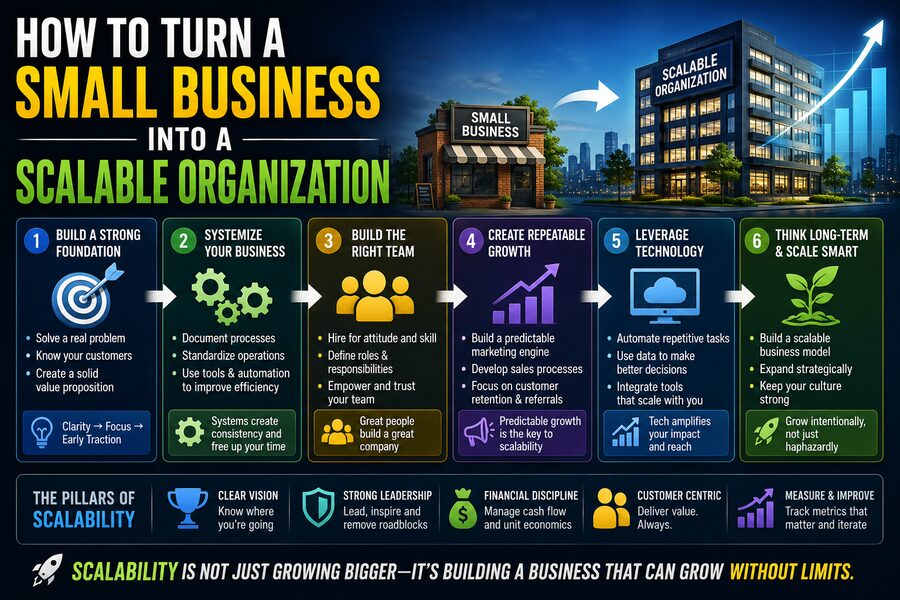

Many small businesses begin with a simple formula: the founder finds customers, delivers the product or service, solves problems, manages employees, approves expenses, handles emergencies, and makes nearly every important decision. In the early stages, this can work surprisingly well. 💼
But there is a limit.
If every sale, customer complaint, hiring decision, and operational problem requires the owner’s direct involvement, the business may grow in revenue without becoming truly scalable.
A scalable organization is different. It can increase customers, employees, locations, or revenue without requiring the founder’s workload to increase at the same rate.
That does not mean growth becomes effortless. It means the company develops systems, leadership, technology, processes, and financial discipline that allow more work to happen reliably without everything depending on one person.
The transition from a small business to a scalable organization is therefore not just about selling more.
It is about changing how the business operates. 📈
🧠 What Does “Scalable” Actually Mean?
A business is scalable when it can handle significantly more demand without needing resources to increase proportionally.
Suppose a company serves 100 customers with five employees.
If serving 1,000 customers requires exactly 50 employees, costs may increase almost as quickly as revenue.
But if better software, standardized processes, automation, specialization, and management allow the company to serve 1,000 customers with 25 employees, the organization has achieved greater scalability.
Scalability can come from:
- Automation 🤖
- Standardized workflows
- Better technology
- Delegation
- Repeatable sales processes
- Strong management
- Efficient use of capital
- Economies of scale
Not every business can scale infinitely. A plumbing company still needs technicians to complete jobs, while a software company may serve millions of users with relatively small increases in labor.
But almost every business can improve its ability to grow efficiently.
👤 The First Problem: Founder Dependence
One of the biggest obstacles to scalability is founder dependence.
In many small businesses, the founder knows:
- How to price jobs
- How to handle difficult customers
- Which suppliers to call
- How to solve operational problems
- How to hire employees
- How quality should be evaluated
Much of this knowledge exists only in the founder’s head.
That creates a bottleneck.
If the founder disappears for two weeks and the business immediately becomes chaotic, the organization is not yet scalable.
The goal is not to make the founder irrelevant.
The goal is to ensure that routine operations do not require constant founder intervention.
📝 Document the Way Work Gets Done
Scalability begins with making important knowledge repeatable.
This means creating standard operating procedures, commonly called SOPs.
An SOP describes how a recurring task should be completed.
For example, a service company might document:
- How a new customer inquiry is handled.
- How a quote is prepared.
- How the job is scheduled.
- How employees perform the work.
- How quality is checked.
- How the customer is invoiced.
- How follow-up is handled.
These procedures do not need to become enormous manuals that nobody reads.
Useful documentation should be practical and easy to follow.
It might include:
- Checklists
- Screenshots
- Short videos
- Templates
- Decision trees
- Scripts
The goal is to create consistency without unnecessary bureaucracy.
🔁 Build Repeatable Processes Before Hiring Rapidly
A common mistake is hiring more employees to compensate for broken processes.
Suppose customer orders are frequently lost because they arrive through phone calls, text messages, email, and handwritten notes.
Hiring another administrator may temporarily reduce the problem.
But the real issue is that there is no standardized order-management system.
A better solution might be:
All orders → central system → assigned owner → tracked status → completion
Once the process is organized, new employees can be added far more efficiently.
Scaling a bad process usually creates a larger bad process.
Improve the workflow first whenever possible.
🧩 Separate the Business Into Functions
When a company is tiny, one person may perform several roles.
The founder may be:
- Sales manager
- Operations director
- Recruiter
- Finance manager
- Customer-service representative
As the organization grows, responsibilities need clearer boundaries.
Most businesses eventually develop functions such as:
Sales – brings in customers.
Marketing – generates demand and leads.
Operations – delivers the product or service.
Finance – tracks money and performance.
Customer success – retains customers.
Human resources – recruits and supports employees.
The exact structure differs by business.
The purpose is not to create corporate titles unnecessarily. It is to make sure each important outcome has a clear owner.
🎯 Define Who Owns Each Result
Scalable businesses avoid situations where everyone is vaguely responsible for something.
If customer retention declines, who owns that metric?
If deliveries are late, who is responsible?
If advertising costs rise, who investigates?
Clear ownership improves accountability.
A useful principle is:
One important outcome should have one clearly accountable owner.
Several people may contribute, but one person should know that the result ultimately belongs to them.
This reduces confusion as teams become larger.
👥 Hire for Roles, Not Just Emergencies
Small businesses often hire reactively.
An employee becomes overwhelmed, so the owner quickly hires someone to “help.”
The new employee receives a mixture of unrelated tasks.
Over time, the organization accumulates unclear roles.
A more scalable approach is to define the role first.
Ask:
- What result should this person produce?
- What responsibilities will they own?
- What skills do they need?
- How will performance be measured?
- Who will manage them?
This creates a more deliberate organizational structure.
🧑💼 Build a Management Layer
A founder may be able to directly manage five or ten employees.
Managing 50 people directly is much harder.
At some point, the business needs managers.
Managers turn organizational goals into daily execution.
They:
- Set priorities
- Coach employees
- Track performance
- Solve routine problems
- Coordinate teams
- Escalate major issues
This management layer allows the founder or CEO to spend more time on:
- Strategy
- Capital allocation
- Senior hiring
- Partnerships
- Product direction
- Long-term growth
The shift can be psychologically difficult for founders who are accustomed to controlling every detail.
But without delegation, growth eventually hits a ceiling.
📊 Manage the Business With Metrics
Small companies often run on intuition.
That may work when the owner personally understands every customer and transaction.
As the business grows, intuition alone becomes less reliable.
A scalable organization needs a small number of meaningful metrics.
Examples include:
- Revenue
- Gross margin
- Customer acquisition cost
- Customer retention
- Sales conversion rate
- Average order value
- On-time delivery
- Employee productivity
- Cash balance
Metrics create visibility.
If sales decline, management can identify the problem earlier.
If margins fall, teams can investigate costs before cash flow becomes dangerous.
The goal is not to measure everything.
Too many metrics create noise.
Measure the numbers that actually influence business performance. 📈
💰 Understand Unit Economics Before Expanding
Growth is dangerous if every new customer loses money.
Before scaling, owners should understand unit economics.
Suppose a business spends $200 to acquire a customer.
If that customer generates only $150 of gross profit before leaving, growth may destroy cash.
But if the customer generates $1,500 of gross profit over several years, spending $200 to acquire them may be highly attractive.
Important questions include:
How much does it cost to acquire one customer?
How much gross profit does that customer generate?
How long does the customer stay?
How quickly is acquisition spending recovered?
Scaling magnifies economics.
Good economics become more powerful.
Bad economics become more painful. ⚠️
💵 Protect Cash Flow
A profitable company can still fail if it runs out of cash.
Growth often consumes cash before it produces cash.
Imagine a business that must:
- Hire workers
- Purchase inventory
- Buy equipment
- Spend on advertising
before customers pay their invoices.
Rapid expansion can create a cash-flow gap.
Scalable businesses forecast:
- Cash inflows
- Payroll
- Supplier payments
- Taxes
- Debt payments
- Capital expenditures
Growth should be financed intentionally rather than assuming revenue will solve every cash problem.
🤖 Automate Repetitive Work
Automation is one of the strongest drivers of scalability.
Employees may spend hours performing repetitive tasks such as:
- Copying data between systems
- Sending reminder emails
- Creating invoices
- Scheduling appointments
- Updating spreadsheets
- Generating reports
Many of these activities can be automated.
A scalable process might look like:
Customer places order → system creates invoice → inventory updates → confirmation sent → task assigned
Instead of employees manually completing every step, software handles the predictable work.
Automation allows people to focus on tasks requiring judgment, creativity, or relationships.
🖥️ Build a Reliable Technology Stack
Technology becomes increasingly important as the company grows.
Useful systems may include:
- Customer relationship management
- Accounting software
- Inventory management
- Project management
- Help-desk software
- Human resources platforms
- Business intelligence tools
The best software stack is not necessarily the most sophisticated.
It should reduce friction.
A company can actually become less efficient if it buys dozens of disconnected tools that employees do not understand.
Technology should support a clear process rather than substitute for one.
📣 Create a Repeatable Customer Acquisition Engine
A business is difficult to scale if every new customer comes from the founder’s personal relationships.
The organization needs repeatable ways to generate demand.
Possible channels include:
- Search advertising
- Social media
- Referrals
- Email marketing
- Partnerships
- Outbound sales
- Content marketing
- Local advertising
The goal is to discover channels where the business can reasonably predict:
Investment → leads → sales → gross profit
Once a channel performs consistently, the company may be able to increase spending while monitoring whether economics remain attractive.
🧲 Do Not Ignore Customer Retention
Acquiring customers is only one side of growth.
If customers leave almost as quickly as new ones arrive, the company is filling a leaking bucket. 🪣
Retention matters because existing customers may:
- Purchase repeatedly
- Buy additional services
- Refer others
- Require less marketing expense
Businesses should track why customers leave.
Possible causes include:
- Poor service
- Product problems
- Pricing
- Slow support
- Competitor offers
Improving retention can sometimes generate more profitable growth than increasing advertising.
📦 Standardize the Offering
Highly customized work can be difficult to scale.
Suppose every customer receives a completely different product, price, contract, and delivery process.
Employees must reinvent the workflow each time.
Standardization reduces complexity.
A consulting company might create three packages.
A service company might establish standard pricing tiers.
A manufacturer might reduce unnecessary product variations.
This does not mean eliminating flexibility.
It means avoiding customization that creates little value but enormous operational complexity.
🛡️ Build Quality Control Into the System
As a business grows, the founder cannot personally inspect every job.
Quality must become systematic.
Companies can use:
- Checklists
- Inspections
- Customer surveys
- Error tracking
- Audits
- Performance dashboards
A scalable organization does not rely entirely on excellent individuals remembering everything.
It builds processes that make consistent quality more likely.
🎓 Create Repeatable Employee Training
Hiring becomes much easier when onboarding is standardized.
Instead of telling each new employee:
“Follow Sarah for two weeks and figure it out,”
a business can create:
- Orientation materials
- Training videos
- Role-specific checklists
- Practice exercises
- Performance milestones
This reduces the dependence on individual trainers.
It also creates more consistent employee performance.
Training systems become increasingly important when a business expands into multiple locations.
🏢 Build the Organization Before Opening More Locations
Opening additional branches can create impressive revenue growth, but it also multiplies operational problems.
If the first location depends heavily on the founder, opening five more locations may create five times the chaos.
Before expanding geographically, businesses should make sure the existing operation has:
- Documented procedures
- Strong managers
- Reliable financial reporting
- Consistent customer experience
- Repeatable hiring
A second location should ideally replicate a proven operating model rather than invent one from scratch.
🧱 Design the Company Around Bottlenecks
Growth usually creates new bottlenecks.
At first, the problem may be leads.
Then sales improve, and fulfillment becomes the bottleneck.
After operations expand, hiring becomes the bottleneck.
Later, management capacity becomes the problem.
Leadership should continually ask:
What is currently limiting growth?
Resources should be directed toward the biggest constraint rather than improving everything equally.
This idea is closely related to the Theory of Constraints.
Removing the current bottleneck can unlock another stage of growth.
📋 Create Decision Rules
When every unusual situation reaches the founder, growth slows.
Decision rules allow employees to handle predictable situations independently.
For example:
Refunds below $100 → customer-service manager can approve.
Purchases below $1,000 → department manager can approve.
Discounts up to 10% → sales representative can approve.
These thresholds reduce unnecessary escalation.
Employees gain autonomy while leadership maintains control over larger decisions.
🧭 Replace Founder Decisions With Principles
Not every situation can be captured in a procedure.
Businesses therefore need clear operating principles.
A company might define priorities such as:
Protect customer trust.
Never compromise safety.
Solve problems at the lowest reasonable level.
These principles help employees make decisions when there is no exact rule.
Strong culture becomes a form of organizational coordination.
🤝 Delegate Outcomes, Not Just Tasks
Weak delegation sounds like:
“Send these emails.”
Stronger delegation sounds like:
“You own customer onboarding. Our goal is to have 95% of new customers fully active within three days.”
The second approach transfers responsibility for an outcome.
Employees can improve the process rather than simply completing instructions.
This is essential for scalability because leaders cannot personally design every action forever.
📢 Communication Must Become More Structured
In a five-person company, important information can spread through conversation.
In a 100-person company, informal communication becomes unreliable.
Growing businesses need more deliberate communication systems.
These might include:
- Weekly team meetings
- Leadership reviews
- Written updates
- Dashboards
- Company-wide announcements
- Clear documentation
The goal is not to increase meetings endlessly.
It is to ensure the right people receive the right information without depending on accidental conversations.
🏆 Promote Leaders, Not Just Excellent Individual Contributors
The best technician is not automatically the best manager.
The best salesperson may not enjoy coaching a team.
Management requires different skills.
Managers need to:
- Give feedback
- Set expectations
- Resolve conflict
- Prioritize work
- Develop employees
A scalable company deliberately develops leadership capability rather than assuming strong employees will automatically know how to manage.
🧯 Reduce Key-Person Risk
Ask:
What happens if one critical employee leaves tomorrow?
If the answer is:
“Nobody knows how their work gets done,”
the company has key-person risk.
Reduce this through:
- Documentation
- Cross-training
- Shared access
- Succession planning
- Standard systems
No employee should be treated as disposable, but important organizational knowledge should not exist in only one person’s head.
🔐 Build Controls as the Business Grows
More employees and larger transaction volumes create opportunities for error and fraud.
Growing companies need appropriate financial controls.
Examples include:
- Approval limits
- Separation of duties
- Inventory controls
- Bank reconciliations
- Expense policies
- Access permissions
Controls should increase with organizational complexity.
A five-person company does not need the bureaucracy of a multinational corporation.
But a 200-person company should not operate with the same informal controls it had when five people worked in one room.
🌍 Expansion Requires Local Adaptation
When businesses enter new regions, the original model may require adjustment.
Differences may include:
- Customer preferences
- Regulations
- Labor costs
- Taxes
- Competition
- Logistics
The core operating system should remain standardized where possible, while allowing necessary local adaptation.
Too much standardization can make the business inflexible.
Too little can destroy the benefits of scale.
⚠️ Do Not Scale Before Product-Market Fit
One of the most expensive mistakes is scaling a business before customers consistently value what it offers.
Hiring large teams and spending heavily on marketing cannot fix a weak product.
Before aggressive expansion, companies should look for evidence such as:
- Repeat purchases
- Strong customer retention
- Referrals
- Reliable demand
- Sustainable margins
Scaling amplifies what already exists.
If customers love the product, scaling can expand success.
If the product is weak, scaling can simply accelerate losses.
📊 A Practical Scaling Sequence
For many businesses, the transition looks something like this:
Founder does everything
⬇️
Processes become documented
⬇️
Employees take ownership of functions
⬇️
Managers lead teams
⬇️
Technology automates repetitive work
⬇️
Metrics guide decisions
⬇️
Sales and operations become repeatable
⬇️
New locations, products, or markets can be added
This sequence is not identical for every company, but it demonstrates an important principle:
Scalability is built internally before growth becomes visible externally.
🌟 Final Thoughts
Turning a small business into a scalable organization requires much more than increasing sales.
The company must gradually transform from a founder-centered operation into a system-centered organization. 🚀
That means replacing informal knowledge with documented processes.
It means developing managers instead of expecting the founder to supervise everyone.
It means tracking economics and cash flow carefully.
It means automating repetitive work, standardizing what can be standardized, and creating clear accountability.
Most importantly, it means building a company that can produce consistent results even when the founder is not personally involved in every transaction.
The core transition can be summarized like this:
Small business:
People depend heavily on the owner.
Scalable organization:
People depend on reliable systems, clear leadership, and repeatable processes.
Growth without these foundations can create chaos.
Growth with them can create leverage. 📈
A scalable company does not merely work harder as it grows.
It becomes better organized, more specialized, more measurable, and more efficient.
That is what allows a small business to become a durable organization capable of serving far more customers without losing control of quality, cash, or culture. 💼⚙️🌍