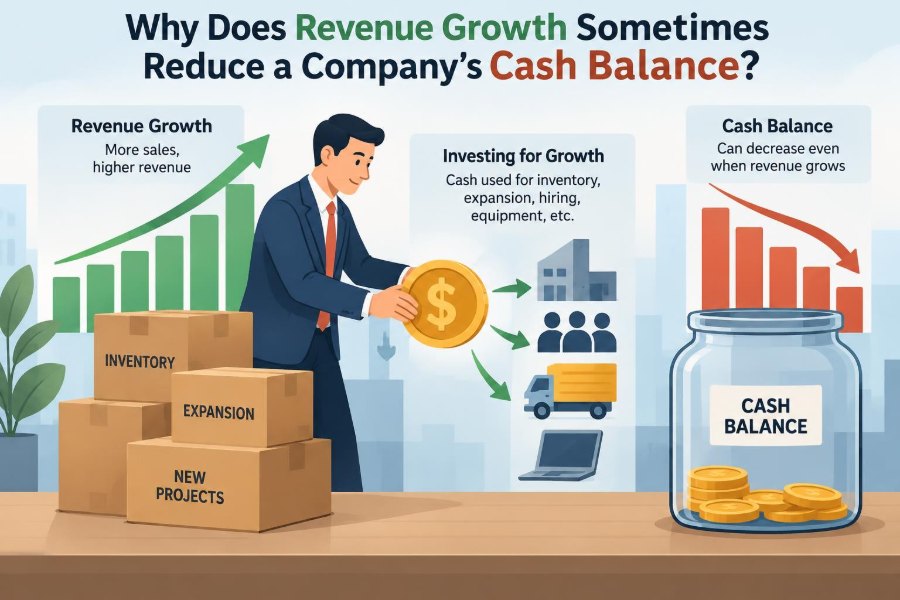

A business owner looks at the monthly sales report and sees excellent news: revenue is rising quickly. Orders are coming in, new customers are signing contracts, and the team is busier than ever.
Then the bank balance tells a different story. There is less cash available to pay suppliers, meet payroll, or cover rent than there was before sales began climbing. That feels contradictory, especially to people who assume that more revenue automatically means more money in the bank.
It is not a contradiction. It is a timing and operating-cycle problem. Revenue measures value earned under accounting rules; cash measures money that has actually entered and left the business.
Understanding the gap helps managers grow without accidentally creating a liquidity crisis. It also helps students and professionals read financial reports with a more realistic question in mind: not just “Are we selling more?” but “What is growth requiring us to finance?”
💡 Revenue and cash are not the same measure
Revenue is income a company earns by delivering goods or services during a period. Under accrual accounting, a company normally records revenue when it has fulfilled its performance obligation, not when the customer eventually pays.
Cash is the money currently available in bank accounts or other immediately accessible forms. A company can record a sale today, send an invoice, and receive the cash weeks or months later.
That distinction explains the basic puzzle. Rapid sales growth can increase reported revenue immediately while increasing cash only later—or, in difficult cases, not at all if customers do not pay.
🧾 The simple sale that reveals the timing gap
Imagine a consulting firm completes a project worth $20,000 in March and gives the client a 60-day payment term. The firm records $20,000 of March revenue because it has done the work.
But if the client pays in May, March cash has not increased by $20,000. The firm may already have paid staff, software subscriptions, and travel costs to complete the work. Revenue is real, but the cash receipt is delayed.
This delay is manageable when growth is steady and payment timing is predictable. It becomes more demanding when the number or size of invoices rises quickly.
🔄 Working capital is the bridge between profit and cash
Working capital refers broadly to short-term operating resources and obligations. A common calculation is current assets minus current liabilities, although managers often focus more closely on cash, accounts receivable, inventory, and accounts payable.
Growth often requires more money to be tied up in day-to-day operations. A company may need to buy materials, hold more finished goods, extend customer credit, or hire people before it collects payment from new sales.
When operating current assets grow faster than operating current liabilities, cash can be absorbed. This is frequently called an investment in working capital.
📈 Fast growth can consume cash faster than slow growth
Consider a retailer whose monthly sales double. Before selling the additional stock, it must usually buy that stock. If suppliers require payment before the retailer sells it, cash leaves first.
A stable business may recycle cash through a familiar rhythm: buy, sell, collect, repeat. A rapidly expanding business must fund several larger cycles at once. It may be paying for next month’s inventory while still waiting to collect cash from last month’s sales.
That is why a healthy growth rate can still strain liquidity. The issue is not that sales are bad; it is that the business needs financing while the expanded operating cycle catches up.
📬 Accounts receivable grow when customers buy on credit
Accounts receivable are amounts customers owe for goods or services already delivered. They are assets, but they are not cash available for payroll today.
When a company sells more on credit, receivables often rise. A larger receivables balance can be perfectly normal, but it means cash has not yet arrived. If collections slow at the same time, the pressure becomes greater.
A software provider, for example, may sign several annual business contracts and recognize revenue over the service period. If invoices are paid late or payment schedules are back-loaded, reported performance and bank balances can move in opposite directions.
⏳ Longer payment terms quietly change the economics of growth
Winning a large customer sometimes requires offering 60-, 90-, or even longer payment terms. Commercially, that may help close a deal. Financially, it means the seller is effectively financing part of the customer’s operations.
A company that shifts from collecting in 30 days to collecting in 90 days may need substantially more cash even if its sales volume stays unchanged. When sales are also increasing, the added requirement can be significant.
Managers should view payment terms as a pricing and financing decision, not merely an administrative detail. A higher-volume contract with slow collection may be less attractive than it first appears.
📦 Inventory can turn sales momentum into a cash squeeze
Inventory includes raw materials, work in progress, and finished goods held for sale. Manufacturers, wholesalers, retailers, restaurants, and many product businesses must pay for inventory before it produces revenue.
To avoid stockouts during expansion, teams may order extra quantities, add safety stock, or buy ahead for an expected busy season. These choices can support customer service, but they also convert cash into products sitting in a warehouse or store.
Inventory becomes cash only after it is sold and the customer pays. If demand is weaker than forecast, the business may hold more stock for longer and possibly need discounts or write-downs.
🏭 Production lead times push cash out before sales arrive
A manufacturer may need to buy components months before a finished product is shipped. During that period, cash is tied up in materials, labor, and partly completed units.
Longer supply chains increase this exposure. A company can appear successful because orders are growing, while its cash balance falls because it is funding production far in advance of delivery and collection.
Service firms can face an equivalent problem. An engineering company might hire specialists and begin work long before it reaches a billing milestone, creating work in progress that has consumed cash but has not yet been invoiced.
👥 Hiring ahead of demand creates an upfront cash commitment
Growth often requires extra salespeople, customer-support staff, operators, managers, and technical specialists. Salaries and payroll taxes are typically paid on a regular schedule, regardless of when customers settle invoices.
Hiring ahead can be sensible when demand is credible and capacity is needed to serve it. Yet it creates an immediate cash requirement. New employees may need training, equipment, and time before they generate revenue.
The risk is especially high if managers treat projected sales as guaranteed cash. A realistic plan allows for delayed starts, slow collections, and a ramp-up period in productivity.
🛠️ Capacity spending may precede the revenue it enables
Some growth requires new machinery, vehicles, technology, store fit-outs, or expanded facilities. These are generally capital expenditures: cash spent on long-lived assets rather than routine operating expenses.
Accounting may spread the cost through depreciation over several years, which means the income statement may not show the full cash outflow immediately. The bank account, however, reflects the payment when it occurs.
Consequently, a growing company can report profit while cash declines because it is investing heavily in capacity. This is not automatically a warning sign, but it must be financed and monitored.
🚚 Supplier payments can arrive before customer receipts
Businesses rarely receive and pay cash on the same day. The relative timing is crucial. If a company pays suppliers in 15 days but collects from customers in 60 days, it must fund a 45-day gap, plus any time inventory is held.
Growth enlarges the amount moving through that gap. More sales may require more purchases, and those purchases must be paid before the related sales are collected.
This timing relationship is often more informative than revenue alone. Two companies with identical sales can have very different cash needs because their supplier and customer terms differ.
🔁 The cash conversion cycle shows the full journey
The cash conversion cycle estimates how long cash is tied up in operations. In simplified form, it combines days inventory outstanding and days sales outstanding, then subtracts days payable outstanding.
In plain language, it asks: how long from paying for inventory or inputs until collecting cash from the customer? A shorter cycle generally frees cash sooner; a longer cycle requires more funding.
| Component | What it measures | Cash implication when it increases |
|---|---|---|
| Inventory days | How long stock is held before sale | Cash stays tied up in stock longer |
| Receivable days | How long customers take to pay | Cash arrives later |
| Payable days | How long the company takes to pay suppliers | Cash remains available longer, within agreed terms |
The metric is a guide, not a complete diagnosis. Service businesses may have little inventory, while project businesses may need to track unbilled work and milestone payments more carefully.
🧮 Profit can rise while operating cash flow falls
The income statement measures performance over a period. The cash flow statement shows where cash actually came from and where it went. The two statements answer related but different questions.
Under the indirect method of presenting operating cash flow, net income is adjusted for non-cash items and changes in operating working capital. An increase in receivables or inventory usually reduces operating cash flow because cash has become tied up there.
For example, a profitable company may show positive net income but negative operating cash flow if it booked many credit sales and bought inventory for future demand. That outcome deserves investigation, not an automatic verdict.
📊 A small hypothetical example
Suppose a distributor begins the quarter with stable sales. It then wins new customers and records an additional $100,000 in revenue, mostly on 60-day credit terms.
To fulfill those orders, it pays $55,000 for inventory and $20,000 for wages and delivery costs before customer cash arrives. It may report a gross margin and perhaps a profit on the sales, but its immediate cash balance can fall by the operating outflows.
If customers pay as expected, the cash picture may improve in the following quarter. If they pay late, return products, or dispute invoices, the shortfall lasts longer. This is hypothetical, but the mechanism is common.
🧾 Revenue recognition can make the picture less intuitive
Revenue recognition rules aim to show when a company has earned revenue, not simply when it has been paid. This can create timing differences in subscriptions, construction projects, long-term service contracts, and sales involving deposits or delivery milestones.
A customer prepayment can produce cash before revenue is recognized. Conversely, delivered work may produce revenue before cash is collected. Neither situation means the accounting is wrong; it means users must read the balance sheet and cash flow statement alongside the income statement.
Managers should also distinguish billed amounts from collected amounts. An invoice is a request for payment, not evidence that cash has arrived.
🏷️ Sales growth can hide weaker collection quality
Not all revenue is equally likely to become cash quickly. A company may grow by selling to customers with weaker credit, accepting more disputes, or relaxing approval standards to hit sales targets.
Receivables can then rise for two reasons: higher legitimate sales and deteriorating collection quality. Looking only at total revenue cannot separate those explanations.
Useful warning signs include invoices becoming overdue, a rising share of receivables concentrated in a few customers, recurring deductions, and larger allowances for expected credit losses. These indicators require judgment and context, but they should not be ignored.
⚠️ Bad debt turns an apparent asset into a loss
When customers fail to pay, the company may need to write off the receivable or recognize an expected credit loss. Revenue may have been recorded earlier, but the anticipated cash will never be received.
This is why aggressive credit extension can make growth look stronger than it is. A sale that does not produce collectable cash may still have consumed inventory, staff time, commissions, and shipping costs.
Prudent credit checks, credit limits, deposits, and disciplined follow-up can protect cash. The appropriate controls depend on the industry and customer relationship; overly restrictive terms can also unnecessarily limit good sales.
🎯 Growth promotions may bring cash-forward costs
New-customer discounts, free trials, launch events, sales commissions, advertising, and onboarding support can all rise during expansion. Some costs are paid before repeat purchasing patterns are clear.
Promotions can be worthwhile if the customer economics support them. But revenue growth that relies on deep discounts or costly acquisition campaigns may not improve cash quickly, especially when payment collection is slow.
Managers should examine contribution after variable costs, the timing of cash receipts, and the expected retention of customers—not just headline sales.
🌱 Seasonal businesses need cash before their busy period
Seasonality makes the growth-and-cash gap more visible. A toy retailer may buy inventory well before a holiday selling period. A landscaping company may hire and prepare equipment before peak contracts begin.
Strong seasonal revenue can eventually replenish cash, but the business needs enough liquidity to survive the buildup. A sales forecast is therefore incomplete without a monthly or weekly cash forecast.
Seasonal borrowing can be appropriate when matched to a predictable cycle. It becomes riskier when demand assumptions are uncertain or inventory cannot be easily sold after the season ends.
🏦 Borrowing can support growth, but it does not remove the discipline
Bank loans, overdrafts, revolving credit facilities, and other forms of finance can bridge the period between spending cash and collecting it. Financing is often a normal part of operating a growing business.
The key question is whether the finance matches the use. Short-term working-capital needs are commonly funded with flexible short-term facilities, while long-lived equipment may be better aligned with longer-term funding.
Debt also creates interest, repayment, and covenant obligations. If growth fails to generate expected cash, borrowing can magnify pressure rather than solve the underlying problem.
🤝 Supplier terms are a strategic operating lever
Negotiating reasonable supplier payment terms can reduce the mismatch between paying for inputs and collecting from customers. Reliable ordering patterns, transparent communication, and a good payment record often strengthen a company’s negotiating position.
However, stretching payables beyond agreed terms is not a sustainable cash strategy. It can damage supplier relationships, interrupt deliveries, remove early-payment discounts, and signal financial stress.
The aim is alignment, not delay for its own sake: collect from customers efficiently, pay suppliers as agreed, and negotiate terms that reflect the commercial cycle.
💳 Deposits and milestone billing can improve cash timing
Some businesses can redesign contract terms so cash arrives earlier. Deposits, progress payments, advance subscriptions, retainers, and milestone billing are examples.
A custom furniture maker might request a deposit before ordering materials. A consulting firm might bill monthly rather than wait until a multi-month project is complete. These arrangements reduce the amount of cash the seller must finance.
Terms should be clear, fair, and compatible with customer expectations. Asking for all cash upfront can deter buyers in some markets, so the right approach balances risk, competitiveness, and trust.
📦 Better inventory planning releases trapped cash
Improving inventory management does not simply mean holding as little stock as possible. Stockouts can lose sales and damage customer relationships. The objective is to hold the right inventory in the right location for expected demand and supply reliability.
Useful practices include better demand forecasting, regular reviews of slow-moving items, smaller order batches where feasible, and coordination between sales, procurement, and operations. A sales forecast disconnected from purchasing decisions can create costly excess stock.
Inventory policies must also account for uncertainty. Leaner stock may improve cash but leave the business exposed if suppliers are unreliable or lead times are long.
📞 Collection discipline protects the value of a sale
Collection begins before invoicing. Accurate customer data, explicit terms, proof of delivery, and prompt, error-free invoices reduce avoidable delays.
After invoicing, companies benefit from monitoring due dates, resolving disputes quickly, and escalating overdue accounts consistently. Automated reminders can help, but important accounts may need direct relationship management.
A useful cultural principle is that a sale is not fully complete when the order is signed or the invoice is issued. From a cash-management perspective, it is complete when payment has cleared.
🗓️ Cash forecasting turns surprises into decisions
A cash forecast estimates expected inflows and outflows by week or month. Unlike an annual budget, it focuses on timing: when invoices will be collected, payroll will be paid, taxes fall due, inventory arrives, and debt payments occur.
A practical forecast should be updated with actual collection behavior rather than relying only on contractual payment terms. It should also include scenarios such as delayed customer payments, lower sales, or unexpectedly high purchasing needs.
Forecasting does not predict the future perfectly. Its value is that it reveals potential gaps early enough for managers to accelerate collections, defer discretionary spending, adjust orders, or arrange funding responsibly.
📉 Watch leading indicators, not just the bank balance
A falling cash balance is a late and highly visible signal. Managers can identify emerging pressure earlier by tracking operational measures that explain cash movement.
- Receivable days and the value of overdue invoices
- Inventory turnover and aging stock
- Payable days, supplier concentration, and upcoming commitments
- Order backlog, delivery lead times, and unbilled work
- Cash collected compared with cash forecast
- Gross margin and cash contribution by customer or product group
No single metric tells the full story. A rising receivables balance may be acceptable when it reflects controlled growth and reliable customers, but concerning when aging and disputes rise at the same time.
🧭 Growth needs a cash plan, not just a sales plan
Sales, operations, finance, and procurement should translate growth targets into a shared cash plan. Sales teams need visibility into credit policies; purchasing teams need credible demand estimates; finance teams need to understand capacity commitments and contract billing schedules.
A growth plan should ask practical questions: What must we spend before delivery? When will each customer pay? What happens if demand is 20% below plan or collections are delayed? Which commitments can be slowed without harming core service?
This cross-functional approach reduces a common failure: each department meeting its own target while the company as a whole runs short of cash.
🧠 Common interpretations to avoid
First, do not assume declining cash proves a business is failing. A profitable expansion, a planned facility investment, or seasonal inventory buildup can all reduce cash temporarily.
Second, do not assume rising revenue proves liquidity is healthy. Sales may be credit-heavy, low-margin, uncollected, or dependent on expensive inventory and customer acquisition.
Third, do not use one financial statement in isolation. The income statement, balance sheet, and cash flow statement form a connected picture. Notes, customer concentration, debt terms, and management forecasts may add essential context.
🔍 Questions managers and analysts should ask
When revenue rises but cash falls, useful questions are specific rather than alarmist:
- Is cash tied up in receivables, inventory, unbilled work, or capital spending?
- Are customer payments arriving as contracted, and are overdue balances increasing?
- Has the cash conversion cycle lengthened?
- Are margins sufficient to justify the additional funding requirement?
- Is the cash decline planned, temporary, and supported by adequate financing?
- What assumptions must hold for cash to recover, and how sensitive are they?
Answers reveal whether the company is making a deliberate investment in sustainable growth or drifting into a funding problem.
⚖️ When a lower cash balance may be reasonable
A lower cash balance can be appropriate when management has deliberately invested in profitable capacity, prepared for a well-supported seasonal peak, or funded receivables from creditworthy customers with dependable payment histories.
Even then, the company needs adequate reserves or committed financing. A sound plan identifies the lowest expected cash point, the assumptions behind it, and the actions available if results differ from plan.
The concern increases when cash falls without a clear operational explanation, collections worsen, inventory becomes obsolete, or financing depends on optimistic assumptions that cannot be tested.
🏁 The core principle: growth must be financed
Revenue growth often reduces cash because a company must spend money before it collects money. Credit sales create receivables, inventory purchases tie up funds, hiring and capacity investments require upfront payments, and supplier terms may be shorter than customer terms.
Profitability remains essential, but it is not enough by itself. A business must also manage the speed and reliability with which profit turns into cash. That requires control over pricing, payment terms, inventory, costs, credit quality, and financing.
The strongest managers treat cash flow as an operating discipline rather than a finance-department afterthought. They pursue growth while continuously asking what that growth demands from the company’s cash resources.
More revenue is valuable only when the business can afford the path from making the sale to collecting the cash. Reading that path clearly turns growth from a potential cash trap into a manageable opportunity. 📊💼💧