
A small online retailer starts receiving more orders than its three-person team can handle. Customer emails pile up, deliveries take longer, and the founder spends evenings fixing avoidable mistakes. The obvious answer seems to be hiring.
Then a different business makes the same decision. It adds several people quickly, but work becomes harder to coordinate, payroll pressure rises, and experienced staff spend most of their time training newcomers. Growth does not speed up; it becomes more complicated.
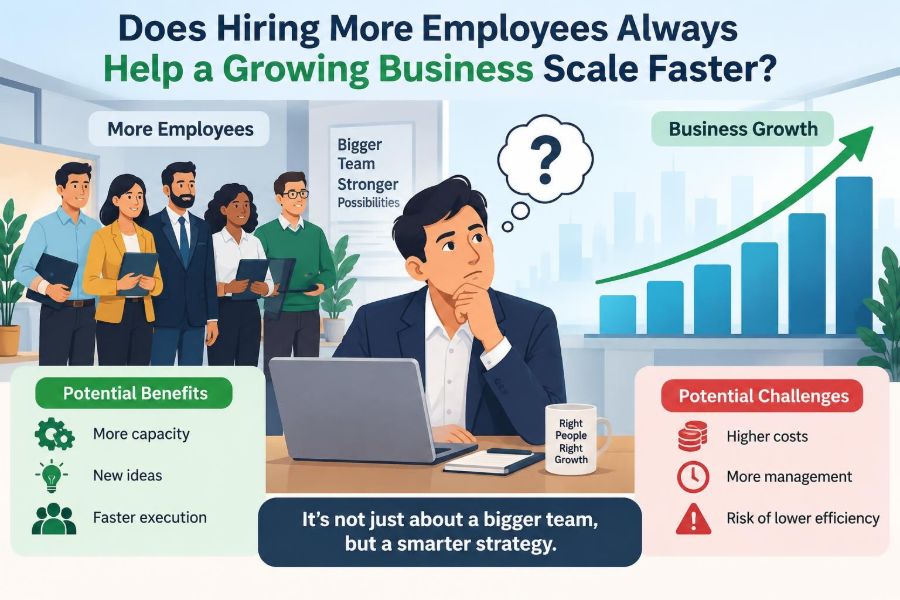
Both situations are familiar because hiring is neither automatically a cure nor automatically a mistake. People create capacity, expertise, and resilience, but they also introduce cost, communication needs, and management work.
The useful question is not simply, “Can we afford another employee?” It is whether a specific hire will remove a real constraint in a business that is ready to use that person’s contribution well.
🌱 Growth and scaling are not the same thing
A business can grow by increasing sales, customers, locations, or output. Scaling means increasing those results without costs and complexity rising at the same pace.
Hiring often supports growth because more people can serve more customers. But a company is not necessarily scaling if every additional sale requires proportionally more labour, more supervision, and more rework.
A catering company that adds staff for each extra event may be growing successfully. It becomes more scalable when standard menus, purchasing systems, training, and scheduling let each team serve events efficiently and consistently.
🧭 The real question behind a hiring decision
Headcount is an input, not an outcome. A better hiring question is: what bottleneck will this role remove, and how will the business know it has been removed?
For example, a sales team may not need another salesperson if leads are scarce. It may need clearer targeting, stronger marketing, or a better process for qualifying enquiries. Adding sellers to an empty pipeline creates cost without creating demand.
By contrast, if qualified leads are consistently waiting too long for follow-up, a sales hire may directly protect revenue that would otherwise be lost.
🚧 Find the constraint before adding capacity
A constraint is the point that limits the whole system’s output. It may be a person, a machine, a decision process, a supplier, or a missing piece of information.
Imagine a workshop where one specialist must approve every design before production begins. Hiring more production workers will not solve delayed orders if designs still sit in the approval queue. The approval stage is the constraint.
Managers should observe the flow of work: where does it wait, return for correction, or depend on one overloaded individual? That evidence is more reliable than a general feeling that everyone is busy.
🔍 Separate temporary overload from a permanent need
A busy month does not always justify a permanent employee. Demand may be seasonal, tied to a one-off contract, or caused by an unusual backlog.
Permanent hiring makes sense when the work is recurring, strategically valuable, and likely to continue. When the workload is uncertain, a temporary employee, contractor, agency worker, freelance specialist, or adjusted shifts may be a more proportionate response.
This is not an argument for avoiding commitment. It is an argument for matching the type of capacity to the type of demand.
📈 Demand must be real, not merely hopeful
Many growing businesses hire based on expected sales. Forecasting is necessary, but forecasts can be wrong, especially when a new product, market, or customer segment is involved.
Look for signals that demand is durable: repeat orders, a dependable pipeline, signed commitments, consistent conversion patterns, or a backlog that cannot be cleared through normal operations. A single enthusiastic prospect is not the same as recurring demand.
Hiring ahead of demand can be sensible when lead times are long or skills are scarce. The risk is lower when the business has enough cash to absorb a slower-than-expected ramp-up.
💵 Count the full cost of an employee
Salary is only one part of the decision. The full employment cost may include benefits, payroll-related costs, equipment, software licences, workspace, recruitment, training, management time, and cover for absence or turnover.
There is also an opportunity cost. Money committed to payroll cannot be used for inventory, marketing, product improvement, technology, or a cash reserve.
A practical planning exercise is to estimate the role’s total monthly cost and ask what additional revenue, capacity, saved time, reduced error, or reduced risk would justify it. The estimate will be imperfect, but it makes assumptions visible.
🧮 Cash flow matters more than annual optimism
A profitable business can still struggle if cash arrives later than bills fall due. Employees must be paid on schedule even when customers pay invoices slowly.
Before hiring, managers should examine the timing of payroll, rent, supplier payments, tax obligations, and expected customer receipts. A healthy-looking annual forecast can hide a difficult period in the middle of the year.
Scenario planning helps. Consider a likely case, a slower-sales case, and a delayed-payment case. The question is whether the business can keep its commitments in each realistic scenario, not just the best one.
⏱️ Productivity does not begin on day one
A new employee rarely delivers full output immediately. They need orientation, access to systems, role-specific instruction, feedback, and time to understand customers and informal working practices.
This ramp-up period can temporarily reduce the output of existing staff because experienced colleagues must answer questions and review work. That is normal, not evidence that the hire was wrong.
The mistake is ignoring ramp-up in capacity plans. If a team is already overwhelmed, it needs protected time and clear materials to train someone effectively.
🧠 Knowledge transfer is a hidden workload
Fast-growing firms often depend on knowledge stored in people’s heads: which supplier is dependable, how to handle an unusual complaint, or why a spreadsheet is organised in a particular way.
When one person must repeatedly explain these details, that person becomes a bottleneck. Hiring may increase dependence on them before it reduces it.
Documenting recurring work, recording short process guides, and creating checklists make knowledge transferable. The goal is not to turn every task into bureaucracy; it is to prevent routine work from requiring constant rescue by a few experts.
🗂️ Clear roles prevent expensive overlap
More people can create ambiguity. Two employees may assume the other will contact a customer, approve a purchase, update stock, or finish a report. Alternatively, they may both do the same work.
A well-designed role states its purpose, main responsibilities, decision boundaries, key relationships, and the results it is expected to influence. It should also explain what the role does not own.
Role clarity matters especially in small firms, where flexibility is valuable. Flexible does not have to mean unclear.
🗣️ Communication costs rise with team size
Each new employee adds more than one pair of hands. They also add relationships, handoffs, meetings, questions, and chances for misunderstanding.
In a very small team, quick conversations may be enough. As the team expands, informal coordination becomes unreliable. People need shared priorities, visible workflows, agreed channels, and regular but purposeful check-ins.
Hiring can therefore produce a short-term coordination tax. Strong operating routines reduce that tax without forcing the organisation into unnecessary meetings.
👥 Managers need capacity too
A new hire needs a manager who can set priorities, remove obstacles, give feedback, and make decisions. If a founder hires several people but still personally approves every small choice, the founder becomes the new bottleneck.
Management capacity is often overlooked because leading people is treated as something done between “real work.” In reality, it is work that determines whether added talent becomes useful output.
Before expanding a team, decide who will manage it and what decisions can be delegated. A first-line manager may be more valuable than another individual contributor when supervision is already stretched.
🏗️ Processes turn effort into repeatable output
Hiring is most effective when work has a reasonably repeatable path. A process does not need to be rigid; it simply identifies the usual steps, the standards, and the handoff points.
Consider customer onboarding. If every employee creates a different welcome sequence, customers receive uneven service and training becomes slow. A basic shared process lets new staff contribute sooner while leaving room for sensible exceptions.
Processes should be revised when they create friction. Their purpose is to support good judgement, not replace it.
⚙️ Automation may solve the smaller problem
Some workload is genuinely human work: building relationships, diagnosing unusual issues, negotiating, designing, or providing care. Other workload is repetitive administration that can be simplified.
Before hiring to copy data between systems, send routine reminders, schedule appointments, or compile standard reports, examine whether a better tool or redesigned workflow would remove the task. Automation can reduce volume, errors, and delays.
However, automation also requires setup, maintenance, and oversight. It is not automatically cheaper or suitable for every process, particularly where exceptions and judgement dominate.
🧰 Outsourcing can test a need before a commitment
An external provider can be useful when work requires specialist skills, varies sharply from month to month, or is outside the company’s core capability. Examples might include legal advice, payroll administration, design projects, or technical implementation.
Outsourcing can reveal the real volume and nature of a task before a business creates a permanent role. It can also provide expertise that would be difficult to recruit immediately.
The trade-off is less direct control and a need for clear briefs, confidentiality arrangements where appropriate, and quality checks. Outsourcing poor processes simply moves the confusion elsewhere.
🎯 Hire for a capability, not just a vacancy
A vacancy describes an empty seat. A capability describes what the business must be able to do better: retain customers, maintain equipment, forecast inventory, launch products, or lead a larger team.
This distinction changes recruitment. Instead of copying a generic job description, managers identify the outcomes required and the skills needed to achieve them.
For instance, a growing service firm may think it needs “another administrator.” Its real need may be someone who can build a reliable customer operations system, which calls for process design and communication skills as well as administration.
🧩 Generalists and specialists solve different problems
Early-stage businesses often benefit from generalists who can shift between tasks, learn quickly, and handle ambiguity. As work becomes more complex or regulated, specialist expertise can improve quality and reduce risk.
Neither profile is universally better. A specialist may be underused in a business with changing priorities, while a generalist may struggle when deep technical judgement is essential.
The right question is whether the work is broad and evolving or deep and repeatable. Hiring for the wrong shape of work can leave both the employee and the business frustrated.
📊 Use leading and lagging indicators
Lagging indicators show what has already happened, such as monthly revenue, completed orders, or customer complaints. They are valuable, but they may reveal capacity trouble after customers have already felt it.
Leading indicators signal developing pressure: response times rising, tasks waiting in a queue, overtime increasing, error rates climbing, or qualified leads going untouched. These measures help managers act earlier.
A small dashboard should focus on the constraint. Tracking dozens of numbers can obscure the few signals that actually guide a hiring decision.
📏 Define success before the person arrives
A hire should have a clear early purpose. That may be reducing order-processing time, increasing the number of properly qualified sales conversations, improving customer retention, or freeing a manager from a specified group of routine tasks.
Not every role can be judged by a simple number. Creative, leadership, and relationship roles need qualitative assessment too. Even then, expected contributions and review points should be discussed openly.
Defining success protects the new employee from vague expectations and helps leaders notice whether a deeper process problem remains unresolved.
🔄 Capacity, quality, and speed interact
More staff can increase throughput, but only if quality holds. Rushing untrained people into customer-facing or safety-sensitive work can create mistakes that consume more time than the hire initially saves.
There is often a trade-off between speed and consistency during expansion. A sensible plan sets minimum quality standards, provides review where needed, and gradually reduces checking as competence grows.
Growth is healthier when customer experience remains dependable. A surge in sales followed by returns, complaints, or lost trust is not a straightforward win.
🛡️ Resilience is a valid reason to hire
Not every hiring decision is about immediate volume. A business may rely too heavily on one person who understands a critical system, maintains a key client relationship, or performs a compliance-related task.
Adding capacity can create redundancy: the ability to continue operating when someone is absent, leaves, or faces an unexpected emergency. This may not show instant revenue, but it reduces operational risk.
Resilience should be planned deliberately. Simply having two people near the same work is not enough if only one has the knowledge, access, or authority to act.
⚖️ Compare options using a simple decision frame
When demand exceeds current capacity, managers have several choices. Comparing them prevents “hire someone” from becoming the default answer.
| Option | Best suited to | Main trade-off |
|---|---|---|
| Permanent employee | Stable, core, long-term work | Recurring cost and management commitment |
| Temporary or contract capacity | Short-term peaks or uncertain demand | Less continuity and onboarding repetition |
| Outsourcing | Specialist or non-core work | Less direct control over delivery |
| Automation or process redesign | Repeatable administrative work | Setup effort and exception handling |
| Delay or reprioritise work | Low-value work consuming scarce capacity | Some tasks or opportunities are deferred |
The best answer may combine options. A business might automate routine requests, use a contractor for a peak period, and then hire permanently once demand is clearer.
🚩 Warning signs of premature hiring
Premature hiring is not always obvious. It often begins with a reasonable desire to relieve pressure, but the underlying cause has not been identified.
- Work is disorganised, yet no one can describe the normal workflow.
- The proposed role has a vague title but no defined outcomes.
- Demand depends on a hoped-for deal rather than an established pipeline.
- The current team spends large amounts of time on avoidable rework.
- No manager has time or capability to onboard the person properly.
- The business has not considered less permanent ways to cover the workload.
Any one warning sign may be manageable. Several together suggest the firm should diagnose first and recruit second.
🌟 Warning signs of understaffing
Delaying hiring also has costs. Persistent overload can exhaust employees, reduce service quality, and cause capable people to leave. A founder who remains trapped in routine work may never have time to build systems or pursue valuable opportunities.
Watch for recurring queues, missed deadlines, customers waiting for basic answers, regular overtime, important improvement work continually postponed, and a team that has no room to handle normal surprises.
Understaffing is not evidence of discipline if it damages the business’s ability to deliver what it has promised.
🧪 Pilot capacity changes where possible
Managers do not always need a perfect forecast before acting. They can run a controlled test: use a fixed-term hire, dedicate an existing employee to the bottleneck for a period, or contract a defined amount of external support.
A pilot should include a baseline. Measure the queue, response time, errors, output, or manager hours before and during the change. Then ask whether the added capacity improved the intended result.
This approach turns a broad debate into practical learning. It also exposes whether the constraint moves elsewhere once the first blockage is removed.
🤝 Involve the people closest to the work
Frontline employees often understand why work slows down. They know which forms cause duplicate entry, which customer requests take disproportionate time, and which handoffs fail regularly.
Asking for their input does not mean every staffing decision is made by committee. It means decisions use operational knowledge rather than relying only on a senior leader’s impression.
Involvement also improves implementation. Existing employees are more likely to support a new role when they understand how responsibilities will change and when their practical concerns have been heard.
📝 Build an onboarding system before rapid expansion
If a business expects to hire repeatedly, each new person should not have to reconstruct the job from scattered messages and informal explanations. A simple onboarding system creates consistency.
- Provide a role plan for the first weeks.
- Give access to essential tools and information before the start date.
- Assign a person for day-to-day questions.
- Schedule early feedback rather than waiting for a formal review.
- Include the standards, customers, and context behind the tasks.
Good onboarding is not a welcome presentation alone. It is the bridge between recruitment and useful contribution.
🔁 Reassess after every growth stage
A role that was perfect for a ten-person business may need redesign at fifty people. What once required a flexible generalist may later require a specialist, a team lead, or a dedicated function.
Managers should review structure periodically: which decisions remain concentrated, which work is duplicated, where teams depend on informal favours, and which capabilities will be needed next.
Reassessment should not become constant reorganisation. The aim is to keep the organisation aligned with its actual operating model as that model changes.
🏁 The core principle: hire into a system, not a hope
More employees can help a growing business scale faster when demand is sufficiently real, the bottleneck is understood, cash can support the commitment, and the organisation can train and manage the new people.
Hiring is less effective when it is used to hide unclear priorities, broken processes, weak demand, or a founder’s reluctance to delegate. In those cases, more people may multiply the disorder rather than solve it.
The strongest approach combines judgement with evidence: identify the constraint, compare alternatives, define what success looks like, and review the result. People are a powerful source of growth, but they need a workable system in which to succeed.
Hiring helps a business scale when each new person removes a proven constraint and is supported by clear work, capable management, and sustainable demand. Thoughtful capacity decisions build growth that lasts. 📊🌱🤝