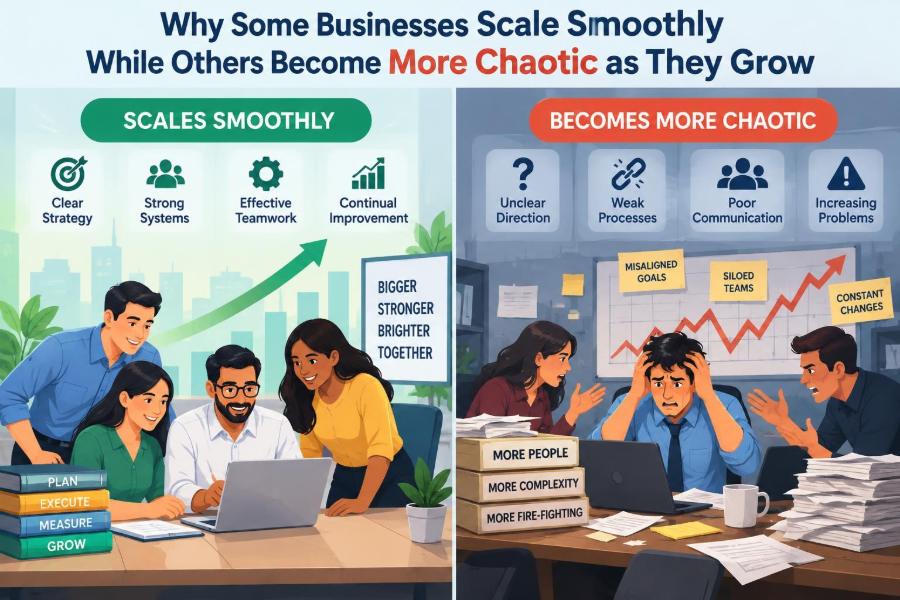

A small business can feel wonderfully simple at first. The founder knows every customer, approves every decision, and can solve a problem by walking across the room. Work moves quickly because the people doing it share the same context.
Then growth arrives. More orders come in, new employees are hired, product lines expand, and customers expect faster answers. What once felt like momentum can begin to feel like a pile of urgent exceptions.
One company seems to add people and revenue without losing its footing. Another becomes slower, noisier, and more dependent on a few exhausted individuals. The difference is rarely just ambition, funding, or effort.
It is usually the difference between growing activity and building an organization that can reliably handle more activity. Understanding that distinction helps managers make better choices before chaos becomes the company’s default operating system.
📈 Growth Is Not the Same as Scale
Growth means the business is getting bigger: more sales, customers, employees, locations, or products. Scaling means it can handle that increase without costs, complexity, errors, and managerial effort rising at the same rate.
A catering company that doubles revenue by doubling its kitchen staff, delivery vehicles, and founder’s working hours has grown. If it develops repeatable menus, purchasing routines, production schedules, and trained supervisors that allow it to serve more events consistently, it is beginning to scale.
Not every business can scale in the same way. Many service businesses will always need skilled people. The goal is not necessarily to remove human work; it is to make good work repeatable, coordinated, and economically sustainable.
🧩 Complexity Grows Faster Than Headcount
A team of five has relatively few relationships to manage. A team of fifty has many more handoffs, dependencies, conversations, and opportunities for misunderstanding. Adding one person does not merely add one set of tasks; it changes the communication system around everyone else.
This is why a business can feel organized at ten people and confused at thirty even when everyone is capable. Informal coordination stops being enough. People no longer overhear every relevant conversation, and leaders cannot personally supply context to everyone.
Healthy scaling recognizes complexity early. Chaotic scaling treats it as a surprise and responds by holding more meetings, copying more people into messages, and asking leaders to intervene more often.
🛠️ Repeatable Work Creates Capacity
Businesses scale more smoothly when their common work is designed as a repeatable process rather than rediscovered every time. This does not mean turning every job into a rigid script. It means identifying the steps where consistency protects quality, speed, safety, or customer trust.
For example, a client onboarding process might define who collects information, what must be checked, when the client receives updates, and how exceptions are escalated. Employees can still use judgment, but they are no longer starting from a blank page.
Repeated work is a strong candidate for standardization because small inefficiencies multiply with volume. A process that wastes ten minutes per order may be tolerable at low volume and deeply expensive later.
🧭 Clear Priorities Prevent Organizational Drift
As businesses grow, more opportunities compete for attention: a promising customer request, a new market, a feature competitors offer, a cost-saving project, or an internal problem. Without clear priorities, departments choose what seems most urgent or visible from their own position.
This creates organizational drift. Sales may promise customization, operations may seek standardization, and product teams may pursue new features while support absorbs the consequences. None of these decisions is irrational in isolation, but together they pull the business apart.
Leaders need to make trade-offs explicit. A short list of current priorities, paired with a clear explanation of what is not being pursued yet, gives teams a practical basis for deciding what deserves time.
🎯 Strategy Must Become Daily Choices
A strategy is useful only when it changes decisions. Statements such as “deliver excellent service” or “be innovative” may express good intentions, but they rarely tell an employee what to do when time, budget, and customer expectations conflict.
A more operational strategy might state that the company will serve a defined customer segment, compete on dependable turnaround times, and limit bespoke work that disrupts the core service. Those choices guide pricing, hiring, product design, and customer conversations.
When strategy remains abstract, every team creates its own version. Smoothly scaling firms translate strategic direction into decision rules that people can use without waiting for executive approval.
🏗️ Structure Should Follow the Work
Organization charts are often treated as symbols of status, but their real purpose is to clarify how work gets done. A structure should make responsibility, coordination, and decision rights easier to understand.
Early businesses commonly organize around individuals: “Ask Maya about anything related to customers.” As volume rises, work needs clearer ownership. That might mean grouping people by function, product, region, customer segment, or a combination of these.
There is no universally best structure. Functional teams can build expertise and consistency, while cross-functional product teams can respond quickly to customer needs. The right choice depends on where coordination is most necessary and where delays are most costly.
👤 Roles Need Outcomes, Not Just Job Titles
A job title alone does not explain what someone owns. “Operations Manager” can mean scheduling staff, improving processes, managing vendors, solving customer issues, or all four. Ambiguity becomes dangerous when important work falls between roles.
Useful role clarity specifies the expected outcome, major responsibilities, authority limits, and key working relationships. For instance, a manager may own delivery performance but need finance approval before changing supplier terms.
Clear roles do not eliminate collaboration. They make collaboration more productive because people know who makes the final call, who contributes expertise, and who must be informed after a decision.
⚖️ Decision Rights Reduce Bottlenecks
Many growing businesses become chaotic because every meaningful decision travels upward. The founder approves discounts, resolves customer complaints, chooses vendors, interviews candidates, and settles routine disagreements. This may protect quality briefly, but it eventually creates a bottleneck.
Decision rights define who has authority to decide which matters, within what boundaries. A customer success lead might approve service credits up to a set limit, while larger concessions require a commercial leader’s review.
Delegation works best when it includes context, guardrails, and feedback. Handing over a decision without explaining desired outcomes is not empowerment; it is simply transferring uncertainty.
🔄 Handoffs Are Where Work Often Breaks
Customers experience one company, but internally their request may move through sales, operations, finance, delivery, and support. Each handoff creates a chance for details to be lost, assumptions to differ, or responsibility to become unclear.
A smooth business designs the handoff itself. It decides what information must travel, what counts as complete, who accepts the work, and what happens when the request does not fit the normal path.
Consider a sales-to-delivery handoff. If sales records promises informally and delivery learns about them after signing, conflict is predictable. A shared checklist or system record is not bureaucracy for its own sake; it is a way to preserve customer commitments.
📚 Documentation Preserves Organizational Memory
In a small team, valuable knowledge lives in people’s heads. Employees remember why a customer prefers a certain format, which supplier is unreliable, or how to fix a recurring system issue. This works until those people are unavailable, overloaded, or gone.
Documentation turns fragile personal knowledge into organizational memory. The most useful documents are usually practical: operating procedures, decision logs, customer playbooks, templates, definitions, and troubleshooting guides.
Documentation should not become a museum of outdated files. Assign owners, store it where people work, and update it when a process changes. If employees cannot find or trust the information, they will return to asking the same few people.
🗣️ Communication Needs Deliberate Channels
Fast communication is not the same as constant communication. When every matter is handled through urgent messages, people struggle to distinguish a true emergency from ordinary coordination.
Growing organizations benefit from agreeing on the purpose of their channels. A chat tool may suit quick questions; a project workspace may hold plans and decisions; a regular meeting may resolve issues requiring discussion; a dashboard may report performance without another meeting.
The goal is not to communicate less. It is to reduce hidden work and repeated explanations by making information visible in an appropriate place.
📅 Useful Meetings Create Alignment
Meetings become frustrating when they substitute for preparation or exist without a clear decision, review, or problem to solve. Yet eliminating meetings entirely can leave teams working from incompatible assumptions.
Effective operating meetings have a repeatable purpose. A weekly leadership review might examine priorities, major risks, and cross-team decisions. A team huddle might focus on immediate delivery constraints. These meetings should end with named owners and next actions.
A useful test is simple: if no one needs to decide, coordinate, learn, or commit, the update may work better in writing. Protecting attention is part of management discipline.
📊 Metrics Should Illuminate, Not Overwhelm
What leaders measure shapes what employees notice. But a long dashboard can create the illusion of control while hiding the few indicators that actually reveal whether the system is working.
Choose measures connected to important outcomes: customer retention, order accuracy, delivery time, quality defects, cash collection, employee turnover, or throughput. Then pair outcome measures with operational measures that help explain movement.
For example, declining customer satisfaction may be an outcome. First-response time, unresolved issue volume, and repeat-contact rates may help identify why. Metrics should prompt questions and action, not become targets people learn to manipulate.
🔍 Leading Indicators Give Earlier Warnings
Some measures report what has already happened. Revenue, monthly profit, and customer cancellations are valuable, but they can be slow to reveal an emerging problem. Leading indicators provide earlier clues about conditions likely to affect future results.
For a delivery operation, missed dispatch cutoffs, rising backlog, or staff absenteeism may signal future customer delays. For a software team, unresolved defects or expanding work in progress may reveal strain before customers complain.
Leading indicators are not crystal balls. They are useful because they make risks discussable while teams still have choices, rather than after a result has become difficult to reverse.
💰 Cash Flow Can Limit Otherwise Healthy Growth
A growing business can be profitable on paper and still face a cash shortage. It may need to pay employees, suppliers, inventory, or equipment costs before collecting payment from customers. Faster sales can widen that gap.
Managers should understand the timing of money, not only the total amount. Long payment terms, slow invoicing, excess inventory, and unplanned hiring can place pressure on working capital, which is the cash used for everyday operations.
Careful growth planning includes realistic assumptions about collection, costs, and capacity. It also avoids treating projected revenue as if it were already available cash.
👥 Hiring Cannot Repair a Broken System Alone
When work piles up, hiring feels like the obvious answer. Sometimes it is the right answer. But adding people to a poorly designed process can multiply confusion, training demands, inconsistent decisions, and management load.
Before hiring, ask what is actually constrained. Is demand genuinely above capacity? Is work waiting for a single approval? Are errors creating rework? Does a missing tool force people to copy information across systems?
A new hire should enter a role with a clear purpose, training path, and manageable workload. Otherwise, experienced employees spend so much time rescuing and teaching that short-term capacity may shrink.
🧠 Managers Need a Different Job at Each Stage
A founder’s early value often comes from doing: selling, building, serving, and solving. As the company expands, leadership value increasingly comes from designing systems, setting direction, developing managers, and allocating resources.
This transition can feel uncomfortable. Leaders who remain the best individual problem-solvers may unintentionally prevent others from learning to solve problems. Teams then wait for answers instead of building judgment.
Management is not distance from the work. It is responsibility for the conditions in which good work can happen repeatedly. That includes coaching people, removing obstacles, and noticing patterns that individual contributors may not see.
🌱 Culture Is Reinforced by Everyday Systems
Culture is often described through values on a wall, but employees learn culture from repeated experience. They notice who gets promoted, which mistakes are punished, whether bad news travels upward safely, and whether leaders follow the processes they expect others to use.
A business cannot scale a culture of trust through slogans while rewarding secrecy or constant firefighting. Similarly, a culture of accountability needs clear goals and authority; people cannot be accountable for outcomes they cannot influence.
As new employees join, deliberate rituals matter: onboarding, manager behavior, decision reviews, recognition, and clear expectations. These mechanisms carry culture farther than informal proximity can.
🧪 Standardization Needs Room for Judgment
Standard processes make routine work reliable, but over-standardization can create its own problems. Employees closest to customers or operations may see exceptions that a central rule does not anticipate.
The practical question is not “standardize or personalize?” It is “which parts must be consistent, and where should trained people adapt?” A hotel may standardize safety, billing, and room preparation while giving staff flexibility to resolve reasonable guest concerns.
Good systems distinguish normal variation from meaningful exceptions. They provide an escalation path for unusual cases, then use recurring exceptions as evidence that the standard process may need redesign.
⚠️ Exceptions Reveal Hidden Process Debt
Process debt is the accumulated cost of shortcuts, unclear rules, and temporary workarounds that were never repaired. Like technical debt in software, it may save time initially while making future changes slower and riskier.
Warning signs include spreadsheets outside official systems, a person who must be copied on every issue, repeated manual corrections, and phrases such as “that is just how we do it.” These are often adaptations to a process that no longer fits reality.
Not every exception deserves a new procedure. But frequent exceptions deserve analysis. Ask whether the customer need, product design, policy, or workflow is producing the same problem repeatedly.
🔥 Firefighting Can Become Addictive
Urgent problem-solving can feel productive because it is visible and immediate. A leader rescues a customer account, fixes a late shipment, or resolves a system failure. The danger comes when heroics become the normal way work gets completed.
Firefighting consumes attention that could prevent future fires. It also teaches employees that planning is less rewarded than being available during a crisis. Over time, teams may stop raising weak signals because they assume someone will fix the issue later.
After significant incidents, teams should review what happened without automatically searching for someone to blame. The more useful question is: what conditions made this failure likely, and what small system change would reduce recurrence?
🧱 Build for the Next Stage, Not the Distant Future
Underbuilding creates strain, but overbuilding can waste scarce resources. A small company does not need the governance, software stack, or management layers of a multinational organization simply because it hopes to become one.
The better approach is stage-appropriate infrastructure: build the simplest process that reliably supports the next level of volume and complexity. Revisit it as assumptions change.
A shared tracker may be adequate for a small pipeline. When multiple teams depend on it and errors affect customers, a more structured system may become justified. The trigger is not fashion; it is the cost and risk of the existing approach.
🔗 Tools Should Support a Process, Not Invent One
New software can improve visibility, reduce manual work, and create consistent records. It cannot resolve unclear ownership or conflicting priorities. Automating a confused workflow often makes confusion happen faster.
Before selecting a tool, map the work: what starts the process, what decisions occur, who needs information, what outputs are required, and where delays or errors happen. This clarifies whether the need is a tool, a process redesign, training, or all three.
Implementation also matters. Teams need agreed definitions, data ownership, and adoption support. A technically capable system that employees avoid becomes another source of fragmented information.
🤝 Cross-Functional Trust Speeds Execution
As specialization increases, no single team can deliver the full customer experience alone. Sales depends on operations, operations depends on finance or procurement, and product teams depend on customer feedback. Smooth execution requires trust across these boundaries.
Trust does not mean avoiding disagreement. It means teams can surface trade-offs, challenge assumptions, and share bad news without turning every conflict into a status contest.
Shared goals help. When departments are measured only on narrow local targets, they may optimize their own result at the expense of the whole. Cross-functional metrics and regular problem-solving sessions make interdependence visible.
🪜 Management Layers Should Add Value
Growth often creates more layers of management. Some are necessary: managers coach employees, coordinate work, make decisions, and connect strategy to execution. But layers added mainly to relay information or approve routine actions can slow the organization.
Each management role should have a clear contribution. Does it improve decisions, develop capability, manage a meaningful span of work, or resolve important coordination problems? If not, the layer may be creating distance without control.
Too few managers can also be harmful. When one supervisor has far too many direct reports, coaching disappears and issues reach leadership only after they have grown.
🧭 Change Needs an Owner and a Cadence
Growing companies constantly change processes, roles, systems, and priorities. If change is announced but not owned, employees may continue using the old method because it is familiar and appears less risky.
Every material change needs a responsible owner, a clear reason, affected groups, training or communication where needed, and a review point. A cadence does not need to be elaborate; it simply ensures that leaders check whether the change is working.
Managers should also limit simultaneous changes. When teams must absorb too many new tools, targets, or structures at once, even good initiatives compete for attention and implementation quality falls.
🧑🏫 Train for Judgment, Not Mere Compliance
Training is often treated as an event completed during onboarding. In a scaling organization, it is an ongoing way of building consistent judgment. Employees need to understand not only the steps in a process, but why those steps matter and when to seek help.
Scenario-based practice is especially useful for roles involving customer issues, quality risks, or exceptions. It lets people apply principles before they face pressure in live work.
Managers should observe work, give specific feedback, and update training when recurring errors appear. Repeated mistakes may indicate weak training or a confusing process, not simply a lack of effort.
🧾 A Practical Scaling Diagnostic
When a business feels increasingly chaotic, begin with evidence rather than assumptions. Ask employees where work waits, where information is re-entered, which decisions stall, and which customer promises are hardest to keep.
- What work is repeated often enough to standardize?
- Which outcomes have no clear owner?
- Where do handoffs create rework or conflict?
- What decisions are unnecessarily escalated?
- Which metrics would reveal strain earlier?
- What recurring exception points to a broken process?
Choose one or two constraints with broad effects. Fixing a major bottleneck usually produces more value than launching many disconnected improvement projects.
🧱 The Core Principle: Scale the System, Not the Stress
Businesses scale smoothly when their operating system becomes stronger as activity increases. That system includes strategy, processes, roles, decision rights, information flows, managers, tools, and cultural norms. None works perfectly alone; their value comes from reinforcing one another.
Chaos is not always evidence that people are failing. Often, capable people are compensating for a system designed for a smaller, simpler business. Their effort keeps work moving, but it cannot remain the long-term architecture.
The central management task is to convert repeated effort into reliable capability while preserving enough flexibility for real customers and changing conditions. That is what allows growth to create capacity rather than confusion.
The businesses that scale best do not ask people to work harder inside rising complexity; they deliberately redesign how work gets done as complexity rises. Start with the constraints your team experiences every day, then improve the system around them. 📈🧭