
A product launch is behind schedule. Marketing is waiting for final messaging, legal has not approved the claims, operations has not confirmed fulfillment capacity, and the project manager keeps hearing the same response: “I thought another team owned that.”
This situation is common because cross-functional work crosses reporting lines, professional languages, and priorities. People may be capable and engaged while still lacking a shared picture of who must do what.
A RACI matrix is a simple responsibility-assignment tool designed to make that picture visible. It does not replace leadership, planning, or collaboration, but it can prevent uncertainty from quietly becoming delay, rework, or conflict.
For students learning project management and professionals leading complex initiatives, understanding what RACI solves is more useful than merely knowing what its four letters stand for.
🧭 1. The basic problem: work falls between functions
Cross-functional projects require contributions from people who belong to different departments. Each group may have a valid view of success, but no single functional manager sees every dependency.
Without explicit ownership, tasks can be duplicated, postponed, or completed in ways that do not fit the wider project. The RACI matrix makes responsibilities discussable before those problems emerge.
🔤 2. What RACI means
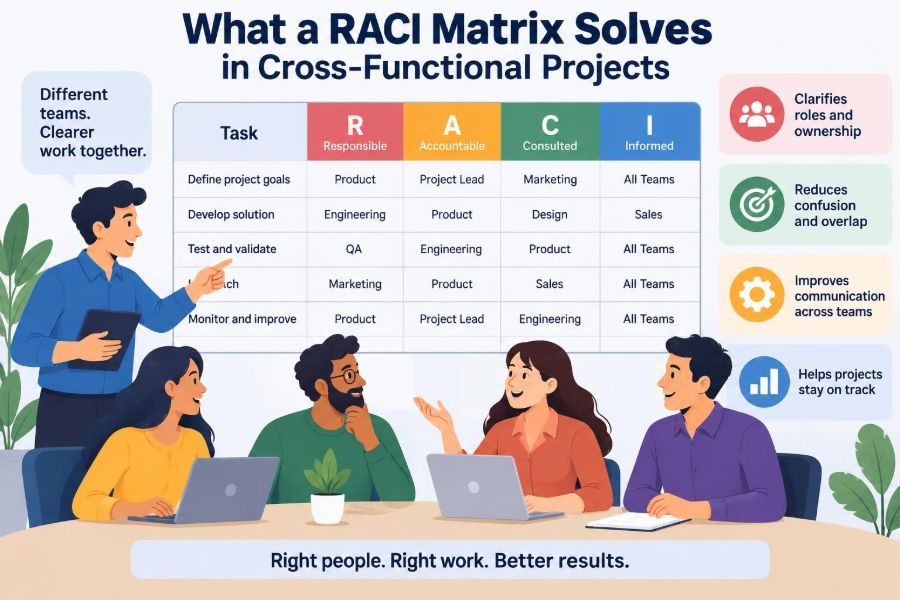
RACI names four distinct relationships that people can have to a task or decision:
- Responsible: the person or role that performs the work.
- Accountable: the person or role answerable for the result and final decision.
- Consulted: people whose input is sought before work or a decision is finalized.
- Informed: people who need updates after progress or decisions occur.
These categories turn a vague statement such as “the team will handle it” into specific, testable expectations.
🗂️ 3. A matrix connects work to roles
A RACI chart is usually a table. Rows list deliverables, activities, decisions, or milestones; columns list roles, teams, or named people. Each relevant cell receives R, A, C, or I.
The value comes from comparing assignments across the whole project. A role may look sensible on one task but overloaded or excluded when viewed across twenty tasks.
| Project activity | Project manager | Marketing lead | Legal counsel | Operations lead |
|---|---|---|---|---|
| Approve campaign claims | I | R | A | I |
| Confirm delivery process | A | I | C | R |
| Publish launch schedule | R | C | I | C |
The table is not a hierarchy chart. It is a map of contribution and decision rights for defined work.
🎯 4. It clarifies ownership
The central problem a RACI matrix solves is unclear ownership. Every important activity should have someone assigned to carry it forward and someone who accepts accountability for its outcome.
When a deadline approaches, the team no longer needs to guess who should act first. That clarity is particularly valuable when a task passes from one function to another. ✅
👤 5. It distinguishes responsible from accountable
Responsible and accountable are often treated as synonyms, but they answer different questions. “Who will do the work?” is not the same as “Who must ensure that the work is acceptable?”
A designer may be responsible for preparing packaging artwork, while a brand manager is accountable for approving it. The same role can hold both assignments for a small task, but separating them exposes decision authority on larger work.
⚖️ 6. It prevents too many final decision-makers
A task with several accountable people can create stalemate. Each person may believe they have equal authority to approve, reject, or redirect the work.
A practical RACI rule is to assign one accountable role per activity or decision wherever possible. This does not reduce collaboration; it establishes who resolves disagreement and gives the final go-ahead.
🏃 7. It stops the “someone else will do it” effect
When a task belongs generally to a department, individuals can reasonably assume that a colleague has picked it up. The result is a hidden gap rather than deliberate neglect.
Assigning a responsible role makes the handoff visible. The person or role need not work alone, but the team knows who coordinates completion and reports progress.
🗣️ 8. It defines the right consultation path
Specialist input matters in cross-functional projects. Finance may need to assess commercial implications, security may need to review data handling, and frontline staff may identify operational constraints.
RACI identifies these contributors as consulted, which signals that their input should be requested before the relevant action is finalized. Consultation is a two-way exchange, not simply a status email.
📣 9. It reduces unnecessary status updates
Not everyone needs to participate in every decision. Yet excluding affected people entirely can create surprise, resistance, or duplicated effort.
The informed category solves this middle ground. It identifies who needs timely awareness without turning every update into a meeting or asking every stakeholder to approve routine work.
⏱️ 10. It shortens decision delays
Projects often slow down not because work is difficult, but because a decision waits in an unclear queue. Teams ask for approval from several people, receive conflicting responses, or wait for a leader who did not know a decision was required.
A well-designed RACI assigns the accountable decision owner and identifies who must be consulted. That gives the project manager a clear escalation route when a decision is late.
🔄 11. It makes handoffs visible
Many failures occur at the boundary between teams: sales promises something operations cannot deliver, product changes a feature without support preparation, or procurement receives specifications too late.
By listing linked activities in sequence, a RACI matrix shows where one role’s output becomes another role’s input. These visible handoffs support better timing, acceptance criteria, and communication.
🧩 12. It exposes missing roles early
A blank row or a task with no responsible person is a useful warning. It may mean the team has not staffed the work, has not defined it clearly, or has overlooked a necessary capability.
For example, a project may include building a new process but omit training, service support, data migration, or compliance review. RACI helps reveal these omissions while they are still manageable.
🚦 13. It reveals overloaded contributors
Looking down a RACI column can show whether a single specialist is responsible, accountable, or consulted on an unrealistic number of activities. This is common with subject-matter experts and senior leaders.
Once visible, the team can delegate, sequence work differently, train a backup, or narrow consultation to high-risk decisions. The chart supports capacity conversations with evidence rather than impressions.
🧱 14. It separates project governance from doing the work
Governance includes approving priorities, accepting risks, resolving escalations, and authorizing major changes. Delivery work includes creating outputs, coordinating contributors, and completing tasks.
Cross-functional teams can become frustrated when governance roles repeatedly enter delivery details, or when delivery teams make decisions reserved for sponsors. RACI helps draw an appropriate boundary between those responsibilities.
📏 15. It gives scope changes a decision route
Scope changes often cause confusion because they affect several functions at once. A new requirement may change cost, timing, technical design, customer communication, and legal obligations.
A RACI matrix can specify who is responsible for documenting the change, who must be consulted about impacts, and who is accountable for approving or rejecting it. This reduces informal changes that bypass review.
🤝 16. It creates a neutral basis for role conversations
Responsibility disputes can feel personal when discussed only as opinions: “Your team should own this” versus “That is not our job.” A matrix shifts the discussion toward the work and the project need.
The question becomes, “Which role is best positioned to do this and make this decision?” That framing supports constructive negotiation across departmental boundaries.
🧠 17. It turns assumptions into explicit agreements
Experienced teams often work from assumptions built through past projects. New employees, external partners, and newly formed teams do not share those assumptions.
Writing RACI assignments forces hidden expectations into the open. A disagreement during planning is usually less expensive than a disagreement after a missed deadline or a flawed release.
🪜 18. It supports escalation without encouraging blame
Escalation is necessary when a project faces a blocked decision, unresolved conflict, or risk beyond the delivery team’s authority. Without clear roles, escalation can appear political or accusatory.
RACI provides a pre-agreed path: responsible roles raise the issue, accountable roles decide within their authority, and higher governance levels address matters outside it. The focus remains on resolution.
🧪 19. It improves quality and risk review
Quality checks and risk assessments are sometimes treated as someone else’s responsibility. In reality, many outputs need both a producer and an independent reviewer or approver.
RACI can state who prepares an assessment, who contributes specialist expertise, and who accepts the resulting risk. This is especially useful where safety, privacy, financial control, or customer impact requires disciplined review.
🌐 20. It aligns distributed and hybrid teams
Remote and hybrid work reduce opportunities for informal clarification. A quick conversation near a colleague’s desk may be replaced by messages, meetings, and delayed replies across time zones.
A shared responsibility matrix gives distributed teams a stable reference point. It does not eliminate communication needs, but it reduces repeated questions about ownership and inclusion. 🌍
📚 21. It helps new team members become effective faster
New contributors need more than a task list. They need to understand who owns decisions, whose expertise matters, and which stakeholders expect updates.
RACI gives them a compact overview of the project’s operating model. It can be particularly helpful when a person joins mid-project and must understand relationships quickly.
🛠️ 22. Start with meaningful activities, not every tiny task
A RACI matrix works best at the level where coordination and authority matter. If it lists every small action, it becomes difficult to read and expensive to maintain.
Use major deliverables, approval points, recurring processes, critical handoffs, and significant decisions as rows. A detailed work plan can manage individual tasks underneath those broader responsibilities.
Useful rows often include
- Defining requirements and accepting them.
- Approving budget, design, or release decisions.
- Completing testing and resolving defects.
- Preparing training, communications, and operational readiness.
- Managing major risks and approved changes.
🧑🤝🧑 23. Assign roles before assigning names when possible
Using roles such as “Finance partner,” “Product owner,” or “Operations manager” keeps the matrix useful when individuals change. It also directs attention to organizational responsibility rather than personality.
Names can be added when a project requires precision, but the underlying role should remain clear. This makes succession, delegation, and onboarding easier.
🔍 24. Review the matrix for common warning signs
Creating a chart is only the first step. Teams should inspect it for patterns that signal confusion or impracticality.
- No R: nobody is assigned to perform or coordinate the activity.
- No A: nobody is answerable for the result or decision.
- Several As: final authority may be disputed.
- Too many Cs: consultation may become slow and unwieldy.
- Too many Is: the communication burden may overwhelm the project.
- One overloaded column: a role may be a bottleneck.
These are prompts for discussion, not automatic proof that an assignment is wrong.
⚠️ 25. Understand what RACI cannot solve
RACI cannot repair weak relationships, insufficient resources, unclear strategy, or poor leadership. It can reveal those issues, but a table alone cannot remove them.
It also does not define the full project schedule, budget, risk register, or performance measures. Treat it as one management tool within a wider project-management approach, not as a complete operating system.
🌀 26. Avoid turning it into bureaucracy
A matrix becomes counterproductive when teams use it to defend territory, require approval for minor decisions, or update it more often than they complete work. Overly granular charts can make responsibility look precise while reducing agility.
Keep the focus on high-value coordination. Review assignments when scope, stakeholders, or decision rights change, and retire the chart when it no longer serves the work.
💬 27. Use the matrix as a conversation, not a verdict
The strongest RACI matrices are developed with the people affected by them. A project manager may draft the first version, but functional leaders and delivery contributors should challenge unclear or unrealistic assignments.
Discussion is essential because a letter does not explain every nuance. Teams may need to agree on response times, approval criteria, delegation limits, and the method for keeping informed parties updated.
📌 28. The core principle: clarity enables coordinated action
A RACI matrix solves a fundamental coordination problem: it makes responsibility, authority, consultation, and communication visible across functions. It helps teams see who acts, who decides, who contributes knowledge, and who needs awareness.
Its purpose is not to create rigid silos. Its purpose is to make collaboration more reliable by reducing ambiguity at the moments when work crosses boundaries.
When cross-functional teams make ownership explicit, they spend less energy asking who should act and more energy delivering the outcome together. 📋🤝✅