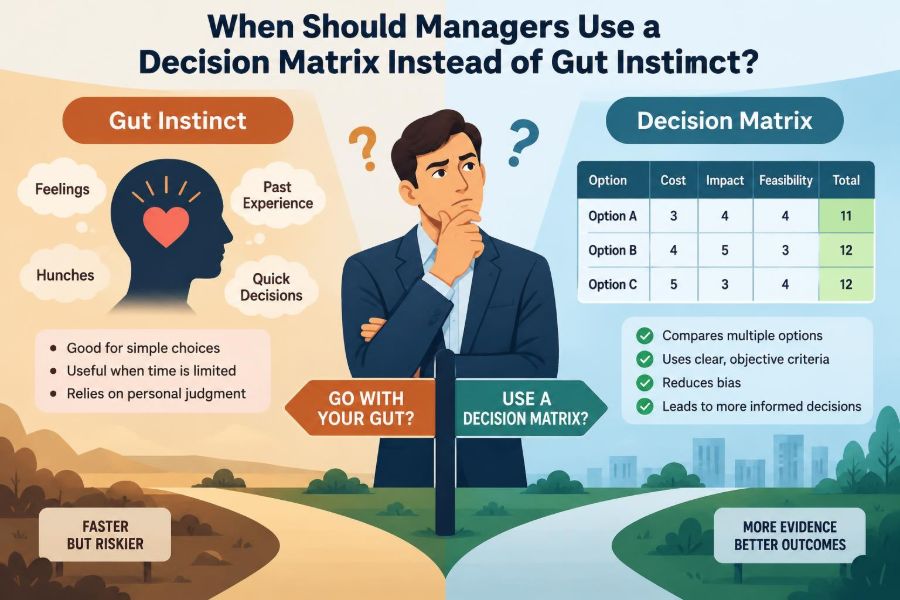

A product manager must choose one of three software vendors by Friday. Each vendor looks credible, but the options differ in price, security, implementation effort, support, and long-term fit.
One executive says, “I have a good feeling about Vendor B.” Another wants to collect more evidence before the team commits. Both responses can be useful, but they serve different kinds of decisions.
Managers make choices under time pressure every day. The challenge is not to eliminate judgment; it is to know when personal experience is enough and when a more visible, disciplined comparison is needed.
A decision matrix helps teams compare alternatives against agreed criteria. It is especially valuable when a decision has multiple trade-offs, affects several people, or needs an explanation that others can inspect and challenge.
🧭 1. Start with the real choice
A decision matrix is not a cure for vague thinking. Before building one, state the decision in a single practical sentence: “Which vendor should we select for the next three years?”
Define the alternatives clearly. If one option is actually a bundle of different configurations, separate those configurations or resolve the ambiguity first.
🧠 2. Understand what gut instinct really is
Gut instinct is rapid judgment shaped by experience, pattern recognition, values, and emotion. It is not automatically irrational; an experienced manager may notice warning signs before they can fully articulate them.
However, intuition can also reflect recent events, personal preferences, incomplete information, or confidence that exceeds the evidence. Its reliability depends greatly on the setting.
⚖️ 3. Use a matrix when trade-offs are central
A matrix is most useful when no option is obviously best on every dimension. One candidate may be cheaper, another faster to implement, and a third more secure or scalable.
When the choice requires trading one benefit against another, a matrix makes those trade-offs explicit instead of leaving them hidden in a conversation.
🧩 4. Turn a complex choice into comparable parts
The basic structure is simple: alternatives appear in rows, and criteria appear in columns. The team scores each alternative against each criterion, then combines the scores using agreed weights if some criteria matter more than others.
The matrix does not decide independently. It organizes the reasoning that managers must still perform.
🚦 5. Recognize decisions that can rely more on judgment
Gut instinct is often appropriate for small, reversible, familiar decisions. A supervisor who has handled a recurring scheduling issue many times may not need a formal scoring exercise.
- The consequences are limited.
- The decision can be changed easily.
- The manager has relevant, repeated experience.
- There are few meaningful alternatives or criteria.
- Speed matters more than documenting the rationale.
Even here, intuition should not override legal, safety, ethical, or policy requirements.
🏗️ 6. Escalate when the decision is consequential
Use a decision matrix when a choice commits substantial money, time, reputation, customer trust, or organizational capacity. The greater the consequences, the more valuable a transparent process becomes.
A matrix can reveal whether enthusiasm for an appealing option is supported by the factors that will matter after implementation.
👥 7. Bring structure to multi-stakeholder decisions
Different functions often define “best” differently. Finance may prioritize total cost, operations may prioritize reliability, IT may prioritize integration, and frontline employees may prioritize usability.
A matrix gives these groups a shared object to discuss. It does not remove disagreement, but it makes the source of disagreement clearer: criteria, weights, evidence, or scores.
🔍 8. Use one when assumptions need to be visible
Many management decisions rest on assumptions about future demand, implementation difficulty, vendor responsiveness, or employee adoption. Informal discussion can leave these assumptions unspoken.
Listing criteria and scores forces the team to ask what evidence supports each judgment. A low-confidence assumption can be marked for further research rather than quietly treated as fact.
📋 9. Choose criteria that reflect the decision’s purpose
Good criteria describe what success requires. They should be relevant, understandable, and distinguish meaningfully among the options.
Useful criterion categories
- Strategic fit: alignment with goals, customer needs, and future direction.
- Financial impact: cost, expected value, affordability, and resource requirements.
- Operational feasibility: skills, capacity, implementation effort, and process fit.
- Risk: security, compliance, supplier dependency, safety, and failure consequences.
- Stakeholder impact: customer experience, employee workload, and partner relationships.
Avoid using a criterion merely because it is easy to measure. Easy measurement is not the same as importance.
🎯 10. Keep criteria distinct
Double-counting happens when several criteria measure nearly the same thing. For example, “ease of use,” “training time,” and “employee adoption” may overlap, although each can be retained if the team defines the boundaries carefully.
Ask whether a poor score in one column would automatically create a poor score in another. If so, combine, redefine, or deliberately limit their combined influence.
⚙️ 11. Weight criteria only after discussing priorities
Weights express relative importance. If reliability is more important than visual design, the matrix should show that rather than pretending every criterion is equal.
Teams can use simple weights such as 1 to 5, percentages that add to 100, or another consistent scale. The exact format matters less than a shared interpretation of what the weights mean.
Weighting is a management judgment, not a mathematical discovery. It should be discussed before scores are assigned, otherwise people may adjust priorities to favor a preferred option.
📏 12. Define the scoring scale before scoring
A score is useful only when participants understand it similarly. A 1-to-5 scale might mean 1 is poor fit, 3 is acceptable fit, and 5 is excellent fit.
For important criteria, add brief anchors. A security score, for example, should refer to defined requirements and evidence rather than a general impression.
| Step | Question to answer | Example |
|---|---|---|
| Criterion | What matters? | Implementation feasibility |
| Weight | How much does it matter? | High because internal capacity is limited |
| Scale | What does each score mean? | 5 = can launch with minimal external support |
| Evidence | What supports the score? | Demonstration, references, and technical review |
🧮 13. Calculate scores without mistaking them for truth
A common weighted score is calculated by multiplying an option’s criterion score by the criterion weight, then adding the results across criteria. The calculation can be done in a spreadsheet, but the arithmetic is not the hard part.
total score = Σ (criterion weight × option score)
The total is a summary of assumptions. It is helpful because it exposes those assumptions, not because it produces an unquestionable answer.
📚 14. Match evidence to the importance of the choice
High-impact decisions deserve stronger evidence than low-impact ones. Evidence may include pilot results, contracts, demonstrations, customer feedback, technical assessments, process data, or informed expert review.
Do not give precise-looking scores when evidence is weak. Instead, note uncertainty, use a score range during discussion, or identify what would need to be learned before a final decision.
🕳️ 15. Separate facts, estimates, and preferences
A disciplined matrix distinguishes what is known from what is predicted and what is valued. A quoted implementation timeline is different from an internal estimate, and both are different from a preference for a particular user experience.
This distinction prevents debates from becoming confused. Teams can verify facts, improve estimates, and negotiate preferences through the appropriate channels.
🗣️ 16. Score independently before seeking consensus
When several people score together from the start, a senior voice or early opinion can anchor the group. Independent first-pass scoring lets participants reveal genuinely different assessments.
Then compare results criterion by criterion. Large gaps are often more informative than the average because they point to different evidence, interpretations, or assumptions.
🧪 17. Test the decision with sensitivity analysis
Sensitivity analysis asks whether the recommendation changes when plausible assumptions change. If a small adjustment to one weight reverses the ranking, the decision is fragile.
A fragile result does not mean the matrix failed. It tells managers that they should investigate the decisive uncertainty, reconsider the criteria, or avoid claiming that one option clearly dominates.
🔴 18. Treat non-negotiables as gates, not ordinary scores
Some requirements should not be traded away by a high total score. A solution that fails a mandatory legal, safety, accessibility, security, or budget condition may be unsuitable regardless of its strengths elsewhere.
Set these screening criteria before weighted scoring. First eliminate options that cannot meet essential requirements, then compare the viable options.
⏱️ 19. Use a lighter matrix when speed is essential
Urgency does not always mean managers should abandon structure. A short matrix with three options and four essential criteria can be completed quickly and may prevent an impulsive mistake.
In a genuine emergency, act to protect people and operations first. Document the reasoning afterward, then review the decision once immediate pressure has passed.
🌪️ 20. Avoid false precision
A score of 4.2 can look more certain than the underlying judgment deserves. If the difference between options is tiny, report that they are closely matched rather than treating a decimal point as a decisive signal.
Use simple scales and plain-language notes. The aim is better judgment, not the appearance of scientific certainty.
🪞 21. Watch for bias before it enters the spreadsheet
A matrix can formalize bias just as efficiently as it can improve a decision. Confirmation bias may lead a team to select favorable criteria; anchoring may make the first proposal seem stronger; familiarity may inflate confidence in a known supplier.
- Invite someone to challenge the favored option.
- Ask what evidence would change the current view.
- Consider an option the team has not initially preferred.
- Record reasons for scores, especially unusually high or low ones.
These practices make the matrix a tool for learning rather than a justification document.
⚠️ 22. Do not use a matrix to disguise a values conflict
Some choices are fundamentally ethical or political, not merely technical. A matrix can clarify consequences, but it cannot decide what an organization ought to value when values conflict.
For example, a decision affecting jobs, privacy, fairness, or community impact may require explicit leadership accountability and stakeholder engagement beyond a weighted total.
🔄 23. Combine analysis with professional intuition
After reviewing the matrix, ask whether an experienced manager has a strong concern that the criteria missed. That concern should not automatically overturn the result, but it deserves examination.
Intuition is especially useful as a prompt: “What pattern am I noticing?” Turning that feeling into a testable question may uncover a missing risk or criterion.
🧭 24. Know when not to build one
A full matrix can waste time when alternatives are nearly identical, when the decision is trivial, or when one option clearly meets a non-negotiable need that others cannot meet.
It is also a poor substitute for experimentation. If a small pilot can answer the central uncertainty more directly, test first and use the results to inform the later choice.
📝 25. Document the rationale, not just the winner
Keep a record of the alternatives considered, criteria, weights, major evidence, uncertainties, and final decision. This supports accountability and helps future managers understand why the choice made sense at the time.
Documentation also makes review easier. If outcomes disappoint, the organization can learn whether the problem was weak information, poor assumptions, flawed priorities, or execution after the decision.
📣 26. Communicate the result in human terms
Most stakeholders do not need every formula. Explain the decision using the few factors that genuinely drove it, the major trade-offs accepted, and any safeguards or next steps.
Clear communication builds confidence because people can see that their concerns were considered, even if their preferred option was not selected.
🔁 27. Review decisions after implementation
A matrix should be treated as a learning record. After enough time has passed to observe outcomes, compare expectations with what actually happened.
Review questions might include whether the right criteria were chosen, whether weights reflected real priorities, and whether early warning signs were overlooked. This improves both future matrices and managerial intuition.
🏁 28. Use structure when the cost of being casually wrong is high
The core principle is simple: use gut instinct for familiar, low-stakes, reversible choices, and use a decision matrix when alternatives involve important trade-offs, uncertainty, multiple stakeholders, or a need for defensible reasoning.
A matrix does not replace leadership. It gives leadership a disciplined way to surface evidence, values, risks, and disagreements before commitment.
The best managers do not choose between instinct and analysis; they use analysis to test instinct when the decision matters most. 🧠⚖️🗺️