
Think about a busy coffee shop during the morning rush. One person takes orders, another prepares drinks, someone checks stock, and a manager steps in when a machine fails or a queue grows too long. Even in this small setting, work only flows when people know what to do, how decisions are made, and who is responsible for the result.
Now scale that challenge to a nineteenth-century factory, a multinational manufacturer, or a remote software team spread across several time zones. The tools change, but the central question remains: how can groups of people coordinate effort to achieve a shared purpose?
Management did not appear fully formed in a textbook. It developed as organizations became larger, work became more specialized, and leaders needed better ways to plan, organize, guide, and evaluate performance.
Understanding that evolution helps students see where familiar ideas such as targets, job design, performance reviews, and teamwork came from. It also helps working professionals judge which management practices still fit their organization—and which belong to a different era.
🏛️ Management Existed Before It Had a Name
People have coordinated large projects for thousands of years. Building irrigation systems, organizing armies, collecting taxes, and running trade networks all required planning, records, supervision, and the allocation of resources.
These early arrangements were not usually described as modern management. Still, they addressed recognizable management problems: dividing tasks, giving authority to certain roles, setting rules, and checking whether work had been completed.
The difference was scale and formality. Many early organizations depended heavily on tradition, personal loyalty, or political power rather than written systems designed for efficient operations.
🌾 Craft Work and the Pre-Industrial Economy
Before factories became widespread, much production happened in homes, farms, and small workshops. A craftsperson might own the tools, choose the pace of work, train an apprentice, and sell directly to customers.
Management was often personal rather than departmental. The owner made decisions because the owner also understood the work in detail. Coordination needs were limited when a workshop employed only a few people.
Guilds—associations connected to particular crafts—also influenced standards, training, and entry into trades in parts of Europe. They show that work has long involved rules and collective organization, even outside large companies.
🏭 The Industrial Revolution Changed the Problem
Industrialization brought machinery, concentrated production, and larger workforces. Factories gathered workers and equipment in one location, making output easier to increase but much harder to coordinate.
A factory owner could no longer rely only on informal observation. Raw materials had to arrive on time, machines needed maintenance, tasks had to occur in sequence, and wages and output required records.
This created the conditions for formal management. The issue was no longer simply “Can someone make this product?” It became “Can hundreds of people produce it reliably, affordably, and at consistent quality?”
⚙️ Division of Labor Increased Output—and Dependence
One influential industrial idea was the division of labor: splitting a complex job into smaller, repeated tasks. Instead of one person making an entire product, each worker might complete one stage.
Specialization can reduce switching time and allow workers to become skilled at a particular activity. It also makes training easier when tasks are clearly defined.
But specialization creates dependence. If one stage slows down, the next stage may have nothing to do. Managers therefore had to focus on workflow, timing, materials, and bottlenecks rather than only individual effort.
📋 Factories Created the Need for Formal Control
Early factories used schedules, supervisors, time records, production counts, and rules to make work more predictable. These controls were partly practical: expensive machinery could not sit idle, and missed deliveries could disrupt an entire operation.
Control, however, could become overly rigid. Rules designed to coordinate work sometimes treated people as interchangeable parts. This tension between efficiency and human dignity has shaped management debates ever since.
Modern organizations still use controls, from project dashboards to quality checks. The useful question is whether a control helps people do better work or merely adds surveillance and paperwork.
🔬 Scientific Management and Frederick W. Taylor
In the late nineteenth and early twentieth centuries, Frederick W. Taylor advanced ideas commonly called scientific management. He argued that work methods should be studied systematically rather than left entirely to individual habit.
Taylor’s approach involved observing tasks, identifying a more efficient method, selecting and training workers, and separating planning from execution. Time-and-motion studies became associated with this school of thought.
The lasting contribution was the belief that work processes can be examined and improved. Its major limitation was a narrow view of motivation: people may value pay and clear instructions, but they also care about autonomy, fairness, meaning, and relationships.
⏱️ What Scientific Management Got Right
Scientific management encouraged managers to replace guesswork with evidence about the work itself. In repetitive, physically demanding processes, careful analysis can reduce unnecessary movement, clarify instructions, and improve safety.
It also highlighted a continuing management responsibility: a poor result is not always an employee problem. Sometimes the process, tools, layout, training, or information flow is poorly designed.
For example, if a warehouse worker walks long distances to collect frequently used items, reorganizing storage may improve performance more than telling the worker to “work faster.”
⚠️ The Human Cost of Treating Work as a Machine
When efficiency becomes the only objective, jobs can become monotonous and tightly controlled. Workers may lose discretion over how to solve problems, and managers may miss valuable knowledge held by people closest to the work.
Strict performance measures can also create unintended behavior. If a call center rewards short call times without considering resolution quality, employees may end conversations quickly while customers remain unsupported.
The lesson is not to abandon measurement. It is to measure what genuinely matters and to consider the effects that a metric has on behavior.
🏢 Administrative Theory and the Whole Organization
While scientific management examined individual tasks, administrative thinkers considered how an entire organization should be designed. Henri Fayol is often associated with broad management functions such as planning, organizing, directing, coordinating, and controlling.
This perspective recognized that leaders must connect many activities: operations, finance, staffing, sales, and decision-making. A well-designed task means little if departments work at cross-purposes.
Many management courses still build on this foundation. The exact labels vary, but managers continue to set direction, arrange resources, lead people, and monitor results.
🗂️ Bureaucracy Brought Rules and Predictability
Max Weber described an ideal type of bureaucracy: an organization built around defined roles, hierarchy, written rules, technical competence, and decisions based on procedures rather than personal favoritism.
In the right setting, bureaucracy supports consistency. A hospital, public agency, or bank cannot depend entirely on each employee improvising important procedures.
Yet bureaucracy can become slow when rules are applied without judgment. The goal is not “more bureaucracy” or “no bureaucracy,” but enough structure to ensure fairness, accountability, and reliable service.
🧾 The Rise of Middle Management
As companies expanded, owners could not personally oversee every worker or decision. Middle managers emerged to translate senior leaders’ objectives into day-to-day action and communicate operational realities upward.
This role remains difficult because middle managers often face competing pressures. They must deliver results, support teams, manage change, and explain decisions they did not create.
Organizations work better when middle managers have clear authority and timely information. Giving them responsibility without decision rights simply creates delay and frustration.
🤝 The Human Relations Movement
By the early twentieth century, management thinkers increasingly examined the social side of work. The human relations movement emphasized that attitudes, group norms, communication, and a sense of belonging can affect performance.
Workers are not motivated by one universal reward. A person may value income, security, recognition, learning, flexibility, purpose, or the chance to contribute ideas. These priorities also change over time.
This shift widened management’s focus from task design alone to the workplace environment in which tasks are performed.
🗣️ Informal Groups Shape Everyday Work
Every organization has a formal structure shown on an organizational chart and an informal network built through trust, friendships, expertise, and shared experience. Informal networks can solve problems quickly because people know whom to ask.
They can also resist change if employees feel ignored or threatened. A manager who announces a new process without speaking to influential team members may discover that informal opinion moves faster than formal communication.
Effective leaders pay attention to both systems. They do not manipulate relationships; they make space for honest feedback and involve people early when change affects their work.
🧠 Motivation Became More Sophisticated
Later theories explored why people choose effort, persist through difficulty, or disengage. No single theory explains every person or workplace, but together they show that motivation is more complex than a bonus or a warning.
People are more likely to contribute when they understand expectations, believe effort can lead to a worthwhile result, and view rewards and decisions as fair. They also need the skills, tools, and authority to succeed.
A manager cannot “install” motivation in another person. They can remove obstacles, make goals meaningful, recognize contribution, and build conditions in which motivation is more likely to grow.
🎯 Management by Objectives Linked Goals to Work
Management by objectives, often associated with Peter Drucker, encouraged managers and employees to agree on clear goals and review progress against them. The idea was to connect individual effort with organizational direction.
Well-written objectives identify an outcome, a time frame, and a meaningful measure. “Improve customer service” is vague; “reduce unresolved customer requests by improving the handover process this quarter” provides a clearer focus.
Goals can fail when they are imposed without context or when measures become more important than the mission. Good objective-setting includes discussion, adjustment, and attention to quality as well as quantity.
📐 Operations Management Made Flow Visible
During the twentieth century, managers developed more systematic ways to plan production, inventory, logistics, and quality. Operations management focuses on converting inputs—such as materials, labor, information, and equipment—into goods or services.
Its core insight is that performance depends on the whole system. Faster work at one station may create a queue at another; ordering extra stock may prevent shortages but increase storage cost and waste.
Service organizations use these ideas too. A clinic, airline, university, and online retailer all manage capacity, waiting time, demand variation, and process reliability.
✅ Quality Management Moved Beyond Final Inspection
Older quality systems often relied on inspecting finished goods and removing defects at the end. Modern quality thinking increasingly emphasizes preventing errors by improving the process that creates them.
That may involve standard work, clearer specifications, employee problem-solving, and feedback from customers. Quality is not solely the responsibility of a final inspection team; it is built into decisions across the organization.
A practical example is an online form that prevents users from submitting missing information. Designing the error out of the process is usually better than repeatedly correcting incomplete submissions later.
🚗 Lean Thinking Focused on Waste and Learning
Lean management developed from production practices associated especially with Japanese manufacturing and has since influenced many sectors. It seeks to improve value for the customer while reducing activities that consume resources without adding value.
Waste can include waiting, avoidable rework, excess inventory, unnecessary movement, and unclear handovers. Lean is not simply a demand to cut costs or make people work harder.
Applied thoughtfully, it asks those doing the work to identify problems and test improvements. Applied carelessly, it can be misused as a headcount reduction program, damaging trust and long-term capability.
🌍 Globalization Expanded the Management Challenge
As companies began sourcing, selling, and operating across borders, managers had to coordinate suppliers, regulations, currencies, cultures, and customers in different regions. A decision that works in one market may need adaptation elsewhere.
Global management requires more than translating documents. Leaders must understand local labor practices, communication styles, legal obligations, and customer expectations without relying on stereotypes.
Global reach can provide access to new talent and markets, but it also makes supply chains more exposed to disruptions. Resilience—not only low cost—has become a major strategic consideration.
💻 Information Technology Changed Speed and Visibility
Computers, enterprise systems, and digital communication changed how managers collect information and coordinate work. A manager can now see sales trends, inventory levels, or project status far more quickly than through paper reports.
More data does not automatically mean better management. Dashboards can overwhelm users, and data may be incomplete, delayed, or interpreted without context.
The valuable skill is turning information into sound judgment: asking what the numbers mean, what they leave out, and which decision should follow.
📈 Data-Driven Management Requires Judgment
Data-driven management means using relevant evidence to inform decisions, not handing all decisions to a spreadsheet. Quantitative data can reveal patterns, while customer comments and employee observations can explain why those patterns exist.
For instance, falling sales may signal weak demand, but they may also result from stock shortages, a website fault, or changes in how sales are recorded. A metric is a starting point for inquiry, not a complete explanation.
Managers should be alert to measurement bias, privacy concerns, and the temptation to reward easily counted activity rather than meaningful outcomes.
🧩 Strategy Connected Internal Choices to the Outside World
Management gradually placed greater emphasis on strategy: the choices an organization makes about where to compete, whom to serve, and how to create value. Strategy is not merely a long document; it is a set of trade-offs.
A business cannot be exceptional at every possible dimension. Choosing faster delivery, premium service, low prices, or deep customization affects staffing, technology, processes, and investment.
Good strategy gives managers a basis for saying no. If a proposed project does not support the organization’s direction, resources may be better used elsewhere.
👥 Leadership Became Distinct From Management
Management and leadership overlap, but they are not identical. Management emphasizes coordination, systems, resources, and dependable execution. Leadership emphasizes direction, influence, meaning, and the ability to help people move through uncertainty.
An organization needs both. A compelling vision without operational discipline may remain a slogan; flawless administration without purpose can leave people disengaged.
Leadership is not limited to job titles. A frontline employee who helps colleagues understand a new process can lead, even without formal authority.
🌱 Ethics and Stakeholders Broadened the Manager’s Role
For much of business history, management discussions centered heavily on owners, productivity, and profit. Modern managers also face responsibilities to employees, customers, communities, suppliers, regulators, and the environment.
Stakeholder management does not mean every interest can be satisfied at once. It means decisions should consider who is affected, what risks are created, and whether the organization can justify its choices.
Ethical management matters most when the easy option conflicts with values. Clear policies help, but managers also need the confidence to raise concerns and question harmful incentives.
🏠 Remote and Hybrid Work Rewrote Old Assumptions
Remote and hybrid work have challenged management practices built around physical visibility. When managers cannot see people at desks, they need clearer goals, better communication, and greater trust.
Effective remote management is not constant monitoring through digital tools. It involves agreed ways of working: when teams meet, how decisions are documented, where updates are stored, and how people can ask for help.
Hybrid arrangements add a fairness challenge. Managers should avoid giving better information, opportunities, or recognition only to employees who happen to be present in the office.
🤖 Automation and AI Are Changing Work Design
Automation can handle repetitive tasks, process large volumes of information, and support decisions. Artificial intelligence tools can also generate drafts, summarize material, or identify patterns, depending on their design and data.
These tools do not remove management responsibility. Managers must decide which tasks should be automated, how outputs will be checked, what data can be used responsibly, and how roles will change.
A sensible approach treats technology as part of job design. If a tool saves time, leaders should consider whether that time will improve customer service, reduce overload, support learning, or simply create more work.
🔄 Agile Management Favored Adaptation Over Long Cycles
Agile approaches emerged prominently in software development but influence many knowledge-work settings. They emphasize short cycles of work, frequent feedback, collaboration, and adjustment when needs change.
Agile does not mean abandoning planning or hierarchy. It means planning with the expectation that some assumptions will need revision as new information appears.
It is most useful where uncertainty is high and learning is rapid. Highly regulated or safety-critical work may require more formal documentation and control alongside agile practices.
🛡️ Risk, Resilience, and Crisis Management
Major disruptions have reminded organizations that efficiency alone is not enough. A supply chain designed with no spare capacity may be inexpensive during stable periods but fragile when a supplier, transport route, or workforce is disrupted.
Resilience involves preparing for shocks, maintaining options, and learning after setbacks. It can include backup suppliers, cross-training, clearer crisis roles, and honest communication about uncertainty.
Managers cannot predict every event. They can build systems that detect problems early and enable people to respond without waiting for unnecessary layers of approval.
🧭 What Has Stayed Constant Across Eras
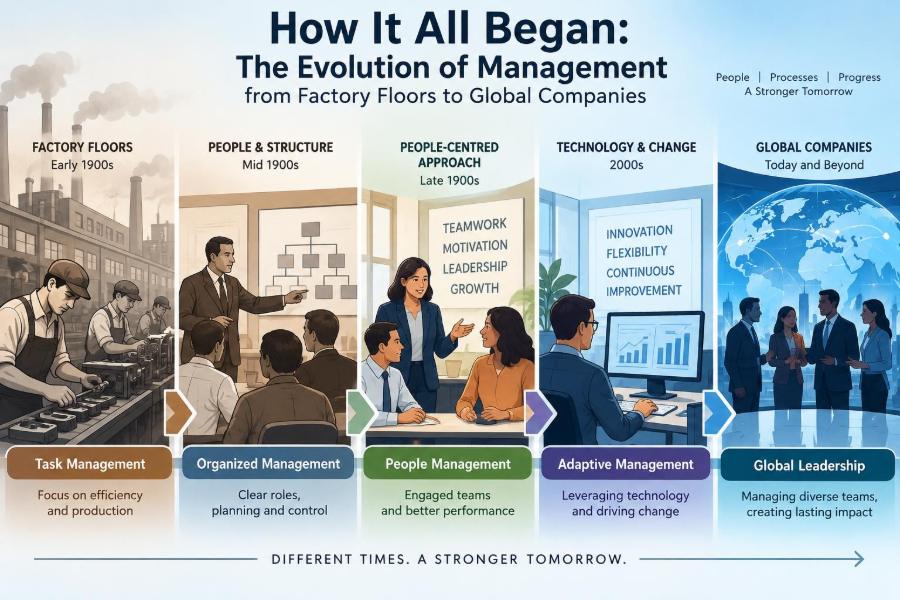
From workshops to global companies, management has always involved aligning people and resources around a purpose. The core activities remain familiar: decide what matters, organize work, support people, monitor progress, and improve.
What changes is the context. Factories required coordination of machines and repetitive labor; global digital organizations must coordinate knowledge, culture, data, partners, and rapid change.
The most durable management principle is simple: design systems that help people do worthwhile work well, then keep learning when the system falls short.
🧰 Practical Lessons for Emerging Managers
Management history is useful when it improves present-day choices. Rather than copying a famous model, ask what problem the model was designed to solve and whether that problem resembles yours.
- Use process analysis when work is repetitive or delays are costly.
- Use clear roles and rules when fairness, safety, or consistency matter.
- Invite employee input when local knowledge can reveal practical problems.
- Use goals and data to create focus, but examine unintended consequences.
- Balance efficiency with quality, wellbeing, ethics, and resilience.
A new manager does not need every answer immediately. They do need curiosity: observe the work, listen carefully, make expectations visible, and improve one real obstacle at a time.
🚀 The Continuing Evolution of Management
Management will keep changing as technology, social expectations, environmental pressures, and business models evolve. No era has discovered a final formula that works for every organization.
Its history shows a recurring pattern. New methods solve real coordination problems, then reveal new limits: efficiency can neglect people, flexibility can reduce consistency, and data can obscure judgment.
The strongest managers learn from those tensions rather than choosing one extreme. They build organizations capable of performing reliably while adapting thoughtfully to what comes next.
Management has evolved from controlling factory tasks to coordinating complex human systems, but its enduring purpose is to turn shared effort into responsible, meaningful results. 📊🤝🌍