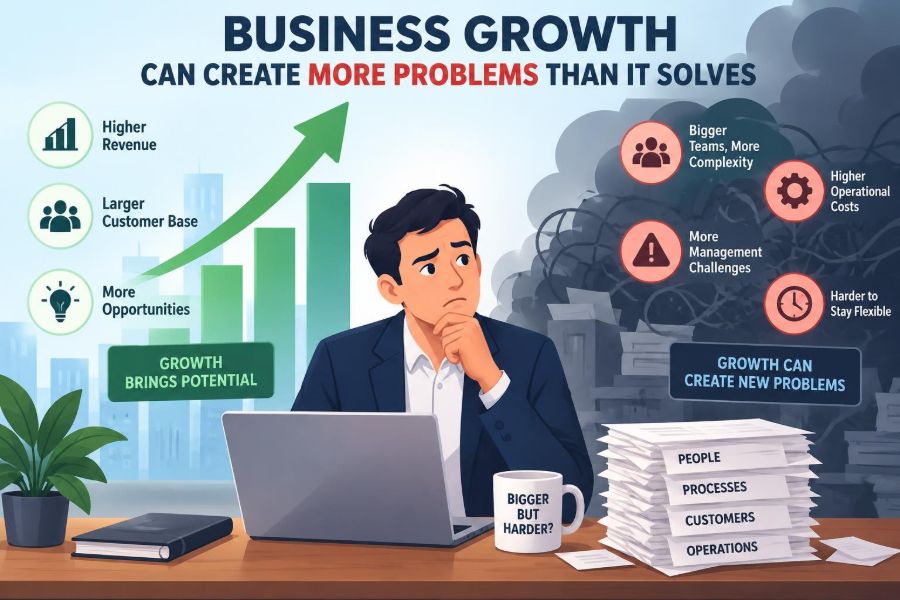

A small business finally gets the break it has been waiting for. A major customer places a large order, social media attention drives hundreds of new enquiries, or a new location appears to double demand overnight.
At first, the signs look entirely positive: revenue rises, the team is busy, and the founder has a more impressive story to tell. Yet behind the celebration, orders begin arriving late, staff work evenings, cash feels tighter than before, and customer complaints increase.
This is not a contradiction. Growth can be valuable, but it also increases the load placed on every part of a business. A company that has not built enough capacity, controls, and clarity may become less reliable as it becomes larger.
Understanding the risks does not mean avoiding ambition. It means treating growth as a management challenge, not simply a sales victory.
🌱 Growth Is an Increase in Complexity, Not Just Revenue
Business growth usually means more customers, transactions, employees, products, locations, or markets. Each addition creates more relationships and decisions to manage.
A café serving fifty customers a day can rely on an owner’s memory and informal routines. At five hundred customers, those same routines may produce errors, inconsistent service, and waste. The business has grown, but its operating system has not.
⚖️ Revenue and Profit Do Not Move Together
More sales do not automatically mean more profit. New revenue may require extra overtime, discounted prices, rush shipping, additional marketing, or expensive temporary staff.
Managers should examine the contribution margin: the amount left from each sale after the costs directly associated with making and delivering it. A fast-growing product with a weak contribution margin can make the company busier while making its financial position worse.
💵 Cash Can Disappear During Successful Growth
Profit is an accounting measure; cash is the money available to pay wages, suppliers, rent, and tax obligations. Growing firms often spend cash before receiving it from customers.
For example, a wholesaler may buy inventory and pay employees this month, then wait sixty days for a large customer to settle an invoice. The sale may be profitable on paper, but the timing gap can create a real liquidity problem.
🧾 Working Capital Demands Rise Quickly
Working capital is the short-term funding needed to run day-to-day operations, including inventory, unpaid customer invoices, and bills due to suppliers. Growth often absorbs more of it than leaders expect.
A retailer that doubles sales may need to order substantially more stock well before the selling season. If demand shifts or deliveries arrive late, cash can become trapped in unsold inventory.
🏭 Capacity Bottlenecks Become Visible
Every business has a constraint: a machine, approval step, skilled employee, warehouse area, or software system that limits output. Growth makes that bottleneck more painful.
Adding salespeople will not help if production is already full. Hiring more production staff may not help if a single quality inspector must approve every batch. Effective growth plans identify the constraint before demand reaches it.
📦 Inventory Becomes Harder to Control
As product ranges and order volumes expand, stock decisions become less forgiving. Too little inventory causes lost sales and backorders; too much ties up cash and increases the risk of damage, obsolescence, or discounting.
Demand forecasts are estimates, not guarantees. Businesses should distinguish stable, repeat-purchase items from uncertain or seasonal items rather than applying one purchasing rule to everything.
🚚 Supply Chains Gain More Failure Points
A larger operation may depend on more suppliers, transport providers, components, and countries. Each dependency introduces possible disruption.
Growth can expose an uncomfortable concentration risk: one supplier may provide a critical material, or one shipping route may handle most deliveries. Alternative sources, realistic lead times, and clear contingency plans become increasingly valuable.
⏱️ Service Quality Can Fall as Demand Rises
Customers judge a growing business by whether it does what it promised, not by how exciting its internal growth feels. Longer queues, delayed replies, inaccurate invoices, and inconsistent delivery quickly weaken trust.
Quality problems are especially costly because they create rework. The business spends time fixing work it has already paid to do, while the customer may still leave disappointed.
🔍 Quality Control May Not Scale Automatically
In an early-stage company, an experienced founder may personally check important orders. That approach can work until volume makes personal inspection impossible.
Scaling quality requires repeatable methods: documented standards, training, sampling, feedback loops, and authority to stop defective work. Inspection alone is not enough if the process itself regularly creates errors.
👥 Hiring Fast Can Lower the Average Fit
Rapid recruitment can lead managers to accept candidates before roles, expectations, and training are clear. New hires may then receive conflicting instructions from overstretched supervisors.
This is not an argument against hiring. It is a warning that headcount is not the same as capability. A smaller, well-supported team can often outperform a larger group that lacks direction.
🎓 Training Is Often Treated as Optional
During busy periods, training is commonly postponed because managers want people productive immediately. The result can be avoidable mistakes, inconsistent customer treatment, and safety or compliance failures.
Training is part of productive capacity. It includes not only technical tasks, but also escalation rules, service standards, systems access, and an understanding of why procedures exist.
🧠 Managers Become Overloaded
Growth usually creates more decisions, exceptions, meetings, and interpersonal issues. A founder who once handled sales, operations, finance, and hiring may become the slowest point in the company.
When every decision requires one person’s approval, people wait instead of acting. Delegation with defined boundaries is more scalable than constant personal control.
🗺️ Informal Knowledge Stops Being Reliable
Small teams often rely on knowledge stored in people’s heads: which supplier to call, how to resolve a complaint, or how a particular customer likes an order handled. This is efficient only while the same few people are available.
Documenting key processes does not require bureaucracy. A simple checklist, shared procedure, or clearly owned workflow can prevent repeated confusion and reduce dependence on one individual.
🔄 Processes Break Before Leaders Notice
A process that works at low volume may fail quietly at higher volume. An email inbox used for customer requests, for example, can become a source of lost orders and duplicated work when several employees respond.
Warning signs include recurring workarounds, frequent “urgent” requests, unclear ownership, and staff maintaining private spreadsheets to compensate for weak systems. These are process signals, not merely employee mistakes.
💻 Technology Debt Starts to Slow the Business
Technology debt is the future cost created by quick, imperfect technical choices. It can include disconnected software, manual data entry, spreadsheet-based reporting, or systems that cannot handle new volumes.
A temporary workaround may be sensible during uncertainty. The risk comes when temporary tools become permanent infrastructure without clear ownership, security, or integration.
🔐 Data and Cybersecurity Risks Expand
More customers and staff usually mean more personal data, payment information, devices, and user accounts. Access that was manageable in a tiny team can become risky when roles multiply.
Businesses should review who can access sensitive information, remove access when people change roles, back up essential data, and establish practical procedures for suspicious activity. Exact legal duties vary by location and industry, so professional advice may be needed.
📈 The Wrong Metrics Can Reward Bad Growth
Sales volume is visible and motivating, but it can hide problems. A manager rewarded only for revenue may offer heavy discounts, accept unsuitable customers, or promise delivery dates operations cannot meet.
A balanced dashboard may include cash conversion, gross margin, repeat purchase, on-time delivery, complaint levels, employee turnover, and customer retention. The aim is not to measure everything; it is to avoid optimizing one number at the expense of the business.
🎯 Customer Acquisition Can Outrun Retention
Acquiring customers is useful only if the business can serve them well enough to keep them. Aggressive marketing can overwhelm support teams and create expectations that operations cannot sustain.
Retention reveals whether customers receive lasting value. It is often more informative than raw sign-up numbers because it reflects product fit, service quality, pricing, and reliability together.
🧩 A Broader Customer Base Can Reduce Focus
Growth sometimes comes from accepting every available customer segment. A company may gradually build a confusing mix of low-volume custom requests, incompatible needs, and difficult payment terms.
Not every sale is strategically useful. Leaders should define which customers, channels, and offerings fit the business model, then be prepared to decline work that consumes resources without supporting that direction.
🏷️ Product Variety Creates Hidden Cost
Adding products can make an offer look more complete, but every additional variant may require purchasing, storage, forecasting, training, support, pricing, and quality control.
A product line with many slow-selling items can conceal complexity behind apparently healthy total sales. Periodic review helps identify offerings that create disproportionate operational effort.
🌍 Expansion Into New Markets Adds Uncertainty
Entering a new region, customer category, or sales channel may increase demand, but assumptions from the original market may not transfer. Buying habits, competitors, delivery expectations, and regulations can differ.
A staged test is often safer than a full rollout. It allows a business to learn about demand and operating costs before committing large amounts of capital or reputation.
🤝 Culture Can Fracture as the Team Grows
Early cultures are often held together by proximity: people see the founder, overhear decisions, and solve problems informally. Growth removes that shared context.
Culture then needs deliberate reinforcement through hiring standards, manager behaviour, communication, recognition, and consequences for poor conduct. Posters on a wall are less influential than what leaders consistently reward and tolerate.
🗣️ Communication Becomes a Management System
In a small group, almost everyone can speak directly. In a larger organization, information can become distorted, delayed, or trapped inside teams.
Useful communication is not simply more meetings. It means defining where decisions are recorded, how priorities are shared, who needs to know about changes, and how frontline concerns move upward.
⚠️ Compliance Obligations May Increase
Growth can bring additional responsibilities relating to employment, taxation, consumer protection, contracts, product safety, data handling, licensing, or reporting. Requirements depend heavily on the business type and jurisdiction.
Treating compliance as an afterthought can be expensive because it may require rushed redesign of processes. Growing firms should identify relevant obligations early and seek qualified local advice where uncertainty exists.
🏦 Debt Can Make Growth Less Flexible
Borrowing can help a company buy equipment, fund inventory, or bridge a cash timing gap. However, fixed repayments can become difficult if demand is slower, margins narrow, or customers pay late.
The key question is not whether debt is always good or bad. It is whether the business can service it under less favorable, plausible conditions rather than only under the most optimistic forecast.
🧯 Risk Concentration Often Hides Behind Growth
Rapid growth can make a business look diversified while dependence actually increases. One large customer may account for most new revenue, or one product may finance the rest of the organization.
Concentration is not automatically dangerous, but it should be visible. Leaders need to understand what would happen if a major customer, supplier, platform, or employee suddenly became unavailable.
🧪 Growth Experiments Need Clear Boundaries
New initiatives are easier to manage when treated as experiments with a purpose, budget, owner, time frame, and review point. Without these boundaries, temporary expansion can quietly become a permanent drain.
For a hypothetical example, a local retailer testing online delivery could begin with a limited delivery area and a narrow product range. The business can then assess fulfillment costs and customer demand before expanding further.
🛠️ Build Systems Before the Next Surge
Businesses cannot predict every opportunity, but they can prepare for common pressure points. The most useful systems are often basic: reliable financial reporting, cash forecasting, role clarity, inventory visibility, customer-service standards, and documented workflows.
These systems should be proportionate. A small firm does not need the same structure as a multinational company, but it does need enough structure to make good work repeatable.
📋 A Practical Readiness Check
Before pursuing a major increase in sales, managers can ask a few direct questions:
- Can we fund the extra inventory, wages, and operating costs before customers pay?
- What is our current bottleneck, and what would remove it?
- Will the new work meet our margin and payment-term requirements?
- Who owns delivery, quality, customer communication, and problem escalation?
- What could go wrong, and what early signals would tell us?
Clear answers do not eliminate risk. They make trade-offs visible while there is still time to act.
🧭 Sustainable Growth Is Designed, Not Chased
The central issue is not whether a business should grow. It is whether growth strengthens the organization’s ability to deliver value repeatedly, profitably, and responsibly.
Healthy growth occurs when demand, cash, people, processes, and capacity develop in step; growth that outruns them can turn apparent success into operational strain. The best managers remain ambitious while being honest about the infrastructure required to support ambition.
Growth deserves celebration, but it also deserves planning. A business that expands at a pace it can finance, staff, and control is far more likely to protect its customers, employees, and long-term future. 📊🌱