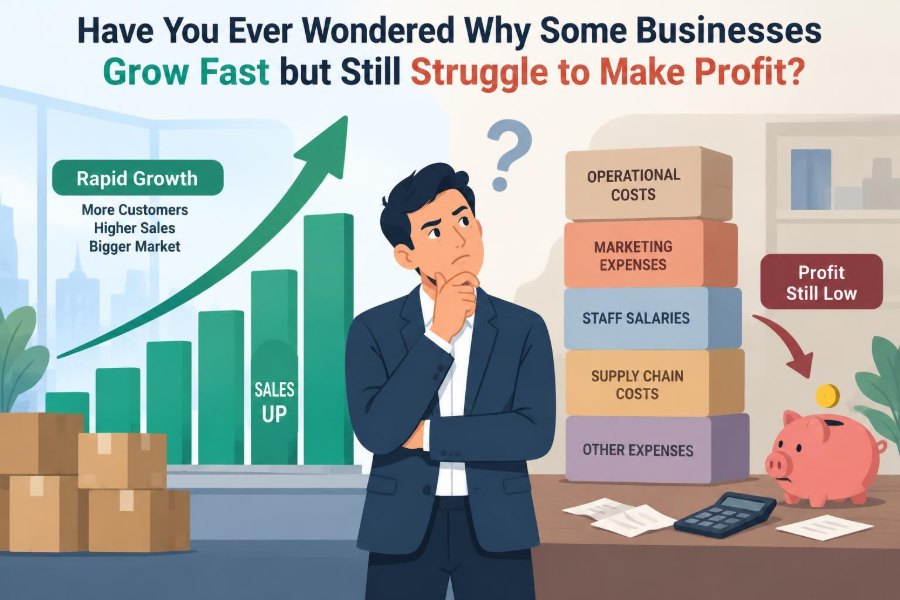

A neighbourhood café opens a second location after queues begin forming at the first. An online retailer doubles its order volume after a successful social-media campaign. A software company adds thousands of users in a few months. From the outside, each business appears to be winning.
Then a less visible story emerges: the owner is delaying supplier payments, the bank balance is shrinking, and the team is working harder without seeing a financial return. Sales are rising, yet the business is not generating enough profit—or enough cash—to feel secure.
This situation is more common than it first appears because growth and profitability are related, but they are not the same thing. A company can expand its customers, sales, staff, locations, or market share while its financial health becomes more fragile.
Understanding the difference helps managers make better decisions about pricing, hiring, marketing, inventory, investment, and speed. It also helps employees and students look beyond impressive growth figures and ask the more useful question: is the business creating sustainable value?
📈 Growth Is Not the Same as Profit
Business growth usually means an increase in something measurable: revenue, units sold, customers, employees, branches, production capacity, or market reach. It describes expansion.
Profit is what remains after a business pays the costs required to earn its revenue. A business may sell more and still lose money if the costs of making, delivering, supporting, and financing those sales rise even faster.
Growth can therefore be a positive signal without being proof of a healthy business model. The key question is not simply, “Are sales increasing?” but “What does each additional sale contribute after its relevant costs?”
🧮 The Basic Profit Equation
At its simplest, profit equals revenue minus expenses. Revenue is the money earned from sales; expenses include wages, materials, rent, marketing, technology, shipping, interest, taxes, and many other operating costs.
A useful distinction is between gross profit, which considers direct costs of providing a product or service, and net profit, which remains after all operating and financing expenses. A firm may have a healthy gross profit but weak net profit because overhead has become too large.
Consider a hypothetical clothing retailer. Selling more jackets raises revenue, but it may also require extra warehouse space, discounted delivery, new customer-service staff, and more advertising. The final result depends on all of those costs, not on sales alone.
🔍 Why Revenue Can Create a False Sense of Security
Revenue is highly visible and easy to celebrate. It appears in sales dashboards, investor presentations, press releases, and monthly targets. It can also increase before the underlying economics are fully understood.
But revenue records activity, not necessarily value. A company that sells a product for less than it costs to supply is becoming busier while deepening its losses.
This does not mean revenue is unimportant. Without sufficient revenue, most businesses cannot survive. It means revenue must be read alongside margins, operating costs, cash flow, customer retention, and the capital needed to support expansion.
💰 Contribution Margin Reveals What Each Sale Adds
Contribution margin is the revenue left after variable costs are deducted. Variable costs rise or fall with sales volume, such as ingredients in a meal, payment-processing fees, packaging, sales commissions, or delivery charges.
That remaining amount contributes first toward fixed costs, such as rent and core salaries, and then toward profit. If contribution per sale is too small, large sales volumes may not be enough to cover the business’s fixed cost base.
Managers should calculate contribution margin by product, customer type, channel, and location where practical. An apparently popular item may be consuming capacity while contributing very little to the business.
🏷️ Low Prices Can Turn Growth Into a Loss Engine
Price reductions can attract customers quickly, especially in crowded markets. They can also make a product difficult to sustain. A discount that brings in twice as many orders is not automatically a success if the margin on every order becomes too thin.
Price competition is especially risky when costs are similar across competitors. If no firm can deliver more efficiently or provide a clear difference in value, lower prices may simply reduce everyone’s profitability.
A lower price can be sensible when it has a defined purpose, such as clearing old stock or attracting customers likely to make profitable repeat purchases. It becomes dangerous when it is used as a permanent substitute for a clear value proposition.
🛒 Discounts and Promotions Need a Full-Cost View
Promotions are often judged by how many orders they generate. A better assessment includes the discount itself, increased fulfilment costs, returns, customer-support demand, marketing spend, and whether buyers return at normal prices.
For example, free delivery may lift conversions but leave the seller carrying most of the delivery bill. A “buy one, get one” offer can move inventory while reducing the average revenue received per unit.
Before launching a promotion, set a clear decision rule: what margin, customer behaviour, or inventory outcome must occur for the campaign to be worthwhile? This turns promotions from hopeful activity into a managed experiment.
📣 Customer Acquisition Can Cost More Than Customers Are Worth
Customer acquisition cost is the spending required to win a new customer, including advertising, sales salaries, promotional offers, and related efforts. It can be reasonable to spend heavily upfront, but only if the relationship produces sufficient future value.
Customer lifetime value is an estimate of the profit a customer may generate over the relationship, not merely the first purchase. The estimate should be treated cautiously because repeat purchase rates, churn, and future margins can change.
A fast-growing company can struggle when it pays generously for every new customer but those customers purchase once, demand extensive support, or leave when discounts end. More acquisition then magnifies the shortfall.
🔁 Retention Often Determines Whether Growth Pays Off
Retention measures whether customers continue buying, renewing, or using a service. It matters because repeat customers may require less marketing expenditure than new ones and can make demand more predictable.
However, retention is not valuable by itself. A retained customer is profitable only when the ongoing revenue exceeds the costs of service, fulfilment, incentives, and support.
Businesses should examine why customers stay and why they leave. Product quality, service reliability, ease of use, trust, and fair pricing usually matter more over time than a one-off acquisition campaign.
🏭 Fixed Costs Can Rise Before Revenue Becomes Reliable
Fixed costs do not change much in the short term with each additional sale. Examples include leases, permanent staff salaries, equipment contracts, insurance, and core software systems.
These costs can be helpful when demand is stable because a larger volume of sales spreads them across more units. But expansion often commits a business to fixed costs before demand has proved durable.
Opening a new site, hiring a full team, or purchasing large equipment can leave a company exposed if sales growth slows. The decision should be based on realistic demand scenarios, not only the strongest recent month.
⚙️ Variable Costs May Rise Faster Than Expected
Managers sometimes assume that producing more will make every unit cheaper. This can happen, but not automatically. Overtime pay, rush shipping, temporary labour, waste, higher supplier prices, and quality failures can push variable costs upward.
A restaurant that rapidly increases delivery orders may need more packaging, third-party platform fees, and additional kitchen labour. Its sales can rise while the cost of serving each order rises too.
Track unit economics regularly rather than assuming last quarter’s cost structure still applies. Rapid change is precisely when old assumptions become least reliable.
📦 Inventory Can Consume Cash Without Creating Profit
Growing businesses often buy more inventory to avoid stockouts or obtain supplier discounts. Inventory is an asset, but it ties up cash until it is sold and collected from the customer.
If products become obsolete, damaged, unfashionable, or slow-moving, their eventual selling price may be lower than expected. Storage, insurance, handling, and markdowns add further pressure.
Good inventory management balances availability against carrying cost. Demand forecasts, reorder points, supplier lead times, and regular reviews of slow-moving stock help prevent growth from becoming a warehouse full of cash that cannot be used.
🚚 Operational Complexity Has a Hidden Price
More products, regions, sales channels, suppliers, and customer segments can create revenue opportunities. They also create complexity: different systems, training needs, compliance requirements, service expectations, and coordination problems.
A business that adds ten products may not need ten times the work, but it often needs more than expected. Errors become harder to diagnose, purchasing becomes less predictable, and managers spend more time resolving exceptions.
Complexity should earn its place. A new channel or product line needs to offer enough strategic or financial value to justify the systems and attention it requires.
👥 Hiring Ahead of Demand Can Weaken Margins
Hiring is frequently necessary for growth, but payroll is a major recurring commitment. Companies sometimes hire based on optimistic forecasts, then discover that sales take longer to arrive or require fewer people than expected.
The issue is not simply headcount. It is whether roles have a clear link to customer value, capacity constraints, revenue generation, quality, or risk control. An expanding management layer can increase cost without solving a real operating problem.
Phased hiring, temporary capacity where appropriate, and clear productivity measures can reduce risk. Yet excessive caution also has costs: under-staffing can damage service, increase turnover, and limit genuinely profitable demand.
🏗️ Scale Economies Are Real—but Not Guaranteed
Economies of scale occur when average cost per unit falls as output rises. Bulk purchasing, fuller use of equipment, specialised roles, and shared central functions can all create this effect.
But scale can also produce diseconomies of scale: slower decisions, more bureaucracy, communication failures, duplicated work, and weaker accountability. Larger organisations are not automatically more efficient.
The practical task is to identify which costs truly improve with volume and which become harder to manage. Growth is financially attractive only when the business can preserve quality and control while gaining efficiency.
📊 A Simple Unit-Economics Check
Unit economics asks whether one unit of business—a product sold, customer served, subscription month, delivery, or project—creates value after its direct and attributable costs. The “unit” should match how the business actually operates.
| Measure | Question it answers | Warning sign |
|---|---|---|
| Revenue per unit | What does one sale bring in? | Revenue falls because discounts become routine. |
| Variable cost per unit | What does it cost to fulfil one sale? | Delivery, labour, or returns rise with volume. |
| Contribution per unit | What remains for fixed costs and profit? | The business needs unrealistic volume to break even. |
| Repeat behaviour | Does the customer return profitably? | Most customers buy only during promotions. |
The calculation is not perfect, particularly where costs are shared, but it is far more useful than relying on sales totals alone.
🧾 Gross Margin Can Fall as Sales Rise
Gross margin is commonly expressed as the share of revenue remaining after direct costs. It can decline during growth for several reasons: a shift toward lower-margin products, greater use of wholesalers, higher material costs, or a growing share of discounted sales.
A company may deliberately accept a lower gross margin to enter a new market or serve a different customer segment. That choice can be strategic, but it should be visible and time-bound rather than accidental.
Review margins by category and channel. Aggregate figures can hide the fact that a fast-growing part of the business is less profitable than the established one.
🏦 Cash Flow Is Different From Profit
Profit is calculated using accounting rules that match revenue and expenses to a period. Cash flow tracks money actually entering and leaving the bank account. A business can report profit and still face a cash shortage.
For instance, a firm may sell to customers on credit, pay suppliers quickly, and invest in inventory before customers settle their invoices. Revenue is recorded, but cash has not yet arrived.
Cash pays wages, suppliers, loans, and taxes. That is why managers must monitor both profitability and cash timing, particularly during fast expansion.
⏱️ Working Capital Can Strain a Growing Company
Working capital broadly concerns short-term operating resources: cash, inventory, amounts owed by customers, and amounts owed to suppliers. Growth often requires more of these resources before it releases more cash.
A construction business, for example, may pay labour and materials throughout a project but receive a large share of payment only after a milestone is approved. Taking on more projects can increase the funding gap.
Improving invoice collection, negotiating sensible supplier terms, managing stock carefully, and forecasting weekly or monthly cash needs can make growth more manageable. These actions do not replace profit, but they can prevent a profitable business from running out of cash.
🤝 Large Customers Can Bring Concentration Risk
Winning a major account can make revenue jump quickly. It can also give one customer substantial influence over price, payment terms, service levels, and production schedules.
If that customer requests extended payment terms or demands bespoke work not fully reflected in the price, headline growth may come with poor cash flow and low margins. Losing the account later can expose how dependent the business became.
Customer concentration is not always avoidable, especially in business-to-business markets. It should be managed through clear contracts, profitability reviews, relationship planning, and a deliberate effort to diversify over time.
🧩 Product Mix Matters More Than Total Sales
Not all revenue is equal. Some products have strong margins, repeat demand, and low support requirements. Others require frequent returns, custom work, complex installation, or costly after-sales service.
Suppose a technology reseller grows by selling more low-margin hardware while its higher-margin support plans remain flat. Total sales can look strong while profitability weakens.
Managers need a product-mix view: which offerings create contribution, which bring customers into the business, and which consume disproportionate resources? A loss-leading product can be justified, but its role should be explicit.
🔄 Channel Growth Can Change the Economics
Direct sales, distributors, marketplaces, physical stores, and subscription platforms each have different economics. A new channel may broaden reach but take a commission, require additional stock, reduce price control, or increase returns.
Channel conflict can also occur. Existing partners may object if the company begins selling directly at a lower price, while direct customers may expect faster service than the company can provide.
Evaluate channel profitability after all channel-specific costs, not just revenue. A channel that seems smaller can be more valuable if it produces better margins, payment terms, or long-term customer relationships.
🧪 Expansion Experiments Need Clear Limits
Growth initiatives involve uncertainty. A pilot in a new city, a new service tier, or a new advertising message can generate useful learning even when it does not immediately make a profit.
The risk is allowing a pilot to become a permanent drain because no one defined success, budget limits, ownership, or a review date. “We are still growing” can become a reason to avoid a difficult decision.
Set hypotheses in advance: who is the target customer, what will it cost to serve them, what result would justify expansion, and what evidence would lead the business to stop or redesign the experiment?
🎯 Fast Growth Can Hide Weak Processes
When demand is rising, operational problems may be disguised by the energy of expansion. Staff improvise, managers solve urgent issues personally, and customers may tolerate inconsistency while the offering is new.
Eventually the volume exposes fragile processes: orders are missed, data is inaccurate, quality varies, and support queues grow. Costs then rise through refunds, rework, staff turnover, and reputational damage.
Standardising essential workflows does not mean removing flexibility from every decision. It means making recurring work reliable enough that growth does not depend on constant rescue efforts.
🧠 Management Metrics Shape Management Behaviour
People tend to focus on what they are measured and rewarded for. If sales teams are rewarded only for new revenue, they may offer discounts, accept difficult customers, or promise service levels that operations cannot provide.
A balanced performance view can include revenue, contribution margin, retention, cash collection, quality, delivery reliability, and customer satisfaction. The right mix differs by business model.
The purpose is not to create a dashboard with dozens of numbers. It is to prevent one appealing metric from driving decisions that weaken the whole business.
🗺️ Forecasting Requires More Than an Optimistic Sales Line
A useful forecast connects expected sales with the costs, people, stock, equipment, and cash required to deliver them. It should include assumptions that managers can challenge rather than presenting a single confident answer.
Scenario planning is particularly helpful. Build a base case, a slower-growth case, and a higher-growth case, then consider what each one means for cash, capacity, and profitability.
This approach does not predict the future perfectly. It prepares leaders to spot when reality is moving away from the plan and to act before commitments become difficult to reverse.
🚦Know the Difference Between Investment and Leakage
Not every unprofitable period is a failure. A business may invest in product development, new equipment, staff capability, market entry, or systems that are expected to improve future returns.
The distinction is whether the spending has a credible strategic rationale, a defined expected benefit, and a way to review progress. Investment is deliberate; leakage is recurring cost with no clear owner, result, or explanation.
Managers should protect worthwhile investment while challenging waste. Cutting every cost can damage the capabilities needed for future profit, just as spending without discipline can exhaust the business.
🛠️ Practical Steps to Improve Profitable Growth
Profitable growth comes from better decisions across the operating model, not one dramatic fix. Start by making the economics visible and assigning responsibility for improvement.
- Calculate contribution margin for major products, customers, and channels.
- Review discounts, returns, delivery costs, and service time alongside sales growth.
- Forecast cash needs before committing to inventory, hiring, or new sites.
- Identify slow-moving inventory and customers with persistently weak margins.
- Test expansion in stages where practical, with clear success and stop criteria.
- Align targets so commercial teams, operations, and finance share responsibility for quality growth.
The exact priorities depend on the business. A subscription service may focus on retention and support costs, while a manufacturer may focus on material yield, capacity use, and payment terms.
⚠️ Common Responses That Make the Problem Worse
When profit disappoints, leaders can make reactive choices that increase the damage. Cutting quality may reduce immediate costs but raise returns and customer loss. Raising prices without understanding customer value may reduce demand without fixing internal inefficiency.
Another common mistake is chasing more volume to “solve” overhead. This only works if additional volume has a positive contribution margin and the business has capacity to serve it efficiently.
Ignoring bad news is equally costly. A declining margin, delayed collections, or growing refund rate is not always a crisis, but it is a signal worth investigating early.
🧑💼 Questions Leaders Should Ask Regularly
Regular, specific questions keep growth grounded in operating reality:
- Which sales are genuinely profitable after direct fulfilment and service costs?
- What has changed in margin, customer behaviour, or cash conversion?
- Where are we adding complexity faster than capability?
- Which investments are producing evidence of progress, and which need redesign?
- Could we meet a demand surge without harming quality or cash flow?
These questions are useful for small owner-managed firms and large organisations alike. The answers will rarely be static, which is why review routines matter.
🌱 Sustainable Growth Is Designed, Not Assumed
The healthiest businesses do not treat profit as something that will automatically appear after enough growth. They design for it through pricing discipline, useful customer propositions, controlled costs, capable operations, sound cash management, and measured investment.
That does not require avoiding risk or expanding slowly in every situation. It requires understanding what growth demands and deciding whether the business can meet those demands without destroying the value it is trying to create.
In practice, sustainable growth is a balancing act: move quickly enough to seize opportunity, but carefully enough to know which opportunities truly strengthen the business.
🧭 The Core Principle: Grow Value, Not Just Volume
Fast growth becomes financially dangerous when a business mistakes activity for progress. More orders, customers, stores, employees, or market attention can all be meaningful, but none is a substitute for positive unit economics and reliable cash flow.
The strongest managerial habit is to connect every growth decision to its full consequences: revenue, direct cost, overhead, working capital, operational capacity, customer experience, and long-term strategic value. This wider view makes it easier to distinguish promising expansion from expensive momentum.
A business becomes stronger not when it sells more at any cost, but when each stage of growth creates more value than it consumes. That is the standard that turns growth into durable profitability. 📊🌱