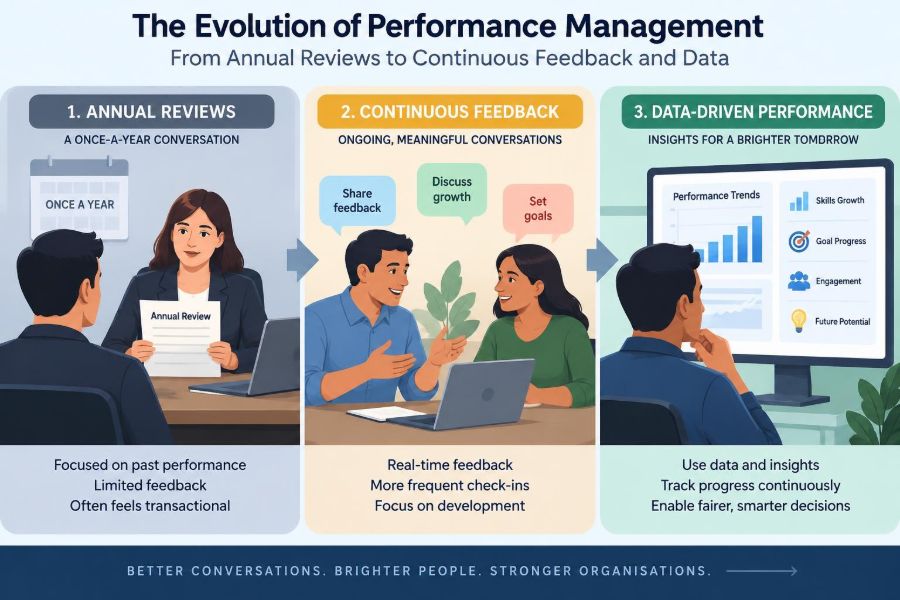

Imagine finishing a demanding project, solving a difficult customer problem, or quietly taking on work that kept your team moving. Months later, your annual review arrives. The details have blurred, your manager is relying on memory and scattered notes, and the conversation feels more like a verdict than a useful discussion.
That experience explains why performance management has changed. Organizations still need a fair way to clarify expectations, develop people, recognize contribution, and make employment decisions. But doing all of that in one annual meeting is rarely sufficient.
Modern performance management increasingly combines regular conversations, clearly defined goals, coaching, and carefully chosen data. The shift is not simply from paper forms to software. It is a change from judging the past once a year to helping people perform, learn, and adapt while the work is happening.
For students entering the workplace and professionals leading teams, understanding this evolution makes performance conversations less mysterious—and makes it easier to use them productively.
🧭 What Performance Management Actually Means
Performance management is the ongoing process of setting expectations, supporting work, reviewing results, and developing capability. It is broader than a performance appraisal, which is one formal assessment within that larger process.
A sound system connects individual work to team priorities. It should answer practical questions: What does good performance look like? What resources are needed? What is improving? What needs to change?
📜 The Traditional Annual Review Model
For much of modern organizational life, performance management centered on an annual appraisal. An employee and manager discussed the previous year, assigned ratings, recorded comments, and often linked the outcome to pay, promotion, or bonus decisions.
This approach offered administrative order. Leaders could compare employees at a common point in time, keep records, and meet internal policy requirements. Its weakness was not that formal review is inherently wrong; it was that a single event was expected to serve too many purposes.
⏳ Why Once-a-Year Feedback Falls Short
Feedback loses usefulness when it arrives long after the behavior or result. If a presentation in March needed a clearer recommendation, discussing it the following January gives the employee little chance to improve on the next presentation.
Annual cycles also struggle in workplaces where priorities shift quickly. A goal set twelve months ago may no longer reflect customer needs, technology changes, or a new team strategy.
🧠 The Recency and Memory Problem
People naturally remember recent events more clearly than earlier ones. This recency bias can cause a strong final quarter—or one visible mistake—to overshadow a much broader pattern of contribution.
Managers are not immune to limited recall, especially when supervising several people. A better process captures short notes, examples, and outcomes throughout the period rather than asking anyone to reconstruct a year from memory.
⚖️ When Ratings Became the Main Event
Ratings can simplify some decisions, particularly when an organization must allocate limited rewards. Yet they can also dominate the conversation. Employees may focus on defending a label instead of examining what would help them do better work.
A rating does not explain performance by itself. “Meets expectations” may be reasonable as an administrative outcome, but it is not coaching until the manager can describe the expectations, evidence, strengths, and next steps behind it.
🔄 The Move Toward Continuous Performance Management
Continuous performance management replaces the idea of feedback as a yearly event with a regular rhythm of goal review, check-ins, recognition, coaching, and adjustment. It does not require constant surveillance or daily scoring.
The central principle is timely conversation. A manager and employee revisit priorities often enough to correct course before a small gap becomes a major problem.
💬 What a Useful Check-In Looks Like
A check-in can be brief, but it should be purposeful. It is a two-way conversation, not a manager’s status interrogation. The employee should be able to raise obstacles, request decisions, and discuss workload as openly as progress.
- What outcomes matter most before the next conversation?
- What progress or evidence is available so far?
- What is getting in the way?
- What support, feedback, or decision is needed?
- What should change in the plan?
Weekly, biweekly, monthly, or project-based rhythms can all work. The right frequency depends on the pace and interdependence of the work.
🎯 Starting With Clear Expectations
Feedback cannot be fair when expectations are vague. “Be more strategic” or “show ownership” may sound meaningful, but employees need observable descriptions of what those ideas mean in their role.
For example, a strategic project coordinator might identify dependencies early, explain trade-offs to stakeholders, and connect milestones to a wider business objective. This gives both parties something concrete to discuss.
🗺️ Goals That Can Survive Change
Goals provide direction, but rigid goals can become counterproductive when circumstances change. A useful goal states the intended outcome, the relevant measure or evidence, the time horizon, and the boundaries of responsibility.
Suppose a support team aims to reduce repeat customer contacts. If a product defect drives those contacts, the goal should prompt collaboration with product and engineering rather than pressure agents to close cases prematurely.
📏 Outputs, Outcomes, and Behaviors
Good performance management distinguishes among three related forms of evidence. Outputs are things produced, such as reports, designs, or completed calls. Outcomes are the effects of that work, such as fewer errors or improved customer retention. Behaviors describe how the work was done.
| Evidence type | Example | Why it matters |
|---|---|---|
| Output | Delivered a project plan | Shows completion of a tangible responsibility |
| Outcome | Reduced delays between teams | Shows the value created by the work |
| Behavior | Raised risks early and involved affected colleagues | Shows repeatable ways of working |
Looking at all three reduces the risk of rewarding activity alone or ignoring damaging conduct behind strong short-term numbers.
🪞 Feedback Is Not the Same as Evaluation
Feedback is information intended to help someone understand the effect of their actions and improve. Evaluation is a judgment against an agreed standard, often used for a formal decision. Both have a place, but combining them carelessly can make feedback feel unsafe.
During a coaching conversation, a manager might say, “The client understood the analysis, but the recommendation was buried at the end.” That is specific feedback. A formal evaluation may later assess whether client communication met the role standard.
🔎 Make Feedback Specific and Usable
General praise such as “great job” feels positive but teaches little. General criticism such as “communicate better” can leave a person guessing. Useful feedback identifies a situation, an observable action, and its effect.
For instance: “In yesterday’s handover, you summarized unresolved risks before assigning tasks. That helped the next shift prioritize correctly.” The person can understand what to repeat without treating the statement as a personality judgment.
🧑🏫 Coaching Builds Capability
Coaching differs from simply giving instructions. It uses questions, reflection, practice, and support to help someone build judgment. This is especially valuable when the employee has the capability to solve a problem but needs space to think through options.
A manager might ask, “Which stakeholder is most affected by this delay, and what information do they need first?” In urgent or high-risk situations, direct instruction may be more appropriate. Effective managers know when each approach fits.
🤝 The Employee’s Active Role
Continuous management is not something done only to employees. Individuals can keep a record of outcomes, ask for feedback soon after important work, clarify priorities, and flag constraints before deadlines are missed.
This is not self-promotion for its own sake. It creates better evidence and reduces surprises. A short running record of projects, lessons learned, customer comments, and measurable contributions can make formal reviews more accurate.
👥 The Manager’s Role Is Ongoing
Managers shape the quality of the system through attention, follow-through, and fairness. A platform cannot compensate for a manager who cancels every check-in, gives only vague comments, or notices performance only when something goes wrong.
Managers also need to remove barriers. When a goal is missed because another department withheld needed data, the performance conversation should address coordination and resources, not merely individual effort.
🌐 Peer Feedback Adds a Wider View
Many roles depend on people outside the direct reporting line. Peer, project, or stakeholder feedback can reveal collaboration patterns a manager cannot personally observe.
However, broader input needs structure. Asking contributors to comment on agreed behaviors or specific projects is more useful than inviting unbounded opinions. Anonymous feedback may encourage honesty in some settings, but it can also produce vague or unaccountable criticism if poorly designed.
📊 Why Data Entered Performance Conversations
Digital systems make it easier to track goals, projects, customer outcomes, learning activity, and operational measures. Properly used, data can make conversations more evidence-based and reveal patterns that memory alone misses.
For example, a sales dashboard may show conversion patterns, while project records may show delivery reliability. Neither tells the whole story, but each can prompt better questions.
🧮 Metrics Need Context Before Meaning
A metric is a measurement, not a complete explanation. High output may reflect skill, favorable assignments, automation, or unsustainable overtime. Low output may indicate poor process design, new-role learning, difficult cases, or an unclear target.
Before drawing a conclusion, ask what the metric measures, what it leaves out, and whether the employee had reasonable control over it. Context converts data from a blunt instrument into useful evidence.
🚦Leading and Lagging Indicators
Lagging indicators show results after the fact, such as completed revenue, defect rates, or customer renewals. Leading indicators suggest whether future results are becoming more likely, such as timely follow-up, quality checks, or progress through key milestones.
A balanced view uses both. If a team waits only for a late outcome measure, there may be little time to intervene. Leading indicators support earlier coaching without pretending they guarantee success.
🧩 Avoiding the “Measure Everything” Trap
Because work systems generate abundant data, organizations can be tempted to track every available activity. This creates noise, encourages performative behavior, and can make employees feel monitored rather than trusted.
Select a small number of measures connected to real value. If a measure changes behavior in an undesirable way—such as rewarding fast call handling while harming customer resolution—it needs redesign or balancing measures.
🔐 Privacy, Consent, and Data Boundaries
Performance data can be sensitive. Organizations should be clear about what they collect, why it is needed, who can access it, how long it is retained, and how employees can question inaccuracies.
Legal requirements vary by location and sector, so organizations should seek appropriate professional guidance when designing monitoring or analytics practices. Even where collection is permitted, ethical use requires restraint, relevance, and proportionality.
⚙️ Algorithms Can Support, Not Replace, Judgment
Analytical tools can identify trends, organize evidence, or flag patterns worth reviewing. They should not be treated as neutral decision-makers. A model reflects its data, definitions, and design choices, which may contain gaps or historical bias.
Human review remains essential, particularly when a result could affect pay, promotion, discipline, or employment. People need a meaningful opportunity to understand and challenge evidence used about them.
⚖️ Fairness Requires Calibration
Calibration is a structured discussion in which managers compare how they apply standards across employees and teams. Its purpose is to improve consistency, not to force people into a predetermined ranking.
Useful calibration asks for evidence, examines whether standards are comparable, and checks whether certain kinds of work are being overlooked. It should also recognize that roles, territories, projects, and available resources may differ substantially.
🧱 The Risk of Forced Rankings
Forced ranking systems require managers to place a fixed proportion of employees into performance categories. They may create apparent differentiation, but they can be unfair when a team is uniformly strong, when roles are not comparable, or when collaboration is essential.
Such systems can encourage competition for visibility rather than shared success. If an organization uses comparative judgments, it should be especially careful not to substitute relative position for evidence against role expectations.
🌱 Development Should Not Wait for a Problem
Performance discussions are more valuable when they include growth, not only correction. Development may involve stretch assignments, mentoring, targeted practice, exposure to a new stakeholder group, or formal learning.
Development plans work best when tied to future work. Telling an analyst to “improve influence” is less useful than arranging for them to present a recommendation, gather feedback afterward, and refine their approach on the next project.
🏆 Recognition Reinforces the Right Work
Recognition is not merely a morale gesture. Timely acknowledgment shows which contributions the organization values. It is strongest when it names the behavior or result rather than offering generic applause.
Recognition should also be distributed thoughtfully. Highly visible work is easier to notice than behind-the-scenes coordination, documentation, mentoring, or risk prevention. A manager who looks only for dramatic wins may unintentionally narrow what people believe counts.
🛠️ Technology Should Reduce Friction
Performance management software can centralize goals, check-in notes, feedback requests, and development plans. Its best role is to make good practices easier, not to turn conversations into a compliance exercise full of mandatory fields.
Choose tools around the workflow. A small team may need a shared goal document and regular conversations; a larger organization may need integrated systems and access controls. In either case, the quality of discussion matters more than the sophistication of the interface.
🚫 Common Implementation Mistakes
Organizations often announce continuous feedback but retain an annual mindset. Employees are asked to log frequent updates while managers receive little training, goals remain unclear, and compensation decisions still arrive as surprises.
- Collecting feedback without acting on recurring issues
- Confusing activity tracking with performance evidence
- Making check-ins scripted and administrative
- Using one metric for complex, interdependent work
- Giving managers responsibility without time or support
- Separating values statements from actual reward decisions
These mistakes reduce trust because they add process without adding clarity, development, or fairness.
🧪 A Practical Transition Plan
A transition does not require eliminating every formal review overnight. Start by identifying the moments where employees and managers currently lack information: unclear priorities, delayed feedback, inconsistent standards, or weak development follow-through.
- Define role expectations and a manageable set of goals.
- Introduce a regular check-in rhythm suited to the work.
- Train managers to give specific feedback and coach effectively.
- Collect simple evidence during the cycle, including employee input.
- Use calibration for consequential decisions.
- Review the process and remove steps that do not improve decisions or development.
Piloting the approach with one function or team can expose practical issues before wider adoption.
🏠 Adapting the System for Remote and Hybrid Work
When people work across locations, managers have fewer informal observations. That makes clear outcomes, documented decisions, and intentional check-ins more important. It does not justify measuring keyboard activity or online presence as a shortcut for contribution.
Remote teams benefit from agreements about response times, meeting norms, handovers, and visibility of work. Performance should focus on agreed results, collaboration quality, and responsible execution rather than mere digital availability.
🗣️ Preparing for Your Next Performance Conversation
Employees can make the conversation more productive by bringing evidence, questions, and a proposed focus. Consider what you delivered, what impact it had, where you encountered constraints, and what capability would make the biggest difference next.
Managers should prepare examples rather than relying on impressions. Both parties should leave with a shared understanding of priorities, support needed, and the next point at which progress will be reviewed.
🌟 The Core Principle: Performance Is a Shared Process
The evolution from annual reviews to continuous feedback and data is not a rejection of accountability. It is an effort to make accountability more timely, informed, and developmental. Formal decisions may still require documented assessments, but those decisions should grow from an ongoing record rather than a last-minute recollection.
The strongest systems combine clear expectations, frequent human conversation, relevant evidence, fair judgment, and practical support. Data adds discipline; coaching adds learning; regular dialogue keeps both connected to the real work.
Performance management works best when it helps people understand what matters, improve while there is still time to act, and contribute to goals they can clearly see. 📊🤝🌱