
The business world changes constantly. New technologies emerge, customer expectations shift, regulations evolve, competitors appear, and economic conditions can change with little warning. A company that performs well today can quickly lose its advantage if it fails to adapt.
That is why many organizations focus on becoming future-proof.
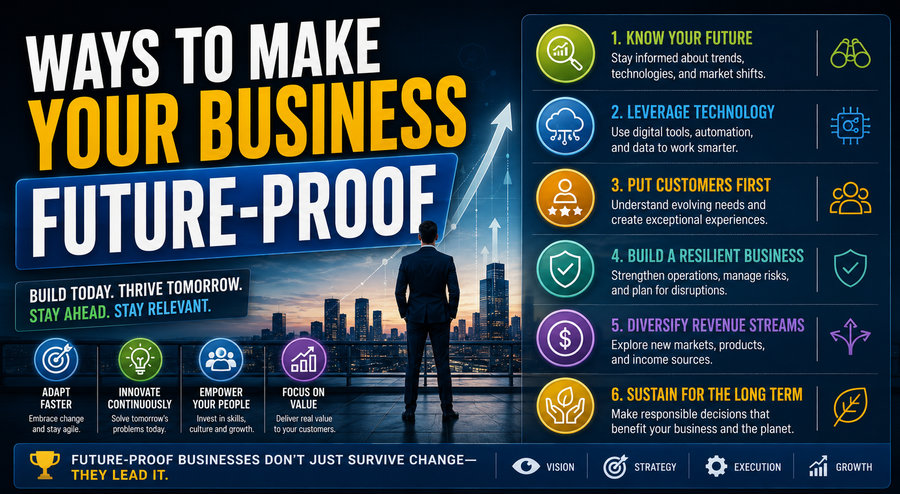
A future-proof business is not one that can predict every technological breakthrough, market disruption, or economic crisis. That would be impossible. Instead, it is a company designed to adapt quickly, learn continuously, manage risks, and take advantage of new opportunities. 📈🧠
Future-proofing requires more than buying new software or launching an artificial intelligence project. It involves strategy, people, technology, finances, customer relationships, operations, cybersecurity, and organizational culture.
Here are some of the most important ways businesses can prepare themselves for an uncertain future.
🔭 1. Continuously Monitor Market Trends
Businesses can become vulnerable when they assume that today’s market will remain unchanged.
Customer preferences may shift because of:
- New technology
- Economic conditions
- Demographic changes
- Environmental concerns
- Social trends
- New competitors
Organizations should therefore regularly monitor their industries.
This can include:
📊 Competitor analysis
📰 Industry research
🧑🤝🧑 Customer surveys
🌍 Economic trends
📱 Social-media behavior
🔬 Emerging technologies
The goal is not to react to every trend.
Instead, companies should identify changes that could significantly affect customer behavior or business economics.
Early awareness gives management more time to respond.
🧠 2. Build a Culture of Adaptability
Technology can be purchased.
Adaptability is harder to buy.
A company can have excellent technology and still struggle if employees are afraid of change or if management refuses to reconsider old practices.
Future-ready organizations encourage employees to:
✅ Experiment
✅ Learn new skills
✅ Question inefficient processes
✅ Share ideas
✅ Learn from failure
Managers should also distinguish between productive experimentation and careless risk-taking.
Not every experiment will succeed.
The objective is to test promising ideas at manageable cost, learn from the results, and scale what works.
A culture that learns quickly can often respond to disruption faster than one controlled by rigid procedures.
💻 3. Invest in Digital Transformation
Digital transformation means using technology to improve how a business operates and delivers value.
It can involve:
☁️ Cloud computing
🤖 Artificial intelligence
📊 Data analytics
⚙️ Automation
📱 Mobile applications
🛒 E-commerce
🔗 Integrated business systems
For example, a manufacturer might use sensors to monitor equipment and predict maintenance needs.
A retailer might use analytics to improve inventory planning.
A professional-services company might automate repetitive administrative work.
Digital transformation should solve genuine business problems.
Buying technology merely because it is fashionable can increase costs without delivering meaningful benefits.
🤖 4. Use Artificial Intelligence Strategically
Artificial intelligence is becoming an increasingly important business tool.
Organizations can use AI to support tasks such as:
- Customer-service assistance
- Document processing
- Data analysis
- Forecasting
- Software development
- Marketing personalization
- Fraud detection
However, successful AI adoption requires more than giving employees access to an AI tool.
Businesses should consider:
🔐 Data privacy
🎯 Accuracy
⚖️ Legal and ethical responsibilities
👤 Human oversight
📊 Measurable business value
AI works best when it complements human expertise.
For example, an AI system might analyze thousands of customer interactions to identify patterns, while a human manager decides how those insights should influence strategy.
📊 5. Become a Data-Driven Organization
Future-proof businesses make important decisions using evidence rather than relying entirely on intuition.
Companies should collect and analyze information about:
💰 Revenue
👥 Customers
📦 Inventory
📈 Sales trends
🚚 Supply chains
⚙️ Operations
📣 Marketing
The purpose is not to collect as much data as possible.
Organizations need reliable, useful, and well-governed data.
Poor-quality information can produce poor-quality decisions.
Businesses should therefore establish clear processes for data accuracy, ownership, security, and accessibility.
👥 6. Invest in Employee Skills
Technology changes job requirements.
Some tasks disappear while new responsibilities emerge.
Future-proof companies continuously develop their workforce through:
🎓 Training
📚 Professional education
🧑🏫 Mentoring
💻 Digital-skills programs
🔄 Cross-functional experience
Important future-oriented skills may include:
- Data literacy
- AI literacy
- Cybersecurity awareness
- Problem-solving
- Communication
- Critical thinking
- Project management
Companies that neglect employee development may eventually have modern technology but lack the people capable of using it effectively.
🔐 7. Strengthen Cybersecurity
As businesses become more digital, cybersecurity becomes a strategic issue rather than merely an IT responsibility.
Cyberattacks can cause:
💰 Financial losses
📉 Business interruption
🔓 Data theft
⚖️ Regulatory problems
🤝 Loss of customer trust
Businesses should maintain basic protections such as:
🔑 Multi-factor authentication
💾 Reliable backups
🔄 Security updates
🛡️ Endpoint protection
📧 Phishing awareness
👤 Access controls
Cybersecurity planning should also include incident response.
A company needs to know what it will do if critical systems become unavailable or sensitive information is compromised.
Resilience requires preparing for failure rather than assuming attacks will never happen.
☁️ 8. Build Flexible Technology Infrastructure
Older technology systems can make business change extremely difficult.
A company might want to launch a new digital service but discover that its outdated software cannot integrate with modern platforms.
Flexible technology architecture can make adaptation easier.
Businesses may benefit from:
☁️ Cloud services
🔗 APIs
🧩 Modular systems
⚙️ Automation platforms
📦 Scalable infrastructure
The goal is to avoid becoming trapped by systems that are expensive or impossible to change.
However, moving everything to the cloud is not automatically the correct strategy.
Technology choices should consider performance, security, regulation, cost, and operational needs.
🤝 9. Understand Your Customers Deeply
Products can become outdated.
Customer relationships are often more durable.
Future-ready organizations continuously study:
🧑 Customer needs
💬 Feedback
🛒 Purchasing behavior
📱 Digital interactions
😕 Complaints
A company that understands the underlying problem customers are trying to solve can adapt its products as technology changes.
For example, customers usually do not want a specific technical feature merely because it exists.
They may want:
⏱️ Convenience
💰 Lower cost
✨ Better quality
📱 Simpler experiences
Understanding these deeper needs helps businesses innovate more effectively.
🧩 10. Diversify Revenue Streams
Depending entirely on one product, customer, market, or sales channel can create significant risk.
If that area experiences disruption, the entire organization may suffer.
Businesses can improve resilience by developing additional sources of revenue.
Examples include:
- New products
- New geographic markets
- Subscription services
- Digital services
- Partnerships
- Different customer segments
Diversification should still make strategic sense.
Expanding into unrelated areas simply for the sake of diversification can create unnecessary complexity.
💰 11. Maintain Financial Resilience
Future-proof businesses need enough financial flexibility to survive difficult periods.
Companies with extremely high debt, limited cash reserves, and thin margins may struggle when revenue temporarily falls.
Financial resilience can include:
💵 Cash reserves
📉 Controlled debt
📊 Scenario planning
💰 Diverse revenue
📋 Disciplined budgeting
Management should regularly ask questions such as:
What happens if sales fall by 20%?
What happens if borrowing costs rise?
What happens if a major customer leaves?
Scenario planning helps organizations identify vulnerabilities before a crisis occurs.
🚚 12. Create a Resilient Supply Chain
Modern supply chains can be highly interconnected.
A company may depend on components produced thousands of kilometers away.
Disruptions can result from:
🌪️ Natural disasters
⚔️ Geopolitical tensions
🚢 Transportation problems
🏭 Factory shutdowns
📈 Commodity shortages
Businesses can improve resilience by:
- Identifying critical suppliers
- Maintaining alternative suppliers
- Monitoring inventory risks
- Diversifying geographic sourcing
- Improving supplier visibility
The cheapest supply chain is not always the most resilient one.
Sometimes additional redundancy is worth the cost.
🧪 13. Innovate Continuously
Companies often become vulnerable when they rely too heavily on one successful product.
Markets eventually change.
Future-ready organizations maintain an innovation pipeline.
Innovation does not always mean inventing revolutionary technology.
It can involve:
🛠️ Improving products
⚙️ Redesigning processes
💼 Changing business models
📱 Creating digital services
📦 Improving delivery
Small continuous improvements can be just as important as major breakthroughs.
📱 14. Build an Omnichannel Presence
Customers increasingly interact with companies through multiple channels.
These may include:
🏪 Physical stores
🌐 Websites
📱 Mobile apps
📧 Email
💬 Messaging
📣 Social media
Future-proof companies try to create a consistent experience across these channels.
For example, a customer might research a product on a phone, purchase it online, and collect it from a physical store.
Connecting these experiences can improve customer convenience and strengthen loyalty.
🌱 15. Prepare for Sustainability Requirements
Environmental expectations are influencing business strategy.
Customers, investors, regulators, and corporate buyers increasingly examine issues such as:
🌍 Carbon emissions
♻️ Waste reduction
⚡ Energy efficiency
💧 Water use
📦 Packaging
Sustainability can also reduce costs.
For example, improving energy efficiency may lower both environmental impact and operating expenses.
Companies should evaluate how climate-related risks and changing regulations could affect their operations and supply chains.
⚖️ 16. Monitor Regulatory Change
Future-proof businesses must also anticipate changes in regulation.
Areas experiencing rapid regulatory development can include:
🔐 Data privacy
🤖 Artificial intelligence
🌱 Environmental reporting
💰 Financial regulation
🛡️ Cybersecurity
Ignoring new rules can lead to fines, operational disruption, and reputational damage.
Businesses should integrate regulatory monitoring into strategic planning rather than waiting until regulations become urgent.
🔗 17. Build Strategic Partnerships
No company needs to develop every capability internally.
Partnerships can provide access to:
🧠 Expertise
🌍 New markets
💻 Technology
🚚 Distribution
🔬 Research
For example, a traditional manufacturer may partner with a technology company to develop connected products.
A small business may partner with a logistics provider to reach international customers.
Strong partnerships can accelerate innovation while reducing development cost.
🧱 18. Avoid Overdependence on One Technology Provider
Cloud services and software platforms can create enormous efficiency.
However, excessive dependence on one provider can create vendor lock-in.
If pricing changes or a service is discontinued, switching may become difficult.
Businesses should understand:
- Data portability
- Contract terms
- Integration requirements
- Exit options
- Alternative platforms
This does not mean avoiding large providers.
It means understanding dependency risk and maintaining a practical contingency plan.
🚨 19. Develop Business Continuity Plans
Unexpected events will occur.
Businesses should prepare for scenarios such as:
🔥 Facility damage
💻 Cyberattack
⚡ Power failure
🌪️ Natural disaster
📡 Network outage
🚚 Supply disruption
A business continuity plan explains how critical operations will continue during disruption.
It may include:
- Backup locations
- Remote-work arrangements
- Emergency contacts
- Data backups
- Alternative suppliers
- Communication procedures
Plans should be tested periodically.
A continuity document that nobody has practiced may fail when it is actually needed.
🧠 20. Encourage Decentralized Decision-Making
Organizations can become slow when every decision requires approval from senior management.
Future-ready companies often give teams clear responsibilities and enough authority to solve problems quickly.
This can improve:
⚡ Speed
💡 Innovation
👥 Accountability
However, decentralization requires strong goals and clear boundaries.
Employees need to understand which decisions they can make independently and which decisions require escalation.
📈 21. Measure What Matters
Businesses collect enormous quantities of metrics.
But not every metric helps management make better decisions.
Future-proof organizations identify key performance indicators connected directly to strategic goals.
Examples might include:
💰 Profit margins
👥 Customer retention
⏱️ Delivery times
📦 Inventory turnover
😊 Customer satisfaction
🔐 Security incidents
Metrics should help leaders identify problems and opportunities.
They should not become targets that encourage employees to manipulate numbers instead of improving actual performance.
🛒 22. Improve Customer Retention
Acquiring new customers can be expensive.
Keeping existing customers satisfied can provide a more stable foundation for long-term growth.
Businesses can improve retention through:
🤝 Reliable service
🎯 Personalized experiences
💬 Responsive support
✨ Product quality
🎁 Loyalty programs
Customer loyalty also provides resilience during economic uncertainty.
People who trust a company may be more likely to continue purchasing even when competitors offer aggressive promotions.
🌍 23. Think Globally, Even If You Operate Locally
Even small businesses can be affected by global events.
Exchange rates, international supply chains, technology platforms, trade restrictions, and global competitors can influence local markets.
Leaders should therefore understand how international developments may affect:
📦 Costs
💰 Pricing
🚚 Suppliers
👥 Customers
A local company does not need to become multinational, but it should understand the global forces shaping its environment.
🤖 24. Automate Repetitive Work
Automation can reduce time spent on repetitive administrative activities.
Examples include:
📧 Routine email workflows
🧾 Invoice processing
📊 Report generation
📦 Inventory updates
🛠️ Manufacturing tasks
Automation can improve consistency and free employees to focus on activities requiring judgment, creativity, and customer interaction.
However, organizations should avoid automating inefficient processes without first improving them.
Automating a bad process simply makes the bad process operate faster.
🧭 25. Build a Clear Long-Term Strategy
Finally, future-proofing requires direction.
A company that constantly reacts to every trend can lose focus.
Leadership should define:
🎯 Where the company wants to compete
👥 Which customers it wants to serve
✨ What makes it different
💰 How it creates value
📈 Which capabilities it needs
A good strategy should provide direction while remaining flexible enough to change when assumptions prove incorrect.
Future-proofing is therefore a balance between stability and adaptability.
🧩 A Practical Future-Proof Business Framework
A simple way to think about future readiness is to divide it into six areas:
🧠 People
Develop adaptable employees and leaders.
💻 Technology
Maintain flexible, secure, scalable systems.
💰 Finance
Build enough financial resilience to survive disruption.
👥 Customers
Understand changing expectations.
⚙️ Operations
Create efficient and resilient processes.
🔭 Strategy
Continuously monitor the environment and adjust priorities.
Weakness in any one area can limit the organization’s ability to respond to change.
🚫 Common Future-Proofing Mistakes
Businesses sometimes misunderstand what future-proofing means.
❌ Chasing Every New Technology
Not every trend deserves investment.
❌ Ignoring Core Customers
Innovation should not destroy the experience of profitable existing customers.
❌ Cutting Training Budgets
Technology investment without workforce development produces limited results.
❌ Depending on a Single Supplier
Low cost can hide significant operational risk.
❌ Failing to Prepare for Cyber Incidents
Digital growth increases security exposure.
❌ Planning Only for Growth
Businesses should also prepare for recessions, disruptions, and unexpected declines.
Effective future-proofing considers both opportunity and risk.
🔮 The Future-Proof Business Mindset
Perhaps the most important characteristic of a future-proof company is not technology or capital.
It is mindset.
Organizations need to become comfortable with the idea that assumptions will change.
A business model that worked for ten years may eventually need redesign.
A successful product may become obsolete.
A new competitor may enter the market.
Future-ready businesses detect these changes early and respond without abandoning their core purpose.
They continuously ask:
What is changing?
What does it mean for our customers?
Which risks are increasing?
Which capabilities will we need next?
These questions help organizations remain proactive rather than waiting for disruption to force change.
🏁 Final Thoughts
No business can guarantee that it will remain successful forever.
Technology, consumer behavior, economic conditions, regulation, and competition are simply too unpredictable.
But companies can significantly improve their chances of long-term survival by becoming more adaptive, financially resilient, technologically capable, customer-focused, secure, and innovative. 🚀🏢
Future-proofing does not require predicting the future perfectly.
It requires creating an organization that can respond effectively when the future arrives.
That means investing in employees, modernizing technology, strengthening cybersecurity, diversifying risk, monitoring customer needs, improving supply-chain resilience, and maintaining enough financial flexibility to navigate uncertainty.
The businesses most likely to succeed over the next decade may not be the ones that correctly predict every trend.
They will be the ones capable of learning faster, adapting earlier, and executing change more effectively than their competitors. 🔮📈🧠