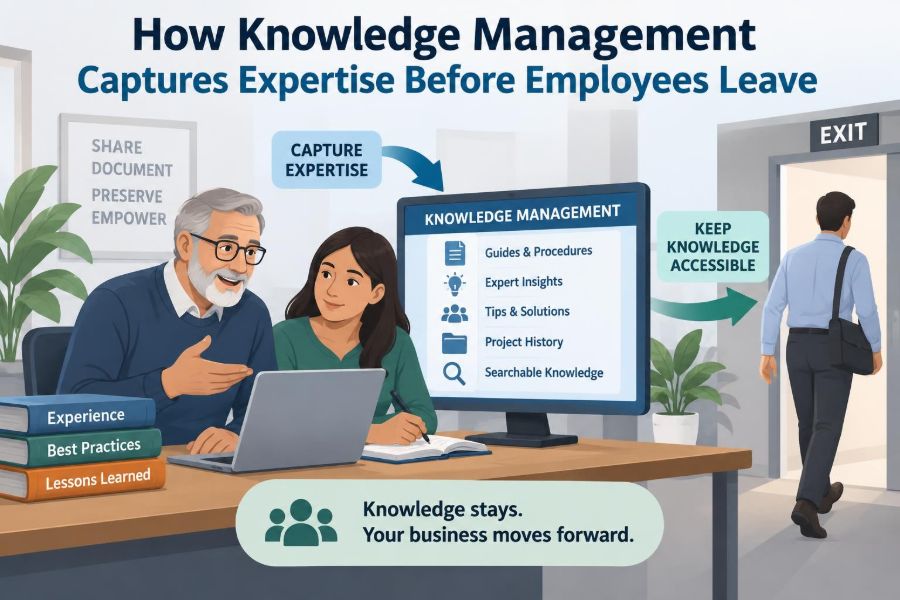

A long-serving operations manager gives notice. Her final weeks are filled with handovers, farewell meetings, and urgent questions from colleagues: Which supplier can solve a recurring defect? Why does the monthly report need three manual checks? What happens when a key customer makes an unusual request?
Some answers sit in folders, spreadsheets, and ticketing systems. Many more sit in her judgement: patterns she has noticed, workarounds she has tested, relationships she has built, and warnings she has learned to recognise.
When that knowledge leaves with the employee, the organisation does not merely lose a person. It can lose speed, consistency, confidence, customer trust, and the ability to make good decisions under pressure.
Knowledge management gives organisations a practical way to identify, capture, organise, share, and reuse expertise before a departure turns into an avoidable disruption. It is not about extracting every thought from employees; it is about preserving the knowledge that helps people do meaningful work well. 🧩
🧠 1. What knowledge management actually means
Knowledge management is the deliberate process of making useful organisational knowledge available to the people who need it. It combines people, working practices, technology, and governance.
Its purpose is not to create a giant archive. Its purpose is to help employees find reliable guidance, learn from experience, and apply expertise at the point of work.
- Capture important know-how before it disappears.
- Organise it so others can locate and understand it.
- Transfer it through conversations, practice, and mentoring.
- Maintain it as processes, tools, and risks change.
🚪 2. Why departures expose hidden organisational risk
Employee exits reveal how much a business depends on individual memory. A process may appear documented until a new employee tries to perform it without the former expert nearby.
This risk arises during retirement, resignation, promotion, internal transfer, parental leave, long-term absence, restructuring, and contractor turnover. The issue is continuity, not the reason a person leaves.
Teams are especially vulnerable when one person is the informal “go-to” expert for exceptions, historical decisions, or difficult systems.
🗂️ 3. Separate explicit knowledge from tacit knowledge
Explicit knowledge can be written, stored, and transmitted relatively easily. Examples include policies, process maps, checklists, product specifications, templates, and recorded training sessions.
Tacit knowledge is harder to express. It includes judgement, instincts, practical skill, awareness of context, and an understanding of what usually goes wrong.
A useful knowledge-management programme addresses both. Saving documents is necessary, but it rarely captures the reasoning that experienced employees use in real situations.
🔍 4. Find the expertise that matters most
Not every piece of knowledge deserves the same capture effort. Start by identifying knowledge that would create serious operational, financial, regulatory, customer, or safety problems if it became unavailable.
Managers should avoid assuming that job title alone indicates risk. A junior analyst may be the only person who understands a fragile reporting script, while a senior leader may hold crucial relationship history.
Questions that reveal priority knowledge
- What work would slow down or stop if this person were unavailable tomorrow?
- Which decisions depend heavily on their judgement?
- What recurring exceptions do they solve that others cannot?
- Which customers, partners, systems, or controls rely on their personal knowledge?
- What mistakes are new employees most likely to make without their guidance?
⚖️ 5. Assess knowledge-loss risk systematically
A simple risk assessment makes the work manageable. Consider the knowledge’s business impact, how unique it is, how often it is used, how difficult it is to learn, and whether a credible backup already exists.
| Risk factor | Lower-risk condition | Higher-risk condition |
|---|---|---|
| Uniqueness | Several people can perform the work | One person holds key know-how |
| Documentation | Current guidance is clear and tested | Guidance is missing, outdated, or unclear |
| Consequence | Delays are minor and recoverable | Failure affects customers, controls, or safety |
| Learning time | A replacement can learn quickly | Competence develops through lengthy experience |
| Change rate | Knowledge is stable | Rules, systems, or conditions change often |
The assessment does not need false precision. Its value lies in helping leaders direct limited time toward the most consequential knowledge.
🧭 6. Begin before anyone announces an exit
The strongest approach is continuous knowledge management, not a rushed response during notice periods. By the time an employee resigns, calendars are crowded and attention is divided.
Build capture and sharing into normal work: project closeouts, role changes, process reviews, onboarding, team meetings, and succession planning. Then a departure becomes a managed transition rather than a knowledge emergency.
Regular habits also reduce the uncomfortable impression that the organisation only values an employee’s insight when they are leaving.
🤝 7. Build trust before requesting a handover
Employees may worry that documenting their expertise makes them less valuable, exposes past shortcuts, or shifts unreasonable work onto them. A knowledge-capture request will fail if it feels extractive or punitive.
Leaders should explain the purpose clearly: reduce risk, support colleagues, recognise contribution, and make work more sustainable. They should provide time, tools, and visible appreciation.
Respect matters particularly when an employee’s expertise was gained through years of difficult experience. The task is to preserve their contribution, not to treat their judgement as a commodity.
🎯 8. Define a focused capture plan
A handover plan should name the critical knowledge areas, the intended audience, the capture method, the owner, and the completion date. Broad instructions such as “document everything” encourage overload and vague output.
Use a short priority list. For each item, specify what a capable colleague must be able to do after the expert leaves.
- Complete a recurring task independently.
- Recognise and escalate a high-risk exception.
- Locate authoritative records and tools.
- Explain why a control or decision rule exists.
- Maintain a key relationship appropriately.
🎤 9. Use structured knowledge interviews
Interviews are one of the best ways to surface tacit knowledge. Rather than asking, “What do you know?”, ask the expert to walk through recent, realistic situations.
Good interviewers listen for decisions, cues, exceptions, dependencies, and trade-offs. They then turn those insights into clear guidance that others can review.
Prompts that produce useful detail
- Talk me through the last time this process did not go as planned.
- What signals tell you that a case needs extra attention?
- What do inexperienced people often misunderstand?
- What would you never change without checking first?
- Who needs to be involved when this decision is difficult?
👀 10. Capture work through observation
People often omit steps they perform automatically. Observation, sometimes called job shadowing, helps reveal the small decisions and tool movements that a written procedure can miss.
A colleague can watch the expert complete a real task, ask brief questions, and record the process in a draft guide. The expert should then review that guide for accuracy.
Observation works especially well for technical configuration, operational routines, customer handling, and physical tasks where timing or sequence matters.
🧪 11. Turn demonstrations into reusable learning
A demonstration becomes more useful when it includes explanation. The expert should describe not only what they do, but why they choose a particular sequence, check, or response.
Screen recordings can help with software-based tasks, while annotated examples can clarify forms, reports, dashboards, and troubleshooting routines. Keep recordings focused on one defined outcome.
A long, unstructured recording may preserve information, but it is difficult to search and harder to learn from. Pair media with a short summary, title, owner, and date.
🧾 12. Document decisions, not only procedures
Procedures describe the standard path. Experienced employees are valuable because they know what to do when the standard path does not fit.
Create short decision guides that explain the relevant criteria, the limits of authority, escalation routes, and examples of common edge cases. This reduces inconsistent judgement after an expert departs.
Decision records are also useful when teams need to understand why a past choice was made, particularly in projects with long lifecycles or changing stakeholders.
🛠️ 13. Preserve troubleshooting knowledge
Troubleshooting is often the first expertise to vanish because it develops through repeated exposure to failures. A technician or analyst may recognise a problem from a subtle symptom that is absent from formal manuals.
Capture known symptoms, likely causes, safe first actions, diagnostic checks, temporary workarounds, permanent fixes, and escalation thresholds. Include warnings about actions that can make the situation worse.
A practical format is a searchable “problem, clues, action, result” record. It converts past incidents into learning rather than allowing teams to rediscover the same solution.
🧱 14. Map the process around the expert
Knowledge rarely belongs to one isolated task. A process map shows inputs, activities, systems, decision points, handoffs, outputs, controls, and responsible roles.
Mapping exposes hidden dependencies, such as an informal spreadsheet, a shared mailbox, a supplier contact, or a monthly approval that only one person remembers.
It also prevents an incomplete handover in which the successor learns a task but not what must happen before or after it.
📚 15. Create a single source of truth
Captured knowledge should have a clear home. If guidance is scattered across personal drives, chat messages, email folders, and unlabelled files, employees will use whatever they find first.
A shared knowledge base, controlled document repository, team workspace, or well-managed service platform can serve as a source of truth. The specific tool matters less than consistent structure and access.
Each important item should identify its purpose, intended audience, owner, review date, and related process. Clear naming makes knowledge discoverable. 🔎
🏷️ 16. Make knowledge easy to find and understand
Storage alone does not create usability. Employees need sensible categories, descriptive titles, keywords, and navigation that reflect the language they use at work.
Write for the person who will use the guidance during a busy day, not for the author who already knows the background. Start with the required outcome, then provide steps, context, and escalation information.
- Use action-based titles such as “Resolve duplicate customer records.”
- State prerequisites and permissions early.
- Separate routine steps from rare exceptions.
- Use examples where ambiguity is likely.
- Remove obsolete versions from normal search results.
🔐 17. Protect sensitive knowledge appropriately
Knowledge sharing must be balanced with confidentiality, privacy, intellectual property, contractual obligations, and security. Not every useful document should be visible to every employee.
Classify sensitive material, apply role-based access where appropriate, and avoid placing personal data, credentials, or confidential commercial details in informal notes. Passwords and secret keys should never be treated as handover documentation.
Good governance protects the organisation while still enabling legitimate continuity. Restrictions should be clear enough that employees know where safe, approved information belongs.
👥 18. Transfer knowledge through people, not files alone
Documents provide reference material, but competence develops through interaction and practice. A successor may read a guide and still struggle to apply it to a messy, real-world case.
Use overlapping work periods, shadowing, reverse shadowing, mentoring, peer review, and guided practice. In reverse shadowing, the successor performs the task while the expert watches and corrects gaps.
This approach tests whether the knowledge has truly moved, rather than merely whether a folder has been populated.
🔄 19. Cross-train to reduce single-person dependency
Cross-training means preparing more than one person to perform important work. It does not mean every employee must become an expert in everything.
Choose backups for critical roles and give them enough repeated exposure to retain competence. A backup who received one rushed walkthrough months ago may not be ready when a real incident occurs.
Cross-training also benefits the current expert. It reduces interruptions, creates room for leave, and allows them to focus on higher-value improvement work.
🌱 20. Use communities of practice for shared expertise
Some knowledge is best maintained by a group rather than handed from one individual to another. A community of practice brings people with similar responsibilities together to compare methods, solve problems, and develop common guidance.
For example, project managers, service advisers, analysts, or supervisors may share lessons from unusual cases. Over time, their discussion can produce better templates, standards, and training examples.
Communities are valuable because expertise continues to evolve after one employee leaves.
✅ 21. Validate what has been captured
Knowledge capture is incomplete until someone other than the expert can use it successfully. Validation should involve the intended user, not only the document author or departing employee.
Ask a colleague to follow the procedure, locate the required information, explain a decision rule, or resolve a sample case. Note where they hesitate, misunderstand, or need undocumented context.
Validation reveals the difference between information that looks complete and knowledge that supports competent action.
📏 22. Measure readiness, not document volume
Counting files, pages, or recorded sessions may show activity, but it does not prove resilience. Better indicators focus on whether the team can continue the work without one particular person.
Useful readiness signals
- Named backups can complete critical tasks with appropriate quality.
- Guidance has a current owner and review cycle.
- New team members can find and apply key instructions.
- Exceptions and escalation paths are understood.
- Work continues during planned absences without major delay.
These indicators encourage leaders to focus on capability rather than paperwork.
⏳ 23. Avoid the last-minute handover trap
In a short notice period, organisations should concentrate on the highest risks. Trying to capture every detail can exhaust the departing employee and produce a large, low-value collection of notes.
Prioritise safety, legal or control obligations, customer continuity, core operations, system access ownership, and irreplaceable decision history. Assign a coordinator to remove obstacles and keep the plan realistic.
After departure, continue the work. Remaining colleagues often discover important gaps only when they begin operating independently.
🚫 24. Recognise common knowledge-management mistakes
Several well-intended approaches fail because they confuse collection with learning. A shared drive full of files, for example, can make retrieval harder rather than easier.
- Capturing too much: overwhelms users and hides what is critical.
- Relying on one format: misses tacit skill that needs discussion or practice.
- Ignoring ownership: allows guidance to become stale.
- Skipping validation: leaves unclear instructions undiscovered.
- Treating experts as replaceable: damages trust and reduces cooperation.
- Forgetting access changes: can leave tools, accounts, or approvals unmanaged.
🧑💼 25. Clarify leadership and employee responsibilities
Knowledge continuity is a shared responsibility, but leaders carry particular accountability for creating time, priorities, and a supportive environment. They must identify vulnerable roles before a crisis forces action.
Employees contribute by documenting work, sharing lessons, mentoring colleagues, and flagging single points of failure. Human resources, learning teams, IT, records specialists, and risk professionals may each support different parts of the system.
Clear ownership prevents a common failure: everyone assumes someone else is responsible for preserving essential knowledge.
💻 26. Use technology as an enabler, not a substitute
Modern tools can improve search, version control, collaboration, access management, transcription, workflow, and reminders for review. They can reduce the administrative burden of managing a large knowledge base.
However, technology cannot decide which expertise is strategically important, create trust with a departing employee, or verify that a successor can exercise sound judgement. Those remain human management tasks.
Select tools that fit existing work patterns. A simple, consistently used system is more valuable than a sophisticated platform that employees avoid.
🌟 27. The core principle: turn individual expertise into shared capability
The goal of knowledge management is not to make talented employees irrelevant. It is to ensure that their expertise strengthens the organisation beyond their individual tenure.
Effective programmes identify critical knowledge early, capture both explicit instructions and tacit judgement, transfer learning through practice, protect sensitive information, and keep guidance current. When these habits become routine, departures are less disruptive and teams become more confident.
The most resilient organisations treat knowledge as a shared capability that must be continuously cultivated, not as a private asset recovered at the exit door. 🧠🤝🌱