
A customer-service representative notices that a popular subscription is difficult to cancel. The script does not explicitly tell her to mislead anyone, but it rewards retention and gives little guidance about when to stop persuading. A customer is waiting for an answer, and the choice feels immediate.
Across the company, a buyer is asked to approve a supplier with unusually low prices. A product team is deciding how prominently to explain data collection. A manager is considering whether to report a near miss before it becomes a serious problem.
These are not rare, dramatic moments involving a single “bad actor.” They are ordinary operational decisions shaped by targets, systems, incentives, information, and time pressure.
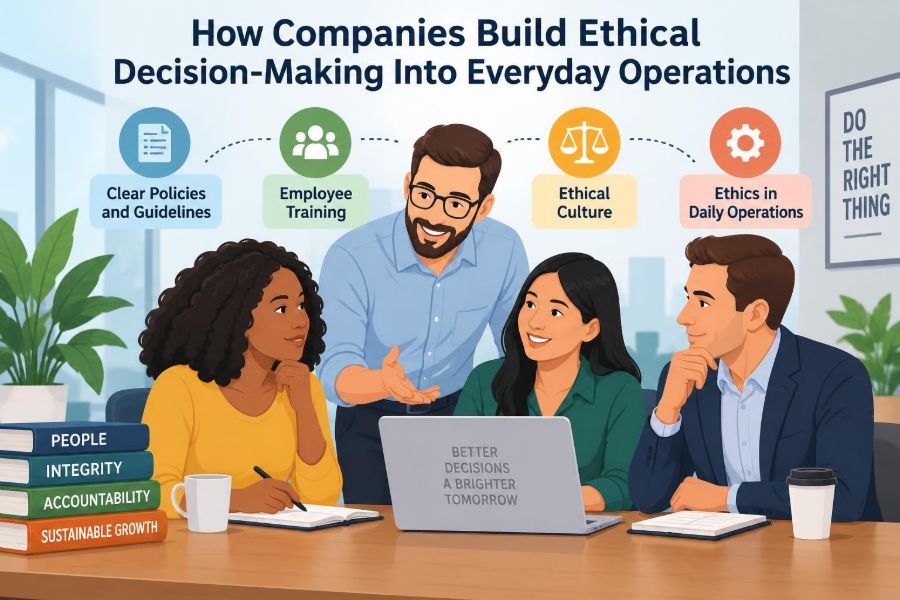
Ethical companies do not rely only on employees having good intentions. They build practical decision-making habits into the way work is designed, managed, measured, and reviewed. That is how values become visible when the pressure is real.
🧭 1. Ethical operations begin with everyday choices
Business ethics is often discussed through major scandals, legal cases, or corporate statements. Yet most ethical risk develops through many small choices: what to disclose, whom to include, which shortcut to take, and whether to raise a concern.
Everyday ethics means making decisions that are lawful, fair, honest, respectful, and responsible for their likely effects. A company needs this definition to be usable by people doing ordinary jobs, not just by senior leaders.
⚙️ 2. Operations are where values meet reality
Operations turn strategy into repeated actions. They include hiring, purchasing, marketing approvals, customer support, manufacturing, data handling, expense claims, performance reviews, and supplier management.
If an organisation says it values integrity but its workflow rewards speed at any cost, employees receive conflicting signals. Ethical behaviour becomes reliable only when the operating system supports it.
🎯 3. Define the values that guide decisions
Broad values such as integrity, respect, accountability, and customer focus are useful starting points. But a value becomes operational only when people can recognise what it requires in a particular context.
- Integrity may mean reporting results accurately, even when the news is unwelcome.
- Respect may mean communicating in accessible language and allowing people to challenge decisions.
- Accountability may mean documenting approvals and correcting mistakes promptly.
- Fairness may mean applying criteria consistently while considering relevant individual circumstances.
Clear examples help employees move from abstract agreement to practical judgement.
🧩 4. Translate principles into decision rules
Decision rules make ethical expectations easier to apply under pressure. They do not eliminate judgement, but they identify boundaries and prompts that should not be ignored.
For example, a customer-facing rule might require material fees, limitations, or cancellation terms to be explained before commitment. A procurement rule might require conflicts of interest to be declared before a supplier is selected.
Good rules are specific enough to guide action and flexible enough to account for legitimate differences between cases.
🔍 5. Identify the moments that carry ethical risk
Companies should map their processes and ask where someone could be harmed, misled, excluded, pressured, or treated inconsistently. This is often more useful than treating ethics as a separate annual topic.
Common decision points
- Setting sales targets and incentive plans
- Approving claims, refunds, credits, and exceptions
- Collecting, using, retaining, or sharing personal data
- Selecting suppliers and negotiating contract terms
- Recruiting, promoting, disciplining, or terminating employees
- Responding to safety, quality, or compliance concerns
The goal is to see risk before a decision becomes routine.
🗺️ 6. Use an ethical decision-making framework
A simple framework gives employees a repeatable way to slow down and examine a difficult choice. It is especially valuable when policies do not provide a complete answer.
- State the decision and the facts known so far.
- Identify who may be affected, including people not in the room.
- Check laws, policies, contracts, and professional obligations.
- Consider options, likely consequences, and unfair burdens.
- Ask whether the decision can be explained openly and defended consistently.
- Seek advice, decide, document the rationale, and review the outcome.
Frameworks work best when teams practise using them before a high-stakes situation occurs.
👥 7. Make stakeholders visible
Short-term decisions often appear attractive because they focus on one immediate outcome: revenue, cost, speed, or an internal target. Stakeholder thinking broadens the frame.
Relevant stakeholders can include customers, employees, contractors, suppliers, communities, regulators, investors, and future users of a product. Their interests will not always align, but ignoring them is not neutral; it simply shifts risk elsewhere.
⚖️ 8. Balance outcomes, rights, and fairness
Ethical reasoning should not depend on one question alone. A choice with strong financial benefits can still be unacceptable if it violates rights, conceals important information, or imposes a disproportionate burden on a vulnerable group.
| Lens | Useful question | Operational example |
|---|---|---|
| Consequences | What benefits and harms are likely? | Will a faster process create avoidable errors? |
| Rights and duties | What must we not do to people? | Are customers given truthful, material information? |
| Fairness | Are similar cases treated consistently? | Does an exception process use clear criteria? |
| Character | What kind of organisation does this reinforce? | Does the response show honesty and responsibility? |
Using several lenses reduces the chance that convenience is mistaken for sound judgement.
🏛️ 9. Leadership sets the practical tone
Employees watch what leaders reward, tolerate, and excuse. A leader who speaks about ethics but celebrates results obtained through questionable methods weakens every formal policy.
Tone at the top becomes credible when it is matched by conduct in meetings, resource decisions, promotions, and responses to bad news. Leaders must show that how results are achieved matters alongside the results themselves.
🗣️ 10. Managers translate culture into daily work
Frontline and middle managers have a particularly strong influence because they assign work, interpret targets, and respond to concerns. Their habits can make speaking up safe or risky.
Managers should ask what trade-offs their teams face, discuss difficult cases, and make it acceptable to pause a process. A quick question such as “What could go wrong for the customer?” can change the quality of a decision.
📜 11. Create policies people can actually use
Policies are important, but long documents written only for legal completeness are rarely effective on their own. People need plain-language guidance, definitions, examples, ownership, and a clear route for seeking help.
A usable policy explains both prohibited conduct and expected conduct. It should also be easy to find at the point of work, rather than buried in an unfamiliar system.
🧠 12. Train for judgement, not recitation
Training is stronger when employees work through realistic dilemmas rather than merely confirm that they have read a code of conduct. Scenarios reveal where instructions are unclear and where incentives may encourage poor choices.
Useful practice questions
- What fact would change your decision?
- Who should be consulted before acting?
- What would you document, and why?
- How would you explain this decision to the affected person?
Regular, role-specific practice helps ethical thinking become a professional skill.
📣 13. Build safe channels for speaking up
Employees need ways to ask questions, report concerns, and disclose mistakes without unnecessary fear. Options may include a manager, another leader, human resources, compliance specialists, an ethics function, or a confidential reporting channel.
Multiple channels matter because the direct manager may be involved in the problem. A reporting route is only credible when concerns are handled respectfully, assessed consistently, and protected from retaliation.
🛡️ 14. Protect people who raise concerns
Non-retaliation is more than a statement in a policy. Companies must look for subtle retaliation, such as exclusion, reduced opportunities, hostile treatment, or unfair performance criticism after someone speaks up.
Protecting reporters also benefits the organisation. Early warnings can reveal control failures, safety issues, misconduct, or harmful customer practices while they are still easier to address.
🔄 15. Design workflows with ethical checkpoints
Ethics is most effective when embedded in existing processes. A checkpoint can be an approval question, a required disclosure, a conflict declaration, a quality review, or a documented exception.
For instance, a new product process might require teams to consider user impact, security, accessibility, and data use before launch. The purpose is not paperwork for its own sake; it is making important reflection hard to skip.
🧾 16. Document decisions and exceptions
Documentation creates a record of what was known, who decided, which alternatives were considered, and why an exception was allowed. This supports continuity, review, learning, and accountability.
Not every routine choice needs a long memo. Higher-risk, unusual, or irreversible decisions deserve a proportionate record, especially when they affect people’s rights, money, safety, or trust.
💰 17. Align incentives with responsible conduct
Incentives are powerful signals. If employees are rewarded solely for volume, speed, or short-term profit, they may conclude that ethical safeguards are obstacles rather than part of successful performance.
Balanced scorecards can include quality, customer outcomes, safety, teamwork, compliance, and sustainable performance. Incentives should never encourage deception, unsafe shortcuts, or pressure that makes people hide problems.
📊 18. Measure what the culture is experiencing
Measurement cannot prove that a company is ethical, but it can reveal patterns requiring attention. Leaders can review concerns raised, response times, repeat issues, training feedback, control failures, customer complaints, turnover patterns, and audit findings.
Numbers need interpretation. A rise in reports may indicate worsening conduct, but it may also reflect growing trust in reporting channels. Managers should examine the context instead of celebrating a single metric.
🔎 19. Audit processes, not just individuals
When a problem occurs, organisations often focus quickly on who made the final decision. Individual accountability may be necessary, but it is rarely the full explanation.
A stronger review asks whether targets, unclear instructions, missing controls, poor supervision, inaccessible systems, or weak escalation routes made the problem more likely. This approach fixes causes rather than only symptoms.
🧪 20. Test decisions before they cause harm
Teams can use pre-mortems and challenge sessions to imagine how a proposed plan might fail ethically. Asking difficult questions before launch is usually less costly than explaining harm afterward.
- Could a reasonable person misunderstand this communication?
- Could this target pressure someone to cut corners?
- Who might be excluded by this process?
- What happens if the decision becomes public?
Testing is not pessimism. It is disciplined anticipation. 🧪
🤝 21. Extend expectations to suppliers and partners
Companies often depend on third parties for labour, technology, logistics, sales, professional advice, and manufacturing. Outsourcing an activity does not remove responsibility for how business is conducted.
Ethical supplier management includes due diligence appropriate to the risk, clear contractual expectations, communication, monitoring, and a plan for addressing concerns. Partnership should combine standards with practical support where improvement is possible.
🔐 22. Treat data and technology decisions as ethical choices
Digital systems can scale both useful services and harmful practices. Automated recommendations, employee monitoring, customer profiling, and artificial intelligence can affect privacy, access, dignity, and fairness.
Teams should ask what data is genuinely needed, whether people understand its use, how errors will be corrected, and who is accountable for automated outcomes. Human review is especially important where decisions materially affect people.
🌍 23. Consider environmental and social consequences
Operational decisions can create impacts beyond the transaction itself. Resource use, waste, working conditions, transport choices, product durability, and community effects all belong in responsible management.
Companies do not need to solve every social problem at once. They do need to understand material impacts connected to their work and avoid presenting limited action as a complete solution.
🚨 24. Respond well when something goes wrong
No control system prevents every mistake. The ethical test includes how a company responds when it discovers harm, misconduct, or a significant failure.
A responsible response normally involves containing the issue, protecting affected people, preserving relevant facts, investigating fairly, communicating appropriately, correcting the cause, and learning from the event. Defensiveness and concealment usually enlarge the original problem.
🔁 25. Turn incidents into organisational learning
After action is taken, teams should ask what needs to change in the process. That may include revising a policy, redesigning a form, changing a target, improving training, or clarifying who has authority to stop work.
Learning should be shared in a way that protects confidentiality while helping others recognise similar risks. A near miss can be valuable evidence if the organisation is willing to examine it.
🌱 26. Make ethical capability part of professional growth
Ethical decision-making develops through knowledge, reflection, feedback, and practice. It should be considered in onboarding, manager development, professional training, and career progression.
Employees need confidence to identify a concern, explain their reasoning, ask for advice, and disagree constructively. These are not soft extras; they are capabilities that protect quality, trust, and long-term performance.
🏁 27. The core principle: build ethics into the system
The central lesson is simple: ethical conduct cannot depend solely on exceptional individuals making heroic choices. Companies build better decisions by shaping the conditions in which ordinary people work.
Clear values, practical rules, thoughtful leadership, safe reporting, aligned incentives, reliable controls, and continuous learning make responsible action easier to choose and harder to bypass. Ethics then becomes part of everyday operations rather than a message reserved for crises.
When an organisation designs its routines to protect people, tell the truth, and surface concerns early, ethical decision-making becomes a repeatable business discipline. ⚖️ 🌱 🤝