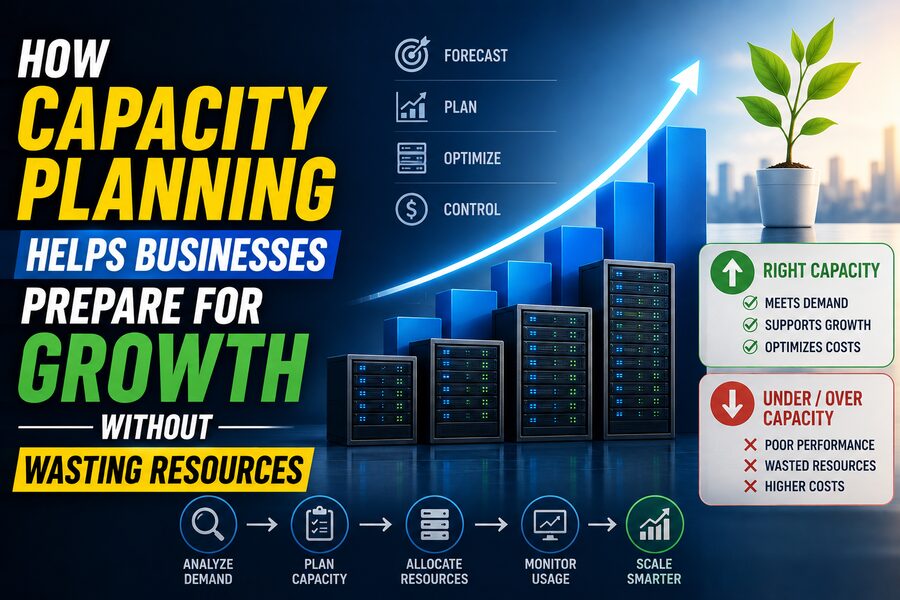

Growth sounds like a positive problem for a business to have. More customers, more orders, more employees, and more revenue usually signal that a company is succeeding. But growth can also create serious operational problems if the business is not prepared to handle the additional demand. 🚀🏢
A company that grows too quickly without enough capacity may experience delayed orders, poor customer service, employee burnout, equipment bottlenecks, inventory shortages, or system outages. On the other hand, a company that prepares for growth by buying too much equipment, hiring too many people, or leasing too much space can waste enormous amounts of money.
This is where capacity planning becomes essential.
Capacity planning is the process of determining how much productive capability a business will need in the future and deciding when and how to add that capability.
The goal is not simply to maximize capacity.
The goal is to have enough capacity to meet expected demand without paying unnecessarily for resources that sit idle. ⚖️
🏭 What Does “Capacity” Mean in Business?
Capacity is the maximum amount of work a system can reasonably handle over a given period.
The exact meaning depends on the type of business.
For a factory, capacity might mean:
10,000 units per week
For a restaurant, it could mean:
250 customers per evening
For a call center:
8,000 calls per day
For a cloud-software company:
500,000 transactions per minute
For a consulting firm:
12,000 billable hours per month
Capacity therefore depends on the resources needed to deliver a product or service.
These resources may include:
- 👥 Employees
- 🏭 Machinery
- 🖥️ Computing infrastructure
- 🏢 Buildings and workspace
- 🚚 Vehicles
- 📦 Inventory
- 🧰 Tools
- 🕒 Available working hours
- 💰 Financial resources
- 🧑💼 Management attention
Capacity planning asks whether these resources will be sufficient as demand changes.
📊 Capacity vs. Demand
The central challenge of capacity planning is matching available capacity with customer demand.
Imagine a factory capable of producing:
1,000 units per day
If customers order only:
600 units per day
then 400 units of potential capacity are unused.
That may mean equipment and employees are sitting idle.
But if customer demand rises to:
1,300 units per day
the factory cannot fulfill every order on time.
Both situations can be expensive.
Too much capacity can create:
- High fixed costs 💸
- Idle workers
- Underused machinery
- Excess warehouse space
- Lower profitability
Too little capacity can create:
- Missed sales
- Long waiting times
- Customer dissatisfaction
- Overtime costs
- Employee burnout
- Lost market share
Capacity planning tries to avoid both extremes.
🔮 Forecasting Future Demand
Capacity planning begins with an estimate of future demand.
Businesses may analyze:
- Historical sales
- Seasonal patterns
- Customer growth
- Market trends
- Product launches
- Marketing campaigns
- Economic conditions
- Geographic expansion
- Contract pipelines
Suppose an online retailer currently ships:
20,000 orders per month
and demand has been growing by approximately:
5% each month
Management may need to estimate how many orders the warehouse could be processing six or twelve months from now.
Those projections influence decisions about hiring, equipment, packaging stations, and warehouse space. 📦📈
🧮 A Simple Capacity Calculation
Suppose a manufacturing line produces:
50 units per hour
and operates:
8 hours per day
The theoretical daily capacity is:
50 × 8 = 400 units per day
If demand is expected to increase to:
500 units per day
the business faces a capacity gap of:
100 units per day
Management must decide how to close that gap.
Possible options include:
- Add overtime
- Increase production speed
- Add another shift
- Purchase another machine
- Outsource some production
- Improve process efficiency
Capacity planning evaluates which option provides the best balance between cost, flexibility, and risk.
⚙️ Design Capacity vs. Effective Capacity
Businesses often distinguish between design capacity and effective capacity.
🏗️ Design Capacity
Design capacity is the theoretical maximum output under ideal conditions.
A machine may technically be capable of producing:
1,000 units per day
🔧 Effective Capacity
Effective capacity accounts for real-world constraints such as:
- Maintenance
- Breaks
- Changeovers
- Quality inspections
- Employee availability
- Setup time
- Equipment failures
The same machine might realistically produce only:
850 units per day
Using theoretical capacity alone can lead managers to underestimate how much additional capacity they need.
Real-world planning should usually focus on sustainable output rather than perfect conditions.
📉 What Is Capacity Utilization?
Capacity utilization measures how much of available capacity is currently being used.
A simplified formula is:
Capacity Utilization = Actual Output ÷ Available Capacity × 100%
Suppose a plant can sustainably produce:
10,000 units per week
but currently produces:
8,000 units
Its utilization is:
8,000 ÷ 10,000 × 100 = 80%
An 80% utilization rate means the facility has some spare room for demand growth.
Whether 80% is ideal depends on the industry.
Running continuously at 100% utilization may sound efficient, but it can leave no room for unexpected demand, maintenance, or disruptions.
🛡️ Why Businesses Need a Capacity Cushion
A capacity cushion is extra capacity held above normal expected demand.
Suppose average customer demand is:
10,000 orders per week
A business might maintain capacity for:
12,000 orders
That extra 20% provides a buffer.
It can help absorb:
- Sudden order spikes
- Equipment breakdowns
- Employee absences
- Supplier delays
- Seasonal changes
- Forecasting errors
Industries where demand is highly unpredictable often require larger capacity cushions.
A stable manufacturing operation may need less spare capacity than an emergency healthcare service or rapidly growing digital platform. 🏥☁️
🚧 Bottlenecks Determine Real Capacity
A business process is usually made up of several stages.
The overall system can process only as much as its slowest critical stage allows.
This limiting point is called a bottleneck.
Imagine a production line with three operations:
Cutting: 500 units/day
Assembly: 350 units/day
Packaging: 600 units/day
Even though cutting and packaging can handle more, the complete line can produce only about:
350 units per day
because assembly is the bottleneck.
Buying a faster packaging machine would not increase overall output.
Capacity planning therefore requires businesses to identify the real constraint before spending money. 🎯
🔍 Why Bottleneck Analysis Prevents Waste
Suppose a company wants to increase output by 20%.
Management could buy new equipment for every department.
That would be expensive.
A better analysis might reveal that only one workstation is limiting production.
Improving that workstation alone could increase total capacity significantly.
Possible bottleneck solutions include:
- Adding another machine
- Redesigning the workflow
- Adding a worker
- Automating repetitive steps
- Reducing setup time
- Scheduling work differently
Effective capacity planning focuses investment where it creates the greatest increase in usable output. 💡
👥 Workforce Capacity Planning
Service businesses often depend more on people than machines.
For example, a customer-support team may receive:
5,000 tickets per week
Suppose each support specialist can handle:
250 tickets per week
The business would theoretically need:
5,000 ÷ 250 = 20 employees
But real planning must also account for:
- Vacation
- Training
- Meetings
- Sick leave
- Complex cases
- Management duties
The practical staffing requirement might therefore be closer to 23 or 24 people.
Workforce capacity planning helps businesses hire before staff become overwhelmed.
⏳ Hiring Too Late Is Expensive
Businesses often wait until employees are overloaded before hiring.
This creates several problems.
Recruiting takes time.
New employees also need training before becoming fully productive.
If a company waits until demand exceeds capacity, it may experience months of:
- Overtime
- Delayed work
- Burnout
- Customer complaints
- Quality problems
Capacity planning considers lead time.
If it takes four months to recruit and train a specialist, management must begin hiring before the workload actually requires that person. 📅
🏭 Equipment Has Lead Times Too
The same principle applies to machinery.
A specialized manufacturing machine may take:
- Several months to manufacture
- Weeks to ship
- Additional time to install
- More time to test
If demand is expected to exceed existing capacity in six months, waiting until that moment to order the machine may be far too late.
Capacity plans therefore connect demand forecasts with the time required to add resources.
🧭 Three Common Capacity Strategies
Businesses generally follow one of three broad strategies.
🚀 Lead Strategy
A company adds capacity before demand arrives.
For example, a factory expands from 100,000 units of monthly capacity to 150,000 while demand is still only 90,000.
Advantages include:
- Ability to handle rapid growth
- Shorter customer wait times
- Lower risk of lost sales
Disadvantages include:
- Higher upfront costs
- Greater risk of unused capacity
This strategy may suit fast-growing markets where running out of capacity would be particularly costly.
🐢 Lag Strategy
The company adds capacity after demand exceeds existing resources.
This reduces the risk of investing too early.
However, customers may face delays while the business catches up.
This approach can work when adding capacity quickly is easy.
⚖️ Match Strategy
A business adds capacity gradually as demand increases.
This attempts to balance risk and cost.
For many businesses, this is the most practical approach.
💰 Capacity Planning and Cash Flow
Capacity decisions often require significant investment.
Buying equipment or opening another facility can consume cash long before the new capacity produces revenue.
Suppose a company spends:
$2 million
to build a new production line.
If customer demand takes two years longer than expected to reach that level, the investment may generate poor returns.
Capacity planning therefore needs to connect operational forecasts with financial planning.
Management should consider:
- Capital expenditure
- Financing costs
- Operating expenses
- Break-even volume
- Expected demand
- Payback period
Growth can create financial problems if capacity is added too aggressively.
🏢 Should You Build, Buy, Rent, or Outsource?
Businesses do not always need to own additional capacity.
If demand temporarily exceeds internal capability, they may:
- Outsource production
- Hire contractors
- Lease equipment
- Use temporary employees
- Rent warehouse space
- Use cloud infrastructure
These alternatives can provide flexibility.
Suppose a manufacturer expects a six-month surge in orders.
Buying a new production line might be wasteful if demand later returns to normal.
Outsourcing some production could be more economical.
Capacity planning therefore includes deciding what type of capacity to acquire, not just how much.
☁️ Capacity Planning in Technology Companies
Software businesses face capacity challenges too.
A website may need computing resources such as:
- CPU
- Memory
- Database capacity
- Network bandwidth
- Storage
- API throughput
If traffic suddenly increases beyond available computing capacity, users may experience slow responses or outages.
Traditional data centers required companies to buy servers in advance.
Cloud computing has changed this substantially.
Businesses can often increase resources dynamically as demand grows. ☁️⚡
📈 Auto-Scaling and Elastic Capacity
Cloud platforms can support auto-scaling.
Suppose an application normally uses 10 servers.
During a major product launch, traffic triples.
An auto-scaling system may automatically increase the fleet to 30 servers.
When traffic returns to normal, excess servers can be removed.
This provides elastic capacity.
However, cloud resources are not infinitely flexible.
Databases, third-party APIs, regional infrastructure, and cost budgets may still create bottlenecks.
Capacity planning remains essential even when resources can scale automatically.
🛒 Seasonal Businesses Need Special Planning
Many businesses experience predictable seasonal demand.
A retailer may handle dramatically more orders during holiday shopping periods.
A tax preparation company may receive most of its workload early in the year.
A hotel may fill during tourist seasons.
These businesses should not necessarily build permanent capacity for the annual peak.
Instead, they may combine:
Permanent base capacity + temporary seasonal capacity
For example:
- Permanent staff handle normal demand.
- Temporary workers support peak periods.
- Additional warehouse space is leased seasonally.
- Extra delivery contractors are added during holidays.
This reduces fixed costs during quieter months. 🎄📦
🧪 Scenario Planning Improves Decisions
Demand forecasts are never perfectly accurate.
Instead of relying on one number, businesses can create several scenarios.
For example:
📉 Low-Growth Scenario
Demand grows 5%.
📊 Base Scenario
Demand grows 15%.
🚀 High-Growth Scenario
Demand grows 35%.
Management can then determine what resources would be required in each case.
This allows the business to prepare contingency plans.
If growth begins tracking the high scenario, it can activate additional hiring or equipment purchases early.
📍 Capacity Triggers
A useful capacity plan defines triggers for action.
Instead of saying:
“We should probably hire more people soon,”
the company might define:
When support-team utilization exceeds 80% for six consecutive weeks, begin recruiting two additional agents.
Or:
When warehouse volume exceeds 85,000 orders per month, begin negotiations for additional space.
Clear triggers reduce emotional and reactive decision-making.
They make expansion more systematic. 🎯
📊 Leading Indicators Matter
Revenue is often a lagging indicator.
By the time revenue shows that the company has outgrown its capacity, operational strain may already be severe.
Good capacity planning tracks leading indicators such as:
- Sales pipeline
- Website traffic
- Customer signups
- Contracted orders
- Quote requests
- Trial conversions
- Hiring plans of major customers
These indicators can provide earlier warnings of future demand.
🏗️ Capacity Planning for Facilities
Physical facilities often have long expansion lead times.
A warehouse may need:
- New racking
- Loading docks
- Forklifts
- Packing stations
- Additional employees
A manufacturer may need:
- New production lines
- Electrical upgrades
- Ventilation
- Quality-control equipment
A restaurant chain may need new kitchens or locations.
Because physical expansion can take months or years, facility capacity planning often looks several years ahead.
🔄 Improving Productivity Before Adding Capacity
One of the best ways to gain capacity is to improve existing operations.
Suppose a factory has 1,000 units per day of theoretical capacity but produces only 700 because of:
- Long changeovers
- Rework
- Equipment downtime
- Poor scheduling
Instead of buying another production line, management might improve processes and raise output to 850.
This effectively creates:
150 additional units of capacity
without major capital spending.
Process improvement can therefore be one of the cheapest forms of capacity expansion. 🔧
🤖 Automation Can Create Capacity
Automation can reduce how much human labor is required for each unit of output.
Suppose an accounts-payable team processes:
100 invoices per employee per day
After introducing automated document processing, each employee can supervise:
300 invoices per day
The company has effectively tripled its processing capacity without tripling headcount.
Automation is therefore an important capacity-planning tool.
However, automation itself requires investment, implementation time, and training.
🧠 Cross-Training Employees Adds Flexibility
Capacity is more flexible when workers can perform multiple tasks.
Suppose Department A is overloaded while Department B has spare capacity.
If employees are cross-trained, some workers can temporarily shift to Department A.
Without cross-training, the company may need to hire additional people even though unused labor capacity exists elsewhere.
Cross-training can improve resilience during:
- Demand spikes
- Absences
- Seasonal changes
- Unexpected bottlenecks
It turns workforce capacity into a more flexible resource. 👥
📦 Inventory and Capacity Are Connected
Inventory can sometimes act as a buffer between production capacity and customer demand.
Suppose a factory has steady production but seasonal sales.
It may produce extra units during slower months and store them.
When peak demand arrives, inventory supplements ongoing production.
However, excess inventory creates costs:
- Storage
- Insurance
- Working capital
- Obsolescence
- Damage
Capacity planning and inventory planning therefore need to be coordinated.
🛡️ Resilience Requires Spare Capacity
From a purely efficiency-focused perspective, unused capacity may seem wasteful.
But some unused capacity provides resilience.
Imagine a delivery company operating every vehicle at full utilization every day.
One truck breakdown immediately causes delays.
If the company maintains a small spare fleet, it can absorb disruptions.
Similarly, hospitals, power grids, logistics systems, and technology platforms often maintain reserve capacity because failure during peak demand would be unacceptable.
The optimal amount of spare capacity depends on the cost of failure. ⚡
📉 The Cost of Under-Capacity Can Be Hidden
Companies often see the cost of excess capacity clearly because it appears on financial statements.
The cost of insufficient capacity can be less obvious.
It may appear as:
- Lost customers
- Poor reviews
- Declining employee morale
- Missed contracts
- Reduced quality
- Delayed projects
- Overtime
- Supplier penalties
These losses can exceed the cost of maintaining some spare capacity.
Capacity decisions should therefore consider opportunity costs, not just visible expenses.
🧮 Break-Even Analysis for Capacity Expansion
Suppose a new machine costs:
$500,000
It increases capacity by:
50,000 units per year
If each additional unit contributes:
$15 of profit
then full use of the added capacity could generate:
50,000 × $15 = $750,000 per year
But if demand requires only 10,000 additional units, the economic benefit is:
10,000 × $15 = $150,000
The investment might still make sense, but the payback is much slower.
Capacity planning connects expected utilization with investment returns.
📊 Useful Capacity Planning Metrics
Businesses may monitor metrics such as:
- Capacity utilization
- Throughput
- Cycle time
- Queue length
- Employee workload
- Machine downtime
- Orders delayed
- Overtime hours
- Forecast accuracy
- Cost per unit
No single metric tells the entire story.
For example, high utilization may look efficient while queue times are becoming unacceptable.
Managers need a balanced view.
🤝 Sales and Operations Must Coordinate
Capacity planning cannot be performed by the operations department alone.
Sales may know that a major customer is about to sign a large contract.
Marketing may be planning a campaign expected to double demand.
Finance may be limiting capital spending.
HR may know that hiring certain specialists takes six months.
These groups need to share information.
Many organizations use planning processes such as Sales and Operations Planning (S&OP) to align expected demand with available resources.
Without coordination, one department may create demand that another department cannot serve.
⚠️ Forecasts Will Always Be Wrong
No capacity forecast is perfect.
A recession could reduce demand.
A competitor could leave the market and create unexpected growth.
A viral social media post could cause a sudden sales spike.
A supplier failure could reduce production capability.
Good capacity planning therefore does not depend on predicting the future perfectly.
It creates flexibility and options.
Businesses can ask:
- What can we scale quickly?
- What requires long-term investment?
- What can we outsource?
- Which resources are hardest to obtain?
- What happens if demand is 30% above forecast?
This makes the organization more adaptable.
🤖 AI and Predictive Capacity Planning
Modern businesses increasingly use advanced analytics and machine learning to improve forecasting.
Models can analyze:
- Sales history
- Weather
- Promotions
- Economic indicators
- Website activity
- Customer behavior
- Supply-chain data
For example, a grocery chain might forecast store-level demand using weather and seasonal patterns.
A logistics company might predict parcel volumes weeks in advance.
Better forecasting allows businesses to prepare capacity earlier and with less unnecessary buffer. 📊🤖
🚀 Capacity Planning Enables Sustainable Growth
Rapid growth can destroy a company’s customer experience if operations cannot keep up.
Imagine a startup doubles its customer base in three months.
Without capacity planning:
- Support tickets pile up.
- Onboarding slows down.
- Servers become unstable.
- Employees work excessive overtime.
Revenue may increase while customer satisfaction collapses.
A planned growth strategy anticipates which resources will become constrained first and expands them before failure.
That allows growth to remain sustainable.
🏁 Final Thoughts
Capacity planning helps businesses answer one of the most important operational questions:
How much capability will we need to serve future demand, and when should we invest in it? 📈
Too little capacity creates shortages, delays, lost customers, and employee overload.
Too much capacity wastes money on idle staff, unused machinery, oversized facilities, and unnecessary infrastructure.
Effective capacity planning finds the balance.
It combines:
Demand forecasting + utilization analysis + bottleneck identification + lead-time planning + financial evaluation + flexible expansion options
The strongest capacity plans also recognize uncertainty.
Instead of assuming one perfect growth forecast, businesses prepare multiple scenarios, maintain appropriate capacity cushions, and define clear triggers for investment.
Capacity does not always need to come from buying more assets. Companies can create additional capability through process improvement, automation, outsourcing, cloud infrastructure, cross-training, and smarter scheduling. ⚙️
Ultimately, capacity planning is not about predicting growth perfectly.
It is about ensuring that when growth arrives, the business is ready to handle it—without having spent years paying for resources it did not need.
That balance between preparedness and efficiency is what turns capacity planning from a simple operations exercise into a powerful tool for sustainable business growth. 🚀🏢✨