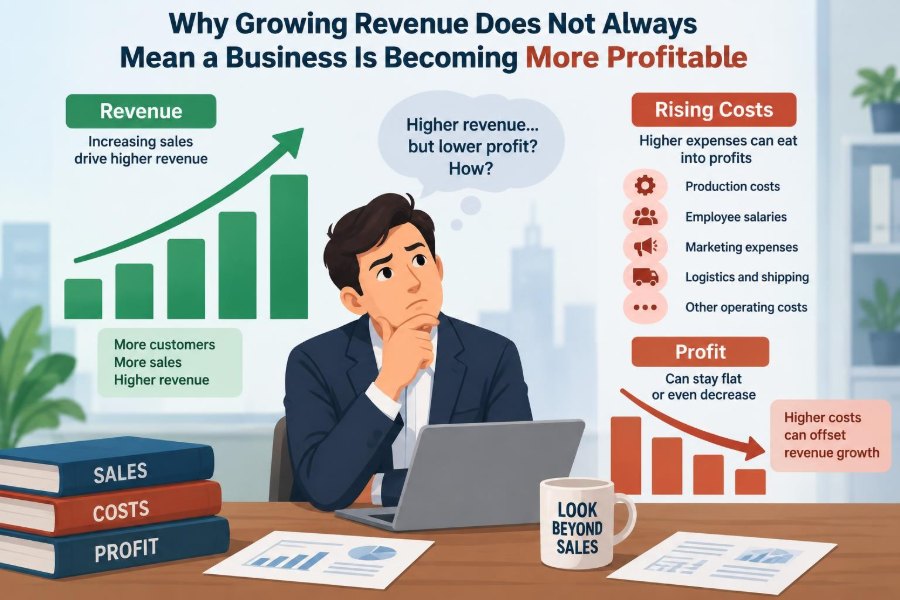

A café owner looks at the monthly sales report and sees a pleasing result: revenue is higher than it was last year. More customers are buying coffee, online orders have increased, and a new location is contributing sales. On the surface, the business appears to be moving in the right direction.
Yet the owner’s bank balance is tight. Ingredient invoices have risen, extra staff were needed during busy periods, delivery platforms take large commissions, and the new location is still absorbing cash. Sales are growing, but the financial pressure has not eased.
This situation is common in businesses of every size. A growing top line can signal demand, good marketing, or successful expansion. It can also hide shrinking margins, rising overheads, poor pricing, and working-capital strain.
Understanding the difference matters because managers make decisions from the story they believe the numbers are telling. Revenue is a valuable signal, but it is not the same thing as profit, cash, or a financially stronger business.
🧾 Revenue Is Only the Starting Point
Revenue is the total amount earned from selling goods or services before most costs are deducted. If a company sells 1,000 subscriptions at $20 each, it records $20,000 in revenue for that period.
That number answers a narrow question: how much did customers agree to pay for what the business sold? It does not reveal how much it cost to make the sale, deliver the service, support the customer, pay employees, or run the organization.
Revenue growth can be encouraging, particularly for a young firm proving that customers want its offering. But it is an incomplete performance measure. Treating it as proof of financial health can lead managers to celebrate activity while overlooking whether that activity creates value.
💰 Profit Measures What Remains
Profit is what remains after relevant costs are deducted from revenue. The exact measure depends on the question being asked. Gross profit considers direct production or purchasing costs, while operating profit also reflects the cost of running the business.
A company can increase revenue by $100,000 while adding $110,000 in costs. Its sales grew, but its profit fell by $10,000. This is why managers must look at the relationship between additional revenue and additional cost, not merely at revenue in isolation.
Profit is not the only outcome that matters, but it gives a clearer view of whether a business model can sustainably support itself. Revenue creates the opportunity for profit; disciplined operations and sound economics determine whether that opportunity is realized.
📈 The Top Line and Bottom Line Tell Different Stories
The phrase top line usually refers to revenue because it appears near the top of an income statement. The bottom line commonly refers to net profit, the amount left after operating expenses, interest, taxes, and other costs.
Both lines can move in different directions. A retailer may report stronger sales because it opened stores and offered promotions, while net profit declines because rent, payroll, markdowns, and financing costs climbed faster.
A helpful management question is: “What did we have to spend to earn the extra sales?” That question prevents a team from assuming that a larger top line automatically improves the bottom line.
🏷️ Higher Sales Can Come From Lower Prices
Discounts often increase sales volume. A business may sell more units after reducing prices, running a promotion, offering free shipping, or giving large customers special terms. Revenue can rise if volume increases enough, but each sale may contribute less toward fixed costs and profit.
Consider a hypothetical online retailer that sells an item for $50 with a direct cost of $30. It has $20 of gross profit per item. If it cuts the price to $40 and still faces the same direct cost, gross profit falls to $10 per item.
The retailer now needs to sell twice as many units just to generate the same gross profit dollars from that product. A discount may still be sensible for clearing stock or attracting profitable repeat buyers, but it should not be mistaken for effortless growth.
🧮 Gross Margin Reveals the Quality of Sales
Gross margin shows the portion of revenue left after direct costs, often called cost of goods sold. Direct costs may include materials, inventory purchases, production labor, packaging, or transaction-specific delivery costs, depending on the business.
A falling gross margin means the business keeps less from each dollar of revenue before covering rent, salaries, technology, marketing, and administration. Sales can therefore grow while the resources available to run the company become more constrained.
| Measure | Simple calculation | What it helps managers see |
|---|---|---|
| Revenue | Sales before most costs | Scale of customer spending |
| Gross profit | Revenue minus direct costs | Money available to cover operating costs |
| Gross margin | Gross profit divided by revenue | Profitability of each sales dollar |
| Operating profit | Gross profit minus operating expenses | Performance of core operations |
| Net profit | Income after all relevant expenses | Overall accounting profitability |
📦 Input Costs May Rise Faster Than Revenue
A manufacturer may be selling more products while the cost of components, energy, freight, or packaging rises sharply. A restaurant may attract more diners while food ingredients become more expensive. In both cases, revenue alone can make performance appear better than it is.
Cost increases do not always arrive evenly. Suppliers may adjust prices before a business can renegotiate contracts or raise customer prices. This lag can temporarily squeeze margins, even in a company with strong demand.
Managers should track the cost of major inputs as a share of sales, not only in total dollars. A bigger purchasing bill is expected when a business grows; a rising cost ratio deserves closer investigation.
👥 Growth Often Requires More People
More sales can require more customer service representatives, warehouse staff, salespeople, supervisors, engineers, or managers. These hires may be necessary, but payroll is often a substantial and recurring expense.
The challenge is timing. A business frequently hires ahead of anticipated demand to avoid missed orders or poor service. If sales take longer than expected to materialize, the additional payroll reduces profit before the revenue benefit arrives.
It is also possible to add revenue without improving labor productivity. If staffing grows at the same rate as sales, the business may become larger without becoming more efficient. Managers should examine output per employee or revenue per labor hour alongside total headcount.
📣 Customer Acquisition Can Be Expensive
Marketing campaigns, sales commissions, introductory offers, referral payments, and free trials can all help a company attract customers. They can also make revenue growth costly, especially when the business is competing intensely for attention.
A customer acquired through an expensive campaign is not necessarily unprofitable. The key question is whether the customer will generate enough future gross profit to recover the acquisition cost and contribute to overhead. This is particularly relevant for subscriptions, professional services, and repeat-purchase businesses.
Managers should separate revenue from new customers and revenue from existing customers where possible. Growth powered mainly by ever-higher acquisition spending is more fragile than growth supported by retention, referrals, and healthy repeat purchasing.
🚚 Delivery, Returns, and Service Costs Can Erode Margins
Some costs appear only after a sale is made. Shipping subsidies, returns, warranty claims, payment processing fees, customer support, installation, and platform commissions can turn apparently attractive revenue into thin-margin revenue.
For example, an e-commerce business might record the full customer payment as revenue, but a returned product can create reverse-logistics costs and leave the business with inventory that must be discounted. Similarly, a service company may win a contract that requires far more support hours than expected.
These costs should be assigned as closely as possible to the products, channels, or customers that cause them. Otherwise, profitable activity can unintentionally subsidize unprofitable activity.
🏢 Fixed Costs Create a Break-Even Challenge
Fixed costs are expenses that generally do not change immediately with each unit sold, such as office rent, base salaries, insurance, software subscriptions, and some equipment leases. They are paid even when sales are weak.
Growth can improve profitability when extra sales use existing capacity, because fixed costs are spread across more revenue. But expansion often raises the fixed-cost base: another facility, a larger management team, new systems, or additional equipment may be needed.
A business that expands too early can move its break-even point upward. It then needs more monthly revenue simply to cover its new cost structure. Growth is beneficial only if demand becomes sufficiently reliable to support that commitment.
🏭 Capacity Expansion Can Reduce Profit Before It Improves It
A factory, clinic, logistics firm, or software company may invest ahead of demand. The business might lease more space, buy machinery, build a support team, or develop infrastructure before it can serve additional customers well.
During this period, profit can decline even while revenue rises. That does not automatically make the investment a mistake. The real issue is whether managers have a credible path to using the new capacity at healthy margins and within a manageable timeframe.
Capital-intensive decisions deserve scenario planning. Leaders should examine what happens if demand is lower, later, or less profitable than forecast, rather than relying solely on the most optimistic sales projection.
🔀 Sales Mix Matters More Than Total Sales
Not every dollar of revenue is equally profitable. A business may sell premium products with strong margins, basic products with modest margins, and custom work with unpredictable costs. Total revenue can rise simply because low-margin categories are growing fastest.
This is called a sales mix effect. Imagine a company sells more of an entry-level product after a successful campaign, but fewer high-margin service packages. Overall sales rise, while overall margin falls.
Managers need reporting by product, service, customer segment, channel, and region. Without it, a favorable total can conceal a shift toward work that consumes resources but contributes little profit.
🤝 Big Customers Can Bring Small Margins
Large accounts can create impressive revenue figures and provide a predictable stream of orders. They may also demand price concessions, long payment terms, customized reporting, dedicated support, or penalties for service failures.
These requirements are not inherently bad. A large customer may help stabilize production or reduce selling costs. However, managers should calculate the full cost to serve the account, including the time of specialist employees and the operational complexity it creates.
Customer concentration adds another risk. If one major account represents a large share of revenue, losing it can quickly expose fixed costs that were previously covered. High revenue from a customer is not the same as a strong, diversified profit base.
🛒 Channel Growth May Shift Economics
Businesses often sell through multiple channels: direct sales, physical stores, distributors, marketplaces, resellers, and online platforms. Each channel has a different combination of pricing control, commissions, fulfillment requirements, marketing costs, and customer data access.
Moving more sales to a marketplace might lift revenue rapidly because the audience is larger. But platform fees, sponsored placement, return policies, and price competition may reduce the profit earned on each sale compared with direct channels.
A channel should be judged on contribution after its specific costs, not merely on the sales it reports. Fast channel growth is useful only if it strengthens the overall economics or serves a deliberate strategic purpose.
🧾 Accounting Profit Is Not the Same as Cash
Profit is calculated under accounting rules, while cash flow tracks money entering and leaving the business. A profitable company can still face a cash shortage if it pays suppliers and employees before collecting payment from customers.
Revenue may be recorded when goods are delivered or services are earned, even if the customer has not paid yet. If sales grow quickly on credit, accounts receivable can rise and absorb cash. Inventory growth can have a similar effect.
This distinction matters because bills must be paid in cash. A manager can truthfully report higher revenue and even an accounting profit while still needing finance to meet payroll, supplier obligations, or loan payments.
⏳ Working Capital Can Consume the Benefits of Growth
Working capital is the short-term funding tied up in day-to-day operations, including inventory and unpaid customer invoices, offset by amounts owed to suppliers. Growing companies often need more working capital because they must buy or produce more before collecting more.
A wholesaler that wins a large contract may need to purchase stock months before the customer’s invoice is paid. The contract can be profitable on paper but stressful in practice if the business lacks sufficient cash reserves or credit.
Managers should model the cash cycle before pursuing large orders. Useful levers include negotiating deposits, improving invoicing discipline, reducing excess stock, aligning payment terms, and arranging appropriate financing before the cash need becomes urgent.
📉 Debt and Financing Costs Can Offset Operating Gains
Expansion is often financed through loans, overdrafts, leases, or other borrowing. The resulting interest and financing charges are real costs, even if the borrowed money helped the business increase revenue.
If returns from growth are weak, debt can magnify pressure. The business must meet scheduled payments regardless of whether sales meet plan. Rising interest rates or refinancing needs can make an already thin margin position more difficult.
Borrowing is not automatically harmful; it can fund productive assets and working capital. The discipline is to compare the expected return from the investment with the full cost and risk of financing it, including a less favorable sales scenario.
🧱 Complexity Has a Hidden Price
As a company adds products, markets, locations, systems, and customer types, coordination becomes harder. More approvals, handoffs, training needs, errors, and reporting requirements can slowly raise costs without appearing as a single line item.
Complexity may also distract management from the core activities that once produced attractive returns. A business can become busier, larger, and more difficult to operate while customers experience little additional value.
Growth plans should ask what will become more complicated and who will own that complexity. Standardizing processes, limiting unnecessary variations, and retiring weak offerings can protect profitability as scale increases.
⚙️ Operational Inefficiency Can Grow With Volume
Volume does not automatically create efficiency. If processes are poorly designed, more orders can mean more rework, overtime, waste, complaints, and stock errors. The organization simply performs an inefficient process more frequently.
For instance, a growing service team may repeatedly solve the same customer problem because onboarding materials are unclear. Revenue rises with customer numbers, but support costs rise too. Improving the underlying process can be more profitable than simply adding staff.
Managers should monitor operational measures that explain costs: defect rates, delivery times, return reasons, utilization, overtime, conversion quality, and customer complaint patterns. These indicators often reveal why profit is not following revenue.
🔍 Contribution Margin Clarifies Individual Decisions
Contribution margin is the revenue from a sale minus the variable costs directly associated with making that sale. It shows how much the sale contributes toward fixed costs and then profit.
This concept is useful when evaluating a promotion, custom order, or additional channel. If an order has a positive contribution margin and uses spare capacity, it may improve short-term profit even if its price is below the usual level. If it displaces higher-margin work, the conclusion may change.
Contribution margin is not a substitute for full profitability analysis. It is a decision tool that helps managers avoid rejecting every lower-priced sale—or accepting every sale—without understanding the incremental economics.
🧭 Track Profitability at Several Levels
Company-wide profit can hide the source of improvement or decline. Better decisions come from viewing profitability at several levels: the total business, business unit, product family, customer segment, sales channel, and sometimes individual contract.
The appropriate level depends on the business. A consultancy may focus on project profitability and employee utilization. A retailer may focus on category margin, store performance, and return rates. A software company may examine customer cohorts and support costs.
Granular reporting should be practical, not obsessively detailed. The goal is to identify meaningful differences that change decisions, rather than create an elaborate dashboard that no one uses.
📊 Use Ratios, Not Just Dollar Totals
Absolute profit dollars matter, but ratios help show whether the economics are improving as the business grows. Gross margin percentage, operating margin percentage, labor cost as a share of revenue, and marketing cost relative to gross profit can reveal trends that totals conceal.
Suppose operating profit rises from $50,000 to $60,000 while revenue doubles. The business earned more profit dollars, but its operating margin may have fallen substantially. Leaders need to decide whether this is a temporary investment, an acceptable trade-off, or a warning sign.
Comparisons should be made across consistent periods and accounting methods. Seasonal businesses, one-off projects, and major investments can distort a single month, so managers should look for patterns rather than react to every short-term movement.
🧪 Test Growth Assumptions Before Scaling
Many growth plans assume that unit costs will fall, customers will stay, prices will hold, and new hires will become productive quickly. These assumptions may be reasonable, but they should be tested rather than treated as facts.
Small pilots can reveal the true cost of serving a new market, running a promotion, or launching a new product. A company might find that demand is strong but returns are unusually high, or that a new customer segment requires expensive support.
Testing does not eliminate uncertainty. It makes uncertainty visible early, when changes are less costly. Clear success criteria—such as a required contribution margin or repeat-purchase threshold—keep a pilot from being judged solely by sales volume.
🎯 Pricing Must Cover Value and Cost
Pricing is one of the most direct levers affecting profitability, yet businesses sometimes set prices by copying competitors or adding a simple markup without understanding customer value, costs to serve, and desired margin.
A price increase can reduce demand, so it must be considered carefully. But avoiding all price changes while inputs, service expectations, or labor costs rise can quietly weaken the business. Price architecture also matters: premium tiers, minimum order values, service fees, and contract terms can improve economics without applying one blunt increase to every customer.
The best pricing decision balances market reality with financial discipline. A business needs enough margin to deliver its promise reliably, invest in improvement, and withstand normal variation in costs and demand.
🛠️ Improve the Cost Base Without Damaging Value
When profits lag, an immediate across-the-board cost cut can harm quality, customer experience, and employee capability. A more useful approach is to identify costs that do not add enough value or that result from avoidable inefficiency.
Potential actions include simplifying low-volume product lines, reducing waste, improving purchasing terms, automating repetitive administrative work, redesigning delivery routes, or ending promotions that attract chronically unprofitable orders. Each action should be assessed for its effect on customers and staff.
Cost discipline is not simply spending less. It is spending intentionally, so the business preserves the activities that support customer value and removes costs that do not produce an adequate return.
🚦Know When Revenue Growth Is Still Worth Pursuing
Not every period of declining profit is a failure. A new business, a company entering a market, or an organization investing in capacity may deliberately accept lower short-term profitability to build a stronger future position.
The difference between strategic investment and unhealthy growth is clarity. Leaders should know why margins are lower, how long the effect is expected to last, what evidence would confirm the plan, and what limit would trigger a reassessment.
Growth is more defensible when it improves durable capabilities, customer relationships, or efficient scale. It is less defensible when it depends indefinitely on discounts, exceptional effort, or financing that the underlying business cannot support.
🧑💼 Questions Managers Should Ask Each Month
A regular review can turn financial statements into management tools rather than historical records. The discussion should connect commercial activity with the costs, capacity, and cash needed to support it.
- Did revenue increase because of volume, price, product mix, or a new channel?
- What happened to gross margin and operating margin?
- Which products, customers, or channels created the most and least contribution?
- Did payroll, marketing, delivery, returns, or overhead grow faster than sales?
- How much cash is tied up in inventory and unpaid invoices?
- Are lower profits explained by a deliberate investment or an emerging operating problem?
These questions encourage constructive investigation. They move the conversation beyond “Did we grow?” toward “Did we grow in a way that makes the business stronger?”
🚫 Common Misreadings of Revenue Growth
One common mistake is celebrating a record sales month without comparing margins. Another is using an average margin for every customer, even when some accounts require far more service or receive much lower prices.
Managers can also confuse cash received with revenue earned, overlook the cost of returns and warranties, or assume fixed costs will remain fixed during expansion. Each error makes growth look simpler and more profitable than it really is.
A final mistake is focusing only on cutting costs when profitability weakens. Sometimes the central problem is not cost control but weak pricing, poor customer selection, an unfavorable sales mix, or a product that is expensive to deliver.
🌱 Build Profitable Growth Into the Plan
Profitable growth begins with targets that include more than sales. Plans should connect revenue goals with margin expectations, staffing needs, capacity limits, cash requirements, and the investments needed to serve customers well.
In practice, this means assigning ownership for key measures, reviewing actual results against assumptions, and responding early when economics deteriorate. Sales, operations, finance, and customer teams need a shared view; profitability cannot be managed by one department alone.
The aim is not to avoid growth or demand immediate maximum profit in every situation. It is to make conscious trade-offs and ensure that temporary sacrifices have a credible path to stronger long-term economics.
✅ The Core Principle: Growth Must Create Value
Revenue growth is evidence that money is flowing into a business. It can reflect customer demand, market reach, and commercial momentum. But it says nothing by itself about the cost of winning, serving, and retaining those customers.
A healthier business watches revenue, margins, operating costs, cash flow, working capital, and risk together. It understands which sales create contribution and which sales consume resources. It also distinguishes deliberate investment from accidental margin erosion.
The most useful goal is not simply to sell more. It is to build a model in which additional sales leave the business better able to serve customers, pay its obligations, invest wisely, and generate sustainable returns.
Growing revenue becomes meaningful only when the business understands what that growth costs, what it contributes, and whether it strengthens profitability over time. 📊💡🌱