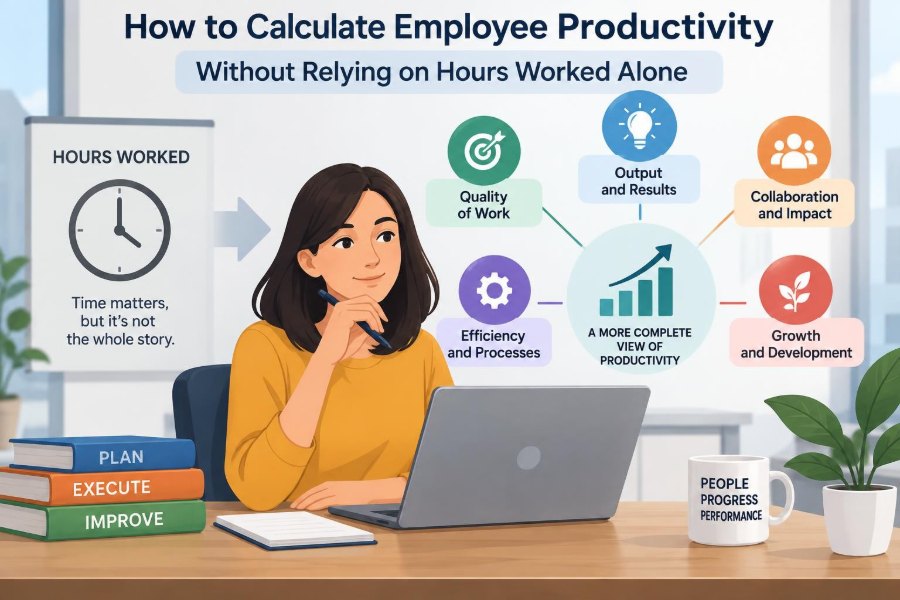

At 5:30 p.m., one employee is still online, replying to messages and moving between spreadsheets. Another signed off an hour earlier after resolving a customer issue, documenting the fix, and preventing the same problem from returning. If productivity means visible time at work, the first person appears more productive.
Most managers know that conclusion can be misleading. Long hours may reflect commitment, but they can also reflect unclear priorities, slow systems, rework, or a workload that was poorly designed in the first place.
The challenge is especially visible in knowledge work, hybrid teams, service roles, and jobs where quality matters as much as volume. A useful productivity measure needs to show what employees create, improve, complete, or enable—not merely how long they remain connected.
That does not mean hours are irrelevant. It means they are only one piece of evidence. The goal is to build a fairer picture of performance that supports better decisions rather than rewarding busyness.
🧭 Start with a broader definition of productivity
Employee productivity is the value of useful output produced with available resources. In simple settings, output might be units assembled or orders processed. In many roles, however, value also includes accuracy, service quality, problem-solving, risk reduction, and work that helps other people succeed.
A practical definition is: productive work delivers a meaningful result at an appropriate level of quality, within a sensible use of resources. Time can describe resource use, but it cannot define the result on its own.
⏱️ Why hours worked are an incomplete signal
Hours tell managers about capacity, attendance, and possible workload strain. They do not reliably tell them whether the right work was done, whether it met standards, or whether it created lasting value.
Two people can spend the same eight hours on a proposal. One may produce a clear, accurate document that advances a decision; the other may create a longer document that requires extensive revision. Treating those efforts as equal hides a material difference.
🔍 Separate effort, activity, output, and outcomes
Confusion often begins when organizations use these four terms interchangeably. They describe different layers of work, and each has a legitimate—but limited—place in measurement.
| Layer | What it describes | Example | Main limitation |
|---|---|---|---|
| Effort | Energy or time invested | Hours spent researching | May not produce a useful result |
| Activity | Actions completed | Calls made or tickets touched | Can encourage busywork |
| Output | Work delivered | Accurate report completed | May not show real-world effect |
| Outcome | Result created or influenced | Client renewal or fewer errors | Often has multiple causes |
Good productivity measurement connects these layers rather than relying on only one. An employee may show strong effort and activity while struggling to create output because the process, tools, or brief are broken.
🎯 Define the job’s real purpose first
Before choosing a metric, ask what the role exists to accomplish. A payroll specialist exists to ensure people are paid correctly and on time, not simply to process the largest possible number of records. A designer exists to create work that communicates effectively, not to produce the most files.
This purpose statement prevents a common error: measuring what is easiest to count rather than what the organization actually needs.
🧩 Identify controllable contributions
Employees should be evaluated mainly on factors they can reasonably influence. A sales representative can influence prospecting quality, follow-up discipline, opportunity development, and relationship management. They cannot fully control a client’s budget freeze or a product outage.
Outcome measures remain valuable, but they should be interpreted alongside controllable leading indicators. This creates a more credible conversation when results are delayed or shaped by external conditions.
📏 Build a balanced measurement set
A balanced set usually combines several dimensions instead of searching for one perfect number. The exact measures should vary by role, but the pattern is consistent.
- Volume: how much relevant work was completed.
- Quality: whether work met defined standards.
- Timeliness: whether work arrived when it was needed.
- Impact: whether work moved an agreed objective forward.
- Collaboration: whether the employee enabled dependable work across the team.
Not every role needs equal weighting across all five. The point is to avoid allowing one easily measured dimension to overpower the rest.
⚖️ Use a scorecard, not a single score
A scorecard makes trade-offs visible. For example, a customer support employee might be assessed through resolution quality, response reliability, case complexity, documentation quality, and customer feedback patterns. The scorecard should support professional judgment, not replace it.
Where a combined score is useful, write down the weighting and review it regularly. A formula can create consistency, but it can also create false certainty when the underlying measures are weak.
🧮 Calculate output only after defining “done”
Counting completed work sounds straightforward until teams discover they count different things. Is a software task done when code is written, reviewed, tested, deployed, or adopted? Is a recruitment vacancy filled when an offer is accepted or when the new hire is performing successfully?
Create clear completion criteria before comparing output. Otherwise, people can improve their count by passing unfinished work downstream.
✅ Make quality measurable enough to manage
Quality does not have to mean a vague manager impression. It can be assessed through error rates, first-pass approval, compliance checks, rework required, audit findings, documented review criteria, or customer issue recurrence.
Quality measures need context. A low error rate may mean excellent work, but it may also mean someone avoids difficult assignments. Pair quality with scope or complexity where possible.
🛠️ Count rework as a productivity cost
Rework consumes time twice: once when the original work is done and again when it is corrected. It also interrupts colleagues, delays decisions, and can erode customer trust.
A team that completes fewer cases but resolves them correctly the first time may be more productive than a team with impressive volume and a large correction backlog. First-time-right work is often a better productivity signal than raw throughput.
🚦 Measure timeliness against meaningful commitments
Speed matters when it affects a customer, a decision, a handoff, or a deadline. Measure it against service expectations or agreed milestones rather than against an arbitrary demand to work faster.
For example, finance may track whether monthly reporting is ready by the decision date. A project coordinator may track whether dependencies are identified early enough for others to act. Fast work that creates avoidable mistakes is not a productivity gain.
🌱 Include outcomes with appropriate caution
Outcomes reveal whether work mattered beyond the immediate task. Examples include reduced customer churn, fewer production incidents, improved conversion, lower turnaround time, or a more reliable process.
However, outcomes are frequently shared. Avoid assigning a single person full credit or blame for results created by a team, market conditions, leadership decisions, and other variables. Use outcomes as evidence within a broader assessment.
🧠 Recognize problem-solving and improvement work
Some of the most valuable work reduces future work. An analyst who automates a recurring report may appear to produce fewer manual reports afterward, yet has increased the team’s capacity. A service employee who finds the root cause of repeated complaints creates similar value.
Track improvements such as eliminated steps, prevented errors, documented process changes, or reusable tools. Do not reward superficial “innovation” claims; require a clear description of the problem, change, and observed effect.
🤝 Treat collaboration as productive work
Individual output is rarely independent. A knowledgeable employee who shares context, gives useful feedback, and makes clean handoffs can raise the productivity of an entire team. Conversely, someone can hit personal targets while creating bottlenecks for everyone else.
Collaboration can be assessed through dependable handoffs, contribution to shared goals, constructive peer input, knowledge documentation, and follow-through. It should not be measured by popularity or the number of meetings attended.
🧱 Adjust for complexity and case mix
Raw volume comparisons are unfair when one employee handles routine work and another handles exceptions, escalations, or high-risk cases. A support agent resolving ten straightforward password resets should not automatically outrank one who resolves three complex technical incidents.
Use categories, difficulty bands, or manager-reviewed case types to interpret volume. Keep the model simple enough that employees understand it and managers can apply it consistently.
📊 Create role-specific productivity indicators
There is no universal productivity metric because jobs create value differently. The best indicator is closely tied to the role’s purpose and can be checked without excessive administrative effort.
Examples of useful role-level combinations
- Customer support: resolved cases, quality review, repeat-contact rate, and response reliability.
- Software development: dependable delivery, defect patterns, maintainability, and contribution to team goals.
- Operations: accurate throughput, safety or compliance performance, waste reduction, and process stability.
- Human resources: quality of candidate pipeline, time to progress agreed stages, hiring-manager feedback, and retention signals interpreted cautiously.
- Marketing: quality and timeliness of campaigns, audience response, learning from tests, and contribution to agreed commercial goals.
These are examples, not universal templates. A metric that fits one organization may be unsuitable in another because systems, responsibilities, and strategic priorities differ.
🗂️ Distinguish individual, team, and organizational results
Some work is best measured at team level. A product launch, hospital unit, consulting engagement, or warehouse shift depends on coordinated contributions that cannot be cleanly separated without distortion.
Use individual measures for individual responsibilities, team measures for shared delivery, and organizational measures for broader performance. Mixing these levels can create unfair accountability and unhealthy competition.
🔢 Use simple formulas transparently
Formulas can structure discussion, especially in operational roles. A basic internal measure might be quality-adjusted output = completed items × quality factor, where the quality factor reflects an agreed review standard.
Another approach is a weighted scorecard: overall indicator = (quality × weight) + (timeliness × weight) + (impact × weight). The numbers are only as useful as the definitions behind them. Do not use a formula to hide subjective decisions or imprecise data.
🧪 Test metrics before attaching consequences
Run a trial period before using a new metric in appraisals, pay decisions, or performance plans. Compare what the metric says with managers’ informed understanding of the work. Ask employees where it misses complexity or rewards the wrong behavior.
A pilot often exposes data gaps, inconsistent definitions, and incentives that were invisible on paper. Revising early is far easier than repairing trust after a flawed system affects careers.
🕹️ Watch for metric gaming
Whenever a number becomes a target, people may find ways to improve the number without improving the work. This is not always dishonest; it can be a predictable response to a narrow incentive.
- Closing tickets quickly rather than resolving them fully.
- Choosing easy tasks while complex work waits.
- Producing unnecessary reports to increase visible output.
- Deferring work to another team to protect local performance.
Counter gaming with balanced measures, periodic sample reviews, and attention to downstream effects. If a metric improves while customer complaints, rework, or staff frustration increase, investigate the contradiction.
🧯 Do not confuse surveillance with measurement
Screen captures, keystroke totals, mouse movement, and constant status monitoring may record activity, but they rarely measure meaningful contribution. They can also encourage performative busyness and damage trust, particularly in work that requires concentration and judgment.
There may be legitimate security, compliance, or operational reasons to monitor specific systems. Those needs should be narrowly defined, communicated clearly, and kept separate from a simplistic claim that activity equals productivity.
🗣️ Involve employees in metric design
Employees understand hidden dependencies, exceptions, and quality risks that are easy to overlook from a dashboard. Asking for their input improves definitions and signals that measurement is intended to support good work rather than merely control it.
Discuss what a fair measure would recognize, what it might unintentionally encourage, and what data are already available. Participation does not mean every preference determines the system; it means practical knowledge informs it.
🔄 Review measures as work changes
Metrics become stale when technology, strategy, workload, or customer expectations change. A measure designed for a manual process may become irrelevant after automation. A volume target may be wrong when the business shifts toward higher-value, more complex clients.
Set regular review points and revise measures when the role changes materially. Consistency matters, but clinging to an obsolete measure is not fairness.
📈 Use productivity data for coaching, not just ranking
The most useful question is not “Who is lowest?” but “What is helping or blocking effective work?” A productivity pattern can reveal a training need, unclear expectations, a workflow bottleneck, poor tool design, or an uneven allocation of difficult cases.
Managers should discuss evidence with the employee, invite context, and agree on a practical next step. Data without conversation can misdiagnose performance; conversation without evidence can become vague and inconsistent.
🧑⚖️ Protect fairness, privacy, and context
Productivity systems can influence opportunities, pay, and job security, so they require care. Compare people doing substantially similar work, account for approved accommodations and varying assignments where appropriate, and avoid collecting data that are not necessary for a legitimate business purpose.
Organizations also need to follow applicable employment, privacy, collective agreement, and data-protection requirements. Because these obligations vary by location and circumstance, managers should seek qualified internal or legal guidance when designing high-stakes systems.
🪜 Introduce the approach in manageable steps
A practical rollout does not require a sophisticated analytics platform. Begin with one role or team where the purpose, workflow, and quality expectations are reasonably clear.
- Write the role’s primary purpose in plain language.
- Choose a small number of output, quality, timeliness, and impact indicators.
- Define data sources and completion rules.
- Test the measures without high-stakes consequences.
- Review anomalies with employees and managers.
- Refine, document, and use the measures in regular coaching.
This sequence keeps measurement connected to work rather than turning it into a separate reporting project.
🚧 Avoid common implementation mistakes
The most damaging mistake is treating a dashboard as objective simply because it contains numbers. Data can be incomplete, delayed, biased toward easy-to-record work, or detached from changing conditions.
Other frequent errors include setting too many metrics, comparing unlike roles, ignoring workload constraints, rewarding speed without quality, and making individual judgments from team outcomes. Each error shifts attention away from genuine contribution.
💡 A hypothetical example: the accounts payable team
Imagine an accounts payable team that measures productivity only by invoices processed per day. Staff respond by prioritizing simple invoices, while exceptions sit longer and errors rise because checks are rushed.
A better scorecard might consider invoices completed, accuracy after review, age of exceptions, timely supplier communication, and improvements that reduce recurring queries. Hours remain available as a capacity indicator, but they no longer dominate the assessment.
The revised view also gives the manager a better operational question: is low output caused by employee capability, unusually complex invoices, missing purchase orders, or a slow approval chain? Each cause requires a different response.
🧭 Know when hours still matter
Hours are still relevant for staffing, overtime management, fatigue risk, legal compliance, shift coverage, and understanding whether expectations fit available capacity. In some roles, physical presence or scheduled availability is itself essential to service delivery.
The key distinction is that hours explain available input; they do not automatically prove valuable output. Use time data to plan and protect people, then assess contribution through results and quality.
🌟 Measure contribution, not chair time
Calculating employee productivity without relying on hours alone requires disciplined thinking, not a perfect algorithm. Define the purpose of the role, select a balanced set of indicators, adjust for context, and use the evidence in conversation with the people doing the work.
The strongest systems make work more visible without making employees perform busyness for a metric. They recognize dependable delivery, thoughtful judgment, quality, collaboration, and improvements that make future work easier.
Productivity is best understood as meaningful contribution delivered well—not simply time spent appearing busy. When managers measure that contribution fairly, they can improve performance, capacity, and trust at the same time. 📊🤝🌱