
A busy restaurant kitchen, a warehouse packing line, and a software support team may appear to have little in common. Yet each faces a familiar question: how can people complete recurring work reliably, quickly, and without unnecessary effort?
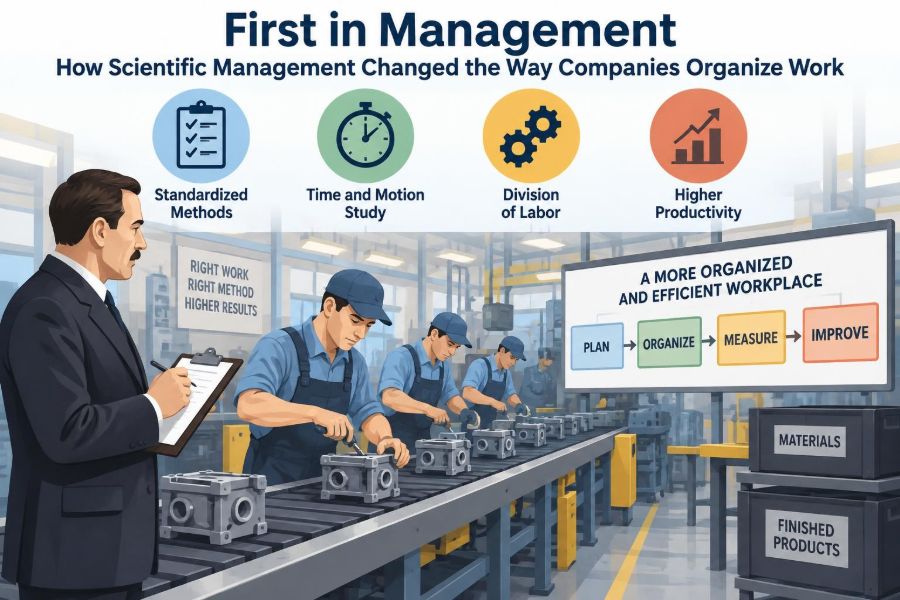
Managers often respond with schedules, checklists, targets, training, or new technology. Those tools have a long history. More than a century ago, scientific management offered one of the first systematic attempts to study work itself rather than simply telling workers to work harder.
The approach changed factories, offices, and management education. It also created serious debates about control, dignity, motivation, and the limits of measuring human effort.
Understanding scientific management helps explain why modern organizations use standard operating procedures, performance metrics, workflow design, and specialized roles—and why these practices need thoughtful limits.
🏭 The basic idea behind scientific management
Scientific management is an approach to organizing work by carefully studying tasks, identifying a more efficient method, standardizing that method, and training people to use it. Its central premise is that many jobs can be improved through observation, measurement, and deliberate design.
It was not “science” in the modern laboratory sense for every decision. Rather, it applied a systematic mindset to everyday operations: break work down, compare methods, remove avoidable motion, and establish a repeatable process.
👤 Frederick Winslow Taylor and the early movement
Scientific management is closely associated with Frederick Winslow Taylor, an American engineer who developed his ideas in the late nineteenth and early twentieth centuries. Taylor was concerned with industrial work that depended heavily on individual judgment, informal habits, and inconsistent supervision.
He argued that managers should study work scientifically instead of leaving each worker to determine the best method alone. His ideas became highly influential in manufacturing and helped establish management as a field of organized study.
🕰️ Why factories needed a new approach
Industrial production brought large groups of workers, machines, materials, and deadlines together in one place. Informal coordination that might work in a small workshop became harder when output depended on hundreds of interconnected tasks.
Different workers could perform the same job in different ways. Tools might be poorly arranged, instructions unclear, and output difficult to predict. Scientific management promised a way to make production more consistent.
🔍 From personal habit to work analysis
Before formal work study, experienced employees often developed their own methods through trial and error. That practical knowledge was valuable, but it could remain private, vary widely, or disappear when a worker left.
Scientific management tried to turn individual know-how into organizational knowledge. Managers observed tasks, documented steps, selected tools, and created a defined method that others could learn.
⏱️ Time studies and motion studies
A time study examines how long a task or task element takes under defined conditions. A motion study examines the physical actions involved, looking for movements that can be reduced, combined, rearranged, or eliminated.
For example, a packing station may require an employee to reach repeatedly for labels, tape, and boxes. Rearranging supplies within easy reach can reduce wasted motion without asking the person to rush. The goal, at its best, is better workflow design rather than faster effort alone.
🧩 Breaking a job into its component tasks
Scientific management treats a job as a sequence of smaller activities. A machine setup, for instance, may include gathering materials, positioning parts, adjusting settings, checking quality, and recording results.
Breaking work down makes hidden delays visible. It can reveal that a bottleneck is not the main task but an approval queue, a missing part, or a poorly designed handoff between departments.
📏 The search for a standard method
A key Taylorist idea was the “one best way” to perform a task. In practice, this meant selecting a method judged to be most effective for a specific job, then making it the standard.
Modern managers should treat that phrase carefully. A method may be best only under particular conditions: a certain product, volume, technology level, safety requirement, and employee skill level. Work changes, so standards should be tested and revised rather than treated as permanent truth.
📋 Standardization makes work repeatable
Standardization means defining consistent tools, sequences, specifications, or procedures. It makes results less dependent on who happens to be doing the work that day.
Consider a café with several locations. A standard recipe, portion guide, and cleaning routine can help customers receive a consistent experience. Standardization also simplifies training and quality checks, particularly for routine, high-volume tasks.
🎓 Training replaces guesswork
Scientific management did not only prescribe methods; it emphasized selecting and training workers for assigned tasks. If management defines a process, it has a responsibility to explain it, provide suitable tools, and allow employees to practice.
A checklist without instruction is not meaningful training. Effective training includes the reason for critical steps, demonstrations, supervised practice, and feedback when conditions differ from the normal process.
🤝 The intended division of responsibility
Taylor proposed a clearer division between management and workers. Managers would plan, study, schedule, and prepare work. Workers would carry out the defined tasks using the specified methods.
This separation made planning a recognized management responsibility. It also had a weakness: people closest to the work may notice practical problems that planners miss. Modern organizations generally benefit when planning is structured but employee knowledge still shapes improvements.
💰 Pay incentives and the productivity question
Scientific management often connected higher output to incentive pay. The reasoning was straightforward: if employees produced more using an improved method, they could earn more, while the organization could lower unit costs or increase capacity.
Incentives can influence behavior, but they are not neutral. If a warehouse rewards only items packed per hour, workers may have less reason to prevent errors or help new colleagues. A sound incentive system balances speed with quality, safety, customer outcomes, and teamwork.
⚙️ Specialization and its trade-offs
Specialization assigns people to narrower, repeated tasks. It can build speed and proficiency because workers do not constantly switch between unrelated activities. It also makes scheduling and capacity planning easier.
But narrow roles can become monotonous and may reduce a person’s understanding of the whole process. Organizations often address this through job rotation, cross-training, broader problem-solving responsibilities, and opportunities to develop new skills.
🏗️ What scientific management changed in factories
In manufacturing, scientific management encouraged systematic production planning, standardized tools, routing of materials, inspection processes, and clearer production targets. It helped shift attention from individual output alone to the design of the entire production system.
These ideas influenced later approaches to operations management, including assembly-line design, production scheduling, quality management, and process improvement. Scientific management was not the sole source of these developments, but it helped make operational analysis a normal managerial activity.
🏢 Its influence beyond manufacturing
The logic of scientific management spread far beyond factories. Offices adopted filing systems, standardized forms, clerical workflows, and measures of turnaround time. Retailers developed procedures for stocking, checkout, and inventory control.
Service organizations use similar principles when they map a customer journey, create a call-handling guide, or establish a repeatable onboarding process. The work may be less physical, but the questions about sequence, delay, variation, and quality remain familiar.
💻 A modern example: customer support workflows
Imagine a hypothetical software company receiving recurring password-reset requests. A process review may show that agents spend time locating the same instructions, verifying the same details, and manually logging the same outcome.
The company might create a secure self-service option, a clear decision tree for exceptions, and a shared knowledge base. This reflects scientific-management thinking: study repetitive work, remove avoidable steps, and standardize routine decisions. It should not, however, turn complex customer issues into rigid scripts.
📊 Performance measurement becomes a management tool
Scientific management strengthened the idea that managers need evidence about how work is performed. Measures such as cycle time, defect rates, queue length, rework, and on-time completion can expose operational problems that anecdotes overlook.
Metrics are signals, not complete explanations. A rising cycle time may indicate poor training, unreliable equipment, a complex order mix, understaffing, or a flawed handoff. Good managers investigate the process behind the number.
🧠 The risk of measuring only what is easy
Some parts of work are easy to count, while others are harder to see. A call center can measure call duration, but duration alone says little about whether the customer’s issue was resolved respectfully and correctly.
When a measure becomes the only target, employees may optimize it at the expense of the larger purpose. This is often called metric fixation: treating a narrow indicator as if it represents the entire performance of a system.
⚠️ Worker resistance was not accidental
Scientific management often drew resistance because workers feared that detailed measurement would lead to tougher quotas, job losses, wage cuts, or loss of control over their craft. In some settings, those fears were well grounded.
Resistance is not simply a sign that employees dislike change. It may signal that a proposed process ignores safety, reduces autonomy without fair compensation, or transfers efficiency gains upward while workers bear the pressure.
🧍 The human cost of excessive control
When every movement is dictated and every minute monitored, work can feel dehumanizing. Employees may have little room to use judgment, solve problems, or adapt to customer needs.
Repetitive work can also create physical strain if efficiency is defined too narrowly. An apparently faster movement may be unsafe when repeated throughout a shift. Ergonomics, rest, safe pace, and employee input must be part of process design.
🗣️ Why employee participation improves the method
Frontline employees regularly encounter exceptions, equipment quirks, and customer needs that do not appear in a flowchart. Their observations can prevent managers from standardizing an unrealistic process.
Participation works best when employees can identify waste, test alternatives, and receive feedback about what happens to their suggestions. Involving people does not mean every procedure is optional; it means the standard is informed by real work.
🔄 Standard work is a starting point, not a cage
A useful distinction in modern operations is between standard work and inflexible bureaucracy. Standard work provides a reliable baseline: the current safest, most effective known method for a recurring task.
Because it is a baseline, it can be improved. If a worker discovers a safer or clearer approach, the organization should test it, update the procedure if appropriate, and train everyone consistently. Improvement without documentation merely creates new variation.
🌱 How later management ideas responded
Later management theories expanded on what scientific management left out. Human relations thinking emphasized social needs, communication, and morale. Quality management focused on preventing defects across systems rather than blaming individual workers.
Lean management retained attention to waste and flow while often stressing continuous improvement and frontline participation. These approaches differ in important ways, but they share scientific management’s interest in understanding how work actually moves through an organization.
🧭 Scientific management versus human-centered management
| Question | Scientific-management emphasis | Human-centered emphasis |
|---|---|---|
| How is work improved? | Analyze tasks and standardize methods | Involve people, build capability, and improve systems |
| What is the manager’s role? | Plan, measure, specify, and supervise | Create conditions for judgment, learning, and collaboration |
| What is the main risk? | Overcontrol and narrow efficiency | Inconsistency or slow decisions if structure is weak |
| Best practical lesson | Make processes visible and testable | Respect the knowledge and needs of the people doing them |
These perspectives need not be enemies. Repetitive, safety-critical work may need precise standards, while knowledge work and customer-facing situations often require more discretion.
🛠️ When scientific-management tools work well
Its tools are particularly useful when work is frequent, observable, and reasonably stable. Examples include order fulfillment, laboratory preparation, routine maintenance, food preparation, claims processing, and basic administrative tasks.
- Use process mapping to identify delays and unnecessary handoffs.
- Use clear standards where consistency, safety, or compliance matters.
- Use time data to plan staffing and capacity, not merely to pressure people.
- Use pilot tests before imposing a redesigned process across the organization.
The more variable the work, the more room employees need to adapt the method.
🎨 When rigid standardization fails
Scientific-management methods become less suitable when tasks depend heavily on creativity, ethical judgment, relationship building, or novel problem solving. A teacher, nurse, designer, or consultant may use routines, but their work cannot be reduced entirely to a fixed sequence.
Even in routine roles, exceptions matter. A bank representative dealing with a distressed customer, for example, needs policies and guidance but also discretion. A script cannot anticipate every human circumstance.
🧪 A practical process-improvement cycle
Managers can use the useful parts of scientific management without repeating its harshest assumptions. The following cycle treats process improvement as collaborative learning.
- Define the outcome: Specify what must improve, such as fewer errors, safer work, or shorter customer waiting.
- Observe the current process: Watch actual work and ask employees where time, effort, or quality is lost.
- Find root causes: Separate symptoms from causes such as unclear instructions, missing materials, or poor system design.
- Test a change: Run a limited pilot and check quality, safety, workload, and customer effects.
- Standardize what works: Document the successful method and provide training.
- Review regularly: Update the process when conditions, tools, or evidence change.
🧯 Safeguards for fair implementation
Efficiency projects should include safeguards before new targets or monitoring systems are introduced. Employees need to know what data is collected, how it will be used, and how they can challenge inaccurate conclusions.
Managers should also examine whether gains come from eliminating waste or merely intensifying labor. A process that shifts more work onto people without better tools, pay, staffing, or recovery time may look efficient on a spreadsheet while creating turnover and errors later.
📚 What students can learn from this history
Scientific management is not just a historical chapter. It teaches a durable analytical habit: do not assume a problem is caused by lazy or incapable individuals before examining the process around them.
Ask practical questions. Is the task clearly defined? Are tools available? Is information arriving at the right time? Are incentives creating unintended behavior? These questions help future managers see performance as a system issue as well as an individual one.
👔 What working managers should remember
Managers do not have to choose between discipline and trust. They can establish clear expectations while inviting workers to improve the methods that shape their day.
A well-designed process reduces avoidable frustration: fewer searches for information, fewer preventable errors, fewer last-minute surprises, and clearer handoffs. The best systems make it easier for people to do good work rather than simply making them easier to monitor.
🔑 The enduring principle of scientific management
Scientific management changed organizations by insisting that work processes can be observed, understood, and deliberately improved. That insight remains central to operations, project management, service design, and organizational performance.
Its limitation is equally enduring: work is performed by people, not interchangeable parts. Productivity is strongest when careful measurement is combined with safety, fairness, skill, voice, and enough autonomy for employees to respond intelligently to real conditions.
The lasting lesson is not to control every movement, but to design work thoughtfully, learn from evidence, and improve systems with the people who use them every day. 📊🤝⚙️