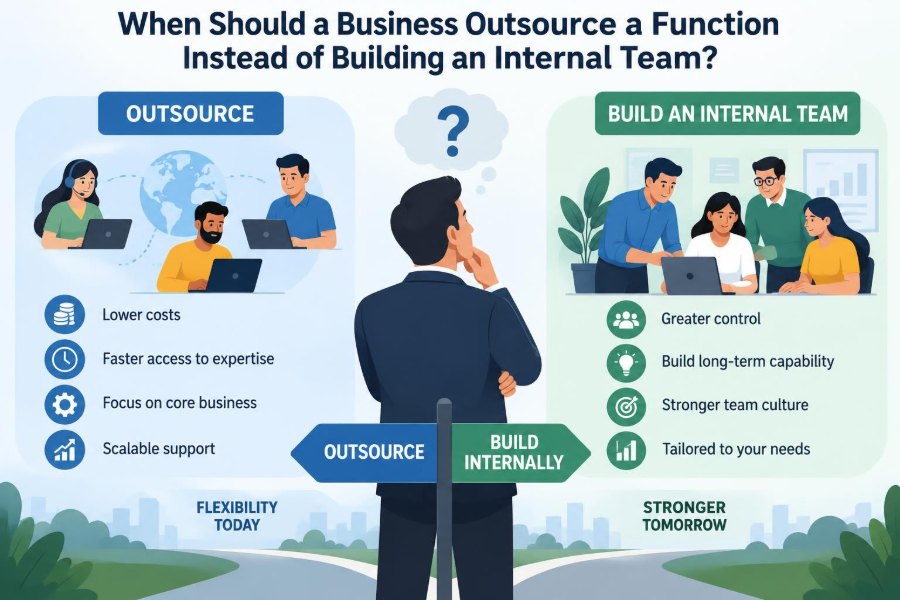

A growing business often reaches the same frustrating point: work is piling up, customers expect more, and the people already on the payroll cannot keep absorbing another specialist responsibility.
Perhaps a retailer needs help with paid advertising, a software company needs round-the-clock customer support, or a manufacturer needs cybersecurity expertise after a major client asks difficult questions. Hiring seems like the obvious answer—until leaders calculate the time, salary, management effort, tools, and uncertainty involved.
Outsourcing can provide capability quickly. But it can also create distance from customers, expose sensitive information, and leave a business dependent on a supplier it does not fully control.
The useful question is not whether outsourcing is “good” or whether internal teams are always better. It is whether a particular function should be owned, developed, and controlled inside the business at this stage of its growth.
🧭 Start With the Real Decision
Outsourcing means paying an external provider to perform a business activity. That provider may be a freelancer, specialist agency, managed-service company, contractor, or business-process partner.
The alternative is not simply “hire someone.” Building internally may require recruiting several people, training them, selecting systems, creating processes, and giving a manager responsibility for the function. A fair decision compares two operating models, not one invoice against one salary.
🎯 Separate Core Work From Supporting Work
A core function is central to why customers choose the business and how it creates lasting advantage. Supporting functions are necessary but do not usually determine the company’s unique position in the market.
A restaurant’s distinctive menu development may be core; payroll processing is usually supporting. For a cybersecurity company, however, security expertise is likely core even if basic bookkeeping remains suitable for an external specialist.
Core does not mean “important.” Payroll, compliance, and IT are all important. It means the activity directly shapes the business’s differentiated value.
🏆 Protect Sources of Competitive Advantage
Businesses should be cautious about outsourcing work that produces their most valuable knowledge, customer insight, or product distinction. If an external party designs the customer experience, learns what users want, and owns the improvement process, the business may lose its ability to innovate independently.
Consider a hypothetical online learning company. Outsourcing routine video editing may be sensible. Outsourcing all instructional design could be riskier if teaching quality and course structure are the reasons learners select it over competitors.
⚖️ Use a Make-or-Buy Comparison
Managers often call this a “make-or-buy” decision: make the capability internally or buy it from outside. The comparison should include the full cost and consequence of each option.
| Question | Building internally | Outsourcing |
|---|---|---|
| Upfront effort | Recruiting, setup, training | Provider selection and onboarding |
| Control | Usually high and direct | Shared through contracts and governance |
| Speed | Often slower at first | May access expertise quickly |
| Knowledge retained | Develops inside the firm | Can remain with the supplier |
| Capacity flexibility | Less flexible once hired | Often easier to scale up or down |
The lowest immediate price is not automatically the lowest total cost. Nor is direct control automatically worth every additional cost.
💰 Calculate Total Internal Cost
An employee’s salary is only one component of internal delivery. Total cost can include benefits, employer taxes where applicable, recruitment, equipment, software, workspace, supervision, training, and the cost of unfilled roles.
A new internal marketing team, for example, may need analytics tools, design support, campaign platforms, and management time before it produces reliable results. An external agency fee may appear larger than one salary but smaller than a complete functioning team.
🧾 Look Beyond the Supplier’s Fee
Outsourcing has hidden costs too. Leaders may need time to write requirements, review work, coordinate meetings, resolve misunderstandings, audit quality, and manage changes.
There can also be transition costs: moving data, documenting current processes, integrating systems, and communicating changes to employees or customers. Include a realistic allowance for oversight rather than assuming the provider makes management disappear.
⏱️ Consider Speed to Capability
Outsourcing is particularly useful when a business needs a mature capability faster than it can build one. A specialist provider may already have trained people, tested workflows, and suitable technology.
This matters when a short-term opportunity has a clear deadline, such as preparing financial records for a transaction, launching into a new language market, or responding to a temporary surge in demand. Speed is valuable only if the provider can meet the required standard.
📈 Match the Model to Demand Volatility
Stable, predictable work often supports an internal team because utilization can remain high. When demand rises and falls sharply, a fixed internal headcount can create either idle capacity or chronic overload.
Seasonal customer service is a familiar example. A retailer might keep a core internal service team while using a vetted external partner for peak periods. This hybrid model protects everyday knowledge while adding flexible capacity.
🧠 Ask Whether Scarce Expertise Is Needed
Some work requires expertise that is difficult to recruit, develop, or retain for a small volume of activity. Tax specialists, penetration testers, regulatory advisers, and certain engineering disciplines may be needed occasionally but critically.
Outsourcing can provide access to this depth without pretending that every business needs a full-time expert in every field. The key is to define exactly what expertise is being purchased and how its quality will be checked.
🔁 Distinguish Project Work From Ongoing Operations
A defined project with a clear outcome is often easier to outsource than an open-ended operating function. Examples include redesigning a website, implementing an accounting system, or conducting a security assessment.
Ongoing operations require more careful thought because the provider becomes part of the business’s daily rhythm. If priorities change continuously and informal collaboration drives results, an internal team may have a meaningful advantage.
📚 Assess How Much Business Knowledge the Work Requires
Every outsourced function needs some context. The issue is how much tacit knowledge—know-how that is difficult to write down—determines good performance.
A provider can follow a well-documented expense-claim process. It may struggle to handle sensitive customer complaints if successful resolution depends on subtle product knowledge, long-standing relationships, and judgment about the brand’s promises.
🔐 Treat Data Access as a Design Question
Outsourcing does not automatically make data unsafe, and keeping work internal does not automatically make it secure. Risk depends on access, systems, people, controls, and incident response.
Before sharing personal, financial, confidential, or commercially sensitive information, clarify what data the provider needs, where it is stored, who can access it, how access is removed, and what happens if an incident occurs. Legal obligations differ by location and sector, so businesses should seek appropriate professional advice when needed.
🛡️ Check Regulatory and Contractual Limits
Some industries impose requirements on records, confidentiality, professional qualifications, customer communication, or supplier oversight. Customer contracts may also limit where data is processed or who may access it.
These requirements do not always prevent outsourcing. They may require stronger due diligence, specific contractual clauses, approval rights, audit arrangements, or use of providers in particular jurisdictions.
🤝 Evaluate the Customer Experience
Customers rarely care whether a person is an employee or a supplier. They care whether the answer is accurate, timely, respectful, and consistent with what the business promised.
Outsource customer-facing work only when the provider can represent the brand well. Review scripts, escalation routes, language capability, response times, and authority to solve common problems. A cheap contact center can become expensive if it damages trust.
🗣️ Preserve Clear Accountability
A supplier can perform work, but the business remains accountable to its customers, owners, and regulators. “The vendor made the mistake” may explain an event internally, but it rarely solves the external consequence.
Name an internal owner for every outsourced function. That person should understand the desired outcome, monitor performance, make decisions the provider cannot make, and escalate problems early.
📏 Define Outcomes Before Choosing a Provider
Vague outsourcing produces vague results. “Improve our social media” or “handle IT” does not tell a provider what success looks like.
Set practical requirements before procurement: scope, quality standard, turnaround time, volumes, decision rights, reporting, exclusions, and escalation rules. These become the basis for proposals and later performance discussions.
📊 Measure What Actually Matters
Service-level agreements, often called SLAs, specify measurable commitments such as response times, availability, or error handling. They can be useful, but they should not encourage the provider to optimize an easy metric while missing the real goal.
For customer support, rapid replies matter, but so do correct resolutions and appropriate escalation. For payroll, timeliness matters, but accuracy and secure handling matter just as much. Combine quantitative measures with periodic quality review.
🧩 Choose the Right Outsourcing Model
Not all external arrangements are alike. A freelancer may suit a narrow task; an agency may suit a campaign; a managed service may operate an ongoing technical function; a business-process provider may handle a high-volume back-office workflow.
- Staff augmentation: external people work alongside internal teams under close direction.
- Project outsourcing: a provider delivers a defined result within an agreed scope.
- Managed service: the provider operates an ongoing service against agreed performance levels.
- Hybrid model: internal staff retain ownership while a provider supplies specialist or peak capacity.
The model should match the work, not simply the supplier’s preferred sales package.
🔍 Conduct Due Diligence Beyond a Sales Presentation
Strong proposals are useful, but they are not evidence that daily delivery will work. Ask who will actually do the work, how experienced they are, what happens when a key person is unavailable, and how the provider manages quality.
Review relevant experience, security practices where appropriate, financial stability, references that can be independently checked, and the provider’s approach to transition. A small pilot can reveal more than a polished presentation.
📝 Build a Contract for Reality
A contract should make expectations workable when circumstances are calm and when they are difficult. It should address scope, payment, ownership of work, confidentiality, data handling, service levels, change requests, liability, dispute resolution, and termination.
Contracts are not a substitute for trust or communication, but they prevent important assumptions from becoming expensive arguments. Complex arrangements should be reviewed by qualified legal and procurement professionals.
🚪 Plan the Exit Before the Beginning
Vendor lock-in occurs when changing provider—or bringing work back inside—becomes excessively difficult or costly. It can arise from proprietary systems, undocumented processes, inaccessible data, or a supplier holding essential operational knowledge.
An exit plan should specify data return, knowledge transfer, transition support, access removal, and ownership of documentation. This planning improves bargaining power even if the relationship remains successful for years.
🌱 Avoid Hollowing Out Internal Capability
Repeatedly outsourcing every difficult task can leave a company unable to judge quality, set strategy, or respond when a supplier fails. The problem is not merely dependence; it is the loss of internal learning.
Retain enough knowledgeable employees to make informed decisions. For strategic technology, for example, the business may outsource infrastructure operations while keeping internal product, architecture, and vendor-management capability.
👥 Consider Culture and Employee Impact
Outsourcing can affect morale, especially when employees believe their jobs, career paths, or expertise are being devalued. Sudden announcements and vague explanations increase anxiety.
Explain the business reason, the expected effect on roles, and the transition process honestly. Involving employees who understand current work can also improve supplier selection and prevent valuable process knowledge from being overlooked.
⚠️ Recognize Warning Signs That Outsourcing Is a Poor Fit
Outsourcing may be the wrong answer when a function is central to differentiation, requires constant fast collaboration, depends heavily on confidential insight, or lacks a stable and documentable process.
It is also risky when leadership lacks time to manage the relationship, chooses solely on price, or cannot explain what acceptable performance looks like. In those cases, the business may be trying to transfer an internal management problem rather than solve it.
🏗️ Recognize When Building Internally Makes Sense
Build an internal team when the work is enduring, strategically important, and likely to generate knowledge the business needs to own. Internal hiring also makes sense when frequent iteration with product, operations, and customers is essential.
An internal team can strengthen culture and institutional memory. It is not automatically faster or cheaper, but it can become more effective as the organization learns and processes mature.
🔄 Use a Phased Decision Rather Than a Permanent Bet
The choice does not need to be irreversible. A business might outsource a capability while validating demand, then hire internally once volume and strategy justify it. It might also build a small internal center of expertise while using an external provider for execution.
Set a review point at the start: what conditions would lead the business to renew, renegotiate, expand, reduce, or insource the arrangement? This keeps a temporary decision from becoming permanent through neglect.
🧪 Test With a Controlled Pilot
A pilot is useful when the function can be separated into a limited, low-risk scope. It lets the business assess communication, quality, reporting, and cultural fit without committing the entire operation.
Design the pilot with real success criteria and a fixed review date. Avoid judging it only by whether the provider is pleasant to work with; examine whether outcomes, costs, and handoffs meet the actual business need.
🗺️ Follow a Practical Decision Sequence
- Define the function and the outcome it must produce.
- Classify its strategic importance and knowledge sensitivity.
- Estimate full internal and external costs, including management effort.
- Assess demand stability, speed requirements, and specialist skill needs.
- Identify data, regulatory, customer, and continuity risks.
- Select a model, test providers, and set measurable governance.
- Plan transition, review points, and a workable exit route.
This sequence makes the decision more rigorous without treating it as a purely financial calculation.
✅ The Core Principle: Outsource Capacity, Not Responsibility
The strongest outsourcing decisions use outside capability where it adds flexibility, specialist depth, or speed without surrendering the knowledge and control that define the business. The company keeps strategic ownership even when another organization performs part of the work.
Conversely, building internally is justified when the function is deeply connected to competitive advantage, continuous learning, and the experience customers value. The answer can differ across functions within the same company—and can change as that company grows.
A business should outsource when an external partner can deliver a clearly defined, well-governed function more effectively than an internal team, without weakening the capabilities the business must truly own. Good outsourcing is not abdication; it is a deliberate operating choice that is reviewed as needs evolve. 📊🤝