
A department is asked to reduce spending by 10%. The first choices seem obvious: postpone software upgrades, freeze hiring, trim training, renegotiate supplier contracts, and ask the team to “do more with less.” For a while, the numbers may look encouraging.
Then small frictions begin to appear. Customer requests wait longer, experienced employees leave, salespeople lose time fixing operational problems, and managers approve exceptions that quietly undo the original savings. The business has spent less, but it may also be becoming harder to run.
Cost control is necessary in every organization. Cash is finite, markets change, and waste should not be protected simply because “that is how we have always done it.” Yet reducing cost and improving efficiency are not the same thing.
The central management challenge is knowing where the productive discipline ends and where harmful underinvestment begins. That boundary is rarely found in one budget line; it is revealed through customer value, operating capacity, employee capability, and the business’s ability to grow.
🎯 Cost Cutting Is Not the Same as Efficiency
Cost cutting means reducing spending. Efficiency means producing the same or greater value with fewer resources, less time, or less avoidable effort. A spending reduction can create efficiency, but it can also merely transfer work, risk, or expense elsewhere.
For example, automating invoice matching may lower processing time while improving accuracy. That is efficiency. Eliminating the staff who resolve complex supplier disputes may reduce payroll immediately, but create delayed payments, missed discounts, and damaged relationships. That is a cost reduction with uncertain economic value.
The question is not “Can this expense be removed?” It is “What output, risk protection, or future capability does this expense support?”
📉 Why Leaner Budgets Can Look Better Than They Are
Financial reports often show a cut before they show its consequences. Payroll falls this quarter; lost renewals may not be visible until next year. A maintenance budget shrinks now; equipment failures may emerge later.
This timing difference can make short-term savings appear more attractive than they truly are. Managers should distinguish between real structural savings and costs that have simply been delayed, shifted to another team, or converted into future risk.
A lean budget is useful only if the organization can still deliver its promised value reliably.
🧭 Begin With the Business Model
There is no universal safe percentage for cost reduction. A low-margin distributor, a premium consulting firm, a hospital, and a software company depend on different resources to compete.
Start by identifying what customers actually pay for. It may be speed, low price, specialist expertise, product reliability, personal service, convenience, or trust. Costs directly supporting that promise deserve closer protection than costs with little connection to it.
A budget should reflect the business model. Cutting the capability that makes a firm distinct can leave it cheaper to operate but less compelling to choose.
🔗 Separate Value-Creating Costs From Supporting Costs
Every cost is not equally valuable, but neither is every indirect cost waste. A useful first step is to map expenses into broad roles.
| Cost role | Typical examples | Management question |
|---|---|---|
| Direct value creation | Production inputs, delivery staff, product expertise | Does reducing this weaken the customer offer? |
| Capability building | Training, product development, systems improvement | Does this support future performance or growth? |
| Risk and resilience | Maintenance, quality control, cybersecurity, compliance | What failure becomes more likely if this is cut? |
| Administrative support | Reporting, facilities, coordination, routine processes | Can the work be simplified, shared, or automated? |
This classification does not decide the answer automatically. It makes the trade-off visible before leaders treat all expenses as interchangeable.
⚙️ Find Waste Before Removing Capacity
The safest savings often come from work that consumes resources without improving the customer outcome: duplicate data entry, rework, unused subscriptions, avoidable approvals, poorly timed purchasing, excess inventory, and preventable errors.
Removing waste is different from reducing capacity. If a team spends six hours each week compiling reports no one uses, ending the report may free time without reducing service. If the same team is already fully occupied serving clients, removing a person reduces capacity.
Process observation matters here. Budget spreadsheets can show where money goes, but not always why work exists.
🧮 Measure the Full Cost, Not Just the Invoice
A cheaper option may create hidden costs in delay, supervision, quality failures, returns, downtime, or customer churn. Managers need a total-cost view: the direct price plus the consequences of using that option.
Consider a hypothetical retailer that changes to a lower-cost packaging supplier. The purchase price falls, but damaged deliveries rise and warehouse staff spend more time repacking orders. The apparent saving may disappear once returns, labor, and customer dissatisfaction are included.
Before a major cut, ask who will absorb the work or risk that the budget line previously covered.
📈 Understand the Cost-to-Serve Curve
Not all customers, products, or channels cost the same amount to serve. A small number of accounts may generate frequent custom requests, late changes, complex support needs, or unusually high delivery costs.
Cost-to-serve analysis links revenue to the resources required to earn it. It can reveal that a profitable-looking product line is actually consuming disproportionate operational effort, while a modest account is valuable because it is stable and easy to serve.
The purpose is not automatically to remove high-cost customers. It is to price, redesign, automate, or negotiate service intelligently rather than cutting broadly.
🚦 Watch for the Capacity Threshold
Most operations have a point at which removing a person, shift, machine, or support function causes queues to grow rapidly. This is a capacity threshold. Below it, work still flows; beyond it, delays multiply.
A customer service team, for instance, may cope with normal demand after one vacancy is left unfilled. A second vacancy can push call volumes beyond what the remaining team can handle, increasing abandoned calls and burnout.
Average workload can hide this problem. Managers should examine peak periods, seasonal variation, absences, and the time required for complex cases.
⏱️ Treat Waiting Time as a Business Cost
Waiting is often invisible because it does not appear as a separate invoice. Yet customers wait for deliveries, employees wait for approvals, sales teams wait for proposals, and production waits for decisions or materials.
When staff reductions create bottlenecks, the business may lose revenue without recording a clear “cost-cutting failure.” A slow quote can mean a lost sale; a delayed repair can mean lost production; a delayed refund can damage trust.
Track lead times, backlog, response times, and handoffs alongside expense reductions. They reveal whether a leaner operation is still responsive.
👥 Labor Cuts Carry Knowledge Costs
People do more than complete visible tasks. Experienced employees understand exceptions, informal workflows, customer history, supplier behavior, and warning signs that rarely appear in process manuals.
Reducing headcount can therefore remove organizational memory. Remaining colleagues may spend months rediscovering how to handle unusual situations, while managers become the escalation point for problems once solved quickly by experienced staff.
If workforce reductions are unavoidable, document critical knowledge, plan handovers, and protect roles that connect complex systems or key relationships.
🧠 Training Is Often an Investment, Not a Perk
Training budgets are easy to postpone because the absence of training rarely creates an immediate crisis. But cutting development can reduce quality, slow adoption of new tools, increase errors, and narrow the internal pipeline for future roles.
Not every course is worthwhile. The better question is whether learning is tied to a real capability need: safer operations, stronger management, technical competence, customer communication, or required compliance.
Targeted learning can often be redesigned more efficiently through peer coaching, internal workshops, or focused modules. Eliminating it entirely may be a false economy.
🛠️ Maintenance Cuts Can Turn Into Downtime
Preventive maintenance is work done before a failure occurs. Because it produces no dramatic visible output on a good day, it is frequently treated as discretionary.
Its value lies in reliability. Skipping routine checks may save labor or contractor fees now, but failures can interrupt production, delay customers, require urgent repairs, and create safety or quality concerns depending on the setting.
Managers should distinguish low-value maintenance routines from maintenance that protects critical assets. Asset history, manufacturer guidance, usage conditions, and operational consequences all matter.
🔐 Protect Controls, Safety, and Compliance
Some costs exist to prevent low-frequency but serious events: data breaches, financial errors, workplace injuries, regulatory failures, and reputational damage. Their value is partly the absence of a problem, which can make them difficult to defend during a budget review.
These functions should not be exempt from improvement. Processes can be simplified and technology can reduce manual control work. However, reducing safeguards without understanding the resulting exposure is not efficiency.
Where legal, safety, or financial obligations apply, organizations should seek appropriate professional advice rather than relying on general budget rules.
💻 Distinguish Digital Simplification From Digital Underinvestment
Software subscriptions, technical support, and system upgrades deserve scrutiny. Businesses commonly retain duplicate tools, pay for unused licences, or buy features that do not fit actual workflows.
At the same time, removing a core system or delaying essential upgrades can create manual work, weak data, security gaps, and frustrated customers. The right move may be consolidation rather than indiscriminate technology cuts.
Review usage data, integration needs, contract terms, and the manual effort required if a tool disappears. A low subscription cost may support a high-value process.
🏷️ Procurement Savings Need Quality Guardrails
Supplier negotiations can create meaningful savings through better terms, volume planning, specification changes, or reduced fragmentation. But selecting solely on unit price can increase defects, delivery uncertainty, and management effort.
Use clear guardrails when sourcing: acceptable quality, lead time, continuity of supply, service standards, and total cost. A supplier that is modestly more expensive but consistently dependable may protect sales and operating stability.
Competitive bidding is most useful when requirements are clear. If specifications are vague, suppliers may quote differently, making a cheap comparison misleading.
📦 Inventory Can Be Lean Without Being Fragile
Excess inventory ties up cash, uses space, and can become obsolete. Reducing it can improve cash flow and reveal planning problems. Yet inventory is also a buffer against demand swings, supplier delays, and production interruptions.
The appropriate buffer depends on demand predictability, replenishment time, product criticality, and the cost of a stockout. A spare part that prevents days of downtime may justify a higher stock level than a slow-moving decorative item.
Lean inventory works best when forecasting, supplier reliability, and replenishment processes are strong enough to support it.
📣 Marketing Cuts Can Shrink Tomorrow’s Pipeline
Marketing spend is often reduced first because its returns are not always immediate or neatly attributable. Some campaigns are indeed ineffective and should be stopped. Others build awareness, nurture leads, retain customers, or support launches whose results emerge over time.
Instead of applying a blanket reduction, review channel purpose and evidence. Which activity generates qualified demand? Which protects retention? Which is being continued only by habit?
A business that cuts all demand generation during a downturn may improve short-term profit while making recovery harder when capacity becomes available again.
🌱 Product Development Determines Future Relevance
Research, design, experimentation, and product improvement can seem optional when current sales are under pressure. However, these activities help a business respond to changing customer needs and competitors.
Not every initiative should survive. Projects with unclear customer value, weak learning, or no feasible path to delivery may need to pause. The mistake is treating all development as overhead rather than managing it as a portfolio of bets with different levels of risk and promise.
Protect a realistic level of exploration, especially where the current offering is aging or the market is moving quickly.
🤝 Customer Service Is Part of the Product
For many businesses, the experience after purchase shapes repeat sales as much as the product itself. Reducing support channels, shortening service hours, or increasing caseloads may lower costs while raising customer effort.
Customer service does not always need more people. Better self-service information, clearer onboarding, product fixes, and smarter routing can reduce demand. But self-service should solve simple problems, not force customers through a maze when they need human judgment.
Monitor repeat contacts, escalations, complaints, cancellation reasons, and resolution time after service changes.
🧾 Use Unit Economics to Test the Decision
Unit economics examines the revenue and costs associated with one unit of activity: a product sold, customer served, delivery completed, or subscription retained. It helps connect broad budget choices to operational reality.
For example, a delivery business might examine revenue per route, fuel, driver time, vehicle use, failed deliveries, and support contacts. A route-saving initiative that increases failed deliveries may damage unit economics even if fuel spending falls.
Choose units that reflect how value is created. A misleading unit measure can encourage managers to optimize the wrong behavior.
📊 Build a Balanced Scorecard for Cost Programs
No single metric can tell leaders whether a cost program is healthy. Expense reduction should be reviewed alongside leading indicators that show operational strain before revenue falls.
- Customer outcomes: retention, complaints, delivery reliability, response times
- Operational flow: backlog, error rates, rework, downtime, cycle time
- People indicators: turnover, absenteeism, overtime, vacancy duration
- Financial outcomes: gross margin, cash conversion, cost per unit, renewal value
The measures should be few enough to use. A dashboard full of numbers that nobody discusses is not a control system.
🧪 Pilot Changes Before Scaling Them
A controlled pilot reduces the risk of a large, irreversible mistake. Test a new staffing model in one region, a revised approval process in one function, or a supplier change with a limited product range.
Define what success and failure would look like before the pilot begins. This includes cost results, service standards, quality thresholds, and the time period needed to observe meaningful effects.
Pilots are not a way to avoid decisions indefinitely. They are a way to learn whether an apparently sensible saving works under real operating conditions.
🔄 Reinvest Some Savings in Better Systems
The strongest cost programs do not simply remove money from the organization. They redirect part of the saving toward changes that permanently lower effort or improve performance: process redesign, automation, cross-training, better forecasting, quality improvements, or modern equipment.
This creates a more durable form of efficiency. For example, reducing redundant reporting can free analysts to improve demand planning, which may later reduce inventory waste and stockouts.
Without reinvestment, repeated cuts can become a cycle of declining capability. With careful reinvestment, a business can operate more simply and serve customers better.
🪜 Sequence Cuts to Preserve Options
Irreversible decisions should usually come later than reversible ones. Canceling unused subscriptions, improving purchasing discipline, simplifying approval layers, and reducing avoidable rework can be tested or reversed more easily than closing a site or eliminating specialist roles.
A sensible sequence gives management time to learn from early measures. It also avoids solving a temporary revenue problem with permanent cuts to capabilities that will be needed when demand returns.
Urgency may sometimes require faster action, but urgency does not remove the need to understand second-order effects.
🗣️ Explain the Logic to Employees
Employees can often identify waste that senior leaders cannot see. They also notice quickly when a program feels arbitrary, unfair, or disconnected from customer realities.
Communication should explain the business context, the principles guiding choices, what is not being compromised, and how people can raise practical concerns. Avoid promising certainty where none exists.
Transparency does not mean sharing every confidential detail. It means treating people as informed participants rather than expecting commitment to unexplained disruption.
⚠️ Avoid Across-the-Board Percentage Cuts
An equal percentage reduction can feel fair, but it assumes every function has the same slack and strategic importance. It may remove essential capacity from a customer-facing team while leaving low-value internal activity largely untouched.
Across-the-board cuts are sometimes used when information is limited and speed is essential. Even then, they should be a temporary starting point, followed by a more detailed review.
Better decisions are uneven by design: deeper where spend has little value, lighter where it protects the customer promise, resilience, or future growth.
🧯 Recognize the Warning Signs of Overcutting
Overcutting seldom announces itself with one dramatic signal. It usually appears as a pattern: more urgent work, increasing exceptions, recurring quality failures, managers doing frontline tasks, longer queues, and rising dependence on overtime.
Other signals include delayed projects, lost institutional knowledge, deteriorating supplier relationships, and customer complaints that are dismissed as isolated events. These are not always proof that a cut was wrong, but they require investigation.
Set review points in advance. If agreed service or quality thresholds are breached, leaders should be prepared to adjust rather than defend the original target.
🧩 Use Scenario Planning for Uncertain Demand
Cost decisions are harder when future demand is unclear. Scenario planning helps leaders test a proposal against several plausible conditions: demand falls further, demand stays flat, or demand recovers faster than expected.
For each scenario, ask whether the business retains enough capacity to serve customers, enough cash to endure pressure, and enough flexibility to respond. This exposes cuts that look safe only under one optimistic assumption.
The goal is not to predict the future perfectly. It is to avoid designing an operation that fails whenever reality differs from the budget.
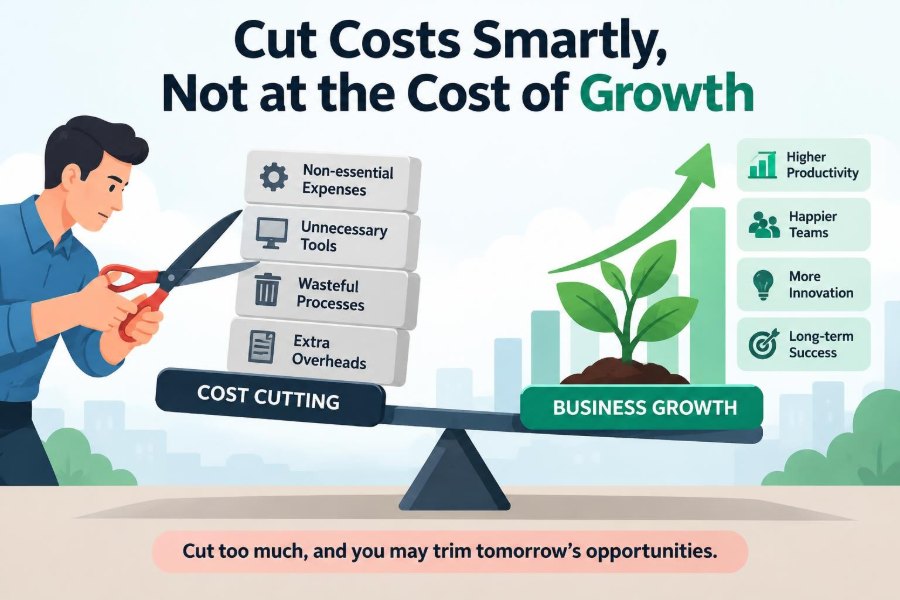
🏁 The Core Principle: Cut Friction, Not the Engine of Growth
The most useful distinction is between friction and the engine. Friction includes unnecessary handoffs, duplicate work, idle assets, poor purchasing, unclear processes, and activities with no meaningful user. The engine includes the capabilities that create demand, deliver reliably, retain customers, develop people, and manage serious risk.
Good management continually reduces friction. It protects and improves the engine. The exact boundary will differ by industry and business model, which is why leaders must use operational evidence rather than a universal spending rule.
A cost program is successful when the organization becomes easier to run, not merely cheaper on paper.
A business has cut too far when each additional saving weakens its ability to deliver value, adapt, or grow more than it improves its financial resilience. Sustainable efficiency comes from removing waste with care while preserving the people, systems, relationships, and capabilities that customers depend on. 📊🌱🤝