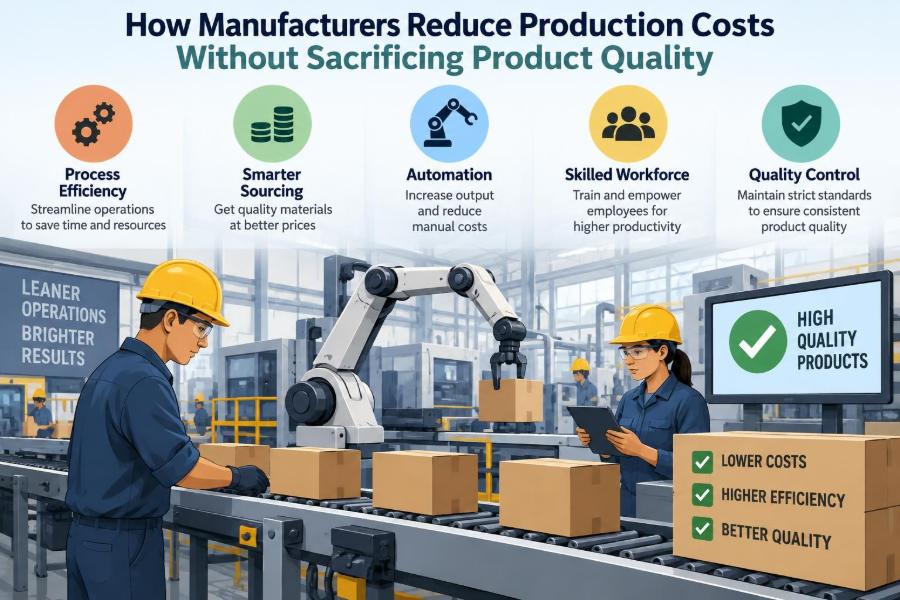

A factory manager sees material prices rise, a late shipment disrupts the schedule, and customers still expect the same reliable product. The obvious response is to cut spending quickly: buy cheaper inputs, reduce inspection, or ask employees to work faster.
Those choices can lower this month’s visible expenses. They can also create hidden costs through defects, returns, rework, missed delivery dates, warranty claims, and lost trust.
Well-run manufacturers approach the problem differently. Rather than simply making products more cheaply, they remove the activities, delays, errors, and variability that make production unnecessarily expensive.
That distinction matters to students learning operations management and professionals making daily decisions. Sustainable cost reduction protects the features customers value while improving how reliably the factory produces them.
🎯 Start With the Right Definition of Quality
Quality is not automatically the most premium material, the tightest possible tolerance, or the largest number of product features. It means consistently meeting the requirements that matter to the intended customer, safely and reliably.
A component for medical equipment, for example, may require strict traceability and precision. A basic storage container may need durability, accurate dimensions, and a clean finish, but not aerospace-level tolerances. Spending beyond the real requirement is waste; spending below it creates failure.
The objective is conformance to customer needs at the lowest total cost, not the lowest purchase price.
🧾 Separate Cost Reduction From Cost Shifting
A decision can appear to save money while merely moving cost elsewhere. Reducing incoming inspection may lower the quality department’s budget, but it can shift the burden to production workers who discover faulty material after machining has begun.
Likewise, extending maintenance intervals may reduce planned maintenance hours while increasing emergency repairs and downtime later. Managers need to trace a proposed saving across purchasing, production, logistics, customer service, and the product’s use.
A genuine improvement reduces the total resources needed to deliver a dependable product. Cost shifting only makes one department look efficient.
🔍 Map the Full Cost of Making a Product
Before changing anything, manufacturers need a practical view of where time, materials, energy, labour, and overhead are consumed. A process map follows the product from supplier receipt through processing, inspection, packing, and dispatch.
This exercise often reveals costs that accounting categories conceal: queues between operations, repeated handling, searching for tools, waiting for approvals, and scrapping parts after significant work has already been added.
For a hypothetical metal bracket, the cutting operation might take two minutes, yet the part may spend hours waiting in containers. The machine cycle is not necessarily the main opportunity.
🗑️ Remove Waste Without Removing Value
Lean manufacturing uses the term waste for activity that consumes resources without adding customer value. The idea does not mean eliminating every support activity; calibration, safety checks, and essential inspections may not change the product directly, but they protect its quality.
Common forms of waste include:
- Overproduction: making items before they are needed.
- Waiting: idle people, machines, or materials.
- Excess transport and motion: moving products or searching for equipment.
- Overprocessing: doing work beyond the specification.
- Inventory: holding more material or work-in-progress than necessary.
- Defects: correcting, replacing, or discarding nonconforming output.
Removing waste frees capacity and reduces cost without asking customers to accept a weaker product.
📏 Build Quality Into the Process
Inspecting finished goods is necessary in some industries, but it is a weak primary method of quality control. By the final stage, labour and materials have already been invested in a defective item.
Process quality means designing work so errors are less likely and easier to detect immediately. Examples include fixtures that hold a part in only the correct orientation, sensors that confirm a component is present, and software that prevents an operator from selecting the wrong program.
This approach is often called quality at the source. It lowers the cost of failure by stopping errors close to where they occur.
🧩 Use Standard Work to Reduce Variation
Standard work documents the safest and most effective currently known method for completing a task. It can define the sequence, tools, settings, checks, and expected time without treating skilled employees as interchangeable machines.
When each operator uses a different informal method, output can vary in dimensions, appearance, and speed. Training becomes harder, troubleshooting turns into guesswork, and dependable quality depends too heavily on individual experience.
Good standards are living documents. Teams should revise them when evidence shows a safer, simpler, or more consistent method.
⚙️ Improve the Bottleneck First
The bottleneck is the resource that most limits the system’s overall output. It may be a machine with the longest cycle time, a specialised operator, a test station, or an approval process.
Improving a non-bottleneck machine can make that local area look productive while creating more inventory waiting at the true constraint. Improving the bottleneck, by contrast, can raise throughput and reduce late orders across the operation.
Managers should observe actual flow, not rely only on equipment utilisation reports. A machine running continuously may be making items nobody needs yet.
⏱️ Shorten Changeovers Carefully
A changeover is the time required to switch a machine or line from one product, colour, size, or batch to another. Long changeovers encourage large batches because managers try to spread setup time across more units.
Large batches can hide defects for longer, consume storage space, and make a business slow to respond to changes in demand. Reducing setup time makes smaller, more responsive batches economically practical.
Useful techniques include preparing tools and materials before the machine stops, using quick-release fixtures, and separating tasks that can be done while equipment is running from those that cannot. Any change must still preserve setup verification.
📦 Control Inventory Rather Than Simply Cutting It
Inventory ties up cash, needs storage, can become obsolete, and may conceal unreliable processes. Yet inventory also protects production from supplier delays and demand fluctuations. The right level depends on risk, lead time, reliability, and the consequences of a stockout.
Blindly reducing stock can cause line stoppages and expensive urgent freight. Better inventory control begins with accurate records, realistic demand assumptions, clear reorder rules, and attention to slow-moving items.
Inventory should be a deliberate buffer, not an accidental substitute for solving operational problems.
🚚 Strengthen Supplier Quality and Collaboration
Cheaper purchased material is not cheaper if it produces more scrap, requires extra sorting, damages equipment, or performs poorly for the customer. Supplier selection should consider delivered quality, consistency, lead time, responsiveness, technical support, and total landed cost.
Manufacturers can share specifications clearly, provide feedback on defects, and work with important suppliers to improve packaging, batch control, and delivery schedules. This is more constructive than treating suppliers solely as targets for price pressure.
Dual sourcing can reduce disruption risk, but it also requires effort to qualify and monitor more than one source. The appropriate approach depends on the criticality of the item.
🛠️ Prevent Breakdowns Before They Stop Production
Unplanned equipment failure is costly because it interrupts flow, forces rescheduling, risks missed deliveries, and may produce poor-quality output before anyone notices a problem. Preventive maintenance schedules inspections, lubrication, adjustments, and replacement of known wear items.
Predictive maintenance goes further by using condition signals, such as vibration, temperature, or operating history, to identify emerging issues. Not every machine needs sophisticated monitoring; a simple daily check can be valuable on a critical asset.
Maintenance should be judged by uptime, reliability, and quality stability, not only by how little is spent on repairs.
📉 Reduce Defects Through Root-Cause Analysis
When a defect occurs repeatedly, workers may be tempted to add another inspection or tell operators to “be more careful.” These responses can contain the issue, but they rarely explain why it happens.
Root-cause analysis investigates the conditions that allow a problem to occur: an unclear drawing, worn tooling, an unstable temperature, an incorrect material label, or an impractical work instruction. Teams may use tools such as the “five whys” or cause-and-effect diagrams, but the tool matters less than verifying the cause with evidence.
A durable corrective action changes the process, not merely the reminder.
🧪 Apply Statistical Process Control Where It Fits
Statistical process control, often shortened to SPC, uses measurements over time to distinguish routine process variation from unusual signals that need investigation. A control chart can show whether a dimension is drifting before it crosses a specification limit.
SPC is especially useful for repeatable processes that generate enough data, such as filling, molding, machining, or coating. It is less helpful when measurements are unreliable or when operators collect numbers without authority to act on them.
The goal is not to create more paperwork. It is to intervene early, before ordinary variation becomes customer-visible failure.
🧠 Design Products for Manufacturability
Many production costs are determined before the factory begins making the product. Design for manufacturability asks whether a product can be produced consistently with available processes, reasonable tolerances, straightforward assembly, and practical inspection.
For example, reducing the number of unique fasteners can simplify purchasing, storage, assembly, and maintenance. Changing a feature so it can be accessed by a standard tool may reduce assembly time without changing customer value.
Design changes require cross-functional review. A part that is easier to manufacture but harder to service or less durable is not necessarily an improvement.
🔧 Simplify Product Variety When It Adds Little Value
Every additional variant can create separate bills of materials, forecasts, tools, labels, training needs, inventory positions, and quality risks. Product variety can be valuable when it addresses genuinely different customer needs, but some variation exists only because old options were never reviewed.
Manufacturers can analyse which configurations sell consistently, which create disproportionate complexity, and whether components can be shared across models. Modular design lets customers choose meaningful options while keeping the core product stable.
Eliminating a variant should be based on demand, margin, strategic value, and customer impact—not simply on what is easiest for the factory.
👷 Develop Skills Instead of Relying on Heroics
Experienced employees often know how to spot subtle faults, recover from disruptions, and keep equipment performing well. If that knowledge stays informal, a business becomes vulnerable when people are absent, promoted, or leave.
Structured training, clear visual instructions, cross-training, and mentoring make reliable performance less dependent on individual heroics. Cross-trained teams can also cover absences and reduce delays at specialised workstations.
Training costs time and money, but inadequate training can cause costly errors, accidents, turnover, and uneven quality. Competence is part of the production system.
🗣️ Give Frontline Teams a Voice
Operators, technicians, and material handlers see small sources of waste every day: a bin placed too far away, a label that is easily confused, a fixture that needs repeated adjustment, or a handoff that creates delay.
A continuous-improvement system gives people a straightforward way to raise problems, test ideas, and receive feedback. Management must respond credibly; suggestion schemes fail when employees see ideas disappear without explanation.
Small improvements can be powerful because they are close to the work. They should still be evaluated for safety, quality, and effects on other steps.
🏭 Improve Layout and Material Flow
A poor layout causes unnecessary walking, forklift trips, handling, and congestion. Each movement creates time, damage risk, and opportunities for parts to be mixed up.
Arranging equipment around the actual sequence of work can shorten travel and make problems more visible. In some settings, a cellular layout groups the resources needed for a family of products, allowing materials to flow through a compact area.
Layout changes can be disruptive and may not suit very large equipment or highly variable product routes. A low-cost trial with marked floor areas can reveal problems before permanent changes are made.
💡 Manage Energy and Utilities as Process Costs
Energy, compressed air, water, heating, cooling, and ventilation are production inputs. Leaks, unnecessary idling, poor insulation, and equipment operating outside efficient ranges can add cost without improving output.
Useful actions include shutting down equipment safely during extended idle periods, repairing compressed-air leaks, monitoring unusually high consumption, and aligning operating schedules where practical. However, energy-saving changes must not compromise temperature control, curing, sanitation, or other quality-critical conditions.
Measuring consumption by area or process can help teams identify questions worth investigating, rather than assuming every increase is waste.
📲 Automate Stable, Repetitive Work
Automation can improve consistency, speed, traceability, and safety, particularly in repetitive tasks with predictable inputs. Examples include vision systems checking labels, equipment dispensing a controlled quantity, or software capturing production data automatically.
Automation is not a universal cost-cutting answer. A poorly understood or unstable process may be automated into a faster source of defects. Equipment also brings capital cost, maintenance needs, programming skills, and less flexibility when demand changes.
A sensible case compares the full lifecycle cost with expected gains in capacity, quality, safety, and resilience.
🧾 Use Data That Leads to Decisions
Factories generate data on scrap, downtime, output, returns, delivery, labour hours, and material usage. The challenge is choosing measures that reveal performance rather than creating dashboards nobody uses.
A balanced set may include first-pass yield, on-time delivery, customer complaints, equipment availability, and material loss. Definitions must be consistent; otherwise, teams can debate the numbers rather than improve the process.
Metrics should prompt useful questions: Where did variation increase? What changed? Is the measure being improved by transferring work or risk elsewhere?
💰 Evaluate Total Cost, Not Unit Labour Alone
Low direct labour cost can be attractive, but it is only one part of the equation. A sourcing or production decision may affect freight, inventory, quality assurance, lead time, communication, tariffs where applicable, engineering changes, and disruption exposure.
For example, producing a part closer to assembly may cost more per labour hour but reduce transit time, damage, inventory, and response time. The best decision depends on actual conditions, not a single headline rate.
Total-cost thinking also prevents managers from rejecting quality improvements simply because the savings appear in another department’s budget.
⚖️ Make Quality Costs Visible
The cost of quality includes spending to prevent defects, spending to assess conformance, and the cost of failures. Failures can be internal, such as scrap and rework, or external, such as returns, service visits, recalls, and damage to customer relationships.
Prevention and assessment are not automatically excessive overhead. A well-designed preventive action may cost less than repeatedly correcting the same failure after value has been added.
| Cost category | Typical examples | Management question |
|---|---|---|
| Prevention | Training, process design, supplier qualification | Can the error be avoided? |
| Assessment | Inspection, testing, calibration | Are requirements being met? |
| Internal failure | Scrap, rework, retesting | Why was the issue found late? |
| External failure | Returns, warranty work, complaints | How did the defect reach the customer? |
🚦Pilot Changes Before Full Rollout
A promising change on paper can create unintended effects on safety, product performance, workload, or downstream operations. A pilot limits exposure while the team tests assumptions in real conditions.
Define what success looks like before the trial begins. This may include defect rates, cycle time, material use, operator feedback, and customer-relevant performance. Compare results with a credible baseline rather than relying on impressions.
If the pilot fails, that information is useful. It can reveal a faulty assumption before the organisation commits to a costly rollout.
🛡️ Protect Safety and Compliance Boundaries
Some controls are non-negotiable. Product safety requirements, legal obligations, environmental controls, traceability needs, and validated processes in regulated sectors cannot be casually removed in the name of efficiency.
Even outside highly regulated industries, bypassing guards, reducing safety training, or rushing hazardous tasks can create severe human and financial consequences. The same is true of changing materials without verifying performance and compatibility.
Cost improvement should make work safer and more controlled where possible. It should never depend on accepting avoidable danger or noncompliance.
🚫 Avoid the Most Common False Savings
Several shortcuts repeatedly damage quality and long-term profitability:
- Choosing materials solely by quoted price.
- Reducing inspection before the process is capable and stable.
- Postponing maintenance to meet a short-term budget target.
- Producing oversized batches to maximise local machine utilisation.
- Cutting training, documentation, or calibration without understanding the risk.
- Measuring managers only on departmental costs rather than total performance.
These actions can be tempting because their savings are immediate and visible. Their negative effects often appear later, in another department, or at the customer.
🔄 Create a Continuous Improvement Routine
Cost and quality improve together when improvement is part of normal management, not an occasional emergency project. Teams need regular review of performance, a method for escalating obstacles, and time to test and standardise better ways of working.
A practical cycle is simple: identify a problem, understand the current condition, test a focused change, check the result, standardise what worked, and continue monitoring. This is more reliable than launching many broad initiatives without ownership.
Leaders set the tone by asking for evidence, learning from failures, and recognising improvements that protect customer value.
🤝 Align Finance, Operations, Engineering, and Sales
Production cost decisions cross functional boundaries. Engineering may specify a feature, purchasing may select a supplier, operations may absorb variation, finance may measure savings, and sales may manage customer expectations.
Cross-functional review prevents local optimisation. For instance, a packaging change that reduces material expense should be tested for transport damage, packing speed, customer usability, and recycling requirements.
Shared goals help teams make trade-offs openly. The question becomes “What gives the business and customer the best outcome?” rather than “Whose budget improves?”
🌱 Treat Resilience as Part of Efficiency
An extremely lean system with no spare capacity, no qualified alternatives, and no recovery plan may appear efficient until a disruption occurs. Supply interruptions, equipment failures, quality incidents, and demand swings can make fragility very expensive.
Resilience may require carefully chosen buffers, backup suppliers, maintenance capability, documented recovery procedures, or flexible skills. These measures have a cost, so they should be proportionate to the likelihood and impact of disruption.
The aim is not to eliminate all risk. It is to avoid savings that leave the operation unable to serve customers when normal conditions change.
🏁 The Core Principle: Improve the System, Not the Shortcut
Manufacturers reduce costs sustainably by improving the system that creates the product. They prevent errors, simplify flow, manage variation, maintain equipment, develop people, and make decisions using total cost rather than isolated line items.
Quality and cost are not automatic opposites. Poor quality is itself expensive because it consumes materials, capacity, management attention, and customer goodwill. The most valuable savings frequently come from doing necessary work correctly the first time with less waiting, handling, and uncertainty.
When a proposed saving is considered, a useful test is straightforward: does it remove waste while preserving the product’s required performance, safety, and reliability? If not, it is probably a short-term shortcut rather than a lasting improvement.
The strongest manufacturing cost strategy is to make value flow reliably, so fewer resources are spent correcting problems that should never have occurred. That principle protects both margins and customer confidence over the long term. 📊⚙️🤝