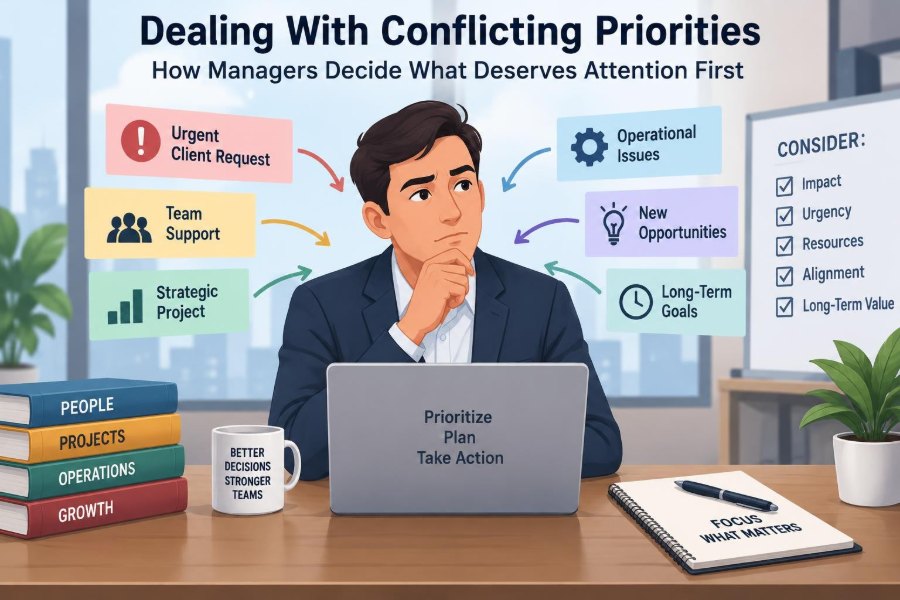

At 9:00 a.m., a manager may face a customer escalation, a deadline for the executive team, an employee asking for help, a system alert, and a project that is already behind schedule. Every item appears urgent to someone. Only a few can receive immediate attention.
This is not simply a test of personal productivity. It is a management decision with consequences for customers, employees, revenue, risk, and the organization’s ability to deliver on its promises.
Conflicting priorities are unavoidable because organizations operate through limited time, money, attention, and capacity. The challenge is not to make everything fit. It is to decide what should move first, what can wait, what must be delegated, and what may need to stop.
Managers who make these decisions well do more than maintain a busy calendar. They create clarity when pressure makes work feel chaotic.
🧭 Why Priority Conflicts Are a Management Problem
A priority conflict occurs when two or more worthwhile demands compete for the same scarce resource. That resource may be a manager’s attention, a specialist’s time, a budget, a production slot, or access to a decision-maker.
Employees often see their own task as the obvious first choice because they understand its local impact. Managers must take a wider view: which choice best protects the organization’s goals, obligations, and people?
That broader view is why prioritization cannot be reduced to replying to the loudest email first.
🎯 Start With the Organization’s Actual Objectives
Priorities become easier to judge when managers can connect work to clear objectives. These may include serving customers reliably, protecting cash flow, improving safety, meeting a legal obligation, launching a product, or retaining key employees.
Without agreed objectives, teams often substitute visible activity for meaningful progress. A full task list can hide the fact that people are working hard on items with little strategic value.
A useful question is: “If we succeed at this task, which organizational goal moves forward?” If the answer is vague, the task may deserve reconsideration.
⚖️ Separate Importance From Urgency
Urgency concerns time pressure: something has a near deadline or requires quick action. Importance concerns consequences: it meaningfully affects outcomes, risk, commitments, or long-term direction.
A client issue due today may be both urgent and important. A request to format a presentation for a meeting tomorrow may be urgent but less important. Planning next quarter’s staffing needs may be important but not immediately urgent.
Managers need room for both. Treating every urgent item as important creates reactive teams; treating only long-term work as important can cause missed commitments and avoidable damage.
🧱 Recognize Capacity as a Real Constraint
Prioritization is necessary because capacity is finite. Adding a new “top priority” does not create extra hours or expertise. It usually displaces, delays, or weakens another piece of work.
Managers should make this trade-off visible. Instead of saying, “Yes, we can do that,” say, “We can begin it this week, but that means delaying the reporting upgrade until next Tuesday. Which outcome should take precedence?”
This approach is not resistance. It is an honest description of operational reality.
🔍 Identify the Consequences of Delay
When demands collide, ask what happens if each one waits. The answer reveals more than a deadline alone can.
- Will a delay harm a customer relationship or contractual commitment?
- Could it create a safety, compliance, security, or financial risk?
- Will it block several other people from working?
- Does waiting make the work substantially harder or more expensive?
- Will the opportunity disappear if no action is taken now?
The task with the most serious and least reversible consequence of delay often deserves early attention.
🚨 Put Safety, Legal Duties, and Serious Risk First
Some priorities are not optional trade-offs. A credible safety issue, a legal requirement, a significant security concern, or a situation that could expose people to serious harm should normally outrank routine commercial work.
Managers do not need to be legal, technical, or safety specialists to recognize when escalation is necessary. Their responsibility is to involve the appropriate people promptly rather than minimizing an unfamiliar risk.
At the same time, not every concern requires a full emergency response. Good judgment means assessing evidence, scope, and immediate exposure rather than labeling every inconvenience a crisis.
🤝 Protect Commitments Made to Customers and Partners
Promises matter because other people plan around them. A missed delivery, unanswered service failure, or delayed decision can create work and uncertainty far beyond the manager’s own team.
When a commitment cannot be met, early communication may be more valuable than silent effort. A manager can explain the situation, offer a realistic revised plan, and prevent a manageable problem from becoming a trust problem.
Keeping commitments does not mean accepting every request. It means being precise about what the team has agreed to deliver.
🌉 Look for Work That Unblocks Others
Some tasks have a multiplier effect. Approving a decision, resolving an ambiguity, securing access, or assigning an owner may take ten minutes but allow several people to continue productive work.
These are often called blockers: obstacles that prevent progress elsewhere. A manager who clears a blocker can create more value than one who spends the same time completing an individual task.
During a busy day, ask: “What decision or action would release the most useful work?”
📈 Consider Strategic Value, Not Just Immediate Pain
Immediate problems naturally attract attention because they are visible and emotionally demanding. Yet a manager must also protect work that advances a major goal, builds a needed capability, or prevents predictable future problems.
For example, repeatedly fixing errors in a manual process may feel more urgent than improving the process. But if the errors recur every week, allocating time to redesign the workflow can reduce future disruption.
Strategic work should be scheduled and defended, not merely attempted when the inbox is empty.
⏳ Account for Deadlines and Time Sensitivity
Deadlines matter most when they represent a genuine decision point or external dependency. Missing a filing date, a customer launch window, or a supplier cutoff can have effects that cannot be repaired later.
However, managers should examine deadlines rather than accepting them automatically. Some are fixed; others are internal preferences presented as immovable dates. Knowing the difference helps teams avoid unnecessary fire drills.
A useful clarification is, “What changes if this is completed tomorrow rather than today?”
🔗 Map Dependencies Before Reordering Work
Projects contain dependencies: one task must be completed before another can begin. A seemingly minor approval can delay design, procurement, testing, and launch if it sits unresolved.
A simple dependency map does not need specialized software. Managers can list key deliverables, identify what each one needs, and find the work sitting on the critical path—the chain of dependent activities that determines the earliest possible finish.
Prioritizing work on that path helps prevent late surprises caused by hidden waiting time.
💰 Weigh Impact Against Effort
Impact-effort thinking compares the likely value of an action with the resources required to complete it. It is not a perfect calculation, but it stops teams from giving equal treatment to unequal choices.
| Type of work | Typical response | Reason |
|---|---|---|
| High impact, low effort | Do promptly | It produces a useful return quickly. |
| High impact, high effort | Plan and resource | It needs deliberate ownership and milestones. |
| Low impact, low effort | Batch, automate, or delegate | It should not crowd out major work. |
| Low impact, high effort | Challenge or stop | Its opportunity cost may be too high. |
Managers should be cautious: a low-effort task is not automatically valuable, and a high-effort task is not automatically wasteful.
🧮 Use Simple Scoring When Opinions Collide
When several stakeholders disagree, a transparent scoring method can make assumptions discussable. The team might assess each item against criteria such as customer impact, risk, strategic alignment, deadline sensitivity, and effort.
Scores are aids to judgment, not machines that make decisions. Different criteria may deserve different weight, and a serious safety concern should not be diluted by a generic average.
The main benefit is clarity: people can debate the reasoning instead of arguing only for their preferred project.
🗣️ Ask Who Is Affected and How Deeply
Priorities should reflect the scale and intensity of their effects. A problem affecting many people is often significant, but a problem affecting one vulnerable customer, employee, or critical account may also warrant urgent attention.
Managers should avoid relying solely on volume. Ten minor inconveniences do not always outweigh one issue that could cause substantial harm, loss, or unfairness.
Stakeholder analysis brings human consequences into decisions that might otherwise look like abstract task comparisons.
🧠 Distinguish a Crisis From a Loud Interruption
A crisis threatens significant harm, demands coordinated response, and may worsen quickly without action. A loud interruption may involve frustration, pressure, or seniority without meeting that threshold.
Managers should gather essential facts before redirecting the whole team. What happened? Who is affected? What is the likely consequence? What action is needed in the next hour, rather than eventually?
Calm triage—rapid assessment and sorting—protects teams from overreacting while ensuring real emergencies receive decisive attention.
👥 Match the Work to the Right Person
A manager’s priority list should not become the manager’s personal workload. The central question is often not “Should this be done?” but “Who is best placed to do it?”
Delegate work when another person has the necessary authority, skill, information, or development opportunity. Retain tasks that require managerial judgment, confidential context, cross-team coordination, or accountability that cannot reasonably be transferred.
Delegation is incomplete unless the outcome, deadline, decision rights, and check-in point are clear.
🛠️ Use Automation and Process Design Carefully
Repeated low-value work can absorb disproportionate attention. Templates, standard operating procedures, shared dashboards, approval rules, and automation may reduce this burden.
But automating a poor process can make inefficiency faster. Before introducing a tool, managers should ask whether the task is necessary, whether steps can be removed, and where human judgment is still needed.
The goal is not to eliminate people from decisions. It is to preserve attention for work where people add the most value.
📅 Create a Rhythm for Reviewing Priorities
Priorities should be reviewed at more than one pace. A brief daily check helps teams respond to changing conditions, while weekly and monthly reviews keep immediate demands from displacing longer-term commitments.
A practical rhythm might include:
- a daily check on urgent risks, blockers, and commitments;
- a weekly review of workload, milestones, and trade-offs;
- a periodic review of goals, capacity, and projects that should be paused or ended.
Regular review reduces the temptation to redesign the plan every time a new request arrives.
📝 Make Trade-Offs Explicit
Vague priority language creates hidden conflict. Saying that five projects are all “number one” tells employees that they will be blamed for whichever deadline slips.
Instead, managers can state a sequence: “First restore service, then complete the customer update, then return to the training plan.” This does not eliminate pressure, but it gives people a defensible basis for action.
Explicit trade-offs also reveal when expectations exceed capacity and require a leadership decision.
📣 Communicate the Why, Not Only the Order
People are more likely to support a priority decision when they understand its rationale. A short explanation—“This comes first because it affects a contractual commitment and blocks the implementation team”—is usually enough.
Sharing reasons is especially useful when a valued project is delayed. It signals that the work has not been dismissed; it has been sequenced against clearer criteria.
Managers should avoid false certainty. If information is incomplete, say what is known, what is being checked, and when the decision will be revisited.
🧩 Align Priorities Across Teams
Many priority conflicts originate between teams rather than within them. Sales may promise a rapid delivery, operations may face limited capacity, and finance may require controls that slow the process.
Local optimization—each team maximizing its own targets—can harm the broader organization. Cross-functional conversations should focus on shared outcomes, constraints, and decision rights.
A common priority language, such as customer impact, risk, strategic value, and capacity, helps teams compare requests more fairly.
🏛️ Know Who Has Decision Rights
Decision rights define who has authority to choose, approve, recommend, or be consulted. Confusion about these roles causes delays because people either wait for unnecessary permission or make commitments they cannot fulfill.
For recurring decisions, managers should clarify who owns the final call and who must provide input. This is particularly useful when speed matters but the consequences extend across departments.
Clear authority does not mean ignoring expertise. It means ensuring that consultation leads to a decision rather than an endless loop.
🧪 Use a Practical Triage Example
Imagine a hypothetical operations manager on a Monday morning. A customer reports a service outage, a director requests slides for an afternoon meeting, an employee needs approval for annual leave, and a process-improvement workshop is scheduled for later that week.
The outage comes first because it affects current customers and may expand if unresolved. The manager delegates the slide preparation using existing data, handles the leave approval quickly if policy allows, and protects the workshop unless the outage requires extended response.
The lesson is not that workshops are unimportant. It is that a manager can sequence, delegate, and communicate rather than abandoning every non-urgent commitment.
⚠️ Avoid the “Everything Is Urgent” Culture
When every request is labeled urgent, the label loses meaning. Employees begin switching constantly between tasks, making more errors and struggling to complete focused work.
Managers can challenge urgency constructively: “What is driving the deadline?” “What is the impact of waiting?” “Is there a smaller action that reduces the immediate risk?”
Over time, this teaches requesters to provide context rather than pressure alone.
📥 Do Not Let the Inbox Set the Agenda
Email, chat alerts, and meeting invitations reward responsiveness, not necessarily good judgment. The most recent message may be less consequential than a problem no one has yet escalated.
Managers should reserve short periods to scan communications, then return to their ranked work. Notifications may need different settings during focused tasks or meetings.
Responsiveness still matters, especially for emergencies. The point is to create a deliberate intake process instead of allowing every notification to redefine the day.
🔄 Reprioritize When Conditions Change
A plan should be stable enough to guide action and flexible enough to respond to new information. Customer conditions, staffing, costs, technology failures, and leadership decisions can all legitimately change the order of work.
Reprioritization should have a trigger: new evidence, a material risk, a missed assumption, or a changed organizational goal. Changing direction because someone is impatient creates churn rather than agility.
When the order changes, document what moved, why it moved, and what will now be delayed or stopped.
📊 Measure Outcomes, Not Busyness
Teams can complete many tasks while failing to improve the outcomes that matter. Managers should review whether priority decisions protected service quality, reduced recurring problems, met commitments, and advanced agreed goals.
This review should include unintended effects. For example, accelerating a launch may meet a date but overload support staff or create rework later.
Outcome-focused reflection improves future decisions because it tests the quality of the prioritization logic, not simply the amount of activity.
🌱 Build Team Judgment Instead of Becoming the Bottleneck
If every decision reaches one manager, work slows and employees do not develop judgment. Managers can teach teams to assess risk, customer impact, deadlines, dependencies, and effort using shared principles.
Provide boundaries: which issues employees can decide independently, which require consultation, and which must be escalated immediately. Then discuss real cases after the fact, including decisions that did not work as expected.
A capable team does not need a manager to rank every task. It needs enough context to make sound local choices.
🪜 Learn From Prioritization Mistakes
Even careful managers will sometimes choose poorly because information is incomplete or conditions change. The useful response is not defensiveness; it is a brief review of the decision process.
Ask whether the team overlooked a dependency, underestimated effort, accepted an artificial deadline, failed to escalate risk, or communicated the trade-off poorly. These questions turn a setback into a better operating practice.
Repeated mistakes often point to a system issue—unclear goals, poor workload visibility, or ambiguous authority—rather than a single person’s failure.
🧭 A Simple Decision Sequence for Busy Moments
When competing demands arrive at once, managers can use a short sequence before acting:
- Clarify the request, deadline, and desired outcome.
- Check for safety, legal, security, or serious customer risk.
- Assess consequences of delay and dependencies.
- Compare strategic value, impact, and required effort.
- Decide: do now, schedule, delegate, defer, reduce, or stop.
- Communicate the choice and the displaced work.
- Review if material facts change.
This sequence is deliberately simple. Under pressure, a usable framework is more valuable than a complicated one that nobody applies.
🏁 The Core Principle: Choose Deliberately
Effective prioritization is not about finding a universally correct list. It is about making visible, reasoned choices under real constraints.
The strongest managers connect decisions to objectives, protect people and critical commitments, clear blockers, use capacity honestly, and explain trade-offs. They neither chase every interruption nor rigidly cling to a plan when evidence changes.
Most importantly, they understand that saying yes to one task is also a decision about what will receive less attention.
Managers earn trust when they turn competing demands into clear choices, realistic commitments, and purposeful action. That discipline helps teams spend their limited attention where it can do the most good. 📊🧭🤝