
A leadership team changes its pricing model, launches a new sales process, or introduces a hybrid-work policy. Two weeks later, the dashboard looks disappointing. Someone asks the question that turns a normal review meeting into a tense debate: should we stop now?
Waiting too long can waste money, energy, and customer goodwill. Judging too soon can kill a promising strategy before employees have learned it, customers have noticed it, or the underlying economics have had time to appear.
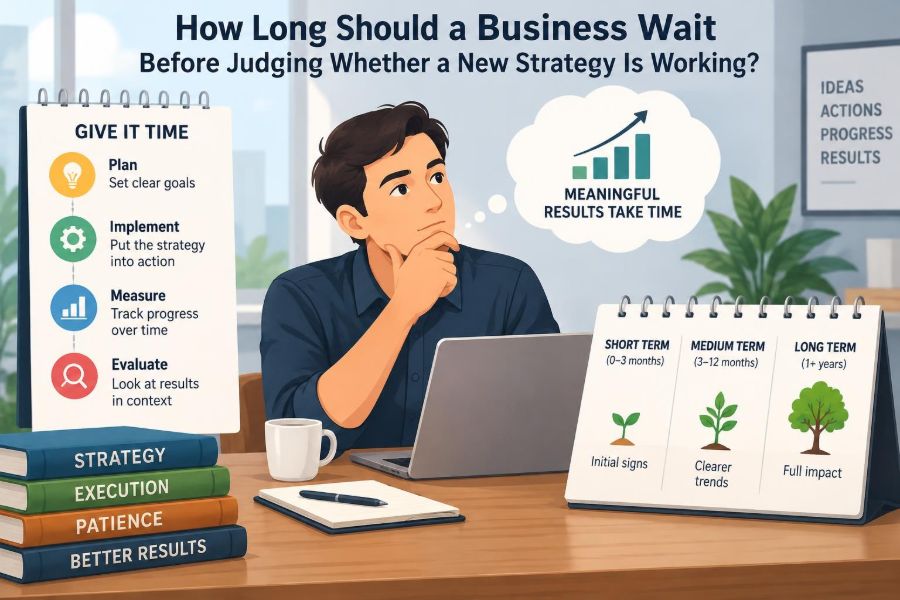
There is no honest universal answer such as “wait 90 days.” A strategy’s appropriate evaluation period depends on what is changing, how customers behave, how quickly the business can measure results, and how costly it is to continue.
The better question is not simply how long to wait. It is: what evidence should be visible by this point, and what would make continuing, adapting, or stopping the strategy the sensible choice?
🧭 Why the timing question is harder than it sounds
Business results arrive at different speeds. A revised email subject line may show an early response within days, while a new brand position may influence customer perceptions and repeat purchases over many months.
Confusion arises when managers expect a long-cycle strategy to deliver short-cycle proof, or allow a fast, measurable experiment to run indefinitely without clear evidence. Timing must match the mechanism through which the strategy is expected to work.
⏳ Separate leading indicators from final outcomes
A leading indicator is an early sign that the activities driving a result are occurring. A final outcome, sometimes called a lagging indicator, is the business result that appears later.
For example, a sales-training program may first increase completed practice sessions, then improve discovery-call quality, then raise proposal conversion, and only later affect revenue. Revenue still matters most, but waiting for it alone makes management slow and blind.
🎯 Start with the strategic hypothesis
Every strategy should state the logic connecting an action to an outcome. “Improve customer experience” is an aspiration; “reduce handoffs in onboarding so new clients reach their first useful result sooner and renew more often” is a testable hypothesis.
A useful hypothesis identifies the audience, action, expected mechanism, and intended result. It also makes the review period easier to set because managers can ask when each link in the chain should reasonably become visible.
🗺️ Map the journey from action to impact
Before implementation, map the sequence from decision to financial or operational value. This prevents the common mistake of treating strategy as a switch that instantly changes results.
- Inputs: budget, tools, training, staffing, and leadership attention.
- Activities: the new process, campaign, product change, or policy.
- Early signals: adoption, reach, cycle time, quality, or customer response.
- Outcomes: retention, margin, market share, revenue, or risk reduction.
Each stage has its own delay. The full waiting period should reflect the slowest important stage, not merely the date the initiative was announced.
📏 Define success before looking at the results
Deciding what success means after the data appears invites rationalization. Teams may protect a favored initiative by changing the target, or reject one by focusing only on an unfavorable measure.
Set a baseline, a direction of improvement, a review date, and a practical threshold beforehand. The threshold need not be a false promise of certainty. It should describe what level of movement would justify the next investment decision.
🔍 Measure the baseline, not just the new number
A result has little meaning without context. If monthly customer complaints fall after a service change, managers need to know whether complaints were already declining, whether demand fell, and whether reporting practices changed.
Use a baseline from a relevant prior period and account for normal variation. Comparing a busy holiday month with a quiet month, for example, can make an ordinary seasonal pattern look like a strategic breakthrough or failure.
🧪 Treat a new strategy as a testable experiment
Not every strategic decision can be tested in a laboratory, but experimental discipline is still valuable. Define who is affected, what changes, which measures matter, and what alternative explanation might account for the result.
Where practical, phase a rollout by location, customer segment, product line, or time period. A comparison group is not always possible, but it can reveal whether an observed improvement is likely connected to the strategy rather than a broader market shift.
🚦Use decision gates instead of one final deadline
A single “judgment day” encourages either premature panic or passive waiting. Decision gates create several planned moments to ask different questions as evidence develops.
| Review stage | Main question | Typical evidence |
|---|---|---|
| Early implementation | Can the strategy be delivered as designed? | Training, system readiness, process compliance |
| Early response | Are customers or employees reacting as expected? | Usage, quality, engagement, conversion signals |
| Outcome review | Is the strategy producing enough value? | Retention, margin, revenue, cost, risk indicators |
At each gate, choose among continuing, adjusting, expanding, pausing, or stopping. This is more useful than treating every review as a simple pass-or-fail vote.
🏗️ Give implementation time to become real
A strategy cannot be fairly judged while it exists mostly in presentation slides. Employees may need time to learn a new system, managers may need to reinforce new behaviors, and operational problems may need correction.
However, “implementation is difficult” should not become an excuse for endless delay. Track whether the essential actions are occurring reliably. If adoption remains low because the process is confusing or incentives conflict with it, the strategy has not yet received a valid test.
👥 Account for adoption and behavior change
Many strategies depend less on the formal decision than on repeated human behavior. A customer relationship management system produces little value if salespeople keep information in personal notes. A safety policy does not reduce risk if supervisors treat it as paperwork.
Measure adoption directly: active use, completion quality, adherence to critical steps, and barriers reported by users. Distinguish resistance to an unfamiliar change from evidence that the design genuinely makes work worse.
🛒 Match the wait to the customer buying cycle
A low-cost consumer purchase may respond quickly to a clearer offer or promotional message. In contrast, a business-to-business sale involving budgets, committees, trials, and contracts may take months to move from initial interest to booked revenue.
For longer buying cycles, early evidence may include qualified opportunities, meetings with appropriate decision-makers, trial usage, or proposal progression. These are not substitutes for sales, but they show whether the strategy is gaining traction before closed deals appear.
🔁 Consider the retention and repeat-purchase cycle
Strategies designed to improve loyalty should not be judged solely by immediate acquisition. A revised onboarding process may be successful only if customers stay longer, use more of the service, or require less support later.
The relevant waiting period is often at least long enough for a meaningful cohort of customers to reach the renewal, reorder, or usage milestone affected by the change. Cohort analysis compares groups that started in similar periods, making patterns easier to interpret.
📅 Watch for seasonality and calendar effects
Demand, staffing, cash flow, and customer attention often vary by week, month, or season. A retailer, educational provider, tourism business, and tax service may each see very different normal patterns.
When possible, compare like with like: similar days of the week, equivalent sales periods, or matching seasonal windows. If waiting for a full cycle is impractical, use cautious interim evidence and avoid strong conclusions from an unrepresentative period.
🌪️ Separate strategy effects from outside events
Competitor actions, supply disruptions, economic conditions, media attention, and regulatory changes can all alter results. A strategy may appear weak during a temporary demand shock, or look stronger than it is because a competitor exited the market.
Keep a simple record of material events during the test period. Review both internal measures and external context. The goal is not to explain away bad results, but to avoid claiming causes the available evidence cannot support.
💰 Consider the cost of waiting
More time produces more information, but it also consumes resources. Continuing a costly strategy with warning signs may mean lost cash, distracted employees, and missed alternatives.
Ask what is being spent each additional period and what harm could occur if the strategy is wrong. A low-cost content experiment can often run longer than a pricing decision that is rapidly eroding margin or confusing loyal customers.
🛑 Set stop-loss conditions for serious downside risk
A stop-loss condition is a pre-agreed trigger for pausing or reversing an initiative when unacceptable harm appears. It is common sense risk management, not an admission that leaders lack confidence.
- Material safety, legal, privacy, or compliance concerns.
- Severe deterioration in service quality or customer trust.
- Losses that exceed a defined financial tolerance.
- Evidence that a key assumption was plainly false.
These conditions deserve immediate attention even if the planned evaluation window is not over. Some risks are too consequential to “wait and see.”
⚖️ Distinguish a bad strategy from bad execution
A disappointing result can mean the idea is flawed, but it can also mean the organization did not execute it consistently. These require different responses.
If a new value proposition is not reaching the intended audience, improve targeting or sales enablement before dismissing the proposition. If it reaches the audience clearly and they still do not respond, the underlying customer assumption may be the issue. Diagnose the broken link rather than applying a generic fix.
🧩 Test assumptions, not only headline metrics
A strategy usually rests on several assumptions: customers have a particular problem, the offer solves it, the price feels worthwhile, employees can deliver it, and capacity exists to support demand.
Break these assumptions into questions. Interviews, call reviews, usability observations, win-loss notes, and operational data can reveal why a metric moved. A revenue dashboard tells you what happened; targeted evidence helps explain what to change.
📊 Combine quantitative and qualitative evidence
Numbers make trends visible, but they may miss the reasons behind them. Customer feedback can explain why a redesigned checkout causes abandonment; employee observations can reveal where a new workflow creates delays.
Qualitative evidence should be gathered systematically rather than selected from the loudest complaint or most enthusiastic anecdote. Look for recurring themes, compare them with behavioral data, and remain alert to views that challenge the team’s preferred story.
🔢 Avoid false precision in small samples
Early results can swing dramatically when few customers, transactions, or employees are involved. One large sale, one cancellation, or a handful of responses may distort an apparent trend.
Do not pretend that a small sample can settle a major decision. Use it to identify signals, improve the design, and determine whether a larger test is warranted. Confidence grows when a pattern persists across enough relevant observations and conditions.
📈 Use trend direction, not one isolated snapshot
Most real business measures fluctuate. A single week below target does not necessarily mean a strategy is failing, just as one strong week does not prove it is working.
Examine the direction, consistency, and pace of change. Is adoption steadily rising? Is conversion improving after initial training problems? Are results improving only when a particular manager intervenes? Trends invite better questions than isolated red or green dashboard cells.
🧮 Evaluate value, not just activity
High activity can look reassuring while masking poor economics. More website visits are not automatically valuable if they do not produce relevant enquiries. More sales calls do not help if they target unsuitable prospects or require unsustainable discounts.
Link activity measures to value measures such as contribution margin, customer retention, cost to serve, capacity use, or strategic capability. A strategy can be busy and still be unproductive.
🧱 Recognize when the strategy needs more runway
Some initiatives naturally have delayed payoffs. Product development, capability building, reputation repair, market entry, and infrastructure modernization may require sustained work before results are visible.
More runway is justified when the causal path remains credible, implementation is improving, early indicators move in the intended direction, and the business can afford the investment. It is not justified merely because leaders dislike admitting that a bet is underperforming.
🔧 Know when adaptation is smarter than persistence
Strategy rarely needs to be either fully retained or fully abandoned. Evidence may support changing the target segment, simplifying the offer, revising a process, or reallocating budget toward the strongest channel.
Adaptations should preserve a clear record of what changed. If a team changes pricing, messaging, audience, and product features at once, it becomes hard to learn which adjustment made a difference. Change deliberately, then reassess.
🚪 Know when to stop decisively
Stopping can protect resources for better opportunities. It is appropriate when a critical assumption has been disproved, downside risk exceeds tolerance, the economics cannot work at a realistic scale, or repeated improvements fail to address the central problem.
Stopping is most useful when accompanied by learning. Record the original hypothesis, evidence gathered, what failed, and what remains uncertain. This turns an unsuccessful initiative into information that can improve future decisions.
🧠 Guard against commitment bias
Commitment bias occurs when people continue investing largely because they have already invested time, money, or reputation. The past cost cannot be recovered by refusing to examine current evidence.
Counter it by assigning a reviewer who was not deeply involved in designing the strategy, using pre-agreed criteria, and asking a simple question: if we had not started this today, would the evidence justify starting or continuing it now?
🤝 Make review meetings learning-oriented
If review meetings punish people for unfavorable data, teams may delay reporting problems or present overly positive interpretations. That makes strategies appear healthier until the correction becomes more expensive.
Use a consistent agenda: what was expected, what occurred, what changed in the environment, what the team learned, and what decision is needed. Hold people accountable for clear thinking and responsible execution, not for controlling every uncertain outcome.
🗣️ Communicate the evaluation plan early
Employees and stakeholders are more likely to support a change when they understand how it will be assessed. Explain the objective, measures, review dates, decision-makers, and safeguards.
Clear communication also prevents an early dip from being interpreted as abandonment. At the same time, avoid promising success. State that the organization is testing a reasoned approach and will adapt based on evidence.
🏪 A practical hypothetical example
Imagine a regional retailer introducing online appointment booking for higher-value consultations. It would be unreasonable to judge the strategy only by first-week revenue, because staff must learn the scheduling process and customers must discover it.
In the first month, the retailer might review whether booking is functioning, whether staff are offering it, and whether customers complete appointments. In later months, it could examine attendance, conversion after appointments, average order value, and cancellation patterns against comparable periods.
If bookings are strong but attendance is poor, reminder messages or time slots may need adjustment. If attendance is strong but sales do not improve, the consultation experience or offer may be the problem. The timing follows the chain of cause and effect.
📝 Build a simple strategy evaluation charter
A short written charter prevents vague expectations from undermining a strategy. It need not be bureaucratic; one page can be enough for many initiatives.
- The strategic hypothesis and intended customer or operational problem.
- Baseline measures and leading and lagging indicators.
- Implementation milestones and named owners.
- Review gates, evidence required, and decision authority.
- Financial limits, major risks, and stop-loss conditions.
- Likely external factors and planned comparisons.
The charter makes it easier for a new manager or stakeholder to understand what the organization is testing and why a particular waiting period is reasonable.
🧭 A useful decision rule for most businesses
Judge a new strategy in stages: first confirm that it is being delivered well enough to test, then look for the early behaviors it was designed to create, and finally assess whether those behaviors generate sufficient value.
The right amount of time is therefore not a calendar convention. It is the period needed for the strategy’s critical assumptions to face meaningful evidence, while staying within the organization’s financial and risk limits.
🏁 The core principle: wait for evidence, not hope
Businesses should neither demand instant proof from every meaningful change nor give every initiative unlimited patience. Effective evaluation combines an explicit hypothesis, appropriate measures, staged reviews, relevant comparison, and clear boundaries for risk.
When managers know what should happen first, what should happen later, and what would change their minds, they can move with both discipline and flexibility. That is a stronger basis for strategy than impatience, optimism, or habit.
A business should wait long enough for its strategy’s causal path to produce meaningful evidence—but not so long that avoidable costs, risks, or wishful thinking replace sound judgment. 📊⏳🧭