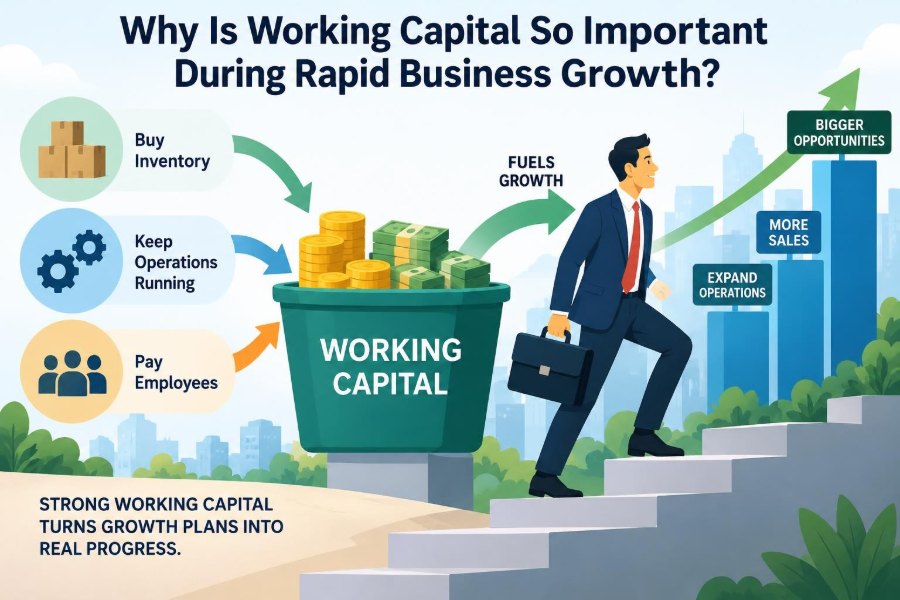

A business can look successful on paper and still struggle to pay a supplier on Friday. Orders may be rising, new customers may be arriving, and the team may be busier than ever. Yet the bank balance can feel tighter each month.
This is a common tension in fast-growing businesses. Growth usually requires a company to buy more stock, hire more people, extend more credit, and serve more customers before it receives all the cash from those sales.
That gap between spending money and collecting it is where working capital becomes decisive. It is not simply an accounting term; it is the cash-management capacity that allows daily operations to continue while the business expands.
Understanding working capital helps managers distinguish between profitable growth and growth that quietly creates a cash crisis. The difference can determine whether an opportunity becomes sustainable progress or an expensive strain.
💧 Working Capital Is the Fuel for Daily Operations
Working capital is the money a business has available to run its short-term operations. In basic accounting terms, it is current assets minus current liabilities.
Current assets are resources expected to become cash, be sold, or be used within a year. They commonly include cash, inventory, and accounts receivable: amounts customers owe the business. Current liabilities are obligations due within a year, such as supplier invoices, wages, taxes, and short-term borrowing.
A positive figure generally means the company has more short-term resources than short-term obligations. But the composition of those resources matters as much as the total.
🧮 The Basic Formula Has an Important Limitation
The familiar formula is:
Working capital = Current assets − Current liabilitiesSuppose a retailer has $180,000 in current assets and $120,000 in current liabilities. Its working capital is $60,000. This gives a useful high-level picture, but it does not prove the retailer has $60,000 ready to spend.
If most of its assets are slow-moving inventory or invoices from customers who pay late, it may still be short of cash. Managers therefore need both the balance-sheet view and a close view of actual cash timing.
🚀 Growth Often Consumes Cash Before It Produces Cash
Rapid growth changes the scale of normal business activity. A company that receives twice as many orders may need to purchase materials, stock, packaging, delivery capacity, and labour well before customers pay.
This creates a cash conversion gap: cash goes out to support sales before cash comes back from those sales. The faster sales rise, the larger that gap can become.
Profit may eventually follow, but suppliers, employees, and landlords cannot usually wait for eventual profit. They require payment according to agreed dates.
🔄 Profit and Cash Flow Are Not the Same Thing
A sale can be recorded as revenue when goods or services are delivered, even when the customer has not yet paid. The business may therefore report a profit while holding little cash.
Consider a hypothetical consulting firm that completes a large project in June and invoices the client with a 60-day payment term. It may record revenue in June, but it still needs cash for June and July payroll before the invoice is collected.
Profit measures whether the business model creates value over time; cash flow measures whether the business can meet obligations when they fall due. During rapid expansion, both measures deserve attention.
📦 Inventory Can Tie Up Cash Quietly
Product businesses often need more inventory to avoid stockouts as demand rises. Buying in advance can protect sales, but every item on a shelf represents cash that cannot currently pay a bill.
The risk grows when forecasts are too optimistic, product lines proliferate, or purchasing teams order large quantities to secure a discount. A discount is not always a saving if it leaves the company unable to fund payroll or more urgent stock.
Inventory should be sufficient to meet realistic demand and supply uncertainty, not simply as large as storage space allows.
🧾 Customer Credit Can Turn Sales into a Financing Burden
Business customers often expect payment terms. Giving a customer 30, 60, or 90 days to pay can help win business, but it also means the seller is effectively financing part of the customer’s operations.
As sales increase, receivables can grow very quickly. A manufacturer might celebrate a large new contract, then discover that it must fund materials, production, and shipping long before receiving payment.
Credit is not inherently harmful. It should, however, be priced, approved, monitored, and matched to the company’s own ability to pay suppliers.
⏱️ The Cash Conversion Cycle Reveals the Timing Problem
The cash conversion cycle estimates how long cash is tied up in operating activity. It follows cash from paying for inventory or inputs, through selling, to collecting payment from customers.
A simplified view is:
Days inventory outstanding + days sales outstanding − days payable outstandingLower is often preferable because the business recovers cash sooner. Still, the right target varies by sector. A custom manufacturer, a grocery retailer, and a software provider naturally have different operating cycles.
📏 Three Timing Measures Managers Should Watch
| Measure | What it tracks | Why it matters in growth |
|---|---|---|
| Days inventory outstanding | Average time inventory is held before sale | Highlights cash tied up in stock |
| Days sales outstanding | Average time customers take to pay | Shows collection speed and credit risk |
| Days payable outstanding | Average time the company takes to pay suppliers | Shows how long supplier credit supports operations |
These measures should be interpreted together, not treated as isolated scorecards. For example, extending supplier payment periods may improve cash temporarily but can damage relationships if done without agreement.
📈 More Sales Can Create a Larger Funding Need
It seems counterintuitive, but a business can become short of cash because it is winning more work. Each additional sale may require an upfront investment in stock, staff time, marketing, fulfilment, or subcontractors.
If gross margins are narrow and customers pay slowly, the company may need substantial funding to carry that growth. This is especially common in wholesale, construction, manufacturing, distribution, and project-based services.
Growth should therefore be assessed not only by revenue targets but also by the working capital required to deliver those targets.
🏗️ Different Business Models Have Different Pressures
A subscription software business may collect fees before providing a year of service, which can create favourable cash timing. A restaurant often receives payment immediately but must manage perishable stock and frequent wage costs.
By contrast, a construction contractor may pay labour and materials for months while waiting for milestone approval and payment. A wholesaler may need to hold inventory and grant trade credit at the same time.
There is no universal “healthy” amount of working capital. The appropriate level depends on the operating model, seasonality, supplier terms, customer behaviour, and access to funding.
🧱 Fixed Costs Make a Cash Shortfall More Dangerous
Some costs are difficult to reduce quickly. Salaries, rent, software commitments, insurance, equipment leases, and debt repayments may continue even when collections slow.
Rapid growth can increase these fixed commitments. Hiring ahead of demand may be sensible, but it raises the monthly cash requirement before new revenue is fully established.
Working capital provides a buffer against the ordinary delays and surprises that occur in real operations. Without it, a single late customer payment can interrupt essential activity.
🤝 Supplier Relationships Are Part of Working Capital Management
Suppliers are not just vendors; their payment terms affect the company’s cash cycle. Predictable, fairly negotiated terms can help a growing business plan its outflows with confidence.
Paying late without communication may preserve cash briefly, but it can lead to delivery holds, reduced credit limits, lost discounts, or damaged trust. Those consequences can be particularly costly when demand is rising.
A stronger approach is to discuss growth plans early, agree realistic order schedules, and avoid promising payment dates the business cannot meet.
💳 Short-Term Finance Can Bridge a Real Timing Gap
Facilities such as overdrafts, revolving credit lines, invoice finance, and short-term loans can help fund working capital. They are tools for smoothing the gap between legitimate operating outflows and expected inflows.
They are most useful when the underlying cash cycle is understood. Financing a reliable invoice from a creditworthy customer is different from borrowing repeatedly to cover persistent losses or obsolete inventory.
Borrowing also brings interest, fees, conditions, and repayment risk. Managers should compare these costs with the margin and strategic value of the growth they are funding.
⚠️ Long-Term Problems Should Not Be Hidden with Short-Term Debt
Short-term finance becomes dangerous when it is used to mask a structural problem. Examples include unprofitable pricing, chronic customer disputes, excess stock, or a cost base that exceeds sustainable revenue.
In those cases, more borrowing may delay a difficult decision rather than solve it. The business can become dependent on renewed facilities while its financial resilience weakens.
A useful question is: Will this funding be repaid when the normal operating cycle completes, or is it covering an ongoing deficit?
🔍 Forecasting Turns Working Capital into a Management Tool
A cash forecast estimates expected receipts and payments across future weeks or months. It is not a perfect prediction; it is a disciplined way to identify likely pressure points early enough to act.
During rapid growth, a short rolling forecast is often more useful than an annual budget alone. Managers can update it as orders, delivery dates, hiring plans, and payment expectations change.
- Start with the opening bank balance.
- List expected customer receipts by realistic payment date.
- Include payroll, tax, supplier payments, debt costs, and capital commitments.
- Test what happens if a major receipt is delayed or demand changes.
Forecasts are valuable when they are regularly compared with actual results and adjusted, not when they are filed away.
🗓️ Payment Dates Matter More Than Invoice Dates
An invoice issued today is not cash today. Likewise, a purchase order is not necessarily a payment today. Working capital planning needs the expected settlement date for each material item.
Teams sometimes build forecasts from accounting reports that show revenue and expenses by period. Those reports remain useful, but they must be translated into the dates cash will actually enter and leave the bank account.
This distinction becomes critical around payroll runs, tax due dates, and large supplier payments.
🧠 Better Credit Decisions Protect Future Cash
Growth can tempt a company to accept every customer and offer generous terms to close deals. A sale to a customer who cannot or will not pay is not a sound source of growth.
Credit policies can be proportionate to the business. They may include verifying customer details, setting credit limits, requiring deposits for large orders, checking disputed invoices promptly, and escalating overdue balances consistently.
Clear terms before work begins are usually easier to enforce than improvised demands after a bill becomes overdue.
📬 Invoicing Fast Is a Simple but Powerful Control
A completed sale cannot enter the collection process until it is correctly invoiced. Delayed, inaccurate, or poorly documented invoices extend the time between delivery and cash receipt.
Operational teams should make sure evidence of delivery, purchase order references, contact details, and agreed prices reach the finance function promptly. This is a cross-functional process, not only an accounting task.
Automated reminders can help, but they do not replace a courteous and timely conversation when a significant invoice is at risk of delay.
🛒 Smarter Inventory Policies Release Cash
Inventory management is a balance between availability and investment. Too little stock can lose sales and damage customer trust; too much stock increases storage, insurance, spoilage, and obsolescence risk.
Useful practices include classifying products by value and demand pattern, reviewing slow-moving items, improving demand forecasts, and coordinating purchasing with sales plans. For some items, smaller and more frequent orders may be appropriate if supplier reliability supports them.
The aim is not to minimize inventory at all costs. It is to hold the inventory that supports service levels without trapping unnecessary cash.
💰 Pricing Must Cover the Cost of Carrying Growth
Managers sometimes set prices by looking only at direct production cost and competitor prices. During expansion, they should also consider the cost of credit, returns, delivery, support, financing, and the time cash is tied up.
A large contract with a low margin and long payment term may consume more working capital than a smaller, faster-paying contract. Revenue alone does not show the quality of an opportunity.
Pricing decisions should reflect commercial strategy, but they should not ignore cash consequences. Deposits, stage payments, and early-payment incentives may be appropriate in some markets.
👥 Sales, Operations, and Finance Need One Shared View
Working capital problems often arise because departments make individually reasonable decisions that clash collectively. Sales offers extended terms, purchasing places large orders, operations adds capacity, and finance discovers the combined cash requirement too late.
A shared planning rhythm helps. Teams can review upcoming large orders, inventory commitments, customer payment risks, staffing needs, and financing capacity before commitments become irreversible.
Finance should not merely say no to growth. Its role includes showing what growth will cost in cash and helping the business choose a sustainable route.
🌦️ Seasonality Requires Extra Preparation
Many businesses build stock or hire staff before their busy period. Retailers may prepare before holiday demand; event businesses may incur costs before a seasonal program; agricultural firms may face production cycles.
These patterns are predictable in broad outline, yet they still create sharp working capital needs. A business should plan for the buildup phase, not just the expected peak sales period.
Comparing forecasts with prior seasons can inform planning, but past patterns are not guarantees. Changes in demand, supply conditions, or customer payment behaviour should be considered.
🚩 Warning Signs Should Trigger Early Action
Cash pressure rarely appears without clues. The most useful signals are operational as well as financial.
- Receivables are increasing faster than sales.
- Inventory is accumulating or turning more slowly.
- Supplier payments require repeated postponement.
- Managers rely on emergency borrowing for ordinary expenses.
- Customer disputes or credit notes are rising.
- Cash forecasts repeatedly miss expected collection dates.
One signal may have an innocent explanation. A pattern across several signals deserves investigation before it becomes a payment crisis.
🧯 Common Responses That Make the Problem Worse
Some reactions provide temporary relief but create larger risks. Blanket discounts may accelerate sales while reducing the cash generated per order. Cutting collections staff can save cost while slowing cash inflows.
Another mistake is ordering excessive stock because a supplier offers a volume deal. The apparent purchasing gain may be outweighed by storage cost, obsolete goods, and reduced liquidity.
Delaying every supplier payment is also risky. Prioritize communication and negotiated arrangements rather than treating supplier credit as unlimited.
🧭 A Practical Growth Readiness Check
Before committing to a major growth plan, managers can ask a small set of direct questions:
- What cash must be paid before the first additional customer payment arrives?
- How long is the likely cash conversion cycle for the new activity?
- Which assumptions about demand, delivery, and collection are most uncertain?
- Can existing cash and credit facilities absorb a delay?
- What action will be taken if sales rise more slowly or customers pay later than planned?
These questions do not remove uncertainty. They turn vague optimism into assumptions that can be tested and managed.
⚖️ Healthy Working Capital Is Not Simply “More”
Holding very large cash balances and inventory may feel safe, but it can also indicate that resources are being used inefficiently. Cash that is permanently idle may not support productive investment, debt reduction, or appropriate returns to owners.
Conversely, extremely lean working capital can leave no room for disruption. The objective is an amount and structure that fit the business’s risk, cycle, and strategy.
Strong management seeks liquidity without waste: enough accessible resources to operate reliably, without tying up more money than the business needs.
📊 Ratios Help, but Context Makes Them Meaningful
The current ratio compares current assets with current liabilities. The quick ratio removes inventory from current assets to focus on more liquid resources. Both can help identify trends.
However, neither ratio explains whether receivables are collectible, whether inventory is saleable, or whether a major payment is due tomorrow. Comparing ratios over time and alongside cash forecasts is generally more informative than relying on one benchmark.
For students and managers alike, the lesson is to ask what sits behind a ratio. Numbers summarize a story; they do not replace it.
🛠️ An Improvement Plan Should Be Specific and Owned
Broad instructions to “improve cash flow” rarely change behaviour. A practical plan names the action, owner, deadline, and measure of progress.
For example, a company might assign a credit manager to review overdue invoices weekly, a purchasing lead to reduce slow-moving stock, and a commercial manager to negotiate deposits on larger projects. Leaders can then review results against the cash forecast.
Small operational improvements can compound when they shorten collection time, reduce unnecessary stock, and make payment commitments more predictable.
🌱 Sustainable Growth Is Funded Growth
Rapid expansion is not automatically a sign of financial health. The business must be able to fund the resources required to fulfil new demand while preserving service quality and payment discipline.
Sometimes the right decision is to slow a rollout, phase a contract, revise payment terms, raise equity, or arrange suitable finance before scaling. Restraint can protect a promising business from taking on more than its cash cycle can support.
The strongest growth plans connect sales ambition with operational capacity and realistic funding.
🎯 The Core Principle: Manage the Gap Between Outflows and Inflows
Working capital matters during rapid growth because growth expands the timing gap between what a company must pay and what it is due to receive. Inventory, customer credit, payroll, supplier terms, and financing all shape that gap.
Managers who monitor cash timing, forecast actively, collect efficiently, hold appropriate stock, and communicate with suppliers are better placed to convert demand into durable progress. They are not avoiding growth; they are making it financeable.
The central task is to ensure that every stage of growth has enough cash support to reach the next stage safely.
Revenue can signal opportunity, but working capital determines whether a growing business can deliver on that opportunity day after day. Treat cash timing as a strategic operating issue, not an afterthought, and growth becomes far more resilient. 📈💧🤝