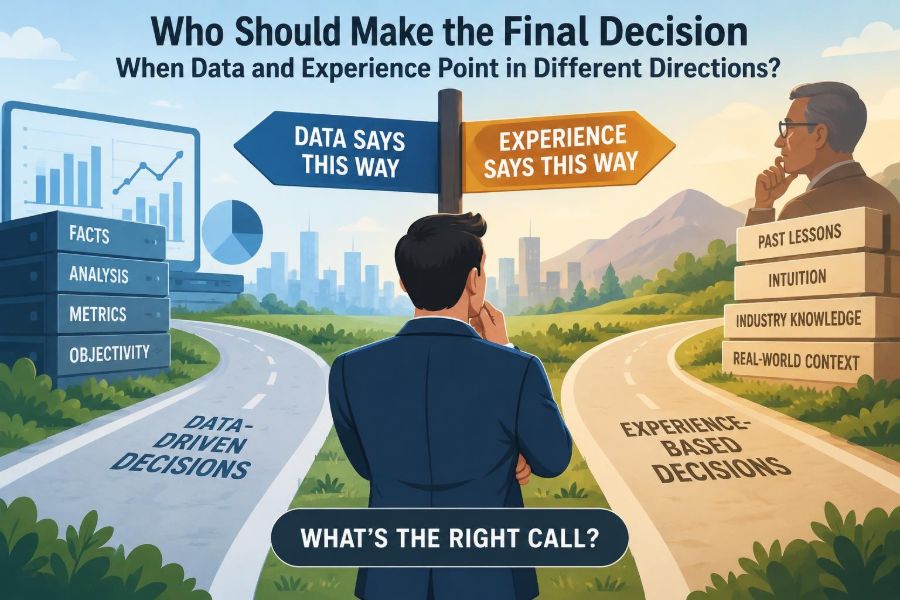

A regional manager is deciding whether to expand a successful store format. The dashboard shows strong demand in a new location. Yet the manager who has opened stores for twenty years notices something the model does not capture: the local hiring market is thin, the parking pattern is awkward, and a competitor is quietly building nearby.
Neither side of the argument is obviously foolish. The data may reveal customer behaviour more accurately than anyone’s intuition. The experienced manager may recognize operational realities that have never been recorded in a spreadsheet.
This tension appears everywhere: a product team debates a feature, a hospital allocates capacity, a lender reviews a borderline application, or a recruiter chooses between a high-scoring candidate and a person with unusual but promising experience. Someone eventually has to decide.
The real question is not whether data or experience should win by default. It is who has the authority, context, accountability, and decision process to make a sound final call when the two conflict.
🧭 Why This Conflict Is So Common
Organizations collect more data than ever, but decisions still occur in changing, incomplete, and human environments. Data describes what was measured; experience interprets patterns, constraints, and exceptions that may not appear in the dataset.
Conflict arises when each source of judgment answers a different question. A forecast may say what is likely under past conditions, while an experienced operator asks whether those conditions still hold.
📚 What Data Actually Contributes
Data is recorded evidence: sales history, defect rates, customer behaviour, costs, turnaround times, survey responses, or controlled test results. Its major strength is consistency. It can reveal patterns across more cases than one person can personally observe.
Good analysis also reduces the risk that a loud anecdote or a recent event dominates the discussion. If an executive claims customers always prefer one option, the records can test that claim.
🛠️ What Experience Actually Contributes
Experience is not merely a senior person’s feeling. At its best, it is pattern recognition built through repeated exposure, feedback, mistakes, and knowledge of how work gets done in practice.
A veteran supply-chain manager may spot that an apparently cheap supplier lacks resilience during disruptions. A model might not see that risk if past data contains few comparable disruptions.
Experience becomes valuable when it can identify missing variables, implausible assumptions, and meaningful context. It is less valuable when it is used as an untestable way to end debate.
⚖️ Why Neither Source Deserves Automatic Control
Data can be incomplete, delayed, biased by measurement choices, or misinterpreted. A neat chart can create false confidence, especially when it hides uncertainty or treats correlation as causation.
Experience can be selective, overconfident, and shaped by conditions that no longer apply. People often remember vivid successes and failures more clearly than ordinary outcomes.
The appropriate final decision-maker is therefore rarely “the data team” or “the most experienced person” in every situation. Authority should follow the nature and consequences of the decision.
🎯 Start by Defining the Decision Precisely
Vague decisions produce vague arguments. “Should we invest more?” is actually several questions: invest in what, for which customer group, over what period, with what risk limit, and against which alternatives?
Before reviewing evidence, write a short decision statement. For example: “Choose whether to launch the service in City A during the next quarter, provided expected delivery quality can meet the stated operating standard.”
Clear scope tells the group which evidence matters and who needs to be involved.
👤 The Accountable Owner Should Make the Final Call
The final decision should normally rest with the person who is formally accountable for the outcome, provided that person has the appropriate level of authority. Accountability means they must explain the choice, manage its consequences, and act when assumptions fail.
This might be a product manager for a feature trade-off, a plant manager for a production change, or an executive sponsor for a major capital commitment. Their role is not to personally know every detail; it is to integrate the right expertise and decide.
Giving the final call to the accountable owner prevents a common failure: a committee debates indefinitely while nobody owns the result.
🏛️ Match Authority to the Stakes
Not every decision deserves executive escalation. A small reversible website test can be owned close to the work. A decision involving safety, legal duties, major spending, or long-term reputation requires more senior oversight and formal challenge.
| Decision characteristic | Suitable final authority | Useful input |
|---|---|---|
| Routine and reversible | Frontline manager or team lead | Local operating data and practitioner judgment |
| Specialist or technical | Qualified domain owner | Validated analysis, peer review, operational input |
| Cross-functional and material | Named business owner or executive sponsor | Finance, operations, customer, risk, and technical views |
| Safety, legal, or ethical exposure | Authorized senior leader with required oversight | Specialist review and documented controls |
The table is not a substitute for governance rules. It illustrates a principle: decision rights should rise with irreversibility, impact, and risk.
🔍 Ask Whether the Data Is Fit for This Decision
Before treating a metric as decisive, ask what it represents. Who or what was measured? Over what time period? Which cases were excluded? Is the measure current enough to reflect the decision environment?
A customer satisfaction score may be useful for improving service but insufficient for predicting retention. A sales trend may reflect a temporary promotion rather than durable demand.
Data quality is not a technical footnote. It determines whether a disagreement is really between evidence and experience, or between experience and weak evidence.
🧪 Separate Observation From Interpretation
Teams often argue because they blur facts and conclusions. “Conversion fell after the redesign” is an observation. “The redesign caused conversion to fall” is an interpretation that needs testing.
Ask each side to state its reasoning in a simple chain: evidence, assumption, conclusion, and recommended action. This turns a personality contest into a discussion of claims that can be examined.
🗺️ Surface the Assumptions Behind the Model
Every forecast and scoring system depends on assumptions, whether they are written down or not. It may assume demand remains stable, customers resemble past customers, prices do not change, or measured factors capture what matters.
Experienced people are often most useful when they challenge these assumptions. Their concern should be translated into a testable statement, such as: “The historical demand data predates the competitor’s new distribution site, so it may overstate future volume.”
🧠 Turn Intuition Into Explainable Judgment
“I have a bad feeling” is a weak basis for a high-stakes decision. “In three prior launches with this supplier profile, late quality failures appeared after initial acceptance because inspection records missed a specific defect” is a useful warning.
The decision-maker should invite experts to explain their intuition through examples, mechanisms, and conditions. This respects practical knowledge without requiring everyone to accept an unsupported assertion.
📈 Distinguish Prediction From Causation
A predictive model can be useful even when it does not explain why an outcome occurs. For instance, it may accurately flag orders likely to be delayed. That does not mean changing every associated variable will prevent delays.
When a decision involves an intervention—raising a price, changing a policy, or redesigning a process—the team needs caution. Historical associations may not predict what will happen after the organization changes the system itself.
⏳ Consider Whether Conditions Have Changed
Past records lose relevance when the environment shifts. New regulations, a different customer segment, a technology change, a competitor move, or an unusual supply condition can make an old pattern unreliable.
Experience can also age badly. A method learned in a stable market may be wrong in a digital, regulated, or globally connected setting. The key question is not whether knowledge is old, but whether the underlying conditions remain comparable.
🚨 Give Safety and Ethics Special Weight
In decisions affecting safety, privacy, fairness, legal compliance, or serious human harm, a favourable business metric is not enough. The accountable leader must use qualified specialist input and follow applicable policies and requirements.
Experience-based concerns deserve careful review here, especially when they identify hazards not captured in routine data. At the same time, tradition cannot excuse unsafe or discriminatory practices. Escalation and documented review are appropriate when these values are at stake.
💰 Evaluate the Cost of Being Wrong
The best choice of decision process depends on downside risk. If a decision can be reversed cheaply, the organization can learn through a limited trial. If it commits years of funding or could harm people, it deserves stronger evidence, independent challenge, and a higher authority level.
Do not confuse probability with consequence. A low-probability failure can still require attention if its impact would be severe.
🔄 Use Reversibility to Decide How Fast to Move
Some choices are doors that can be reopened: changing email wording, testing a queue system in one location, or piloting a feature with a small group. Others are harder to reverse: closing a facility, selecting a core platform, or making a public commitment.
For reversible choices, a responsible owner can decide quickly, measure outcomes, and adapt. For irreversible choices, the same owner should slow down, seek broader evidence, and document why a contrary view was accepted or rejected.
🧩 Bring the Right People Into the Room
Good decisions need relevant perspectives, not the largest possible meeting. Include people who understand the analysis, those who operate the process, those affected by the result, and any function responsible for material risk.
- Analysts can explain data sources, uncertainty, and model limits.
- Practitioners can identify workflow realities and exceptions.
- Customer-facing staff can describe needs that aggregate metrics may obscure.
- Risk, legal, or compliance specialists can flag non-negotiable constraints.
Consultation does not mean shared final authority. It means the accountable owner has a defensible basis for acting.
🗣️ Make Dissent Safe but Specific
If people fear being labelled negative or disloyal, they will withhold concerns until after the decision fails. Leaders should explicitly ask, “What would make this recommendation wrong?” and “What are we not seeing?”
Constructive dissent is not a vague objection. It identifies a risk, explains its mechanism, estimates what evidence would change the concern, and suggests a safeguard or test.
🧾 Use a Decision Memo, Not Just a Meeting
A short written record improves discipline. It need not be bureaucratic; it should make the choice understandable to someone who was not present.
- The decision and the accountable owner
- The objective and constraints
- The key data and its limitations
- The relevant experience-based concerns
- Alternatives considered and why they were not chosen
- Assumptions, risks, safeguards, and review date
Writing exposes gaps that confident conversation can hide. It also prevents later disputes about what was actually agreed.
🧪 Prefer Tests When the Disagreement Is Testable
When feasible, convert debate into learning. A pilot, controlled comparison, prototype, simulation, phased rollout, or independent audit can reveal which claim holds under relevant conditions.
Imagine a hypothetical retailer whose data predicts self-service kiosks will cut queues, while store managers expect customers to need help. Instead of choosing a side nationally, the retailer could trial kiosks in a small set of comparable stores and track wait times, assistance needs, errors, and customer feedback.
A test does not eliminate judgment: someone must decide what to test, what success means, and whether the results transfer to other settings. But it often reduces unnecessary certainty.
📏 Define Success Before Acting
Teams can misread outcomes when success criteria are chosen after results arrive. Before implementation, agree on the main measure, acceptable trade-offs, time horizon, and thresholds that would trigger continuation, adjustment, or withdrawal.
A cost-saving initiative, for example, should not be called successful solely because expenses fall if service quality, employee workload, or customer retention deteriorate beyond an agreed limit.
🧮 Beware Metric Myopia
Metric myopia means optimizing what is easy to measure while neglecting what matters. Call handling time may fall while customers make more repeat calls. Output volume may rise while quality problems emerge later.
The answer is not to abandon metrics. It is to use a balanced set of measures and ask whether each metric is a true outcome, a useful signal, or merely a convenient proxy.
🧱 Watch for Organizational Power Distorting Evidence
Data and experience do not enter meetings neutrally. Seniority, technical jargon, presentation style, and control of reporting can influence whose view seems credible.
A leader should prevent “the numbers say” from becoming a way to avoid scrutiny, just as “I have seen this before” should not become a way to silence analysis. Ask the analyst to explain limitations in plain language and the experienced colleague to explain the observable basis of their concern.
🪞 Recognize Common Cognitive Traps
Confirmation bias leads people to seek evidence that supports their preferred answer. Recency bias gives undue weight to what happened most recently. Automation bias treats a system output as more reliable than it is, while authority bias overvalues the view of a senior person.
A practical countermeasure is a brief pre-mortem: assume the decision failed and ask each participant to describe a plausible reason why. This does not predict the future; it broadens the risks considered before commitment.
🤝 Avoid False Compromise
When data and experience conflict, splitting the difference can feel diplomatic: approve half the budget, launch in half the market, or average two estimates. But a midpoint may have no analytical or operational logic.
The right response is to understand the source of disagreement. Is one side using different assumptions? Is the outcome uncertain? Are both partly right in different segments? A targeted pilot or segmented strategy is often better than an arbitrary compromise.
📣 Communicate the Rationale Clearly
Once the accountable owner decides, they should explain the reasoning, not merely announce the result. People are more likely to execute a decision they disagreed with when they understand the evidence, constraints, risks, and review plan.
Clear communication should also acknowledge uncertainty. Saying “We chose this option because it best fits the available evidence and risk limits, and we will review these indicators in six weeks” is more credible than pretending certainty.
🔁 Treat the Decision as a Learning Loop
A decision is not complete at approval. Assign owners to monitor leading indicators—early signs such as defect reports, adoption patterns, or delivery delays—as well as final outcomes.
Compare actual results with the original assumptions. If experience was right about an overlooked constraint, capture it in future data collection. If the data was right despite strong objections, examine which intuition misled the group. This feedback improves both the model and the organization’s judgment.
🧱 Build Better Data From Frontline Knowledge
Repeated clashes often reveal a measurement problem. If frontline teams consistently identify factors that dashboards miss, those factors may need to be recorded in a structured, ethical, and practical way.
For example, a service operation may discover that a simple reason code for unusual customer requests explains delays better than broad volume figures alone. Experience then improves data rather than competing with it.
🎓 Build Better Judgment From Data Literacy
Managers do not need to become statisticians, but they should be able to ask sensible questions about sample relevance, missing information, uncertainty, and whether a measure supports the conclusion being drawn.
Likewise, analysts benefit from learning the operational process behind their data. A dashboard becomes more useful when its creator understands why staff sometimes work around a standard workflow or why a recorded field may be unreliable.
🧑⚖️ When to Escalate Rather Than Decide Alone
Escalate when the decision crosses authority boundaries, creates a material conflict of interest, involves unfamiliar specialist risk, or has consequences the local owner cannot reasonably absorb. Escalation is also appropriate when evidence remains genuinely ambiguous and the downside is substantial.
Escalation should bring a clearer decision right and additional expertise, not simply add more people and delay action. State exactly what decision is needed, what remains disputed, and what input would resolve it.
✅ A Practical Final-Decision Checklist
Before signing off, the accountable owner can ask:
- What exactly are we deciding, and what objective are we optimizing?
- Is the data relevant, reliable enough, and correctly interpreted?
- What does experienced judgment identify that the data may miss?
- Which assumptions drive the recommendation?
- What is the cost of being wrong, and can we reverse course?
- Have the right specialists and affected operators been heard?
- Can we test this safely before scaling it?
- Who will monitor results, and when will we review the decision?
If these questions cannot be answered, the issue may not be a difficult choice yet. It may be an underprepared one.
🏁 The Core Principle: Accountable Judgment, Informed by Both
When data and experience point in different directions, the final decision belongs to the appropriately authorized person who is accountable for the result—not automatically to the analyst, the longest-serving employee, or the loudest executive.
That owner should not choose evidence by status. They should test data quality, draw out explainable practical knowledge, weigh risk and reversibility, protect dissent, and create a feedback loop. Strong management is not blind faith in numbers or tradition; it is disciplined judgment under uncertainty.
The best final decision is made by an accountable owner who uses data to see patterns, experience to see context, and a clear process to learn when either one is wrong. 📊🧭🤝