
Monday morning starts with a familiar question: “Why are orders taking so long?” The sales team says demand is healthy. Operations says it is working at full capacity. Finance notices invoices are arriving later, while customers are beginning to ask for updates more often.
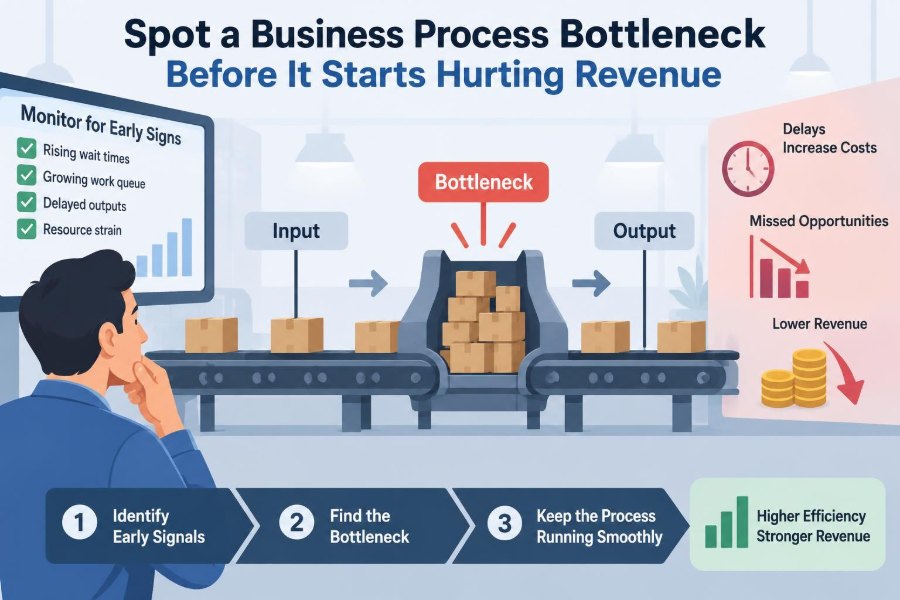
No single person appears to be failing. Yet work is collecting somewhere between the customer’s request and the company’s delivery. That growing pile of unfinished work is often the first visible clue that a business process bottleneck is forming.
Bottlenecks rarely announce themselves as a crisis on day one. They begin as minor delays, extra approvals, repeated corrections, or one unusually busy employee. Left unaddressed, they slow cash flow, raise operating costs, frustrate customers, and eventually limit revenue.
The practical goal is not to make every step equally fast. It is to identify the constraint that limits the entire process, understand why it is under pressure, and act before delayed work turns into lost business.
🔎 What a Business Process Bottleneck Actually Is
A business process bottleneck is the step, resource, rule, or decision point that restricts the flow of work through a larger process. It may be a person, a software system, a machine, a supplier, or a mandatory approval.
Think of a process as water moving through connected pipes. Even if most pipes are wide, the narrowest one determines how much water can pass through the system. Improving a wide pipe does little if the narrow section remains unchanged.
In business, the result is work waiting in queues: orders awaiting review, support tickets awaiting escalation, candidates awaiting interviews, or invoices awaiting approval.
🧭 Why Bottlenecks Become Revenue Problems
A delay does not automatically reduce revenue. A customer may tolerate a slightly slower response, and a backlog may be temporary after a planned campaign. The risk rises when the delay affects a revenue-critical journey repeatedly.
For example, a slow credit check can delay signed contracts, a delayed inventory update can prevent online purchases, and a congested onboarding process can make new clients reconsider their decision. Revenue suffers when customers wait, abandon the process, receive an inferior experience, or cannot be served at all.
Internal effects matter too. Teams may spend more time chasing status updates, correcting errors, or paying overtime. Those costs reduce the value of revenue that does arrive.
📦 Bottlenecks Are More Than Backlogs
A backlog is visible work waiting to be completed. A bottleneck is the limiting condition that causes work to wait. The distinction matters because clearing a backlog once does not necessarily remove its cause.
A manager can ask a team to work late and reduce a queue by Friday. If incoming work still exceeds that step’s normal capacity, the queue will return. The business has treated the symptom, not the constraint.
Look beyond the size of the pile. Ask why work accumulates at that specific point, whether it happens predictably, and whether the step can reliably handle normal and peak demand.
⏱️ The Earliest Signal: Growing Wait Time
One of the clearest early warnings is a rise in wait time: the period when work is ready for the next step but no action is occurring. A customer application may take ten minutes to review but sit for two days before review begins.
Separating active work time from waiting time reveals where flow is breaking down. Teams often focus on how long they spend doing a task, while customers experience the full elapsed time from request to completion.
Track median and unusually long waiting times, not just averages. An average can conceal a group of customers whose requests are delayed far beyond the normal range.
📊 Watch the Queue, Not Just Individual Productivity
High individual productivity can coexist with a poorly performing process. An employee may process many requests per hour while work still accumulates before another downstream step.
Queues show the relationship between demand and capacity. A steadily growing queue indicates that, over a meaningful period, more work is arriving than the constrained step can complete. A queue that rises only at predictable times may be manageable; one that never returns to its normal level needs attention.
Useful questions include:
- Where does unfinished work wait the longest?
- How old is the oldest item in the queue?
- Does the queue clear between busy periods?
- Which types of work remain stuck most often?
📈 Demand Spikes Reveal Fragile Processes
Many processes perform adequately under typical conditions and fail during ordinary variation: a promotion, month-end reporting, a seasonal rush, or one employee’s absence. That is not always a staffing failure. It can reveal that the process has no practical buffer.
A resilient process has enough flexibility to absorb routine swings without creating an extended backlog. This might include cross-trained staff, simpler routing rules, scheduled overflow capacity, or clearer service priorities.
Do not judge capacity solely by quiet days. Examine what happens when demand is high but still foreseeable.
🧮 Compare Capacity With Incoming Work
Capacity is the amount of work a process step can complete in a period at an acceptable quality level. Demand is the work arriving for that step. A bottleneck becomes likely when demand consistently approaches or exceeds usable capacity.
“Usable” matters. A person nominally available for eight hours is not necessarily available for eight hours of processing. Meetings, breaks, complex exceptions, training, system interruptions, and quality checks all affect real capacity.
A simple operational review can compare incoming cases, completed cases, rework, and open items each week. It does not require a sophisticated dashboard to expose an imbalance.
🧱 Find the Step With the Least Slack
Slack is spare capacity: the room a step has to absorb additional work without causing delay. The step with the least slack is often more dangerous than the step with the largest current queue.
Imagine three stages that can complete 100, 90, and 110 orders per day. Even when demand is only 85 orders, the middle stage has little room for an unexpected increase or a difficult batch. It is the likely future constraint.
Mapping capacity side by side helps managers spot this vulnerability before customers see it.
🗺️ Map the Real Process, Not the Ideal One
Formal procedure documents often describe the intended process. Real work may include informal messages, spreadsheet updates, manual checks, duplicate data entry, and unrecorded handoffs. Those hidden steps are frequent sources of delay.
Build a simple process map by following one item from start to finish. Include who performs each action, which system is used, what information is required, and where work waits.
Ask frontline employees to validate the map. They usually know where exceptions, missing information, and workaround routines occur.
🔄 Handoffs Create Quiet Delays
Every handoff introduces a risk that work will be misunderstood, overlooked, or placed behind another priority. The delay may be especially hard to see when ownership changes across departments.
A sales representative may mark a deal as closed, but implementation may not begin until someone checks contract details, creates an account, and confirms technical requirements. Each handoff can be reasonable; together, they can create a slow customer experience.
Clear ownership, defined acceptance criteria, and visible handoff queues reduce ambiguity. A task should not become “someone else’s problem” without a named next owner.
🧾 Approval Loops Often Hide in Plain Sight
Approvals are designed to manage risk, spending, quality, or compliance. But an approval becomes a bottleneck when too many decisions depend on the same person, when approval criteria are vague, or when low-risk work receives the same scrutiny as high-risk work.
Review the purpose of every approval. Some can be replaced with pre-approved limits, standard templates, automated checks, or delegated authority. Others are essential and should remain, but need backup coverage and response expectations.
Removing controls indiscriminately creates a different risk. The better question is whether the control is proportionate to the decision it governs.
🧩 Exceptions Consume More Capacity Than They Seem
Standard work moves quickly because the necessary information and rules are known. Exceptions require judgment, investigation, escalation, or coordination with another party. A small number of difficult cases can consume a disproportionate share of a team’s time.
Classify exceptions rather than treating them as random annoyance. Are they caused by incomplete customer information, unclear policies, unusual product configurations, or system limitations?
Repeated exceptions are process design data. If the same issue appears often, it may deserve a redesigned form, a clearer rule, or a dedicated specialist route.
🛠️ Rework Is Capacity You Have Already Paid For
Rework occurs when completed or partially completed work must be corrected, repeated, or sent backward. It reduces effective capacity because employees handle the same item more than once.
Typical signals include returned applications, corrected orders, repeated customer contacts, rejected submissions, and manual reconciliation. A team can appear busy all day while making little forward progress if rework is high.
Measure where work returns and why. The best fix is often upstream: improve input quality, clarify requirements, or prevent an error in the system before it reaches a reviewer.
🧠 Knowledge Concentration Creates Human Constraints
A process may rely on one person who understands a legacy system, handles complex negotiations, or has authority to resolve exceptions. Their expertise is valuable, but dependence on a single individual creates a fragile bottleneck.
Warning signs include work pausing during leave, colleagues constantly asking the same person for help, and tasks that cannot be completed from documented instructions. These are operational risks, not merely staffing inconveniences.
Cross-training, job aids, decision trees, and planned shadowing can reduce dependency. Not every role can be interchangeable, but routine portions of specialized work often can be shared.
💻 Systems Can Be the Constraint Too
Software bottlenecks include slow response times, limited user licenses, overnight batch updates, disconnected systems, and workflows that require repeated copying and pasting. Employees may compensate with spreadsheets and messages, which can make the underlying issue less visible.
Observe the process while it is happening. If people wait for screens, search across multiple tools, or postpone work until a system refreshes, technology is affecting throughput.
Automation can help, but only when it addresses a clear constraint. Automating a fast step before a congested manual approval may simply deliver more work into the same queue.
🚚 Supplier and Partner Delays Extend Your Process
A company’s process does not end at its own walls. A supplier’s lead time, a logistics partner’s collection schedule, or a payment provider’s review can become the practical constraint on customer delivery.
External dependencies are harder to control, which makes early visibility especially useful. Track promised versus actual turnaround times, recurring causes of delay, and the impact of different suppliers or partners.
Alternatives may include safety stock, clearer service agreements, earlier ordering triggers, dual sourcing where appropriate, or more transparent customer communication. Each option has cost and risk trade-offs.
🎯 Segment Work Instead of Treating Every Item Alike
One queue may contain simple, urgent, high-value, complex, and low-priority work. Processing strictly in arrival order can cause urgent or revenue-sensitive items to wait behind cases that need extensive investigation.
Segmentation creates different paths based on meaningful criteria. For instance, complete standard orders might receive fast-track handling, while incomplete or unusual orders go to an exception queue.
Be careful: prioritization should be transparent and limited. If every manager labels their request urgent, the priority system stops providing guidance and the bottleneck merely shifts.
🚦 Use Leading Indicators, Not Only Lagging Results
Lost revenue, lower renewal rates, and missed monthly targets are lagging indicators: they show that damage has already occurred. Leading indicators provide earlier clues that the process is becoming constrained.
| Leading indicator | What it may signal |
|---|---|
| Rising work age | Items are waiting longer before action |
| Increasing queue size | Demand is outpacing a process step |
| More escalations | Normal routing or service expectations are failing |
| Higher rework volume | Quality problems are consuming capacity |
| More overtime or interruptions | Capacity may be stretched beyond a sustainable level |
Choose a small set of measures that people can review regularly and act on. A crowded dashboard without decisions is not an early-warning system.
📏 Measure Flow Across the Whole Journey
Department-level measures can unintentionally encourage local optimization. A call center may reduce average handling time by transferring complicated customers quickly, while the customer’s total resolution time increases elsewhere.
Use end-to-end measures alongside local ones. Depending on the process, these may include time from order to delivery, request to resolution, lead to signed contract, or invoice to payment.
The purpose is not to blame a department for every delay. It is to see whether the complete value stream is delivering what the customer and business need.
🧪 Test the Suspected Constraint Before Redesigning Everything
Once a likely bottleneck is identified, test the diagnosis with a focused change. Add temporary support during a peak period, simplify one approval rule, separate straightforward work from exceptions, or adjust the sequence of tasks.
If flow improves at the expected point and the queue falls, the hypothesis gains support. If work simply piles up at the next stage, the original constraint may have moved or multiple constraints may exist.
Small tests lower the risk of expensive redesign based on assumptions. Record the starting condition, the change, and what happened to wait time, quality, and downstream workload.
⚖️ Elevate Capacity With Care
When a constraint is genuine, adding capacity may be necessary. Options include hiring, redeploying staff, extending operating hours, outsourcing selected work, upgrading equipment, or introducing technology.
More capacity has costs. Hiring takes time, outsourcing can reduce control, and new software may introduce training and integration work. It is sensible when demand is durable and the constrained step remains the limiting factor after simpler improvements.
Before investing, ask whether demand can be reduced, variability smoothed, rework prevented, or work routed differently. Capacity is valuable, but it is not the only lever.
🧹 Reduce Demand on the Bottleneck
Improvement does not always mean making the constrained team work faster. Often, the better approach is to stop unnecessary work from reaching it.
For example, a finance team reviewing expense claims may receive fewer avoidable questions if the submission form validates required fields. A technical support group may receive fewer routine tickets if customers can find accurate self-service guidance.
This approach works best when it removes genuinely low-value demand. Hiding contact options or forcing customers through confusing self-service may reduce ticket volume while worsening the customer experience.
🪜 Protect the Constraint From Interruptions
A constrained resource should spend as much time as possible on work that only it can do. Constant meetings, status requests, unnecessary reports, and easy tasks can consume the limited capacity that controls overall output.
Protecting the constraint may mean scheduling focused work blocks, assigning administrative support, batching only when it reduces setup effort, or creating clear escalation windows. The objective is not to isolate employees from collaboration; it is to use scarce expertise deliberately.
Also ensure that the constraint has a reliable supply of ready work. A specialist cannot increase throughput if each case arrives incomplete.
🧯 Avoid the “Work Harder” Trap
Overtime and heroic effort can be useful during a short, exceptional event. They are weak long-term solutions because fatigue increases error risk, burnout threatens retention, and hidden process problems remain unsolved.
Likewise, telling every team to improve productivity can create harmful behavior. People may rush work, defer difficult cases, or avoid helping colleagues simply to protect their individual metrics.
Use temporary effort as a bridge while addressing the underlying source of constraint. Sustainable flow is built through process design, not continual emergency mode.
🔁 Remember That Fixing One Bottleneck Can Move Another
Constraints are dynamic. If faster order entry sends more work to fulfillment, fulfillment may become the next bottleneck. This is not proof that the first improvement failed; it shows that the system’s limiting point has changed.
Review flow after every significant intervention. Look for new queues, rising work age, quality changes, and customer effects. Continuous improvement is a cycle of observing, testing, learning, and adjusting rather than a one-time cleanup.
A process with no visible queue is not automatically healthy, either. It may be underused, or employees may be keeping work in personal inboxes where it cannot be seen.
🗣️ Make Bottlenecks Safe to Report
Employees often recognize bottlenecks before managers do. They see recurring missing information, confusing rules, overloaded specialists, and systems that fail at critical moments. They may not speak up if delays are treated as individual incompetence.
Create routines where teams can raise operational friction without blame. A short weekly review of stuck work, recurring exceptions, and customer complaints can uncover patterns early.
The most useful question is often: “What makes this task harder than it needs to be?” It invites evidence and improvement rather than defensiveness.
👥 Give One Person Clear Process Ownership
Cross-functional processes frequently lack an owner because each department controls only its own part. The result is a gap: everyone improves local activity, but nobody is accountable for end-to-end flow.
A process owner does not need direct authority over every employee involved. They do need responsibility for mapping the journey, tracking performance, convening stakeholders, and ensuring improvement actions have owners and deadlines.
Clear ownership is especially valuable where revenue, customer service, operations, and finance all touch the same transaction.
🗓️ Build a Practical Early-Warning Routine
Early detection works when it becomes routine rather than an occasional rescue project. Set a regular cadence appropriate to the pace of the process: daily for high-volume operations, weekly for many service teams, or monthly for slower cycles.
A useful review can cover:
- Demand received versus work completed
- Queue size and age at critical steps
- Rework, exceptions, and escalations
- Capacity changes, absences, and upcoming demand events
- One specific action, owner, and review date
Keep the meeting close to the work. The goal is timely decisions, not a lengthy presentation of metrics.
💡 A Simple Scenario: The Delayed New Customer
Consider a hypothetical business that sells a subscription service. Sales closes more deals after a successful campaign, but new customers must pass through contract review, account setup, data migration, and training.
Account setup is handled by one experienced administrator who also answers internal questions. The queue grows, sales starts promising dates it cannot confirm, and some customers delay their launch. The apparent problem is “slow onboarding,” but the specific constraint is concentrated knowledge and frequent interruption at setup.
Cross-training another employee, protecting setup time, and validating customer information before handoff may improve flow more than asking the administrator to work faster.
🚫 Common Mistakes When Diagnosing Bottlenecks
Several mistakes can delay a useful response:
- Blaming individuals: this ignores workload, process design, and unclear inputs.
- Measuring only averages: long waits and vulnerable customer groups can disappear in the average.
- Automating first: technology can accelerate flawed work or increase downstream congestion.
- Fixing the loudest queue: a visible queue may be a symptom of an earlier constraint.
- Ignoring quality: faster output that produces rework does not improve true capacity.
A disciplined diagnosis follows the work, uses evidence, and checks what happens downstream.
🌱 The Core Principle: Manage Flow Before Revenue Feels It
The most effective bottleneck management is preventive. It combines a clear view of the real process, early signals of waiting and rework, honest capacity assessment, and small, well-observed improvements.
Do not aim to keep every employee or machine busy every moment. Some spare capacity and sensible buffers allow a process to absorb variation. The stronger aim is consistent movement of valuable work from customer request to completed outcome.
When leaders treat queues, handoffs, exceptions, and interruptions as information rather than isolated annoyances, they can intervene while choices are still available.
A bottleneck becomes expensive when it is discovered through missed revenue; it becomes manageable when it is spotted through the flow of work. Watch the wait, understand the constraint, and improve the system before customers have a reason to look elsewhere. 📉⚙️📈