
A manager announces a new bonus scheme, expecting energy and gratitude. Instead, employees compare it with last year’s payout, question the rules, and focus on the one colleague who seems to have received more.
At the same time, a customer abandons an online purchase because a delivery fee appears at the final checkout step—even though the total price is still reasonable. Neither reaction is purely logical, and neither is unusual.
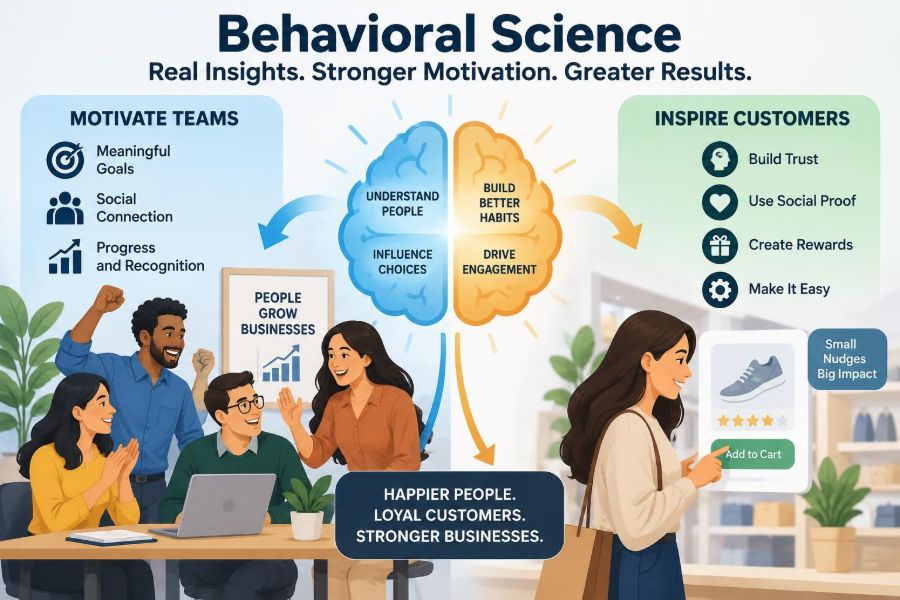
Businesses operate through human decisions: whether people start a task, persist through difficulty, trust a message, buy now, return later, or recommend an employer. Behavioral science helps explain the patterns behind those decisions.
Its most useful lesson is not that people are irrational. It is that people make choices using limited attention, emotions, social cues, habits, and ideas of fairness. When leaders understand those forces, they can design work and customer experiences that are clearer, more motivating, and more ethical.
🧠 What Behavioral Science Brings to Business
Behavioral science draws on psychology, economics, sociology, and related fields to examine how people actually behave. Traditional business models often assume that people carefully compare options and consistently pursue their own long-term interests.
Real decisions are usually made under time pressure and uncertainty. People use mental shortcuts, known as heuristics, to reduce effort. These shortcuts are often useful, but they can also create predictable errors and biases.
For managers, the practical question becomes: what does an employee or customer notice, feel, expect, and find easy to do at the moment of choice?
🔍 Incentives Work, but Context Changes Their Meaning
Pay, commission, discounts, and rewards can influence behavior. Yet an incentive is never interpreted as just a number. People judge its fairness, timing, conditions, and signal about what the organization values.
A sales bonus that rewards only monthly revenue may increase short-term selling while encouraging aggressive tactics or neglected customer relationships. A team incentive may promote cooperation, but it can frustrate high contributors if effort is hard to see.
Good incentive design begins by identifying the desired behavior and possible side effects. Reward systems should make the right action easier, not merely make one metric louder.
💡 Intrinsic Motivation Is More Fragile Than It Looks
Intrinsic motivation means doing something because it is interesting, meaningful, or satisfying. It differs from extrinsic motivation, which comes from outside rewards such as money, status, or avoiding punishment.
External rewards do not automatically destroy internal motivation. They can be helpful for routine, unpleasant, or clearly measurable tasks. Problems arise when rewards feel controlling, replace a sense of purpose, or turn meaningful work into a transaction.
For example, paying customer-support staff only for fast ticket closure may crowd out pride in solving problems well. Combining reasonable compensation with autonomy, feedback, and a service purpose gives motivation more than one source.
🎯 Goals Focus Attention—and Can Create Blind Spots
Clear goals help people direct effort. A vague instruction such as “improve customer service” is difficult to act on; a goal such as “respond to urgent requests within the agreed service window” is easier to translate into daily behavior.
But goals narrow attention. When a target is overly rigid or isolated, employees may ignore quality, safety, learning, or ethical judgment in order to hit it.
Use a small set of balanced measures. A call center, for instance, might track response time alongside resolution quality and customer feedback rather than treating speed as the only definition of success.
📏 The Power of Specific, Credible Feedback
Feedback changes behavior most reliably when it is timely, understandable, and connected to actions a person can control. “Do better” offers little guidance. “Your proposal was clear, but the budget assumption needs a source” points to a next step.
Employees also need to know where they stand without feeling constantly surveilled. Regular check-ins can reduce surprises and make improvement part of normal work rather than an annual verdict.
For customers, feedback includes confirmation messages, order tracking, error explanations, and progress indicators. A calm message explaining what happened and what to do next prevents uncertainty from becoming distrust.
🏁 Progress Can Motivate More Than a Distant Finish Line
People are often energized when they can see movement toward a goal. A large project can feel overwhelming when it appears as one undifferentiated block of work.
Breaking work into visible milestones creates evidence of progress. A learning platform that shows completed modules, or a project board that moves tasks from “planned” to “done,” can make effort feel consequential.
Progress indicators should reflect real progress. Artificial badges and meaningless milestones may briefly attract attention, but they can become manipulative if they disguise slow service or weak value.
🪜 Small Frictions Shape Big Decisions
A tiny obstacle can stop a behavior that people generally intend to perform: a complicated reimbursement form, a login requirement before browsing, an unclear return process, or a meeting link buried in an email thread.
Behavioral design pays close attention to this friction. Reducing unnecessary steps is often more effective than trying to persuade people harder.
Consider an employee benefit that requires five separate approvals. If participation is low, the issue may not be a lack of interest. It may be that the process asks too much effort before the benefit feels real.
🚪 Defaults Quietly Guide Choices
A default is the option that takes effect if a person does nothing. Defaults matter because people are busy, uncertain, and inclined to avoid extra decisions.
Organizations use defaults in areas such as software settings, meeting invitations, subscription renewal, and workplace savings plans. They can make beneficial actions easier, but their influence creates an ethical duty.
A responsible default is easy to understand and easy to change. Hiding cancellation steps or preselecting costly add-ons may increase short-term conversion while damaging trust and attracting complaints.
🧭 Choice Architecture Is Not the Same as Coercion
Choice architecture is the way options are presented: their order, labels, defaults, timing, and required steps. It cannot eliminate influence, because every process must be designed somehow.
The ethical question is whether the design supports informed, voluntary choice. Compare placing a healthier cafeteria option at eye level with concealing the price of an upgrade until payment. Both shape behavior, but they do not respect agency equally.
Managers should ask whether they would be comfortable explaining the design openly to the people affected by it.
⚖️ Fairness Often Matters as Much as the Outcome
People care about what they receive, but they also care about how decisions are made. This is sometimes called procedural fairness.
A promotion decision may disappoint an employee even when the selected candidate is qualified. The disappointment is more likely to become resentment if the criteria were unclear, feedback is absent, or leaders appear to favor insiders.
Transparent processes do not guarantee agreement. They do make it easier for people to understand the decision, see consistent standards, and believe their voice was taken seriously.
🪞 Social Comparison Sets an Invisible Benchmark
Employees and customers rarely evaluate an offer in isolation. They compare it with peers, prior experiences, advertised alternatives, and what they believe others received.
This helps explain why compensation secrecy can fuel speculation and why a customer may feel irritated by a price difference they see as arbitrary. Comparison is especially powerful when rules are ambiguous.
Leaders cannot remove comparison, but they can reduce needless confusion. Explain pay bands where appropriate, clarify eligibility rules, and make customer pricing policies understandable before commitment.
👥 Social Proof Reduces Uncertainty
When people are unsure what to do, they look at what others appear to be doing. This tendency is known as social proof.
For customers, honest reviews, credible usage information, and examples of common choices can reduce uncertainty. For employees, visible participation in training or safety practices can establish a constructive norm.
Social proof becomes harmful when it is fabricated or when it pressures people to follow a crowd against their judgment. Testimonials should be genuine, and workplace norms should leave room for questions and dissent.
🤝 Reciprocity Turns Helpful Acts Into Relationships
People often feel a desire to respond positively after receiving genuine value. In business, reciprocity can arise when a company gives useful information, solves a problem quickly, or makes a reasonable accommodation without demanding something in return.
The key word is genuine. A “free” offer designed mainly to trap people into a difficult cancellation process is not relationship-building; it is pressure dressed as generosity.
Managers can apply reciprocity internally as well. When leaders share context, protect time, and recognize effort fairly, employees are more likely to respond with trust and discretionary effort.
🧩 Autonomy Supports Ownership
Autonomy means having meaningful room to decide how work is done. It does not mean no standards, no accountability, or no coordination.
A skilled analyst may need clear outcomes and deadlines but still benefit from choosing the tools, sequence, or presentation method. That discretion signals competence and can increase commitment to the result.
Too much control communicates distrust and slows decisions. Too little structure can leave people uncertain. Effective managers define boundaries, then give people space inside them.
🌱 Mastery Makes Effort Feel Worthwhile
People are more likely to sustain effort when they can develop competence. Work that is permanently easy becomes dull; work that is permanently impossible becomes discouraging.
Managers can support mastery through stretch assignments, coaching, practice time, and feedback that identifies a learnable skill rather than a fixed personal flaw. “Try a clearer opening structure” is more useful than “You are not strategic.”
Customers also value a sense of mastery. Straightforward onboarding, helpful tutorials, and predictable controls make a product feel less intimidating and more usable.
🧭 Purpose Connects Tasks to Consequences
Purpose is not a poster on a wall. It is an understandable connection between work and an outcome that matters to someone.
A payroll employee may find purpose in accuracy because late or incorrect pay affects colleagues’ lives. A warehouse worker may see meaning in reliable delivery when leaders explain how the operation supports customers or essential services.
Purpose should be specific and believable. Grand language cannot compensate for poor working conditions, inconsistent leadership, or a product that does not deliver real value.
🧠 Loss Aversion Changes the Way Offers Land
People often react more strongly to a potential loss than to an equivalent gain. This pattern, known as loss aversion, helps explain why a fee feels more painful than a missed discount feels rewarding.
It can shape customer communication: “Keep your current service level by renewing” may be more attention-grabbing than “Gain continued service.” But framing should never create false urgency or exaggerate what is at stake.
At work, leaders should be careful when changing benefits, schedules, or tools. Even a change that offers long-term value can meet resistance if employees experience it first as losing something familiar.
⚓ Anchors Influence Judgments Before Analysis Begins
An anchor is an initial number or reference point that influences later judgment. A high list price can make a lower price seem attractive; last year’s budget can shape expectations for this year’s spending.
Anchors are useful when they provide relevant context, such as showing a product’s standard package beside an upgraded package. They are misleading when the reference price is artificial or unlikely ever to have been paid.
In negotiation and performance discussions, remember that the first figure is not automatically the right figure. Ask what evidence supports it before letting it set the entire conversation.
🧾 Mental Accounting Explains Why Money Is Not Interchangeable
People tend to categorize money mentally: rent money, holiday money, a work budget, or a “treat” fund. Economically, one unit of currency is interchangeable with another, but psychologically the source and label matter.
Businesses can use this insight responsibly by making spending categories clear and helping customers understand total ownership costs. Employers can make benefits easier to value by clearly showing what each component provides.
However, splitting a price into many small charges can obscure rather than clarify the true cost. Clarity should be the goal, not confusion.
⏳ Present Bias Favors Immediate Rewards
Present bias is the tendency to give extra weight to immediate costs and benefits compared with future ones. It explains why people may postpone training, avoid preventive maintenance, or delay a useful purchase that requires effort now.
Businesses can counter this by making the first step small. Offer a brief trial task, schedule learning time in the calendar, or let customers save progress rather than forcing them to complete a long process at once.
Do not confuse present bias with laziness. The immediate burden may genuinely be too high, especially for people dealing with limited time, money, or attention.
🔁 Habits Depend on Cues, Routines, and Rewards
Many repeat behaviors are driven less by fresh decisions than by habit. A cue triggers a routine, followed by some reward: opening a dashboard after a morning notification, for example, may produce the reward of feeling informed.
To build a useful workplace habit, make the cue reliable and the action simple. A team might begin weekly meetings with a two-minute risk review, using the calendar invitation as the cue.
Customer retention also depends on useful routines. A product that fits naturally into a person’s workflow has a stronger foundation than one that relies only on promotional reminders.
📣 Message Framing Changes What People Notice
The same information can produce different reactions depending on how it is framed. A safety message that names the concrete action and consequence is generally easier to use than an abstract warning about “best practice.”
Framing should clarify, not manipulate. If a financial product emphasizes possible returns while minimizing risk, the message is incomplete. If a workplace change describes benefits but ignores disruptions, employees will notice the omission.
Test messages for comprehension. The best wording is often the one that helps a person accurately explain the choice back to someone else.
📉 Scarcity Can Signal Value—or Manufacture Anxiety
Limited availability can increase attention because people do not want to miss a valuable opportunity. Sometimes scarcity is real: a workshop has limited seats, a seasonal item has finite stock, or a specialist has limited appointment time.
Artificial countdown timers and perpetual “last chance” messages can create urgency without useful information. Over time, customers learn to distrust them.
Use scarcity claims only when they are accurate and relevant. For internal opportunities, explain the constraint and offer a fair selection process rather than rewarding whoever reacts fastest.
🪟 The Endowment Effect Makes Change Feel Costly
People often value something more once they feel it is theirs. This endowment effect helps explain why employees can resist replacing a familiar system and why customers may hesitate to give up a product feature.
Change leaders should not dismiss this as stubbornness. Familiar tools contain learned shortcuts, identity, and confidence. Replacing them creates a real transition cost even when the replacement is objectively better.
Migration support, parallel running periods, and clear explanations of what people keep can reduce unnecessary resistance.
🗣️ Voice and Participation Improve Acceptance
People are more likely to accept decisions when they have an opportunity to contribute information or raise concerns. Participation does not require consensus on every choice.
Before changing a workflow, leaders can ask frontline employees where delays occur and which exceptions a formal process may miss. Customers can identify confusing steps through usability testing and support feedback.
The value lies partly in better information and partly in respect. Asking for input and then ignoring it without explanation can be worse than not asking at all.
🔒 Trust Is Built Through Consistency
Trust grows when promises, policies, and everyday behavior align. A company cannot compensate for hidden fees with polished branding, and a manager cannot build psychological safety while punishing people for raising bad news.
Consistency matters in small moments: whether delivery estimates are realistic, whether performance criteria are applied evenly, and whether support staff can solve predictable problems without making customers repeat themselves.
Trust takes time to build and can be weakened quickly by a mismatch between stated values and lived experience.
🛡️ Psychological Safety Enables Better Team Decisions
Psychological safety is a shared sense that people can ask questions, admit mistakes, and raise concerns without humiliation or retaliation. It is not the same as avoiding difficult feedback or lowering standards.
Teams need it because errors and weak assumptions are easier to catch when people speak early. A junior employee who notices a data problem should be able to flag it before a client presentation, not after it fails.
Leaders shape safety by responding productively to bad news, inviting alternative views, and separating a person’s worth from a correctable mistake.
⚠️ Measurement Can Distort the Behavior It Tracks
Metrics are essential, but people adapt to what is measured. If a team is rewarded only for output volume, quality may suffer. If leaders monitor visible activity rather than outcomes, employees may perform busyness.
This is not an argument against measurement. It is an argument for checking whether a metric remains a useful signal after it becomes a target.
Review dashboards with the people doing the work. Ask what behavior the measure encourages, what it misses, and whether anyone can improve the number while making the underlying outcome worse.
🧪 Test Designs Carefully Rather Than Guessing
Behavioral ideas are hypotheses, not magic formulas. A message or incentive that works for one audience may fail for another because needs, constraints, and culture differ.
When practical, test one meaningful change at a time and define what success would look like before rollout. Look beyond immediate clicks or participation rates to outcomes such as comprehension, satisfaction, repeat use, quality, and complaints.
Small tests should still respect privacy, fairness, and informed expectations. A/B testing is not a license to expose people to deceptive or harmful experiences.
🌍 Culture Determines What a “Good” Nudge Looks Like
Behavior is shaped by social and organizational culture. Direct competition may motivate one team and damage cooperation in another. Public recognition may feel rewarding to one person and uncomfortable to another.
Global businesses should avoid assuming that one motivational design travels unchanged across locations. Local managers and users can reveal differences in language, norms, access, and trust.
Personalization can be useful, but it should not become intrusive surveillance. Use only information that is necessary, expected, and handled responsibly.
🚫 Common Behavioral Design Mistakes
Many weak programs fail not because behavioral science is wrong, but because it is reduced to a collection of tricks. The following mistakes are especially common:
- Using rewards to solve a broken system: bonuses cannot fix unclear roles, unsafe workloads, or missing tools.
- Creating dark patterns: confusing cancellations and hidden charges may lift a metric while undermining trust.
- Copying a tactic without diagnosing the problem: a low-performing team may need training, not gamification.
- Ignoring equity: a “simple” default may disadvantage people with less time, access, or confidence.
- Celebrating short-term behavior only: immediate conversion or output can conceal later churn, errors, and burnout.
🧰 A Practical Process for Managers
Start with the behavior, not the fashionable intervention. Describe what people currently do, what they need to do instead, and the specific moment where the gap occurs.
- Identify the audience and the decision moment.
- Map barriers: effort, uncertainty, timing, skill, trust, incentives, or social norms.
- Choose the least intrusive change that addresses a real barrier.
- Make the choice and its consequences clear.
- Measure intended results and unintended effects.
- Revise based on evidence and user feedback.
This process prevents leaders from treating every issue as a communication problem. Sometimes the soundest behavioral intervention is simply removing an unreasonable obstacle.
🌟 The Core Principle: Design for People, Not Perfect Machines
Behavioral science changed business thinking by replacing the image of the perfectly rational employee or customer with a more realistic one. People want fair treatment, understandable choices, progress, belonging, competence, and control over meaningful parts of their lives.
The strongest applications combine business goals with those human needs. They make good actions easier, make information clearer, create feedback people can use, and preserve freedom to choose.
Used carelessly, behavioral techniques can become manipulation. Used responsibly, they help organizations build environments where employees can do better work and customers can make decisions they genuinely understand.
Lasting motivation does not come from pushing people harder; it comes from designing systems that respect how people actually think, feel, and decide. 📊🧠🤝