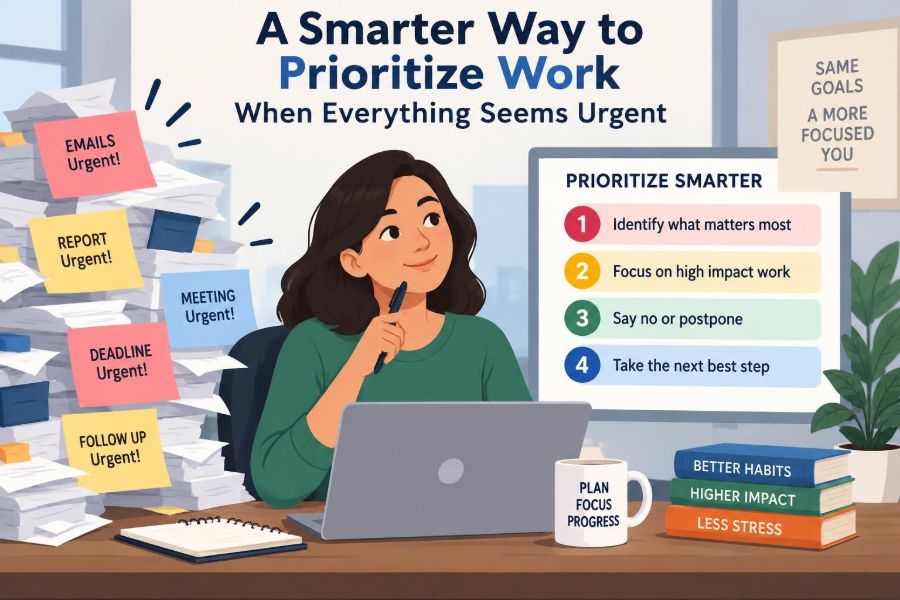

The inbox is full before the day begins. A manager wants an update, a customer needs an answer, a meeting starts in 20 minutes, and a colleague marks another message “urgent.” Each request may be legitimate. Together, they can make focused work feel impossible.
When every item appears urgent, people often respond by working faster, extending the day, or tackling whichever request arrives most loudly. That can create activity, but it does not necessarily create progress.
Prioritization is the discipline of deciding what deserves attention now, what needs to be planned, what can wait, and what should not be done at all. It is less about finding a perfect productivity system and more about making sound trade-offs visible.
A smarter approach protects important outcomes while still responding responsibly to real deadlines and disruptions. It helps students, individual contributors, managers, and teams replace constant reaction with deliberate choices.
🚨 Why Everything Starts to Feel Urgent
Urgency is often contagious. A rushed message, a looming meeting, or a senior person’s request can trigger an immediate response even when the actual consequence of waiting is small.
Work also feels urgent when tasks are vague. “Prepare for the client” sounds alarming because it could mean anything from checking one document to rebuilding an entire presentation. Unclear work expands in the mind.
Finally, many workplaces reward visibility. Quick replies are easy to observe, while careful planning, risk prevention, and deep analysis are less visible. This can quietly train people to prioritize what is noticeable over what matters.
🎯 Urgent Is Not the Same as Important
Urgent work requires attention soon; important work materially supports a meaningful goal, responsibility, or outcome. A payroll problem may be both urgent and important. Replying “received” to a routine email may be urgent only because someone expects a fast answer.
This distinction matters because important work often has a longer time horizon. Training a new employee, improving a process, studying for a professional qualification, or resolving the source of repeat errors may not demand action this hour. Neglecting them, however, creates larger problems later.
Ask two separate questions: “What happens if this waits?” and “What outcome does this help create?” The answers are more useful than the sender’s subject line.
🧭 Start With Outcomes, Not a Task Pile
A task list tells you what people have asked for. Outcomes explain why the work exists. Before ranking individual tasks, identify the few results that matter in the current week, month, or project phase.
For example, a project coordinator may have three core outcomes: secure an approved project plan, keep a launch date realistic, and resolve a supplier dependency. These outcomes give context to dozens of smaller requests.
Without this anchor, prioritization becomes a contest between task titles. With it, you can ask whether a task advances a committed result, reduces a meaningful risk, or merely creates the appearance of responsiveness.
🔎 Define the Real Request
Many urgent requests are incomplete requests. Before beginning, clarify the deliverable, decision needed, audience, deadline, and standard of quality.
Suppose a leader says, “I need the sales numbers urgently.” Do they need a rough total for a conversation in 15 minutes, a verified report for the board, or a chart for a presentation tomorrow? Each version requires different effort.
A useful response is: “I can provide a preliminary total by 2 p.m. and a checked breakdown tomorrow morning. Which one is needed?” Clarification is not delay; it prevents unnecessary work.
⏳ Examine the Consequence of Delay
Real urgency has a credible consequence. Missing a regulatory filing deadline, leaving a customer unable to use a paid service, or failing to address a safety concern can cause immediate harm.
Other tasks have softer consequences: someone may be mildly inconvenienced, a meeting may be less polished, or a requester may need to wait. Those outcomes still deserve consideration, but they do not automatically justify interrupting high-value work.
Try stating the consequence plainly: “If we do not complete this today, the invoice will be late,” or “If we wait until tomorrow, the manager will have to use last week’s figures.” Concrete language separates risk from pressure.
🏷️ Use a Simple Priority Classification
A small number of categories is easier to use than a complicated scoring system in the middle of a busy day. The aim is not scientific precision; it is consistent judgment.
| Category | Meaning | Typical response |
|---|---|---|
| Critical now | Serious, time-bound consequence if delayed | Act, escalate, or assign immediately |
| Important next | Strongly advances a key outcome or prevents future problems | Schedule protected time |
| Necessary routine | Supports normal operations but has limited strategic impact | Batch or delegate where appropriate |
| Optional or unclear | Low value, duplicate, premature, or poorly defined | Clarify, defer, simplify, or decline |
Classify the work, then decide the response. A category is useful only if it changes what you do next.
📌 Separate Deadlines From Preferences
A deadline is a point after which a requirement cannot reasonably be met or a consequence occurs. A preference is a desired time that may be negotiable. People frequently use the same language for both.
When a request says “ASAP,” ask for the latest useful time and the reason. “Would noon work, or does this need to be ready for the 10 a.m. call?” often reveals room to plan.
This is especially valuable for teams. Unquestioned preferences consume capacity that may be needed for immovable commitments.
🧱 Consider Dependencies Before Starting
A task may look urgent while being blocked by information, approval, access, or another person’s work. Starting it immediately can produce waiting rather than progress.
Map the next dependency: What must be true before this can move? Who owns it? When will it be available? This may show that the best action is a short request for missing input, not hours of premature work.
Dependencies also reveal leverage. Completing a decision that unblocks five people can outrank completing a standalone task, even if the standalone task has a more dramatic subject line.
⚖️ Weigh Impact Against Effort
Not every valuable task deserves immediate attention. A quick action that prevents a customer problem may be a sensible first move; a large initiative with uncertain value may need a planned block rather than an interruption.
Consider four factors together: expected impact, effort, deadline, and certainty. High impact does not justify endless effort if the outcome is speculative. Low effort does not make a task worthwhile if it solves nothing meaningful.
This is judgment, not arithmetic. The purpose is to avoid treating all tasks as equal simply because they occupy the same list.
🛑 Identify True Emergencies
A true emergency involves an immediate threat to safety, security, legal obligations, critical operations, or a major customer commitment. It may require an immediate response before normal prioritization can occur.
But an emergency category must remain narrow. If routine late requests are repeatedly treated as emergencies, teams lose the capacity to respond when a genuine crisis appears.
Organizations benefit from defining escalation paths in advance: who is contacted, who decides, what information is required, and when normal work may be interrupted. Clear rules reduce panic.
🧠 Account for Cognitive Switching Costs
Every interruption has a hidden cost. After answering a message, many people need time to remember where they were, reconstruct their reasoning, and regain concentration.
That cost is particularly high for analysis, writing, planning, coding, financial review, and learning. Five small “urgent” interruptions can erode more than five small blocks of time.
Protecting focus is not a refusal to collaborate. It is a recognition that some work needs continuity to be done accurately and efficiently.
📥 Triage Incoming Work at Set Times
Constantly reassessing every notification gives incoming work control over the day. Instead, set regular triage points: perhaps at the start of the day, before midday, and late afternoon.
At each triage point, decide whether a request needs immediate action, a scheduled slot, a reply with a revised expectation, delegation, or no action. Urgent channels for genuine incidents can remain available outside these windows.
This approach is not suitable for every role. Frontline service, operations, and incident-response work may require continuous monitoring. Even then, a defined rotation or escalation process can protect others from needless interruption.
🗓️ Turn Priorities Into Calendar Commitments
A priority that stays on a list is easy to displace. Important work becomes more likely when it has a realistic place on the calendar, with enough time for preparation and follow-up.
Block time for work that requires concentration, and label the block by outcome rather than a generic phrase such as “admin.” “Draft the decision brief” creates a clearer commitment than “catch up.”
Leave some unscheduled capacity. A calendar filled to every minute assumes a perfectly predictable day, which most jobs do not provide.
🧰 Break Large Work Into Decidable Next Actions
Large projects often lose to small urgent tasks because they feel difficult to start. “Improve onboarding” competes poorly with “reply to email” until it becomes a concrete next action.
Examples of useful next actions include reviewing the current onboarding steps, interviewing two recent hires, listing recurring questions, or drafting a one-page proposal. Each creates momentum without pretending the entire project can be completed at once.
A next action should be visible, feasible, and connected to an outcome. If it is still too broad to begin, it is not yet a next action.
🧮 Use Scoring Only When Choices Are Repeated
For recurring decisions, a lightweight scoring method can make priorities more transparent. A team might rate requests by customer impact, deadline risk, strategic alignment, effort, and confidence in the expected benefit.
Scores should guide conversation, not replace it. A simple model cannot fully capture a sensitive client relationship, a new compliance risk, or an opportunity that depends on timing.
Use a score when many similar requests compete for limited capacity. For one-off decisions, a clear discussion of outcomes and trade-offs is often faster and more honest.
👥 Match the Work to the Right Owner
Prioritization is not only about sequence. It is also about ownership. A task may be urgent for the organization but not require the most senior, busiest, or technically specialized person to do it.
Delegate when someone else has the skill, authority, or proximity to complete the work effectively. Provide the needed context, expected result, deadline, and decision boundaries; delegation without clarity merely transfers confusion.
Conversely, do not delegate a decision that requires your accountability simply to remove it from your list. The right owner is not always the available owner.
💬 Negotiate Priorities Openly
When capacity is limited, accepting a new priority means moving something else. Naming that trade-off is responsible, not confrontational.
Try language such as: “I can complete the customer analysis today, but the budget review will move to tomorrow. Which outcome should take priority?” This turns a private overload problem into a shared decision.
Managers play a central role here. Team members cannot make sensible choices if leaders continually add urgent work without confirming what may be paused.
🗣️ Communicate With Specific Options
Vague replies create more messages. A clear update states what you can do, when you can do it, and what you need from the requester.
- “I can send a preliminary answer by 3 p.m.; validation will take until tomorrow.”
- “This is blocked by approval of the revised scope. Once approved, I can finish within one working day.”
- “I can take this on if we defer the training materials. Please confirm the preferred trade-off.”
Specific options give others a chance to decide. They also make hidden constraints visible before a deadline becomes a crisis.
📣 Do Not Let the Loudest Voice Set the Queue
Seniority and customer needs can legitimately affect priorities, but volume, persistence, and emotional intensity are unreliable signals of value. A loud requester may simply be more comfortable escalating.
Use agreed criteria to assess requests consistently. This protects quieter stakeholders, long-term work, and employees who might otherwise feel compelled to answer every message instantly.
If a senior request conflicts with a critical commitment, surface the conflict respectfully. Leaders often lack the visibility to make a good choice until someone explains what will be displaced.
🔄 Batch Routine Work Where Possible
Routine tasks such as approving standard requests, processing expense claims, replying to non-urgent messages, or updating records can consume a day when handled one by one as they arrive.
Batching means grouping similar work into a designated period. It reduces setup time and makes workload more predictable. It does not mean ignoring people; it means establishing reasonable service expectations.
Some requests cannot wait, especially where customers, payments, safety, or operations are affected. Define exceptions clearly so batching does not become rigid delay.
🧹 Reduce Work Before Optimizing It
The best priority system cannot solve a workload filled with unnecessary tasks. Look for duplicate reports, meetings without decisions, approvals that add no control, and updates created only because nobody has questioned them.
Ask whether the task can be eliminated, simplified, automated, combined, or completed at a lower level of detail. A five-minute report may be sufficient when a polished dashboard adds no extra decision value.
This is not an argument for careless work. It is an argument for matching effort to the decision the work will support.
📊 Use a Visible Team Queue
Teams struggle when each person maintains a private understanding of what is urgent. A shared queue, board, or list can show active work, ownership, deadlines, blockers, and the order of priority.
Visibility makes overload easier to discuss. It can reveal, for example, that three “quick” requests collectively displace a major deliverable, or that a task has waited because no one owns a prerequisite.
The tool matters less than the habits around it. Keep it current, make prioritization criteria understandable, and avoid turning the queue into a surveillance device.
🧑💼 Managers Must Protect Capacity
Managers set the practical definition of urgency through their behavior. If they send late-night messages expecting instant answers, repeatedly bypass the team queue, or praise last-minute rescues more than prevention, employees will adapt accordingly.
Good capacity management includes asking what should stop, defending focused time, balancing work across people, and escalating conflicting commitments to the right decision-maker.
It also includes distinguishing development work from spare-time work. Process improvement, training, and planning require allocated capacity or they will be perpetually postponed.
📚 Students Face the Same Trade-Offs
A student’s version of urgency may include assignment deadlines, group messages, paid work shifts, exam preparation, and administrative tasks. The same principle applies: due soon is not automatically the most valuable use of the next hour.
For instance, a small task due tomorrow may deserve a brief scheduled block, while regular exam revision deserves protected time weeks earlier. Waiting until revision becomes urgent is a costly strategy.
Course requirements and personal constraints differ, so no universal schedule fits everyone. The useful habit is to identify assessment weight, preparation time, dependencies, and the consequence of delay.
⚠️ Watch for Perfectionism Disguised as Priority
Sometimes a task remains at the top of the list because it is emotionally difficult to release. People may keep refining slides, rechecking a familiar analysis, or researching beyond what the decision requires.
Set a definition of done before starting: the required audience, level of accuracy, format, and deadline. Then ask whether additional work changes the decision or merely improves comfort.
Quality matters most where errors carry real consequences. Elsewhere, a timely, clear, fit-for-purpose result is often more valuable than an ideal result delivered too late.
🧯 Avoid the Rescue Culture Trap
Rescuing a deadline can occasionally be necessary. Celebrating rescue as the normal way of working, however, can hide poor planning, unclear ownership, unrealistic promises, or chronic understaffing.
After an urgent episode, conduct a brief review: What triggered it? What signal was missed? Which decision came too late? What would reduce the chance of recurrence?
The purpose is improvement, not blame. Repeated emergencies are often a process-design issue rather than an individual effort issue.
🧪 Review Your Priorities at the End of the Day
A short review converts experience into better judgment. Compare what you intended to do with what actually happened, then identify the reason for any difference.
- Which interruptions were genuinely necessary?
- Which important task was displaced, and by what?
- What should be clarified, scheduled, delegated, or declined tomorrow?
This review should be practical, not punitive. Its value lies in adjusting the system while the details are still fresh.
🌱 Build Prevention Into the Week
Many urgent tasks are predictable in disguise: recurring approvals arrive late, stakeholders request data before regular meetings, and project risks surface at familiar milestones. Patterns can be planned for.
Build preventive actions into the week. Prepare a regular report before it is requested, confirm decisions before they become blockers, and reserve time to address recurring sources of rework.
Prevention can feel less satisfying than responding to a visible fire, but it improves reliability. Over time, fewer avoidable emergencies create more room for meaningful work.
🔍 Know When a Framework Is Not Enough
Priority matrices, scores, and calendars are helpful, but they cannot resolve every conflict. A major organizational change, ethical concern, sensitive employee matter, or serious operational risk may require consultation and judgment beyond a personal system.
Similarly, if overload is persistent rather than occasional, individual efficiency is not the complete answer. Work volume, staffing, scope, decision rights, and leadership expectations may need to change.
Recognizing a structural problem prevents people from blaming themselves for failing to optimize an impossible workload.
🏁 The Core Principle: Make Trade-Offs Deliberate
Smart prioritization does not promise a calm day or a completed task list. Work contains uncertainty, competing needs, and occasional genuine emergencies.
Its central discipline is to make choices explicit: clarify the outcome, test the real deadline and consequence, consider dependencies and capacity, assign the right owner, and communicate what will move.
When everything seems urgent, the answer is rarely to do everything faster. It is to protect the work with the greatest consequence and value while consciously managing the rest.
The most reliable priority is not the task that shouts the loudest, but the work that best protects a meaningful outcome at the right time. With clear choices and honest communication, urgency becomes something to manage rather than something that manages you. 📊🧭