
A customer asks a simple question: “When will my order arrive?” The answer should take seconds. Yet someone must find the order, check inventory, ask operations, confirm shipping capacity, and hope the information is current.
Situations like this reveal how a business really works. Performance is rarely determined by one talented manager, one clever strategy, or one new piece of software. It emerges from the connections between everyday work, the people doing it, the information they use, and the choices leaders make.
A business can have excellent employees but confusing processes. It can collect huge amounts of data but make decisions too slowly to act on it. It can set ambitious goals but fail because departments optimize their own work rather than the customer’s experience.
High-performing businesses reduce those disconnects. They create a system in which people can do good work, processes make that work repeatable, data makes conditions visible, and decisions turn insight into action.
🧩 High Performance Is a Connected System
A high-performing business consistently delivers valuable results while adapting to changes in customers, costs, technology, and competition. Consistency matters: a single excellent quarter or successful product launch is not the same as an organization that can perform well repeatedly.
Think of the business as a system rather than a collection of departments. Sales, operations, finance, customer service, technology, and human resources each have distinct responsibilities, but their outputs become someone else’s inputs. A delayed approval in finance may become a stock shortage in operations and a broken promise in customer service.
Performance improves when the system works across boundaries, not merely when individual teams work harder.
🎯 Start With the Value the Business Must Create
Before improving internal work, clarify what the organization is trying to provide and for whom. Value may mean reliable delivery, expert advice, low prices, safety, convenience, customization, or a combination of these.
A hospital, a local retailer, and a software company will organize work differently because customers judge them differently. A business that competes on speed needs short handoffs and rapid decisions. One that competes on precision needs careful checks, specialist knowledge, and controlled variation.
Without this shared definition, departments can make sensible local choices that undermine the wider proposition. For example, purchasing may select the lowest-cost supplier even when inconsistent quality damages a brand built on reliability.
🗺️ Processes Turn Intentions Into Repeatable Work
A process is a connected sequence of activities that transforms inputs into an outcome. It has a trigger, steps, roles, decisions, information, and a result. Receiving an order, hiring an employee, resolving a complaint, and closing the monthly accounts are all processes.
Processes matter because organizations cannot rely on memory and individual heroics at scale. Clear work sequences make quality more dependable, help new employees learn, and reveal where time, effort, or materials are being wasted.
A documented process should not become a rigid script. Its purpose is to establish a reliable baseline, identify necessary exceptions, and make improvement possible.
🔍 See Work End to End, Not Department by Department
Department charts show reporting lines; they rarely show how value moves. An end-to-end view follows work from a customer need to a completed outcome, including the waiting periods and handoffs in between.
Consider a hypothetical business-to-business equipment supplier. A quote begins in sales, moves to engineering for specifications, then to finance for credit approval, purchasing for components, production for assembly, and logistics for delivery. The customer experiences one promise, not six departments.
Mapping that journey often exposes hidden friction: duplicate data entry, unclear ownership, approvals that add little control, or requests that sit in inboxes because nobody knows the next step.
⏳ Handoffs Are Where Delays and Errors Gather
A handoff occurs whenever work, responsibility, or information passes from one person or team to another. Handoffs are unavoidable in specialized organizations, but each one creates a chance for details to be lost, misunderstood, delayed, or changed without notice.
Useful handoffs specify what is being transferred, what “complete” means, who accepts it, and what happens if information is missing. A vague statement such as “send it to operations” is weaker than a shared checklist and a named owner.
Improving handoffs does not always mean removing them. Sometimes the right answer is a standard form, a common system, or a short daily coordination meeting.
⚙️ Standardize the Routine, Protect Judgment
Standardization is most valuable when work is frequent, predictable, and sensitive to errors. Examples include entering customer details, conducting safety checks, processing invoices, or responding to common support requests.
It should not eliminate professional judgment where circumstances differ meaningfully. A support agent handling an unusual customer issue, for instance, may need authority to depart from a standard response rather than forcing the case through an unsuitable workflow.
The practical challenge is to define the boundary: what must be consistent, what may vary, and who may approve an exception. This balance prevents both chaos and bureaucracy.
👥 People Are More Than Roles on an Organization Chart
Job titles describe accountability, but performance depends on capability, motivation, relationships, and working conditions. Two people with the same role can produce very different outcomes if one has relevant training, clear expectations, timely feedback, and access to the right tools.
Managers should ask whether the work design enables success. Are responsibilities realistic? Can employees raise concerns safely? Do they understand how their work affects customers and colleagues? These questions often reveal more than a generic instruction to “be accountable.”
People do not simply execute processes; they notice exceptions, resolve ambiguity, and identify improvement opportunities that formal procedures may miss.
🧠 Build Capability Where the Work Happens
Capability combines knowledge, practical skill, judgment, and the ability to apply them in context. Training is one route to building it, but not the only one. Coaching, job shadowing, practice, peer review, and post-project reflection can be equally valuable.
Effective development is tied to actual performance needs. If a team struggles to forecast demand, a generic communication workshop will not solve the problem. It may need stronger analytical skills, clearer demand definitions, and better access to relevant data.
Organizations also need to protect critical knowledge. When only one experienced employee knows how to handle a recurring issue, the process is fragile.
🤝 Psychological Safety Supports Early Problem-Solving
Psychological safety is the shared sense that people can ask questions, admit mistakes, challenge assumptions, or raise concerns without being humiliated or punished unfairly. It is not a lack of standards or accountability.
In a high-performing business, bad news should travel quickly. A team that hides a quality issue to avoid blame allows a small defect to become a costly customer problem. A team that surfaces it early gives the organization options.
Leaders influence this climate through their responses. Curious questions such as “What made this hard to spot?” generally produce more learning than immediate personal blame.
🧭 Clear Decision Rights Prevent Drift
Many decisions slow down because employees do not know who has authority to decide, who must be consulted, and who simply needs to be informed. This uncertainty leads to repeated meetings, unnecessary escalation, or conflicting actions.
Decision rights make those boundaries explicit. A store manager might be allowed to resolve customer complaints up to a defined limit, while pricing policy remains a central commercial decision. The exact arrangement depends on risk, expertise, and the need for local responsiveness.
Clear rights also prevent a common failure: holding someone accountable for an outcome without giving them enough authority or resources to influence it.
📐 Use Data to Describe Reality, Not to Decorate Reports
Data becomes useful when it answers a real operational or strategic question. A dashboard full of attractive charts may still be unhelpful if no one can explain what action should follow from a change in a number.
Start with a decision: Should staffing change? Is a product problem becoming more common? Which orders require attention? Then identify the minimum reliable information needed to answer it.
Data should be interpreted alongside context. A rise in customer contacts could indicate poorer service, but it might also follow a successful promotion or a newly introduced product that requires more guidance.
📊 Choose Measures That Reflect the Whole Outcome
A metric directs attention, and people often adjust their behavior to improve what is measured. That makes metric design a management choice, not a neutral technical task.
For example, measuring a call center only by average call length may encourage agents to end conversations quickly, even if customers still need help. Combining speed with resolution quality and customer feedback gives a more balanced picture.
| Measure type | What it helps show | Common limitation |
|---|---|---|
| Outcome measure | Whether a desired result occurred, such as orders delivered correctly | May show problems after they have affected customers |
| Process measure | Whether critical work is flowing as intended, such as approval time | Can encourage narrow local optimization |
| Capacity measure | Whether resources can meet demand, such as available staff hours | Does not prove that capacity is used effectively |
| Quality measure | Whether output meets requirements, such as error rates | Requires consistent definitions and reporting |
🧼 Data Quality Is an Operational Responsibility
Inaccurate, incomplete, late, or inconsistently defined data can produce poor decisions with great confidence. If different teams use different definitions of an “active customer,” their reports may conflict even when both are technically correct.
Data quality improves when ownership is clear at the point of creation. People need simple ways to enter information correctly, definitions that match operational reality, and feedback when errors affect downstream work.
Cleaning data only at reporting time treats the symptom. Improving the process that creates it is usually more sustainable.
🔄 Leading and Lagging Indicators Work Together
A lagging indicator reports an outcome that has already occurred, such as monthly revenue, late deliveries, or employee turnover. It is useful for assessing results but may arrive too late to prevent a problem.
A leading indicator signals conditions that may influence a future result. Examples can include unresolved production defects, a growing approval backlog, or a decline in trained staff coverage. Leading indicators are not guarantees; they are prompts to investigate.
Strong management uses both. Outcomes show whether the organization delivered, while earlier signals help teams adjust before performance deteriorates.
🗣️ Turn Information Into Productive Conversations
Data does not create improvement by itself. Teams need regular forums in which they can interpret results, compare them with what is happening on the ground, and agree on the next action.
A useful review meeting focuses on a small number of questions: What changed? Why might it have changed? What evidence is missing? What decision is needed? Who owns the follow-up, and when will progress be checked?
When meetings become status recitals, information is shared but little is learned. The goal is not to discuss every number; it is to resolve uncertainty and coordinate action.
⚖️ Good Decisions Match the Level of Risk
Not every choice deserves the same analysis. Ordering routine supplies, responding to a minor service issue, entering a new market, and changing a safety procedure have very different consequences if the decision is wrong.
High-performing organizations match their decision process to the stakes. Low-risk, reversible choices can often be delegated and made quickly. High-impact or hard-to-reverse choices may require broader evidence, specialist input, and deliberate challenge.
This distinction prevents two costly habits: overanalyzing routine work and making major commitments based on intuition alone.
🚦 Make Reversible Decisions Faster
Some decisions can be tested, adjusted, or reversed at modest cost. A team may pilot a new customer email, trial a revised shift pattern in one location, or test a simplified approval form before applying it widely.
Small experiments reduce uncertainty because they generate real feedback. They work best when the team states what it expects to happen, defines what it will observe, and sets a review point.
Speed should not mean carelessness. A quick test still needs safeguards when customers, privacy, safety, contracts, or reputation could be affected.
🧪 Test Assumptions Before Scaling a Solution
Businesses frequently mistake a plausible idea for a proven solution. A new workflow may appear efficient in a workshop but fail when employees face peak demand, incomplete information, or unusual customer cases.
Testing exposes assumptions about time, capability, technology, and customer behavior. It also reveals unintended effects. For example, automating a request form might reduce administrative effort while making it harder for customers with complex needs to explain their situation.
A pilot should be treated as learning, not as a performance of certainty. If results are mixed, leaders can refine the design rather than forcing a premature rollout.
🏢 Alignment Connects Daily Work to Strategy
Strategy describes the choices an organization makes about where and how it will compete or serve. Alignment exists when priorities, budgets, measures, processes, and daily decisions reinforce those choices.
If a company claims that personalized service differentiates it but measures employees mainly on transaction volume, the operating system sends a conflicting message. People will usually respond to the incentives and constraints they face, not the values written on a poster.
Alignment becomes visible in practical choices: which projects receive funding, what leaders discuss, what managers reward, and what work teams are allowed to stop doing.
🔗 Shared Goals Reduce Local Optimization
Local optimization occurs when a team improves its own metric while making the total system worse. A warehouse may maximize picking speed by batching orders in a way that delays urgent customer deliveries. A procurement team may lower unit prices by buying in large quantities that create costly excess inventory.
Shared goals help teams see their contribution to a wider outcome. Cross-functional measures, such as order accuracy from purchase through delivery, encourage discussions about trade-offs rather than blame between departments.
This does not mean every team needs the same targets. It means local targets should fit within, rather than compete against, the overall objective.
🛠️ Technology Should Strengthen the Work Design
Technology can automate repetitive tasks, make information easier to access, coordinate handoffs, and detect patterns that are difficult to see manually. But software cannot repair a poorly understood process.
Automating confusion often makes confusion faster and harder to reverse. Before selecting a tool, clarify the problem, the user’s work, the information required, and the decision the system should support.
Adoption also matters. A technically capable system may deliver little value if employees lack training, data is unreliable, or the new workflow creates more effort than the old one.
🔐 Control Risks Without Creating Needless Friction
Controls are checks that reduce the chance of fraud, error, unsafe activity, or non-compliance. Examples include approval limits, separation of duties, access permissions, and audit trails. They protect the organization, but every control also adds time or complexity.
Good control design is proportionate to the risk. Requiring multiple senior approvals for a small recurring purchase may slow work without adding meaningful protection. Weak controls over sensitive customer information, however, can create serious consequences.
Review controls when processes change. A control that made sense before digitization or decentralization may no longer address the actual risk.
📣 Customer Feedback Closes the Loop
Internal measures explain part of the story, but customers experience the complete service. Their feedback can reveal problems that departmental reports hide: unclear communication, inconsistent expectations, confusing returns, or gaps between a promise and delivery.
Feedback should be classified and connected to the responsible process, not treated solely as a score for a frontline team. Repeated questions about an invoice may point to unclear billing design rather than poor service behavior.
Individual comments require judgment; one complaint does not automatically prove a systemic failure. Repeated patterns, especially when matched with operational data, deserve closer attention.
🌱 Continuous Improvement Is a Habit, Not a Campaign
Continuous improvement means making work better through repeated observation, testing, learning, and adjustment. It is different from a one-time transformation program because it becomes part of normal management.
Frontline employees are often well placed to spot waste: repeated corrections, unnecessary searching, waiting for approvals, or customer instructions that cause confusion. Leaders need a disciplined way to capture these observations, prioritize them, and report back on what happened.
Not every suggestion should become a project. Small changes can be handled locally, while larger problems may require cross-functional sponsorship and dedicated resources.
🔎 Find Root Causes Instead of Treating Symptoms
When a problem appears, the visible failure is not always the root cause. A late order may result from a picking error, but that error may stem from unclear labels, outdated inventory records, rushed training, or a layout that encourages mistakes.
Root-cause analysis asks what conditions allowed the failure to occur and recur. It should examine the process, tools, information, incentives, workload, and controls before concluding that an individual simply “was not careful.”
People remain responsible for their actions, but a system-focused inquiry is more likely to prevent repetition.
📈 Manage Capacity, Demand, and Flow Together
Capacity is the ability to perform work: people, equipment, space, time, and supplier availability. Demand is the work arriving. Flow is how smoothly that work moves through the system.
A team can have enough total capacity but still miss deadlines if work bunches at one bottleneck. For example, a design team may finish proposals quickly, but all proposals may wait for one legal reviewer. Adding more designers would not solve the constraint.
Managers should look for queues, rework, uneven workloads, and tasks that only a few people can perform. These signals often reveal where flow is breaking down.
🧯 Resilience Means Preparing for Disruption
Efficiency seeks to reduce unnecessary time and resources. Resilience is the ability to continue functioning or recover when conditions change. These goals can conflict when a business removes all spare capacity, relies on a single supplier, or concentrates knowledge in one person.
Resilience does not require planning for every imaginable event. It involves identifying credible disruptions, understanding critical dependencies, and deciding where backup arrangements are justified.
Useful safeguards may include cross-training, documented procedures, alternative suppliers, protected data, and clear escalation plans. The appropriate level depends on the cost and consequences of interruption.
🧑💼 Leadership Shapes the Operating Environment
Leaders influence performance through the environment they create: priorities, resource allocation, behavior, pace, and attention. Employees notice what leaders repeatedly ask about, tolerate, celebrate, and ignore.
A manager who demands accurate forecasting but changes priorities daily creates instability. A leader who asks teams to raise risks but reacts defensively when they do sends the opposite message.
Credible leadership combines direction with curiosity. It sets clear outcomes, invites evidence and challenge, removes obstacles, and follows through on commitments.
🚫 Common Patterns That Undermine Strong Businesses
Many performance problems are predictable. They arise when organizations treat processes, people, data, and decisions as separate management topics instead of interdependent parts of the same operating system.
- Dashboard overload: tracking many numbers without linking them to decisions or action.
- Hero dependence: relying on a few capable people to overcome weak processes repeatedly.
- Metric tunnel vision: rewarding one target while ignoring quality, customer impact, or long-term consequences.
- Change without ownership: launching initiatives with no clear person responsible for adoption and results.
- Blame before diagnosis: focusing on who made an error before understanding why the system allowed it.
Recognizing these patterns early is useful because they often look like normal busyness until their effects become visible.
🧭 A Practical Way to Diagnose Performance
When results disappoint, begin with a specific outcome rather than a vague desire to “improve operations.” Define the problem in observable terms: which customers, products, locations, or stages are affected, and what changed?
- Map the relevant process from trigger to outcome.
- Identify the people, systems, decisions, and handoffs involved.
- Check whether the available data is timely, complete, and consistently defined.
- Look for constraints, rework, unclear decision rights, and incentive conflicts.
- Test a focused change, monitor both intended and unintended effects, and adjust.
This approach is deliberately practical. It avoids assuming that every issue needs a major reorganization, a new technology platform, or a motivational campaign.
🏁 The Core Principle: Design the Connections
The strongest businesses are not those with perfect processes, flawless data, or endlessly energetic employees. Real organizations face uncertainty, competing priorities, and occasional mistakes. Their advantage comes from noticing problems, coordinating responses, and learning faster than the problems can spread.
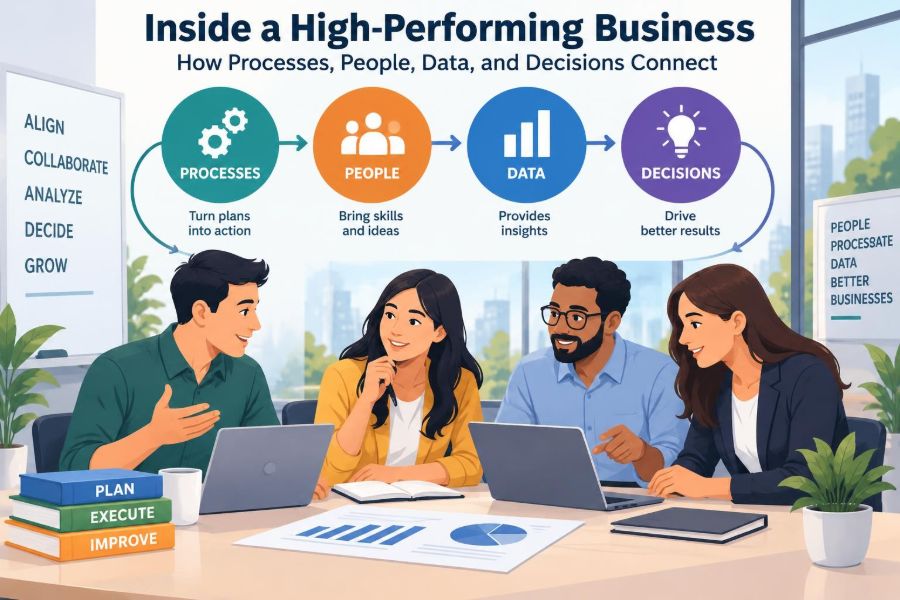
Processes create dependable pathways for work. People contribute skill, judgment, and improvement ideas. Data makes performance and risk more visible. Decisions translate understanding into priorities and action. Each element becomes more valuable when it supports the others.
The central management task is to design and continually improve the connections between processes, people, data, and decisions. That is how a business turns separate activities into a coherent capability that customers and employees can experience.
High performance is not a single initiative; it is the disciplined coordination of work, insight, and human judgment over time. When those connections are clear, organizations can deliver more reliably while remaining able to learn and adapt. 📊🤝🚀