
A small online retailer wins a major contract, and sales suddenly look set to double. The owner is thrilled—until the warehouse runs out of stock, customer enquiries pile up, and supplier invoices arrive weeks before the client pays.
This is a familiar growth paradox. More demand should be good news, but rapid expansion can expose every weak handoff, unclear responsibility, and gap between money going out and money coming in.
A business rarely fails because it grew “too much” in a simple sense. More often, it grew faster than its operating processes, leadership capacity, or cash flow could support.
The useful question is not whether to pursue growth. It is: what rate of growth can the business absorb while continuing to deliver, pay its obligations, and make sound decisions?
🚦 Scaling Is More Than Getting Bigger
Growth means an increase in a business measure, such as revenue, customer numbers, orders, locations, or employees. Scaling is more demanding: it means increasing output without costs, errors, complexity, or management effort rising at the same damaging rate.
A consultant who adds one client only by working more hours is growing, but not necessarily scaling. A firm that develops a repeatable delivery method, trains others to use it, and maintains quality as client volume rises is moving toward scale.
Healthy scaling therefore combines commercial opportunity with operational repeatability. Revenue alone is an incomplete measure of readiness.
🧩 The Real Constraint Is Usually a System
Businesses are systems of connected activities: marketing generates leads, sales makes commitments, operations delivers, finance collects payment, and leaders resolve exceptions. A rapid increase at one point puts pressure on every other point.
The bottleneck may not be obvious. A restaurant can add tables, for example, but its limiting factor may be kitchen capacity, ingredient deliveries, booking software, or a manager who approves every refund.
Before accelerating, leaders should ask where work waits, where mistakes are corrected manually, and where a single person holds essential knowledge. Those points determine the practical speed limit.
📈 Revenue Growth Can Hide Operational Strain
Revenue is easy to celebrate because it is visible and usually reported frequently. Yet a growing sales figure may conceal late deliveries, overtime, rising returns, customer churn, or lower margins.
Consider a hypothetical subscription business that rapidly increases advertising. New sign-ups rise, but its support team cannot respond promptly and cancellations increase after the first billing cycle. The top-line result may look strong while the underlying customer experience weakens.
Track growth alongside operational measures such as order accuracy, delivery lead time, backlog, rework, complaint volume, and service-level performance. These indicators show whether the business is actually absorbing demand.
💵 Profit Is Not the Same as Cash
Profit is an accounting measure: revenue minus costs over a period. Cash flow is the actual movement of money into and out of the bank account. A business can be profitable on paper and still struggle to meet payroll or supplier payments.
This gap becomes especially important during expansion. A company may record a sale when it invoices a customer, but receive the cash much later. Meanwhile, it may need to buy materials, hire staff, ship goods, and pay tax-related obligations before the customer pays.
Growth consumes cash when it increases the amount of working capital tied up in day-to-day operations.
🔄 Understand the Cash Conversion Cycle
The cash conversion cycle describes the time between paying for inputs and collecting cash from customers. For a product business, it commonly includes buying inventory, holding it, selling it, invoicing, and waiting for payment.
A longer cycle means more cash is trapped in operations. A shorter cycle reduces the funding required to support the same level of activity, although shortening it should not come at the cost of damaging valuable supplier or customer relationships.
| Stage | Cash-flow effect | Common scaling risk |
|---|---|---|
| Buy inventory or materials | Cash leaves the business | Over-ordering based on optimistic forecasts |
| Produce or deliver work | Labour and operating costs accumulate | Delays and rework increase unit cost |
| Invoice customer | Revenue is recorded, but cash may not arrive | Weak invoicing and disputed bills slow collection |
| Collect payment | Cash becomes available again | Long payment terms create a funding gap |
Service businesses can have a different pattern, but the principle remains. If work is delivered before payment is received, faster sales may require more cash.
🏗️ Working Capital Is the Fuel in the Tank
Working capital broadly refers to the short-term resources available to run normal operations, often considered through current assets and current liabilities. In practical terms, managers should focus on cash, receivables, inventory, supplier terms, and near-term obligations.
Expansion commonly increases receivables and inventory. If those assets rise faster than available funding, the business can become financially stretched even while demand remains healthy.
A forecast should show the timing of cash movements, not merely an annual revenue and profit target. Monthly, weekly, or even daily visibility may be appropriate when the business has thin reserves or fast-moving transactions.
🧮 Forecast Cash Before Committing Capacity
A cash forecast estimates expected receipts and payments across future periods. It is not a promise; it is a decision tool that makes assumptions visible and allows leaders to test what happens if payment is late, costs rise, or sales arrive unevenly.
Build forecasts from operational drivers. Estimate order volume, average selling price, payment timing, material needs, staffing costs, shipping, taxes, loan payments, and planned investment. Then connect those assumptions to the expected dates of actual cash movement.
Use at least three views: a base case, a slower-collection or lower-sales case, and a higher-demand case. The “good” scenario can create a cash problem too if fulfilment must be funded before receipts arrive.
🛟 Maintain a Cash Buffer
A cash buffer is money reserved for uncertainty rather than immediately committed to expansion. Its appropriate size depends on the volatility of demand, payment reliability, fixed costs, access to credit, seasonality, and the consequences of interruption.
There is no universal reserve level that fits every firm. A business with predictable prepayment may need less protection than one that relies on a few customers paying long after delivery.
The key discipline is to distinguish available cash from cash that is already spoken for. Payroll next week, tax liabilities, supplier commitments, and refunds are not spare funds for a new initiative.
📦 Inventory Can Turn Growth Into a Liquidity Problem
Inventory helps a product business serve demand, but it also locks cash into goods that may not sell as expected. Excess stock can become obsolete, require discounting, take up space, and obscure the real cost of expansion.
Stock-outs create a different problem: lost sales, expedited freight, rushed purchasing, and disappointed customers. The solution is not simply to hold as much inventory as possible.
Improve forecasting by separating fast-moving, predictable items from uncertain or seasonal items. Set reorder rules, monitor supplier lead times, and challenge assumptions after each sales cycle rather than treating an initial forecast as fixed.
🤝 Payment Terms Shape the Growth Limit
Customer payment terms determine how long the business finances work after making a sale. Supplier terms influence how long it can use inputs before cash must leave. Together, these conditions can materially change the cash burden of growth.
For example, a business that pays suppliers quickly but invoices customers on long terms is effectively financing part of its customers’ operations. That may be a deliberate commercial choice, but it needs funding and control.
Useful actions include prompt, accurate invoicing, clear contract milestones, deposit or staged-payment arrangements where suitable, and consistent follow-up on overdue accounts. Terms should be negotiated responsibly, not treated as an afterthought after sales are won.
🧱 Build Repeatable Processes Before Volume Forces Them
A process is a defined, repeatable way of completing work. It clarifies inputs, steps, ownership, decisions, outputs, and quality checks. Good processes do not remove judgement; they reserve judgement for exceptions that genuinely need it.
When a team relies on memory, informal messages, and heroic effort, it may cope at low volume. At higher volume, inconsistencies multiply because different people perform the same task differently.
Document the workflows that affect customers, cash, compliance, and safety first. Order-to-cash, purchasing, onboarding, fulfilment, customer support, and payroll are usually stronger priorities than minor administrative routines.
🗺️ Map the Work, Not the Ideal Version of It
Process mapping means visually or verbally recording how work actually moves through the organisation. The important word is “actually.” A formal procedure may say one thing while employees rely on workarounds, spreadsheets, or verbal approvals.
Ask the people doing the work where it starts, what information they need, what delays them, and what happens when something goes wrong. Include handoffs between teams because many failures occur when responsibility becomes unclear.
A useful map identifies the customer or trigger, each main step, the owner, the system used, the control point, and the output. It should be simple enough to improve, not so elaborate that no one uses it.
⏳ Find the Bottleneck Before Adding Demand
A bottleneck is the stage with the least effective capacity relative to demand. It limits the output of the entire system. Adding people or spending elsewhere may produce little benefit if the true constraint remains untouched.
Suppose a design agency has plenty of sales leads and skilled designers, but every proposal waits for one director’s review. Hiring more designers will not solve the delayed proposal process. Delegated approval criteria or a redesigned review system may.
Look for long queues, repeated escalations, rushed work, persistent overtime, and tasks that depend on one specialist. Improve the constraint, then reassess; once it moves, another limiting stage may appear.
⚙️ Standardise the Routine, Protect the Exception
Standardisation gives routine work a reliable path. Checklists, templates, scripts, specifications, and approval thresholds reduce variation where variation offers little customer value.
However, excessive standardisation can make a business inflexible. Complex clients, unusual projects, and genuine complaints require thoughtful exceptions rather than staff blindly following a script.
The practical balance is to define a normal route and an exception route. Staff should know what they can resolve independently, when to escalate, and who can make a timely decision.
🧑🤝🧑 Capacity Includes People, Not Just Equipment
Capacity is the maximum sustainable amount of work a business can complete at an acceptable quality and service level. It includes physical assets, software, supplier capability, and staff time, skills, attention, and wellbeing.
Teams can absorb a temporary surge through extra effort. They cannot safely operate at emergency intensity indefinitely. Persistent overload leads to mistakes, absence, turnover, poor customer interactions, and weakened training.
Measure workload with practical signals: queue length, overtime, missed deadlines, error rates, response times, and the proportion of work requiring senior intervention. These reveal whether nominal staffing levels match usable capacity.
🎓 Hiring Without Onboarding Creates Hidden Risk
Hiring can increase capacity, but new employees initially require time from experienced staff. If recruitment is rushed and training is weak, the existing team may become less productive while also trying to maintain service.
Create role-specific onboarding that explains the work, tools, quality standards, decision rights, security requirements, and escalation routes. Pair new hires with capable support while avoiding the assumption that one informal shadowing session is enough.
Expansion plans should include the ramp-up period. A headcount figure is not the same as immediate productive capacity.
🧠 Decision-Making Must Move Closer to the Work
Founder-led businesses often rely on one person for pricing, purchasing, hiring, customer concessions, and operational decisions. This can provide control early on, but it becomes a bottleneck as transactions increase.
Delegation works best when it is designed, not simply announced. Define authority limits, expected outcomes, reporting requirements, and decisions that still require escalation.
For instance, a customer-service lead might approve refunds within clear limits while escalating unusual cases. This speeds resolution and frees senior leaders to address larger risks, partnerships, and capacity decisions.
📊 Use a Small Set of Leading Indicators
Financial results often reveal problems after they have become expensive. Leading indicators provide earlier clues that capacity, quality, or cash is under pressure.
- Order backlog and promised delivery dates
- Receivables ageing and disputed invoices
- Inventory cover and supplier lead-time changes
- Support response times and unresolved tickets
- Rework, returns, error rates, and overtime
- Employee turnover, absence, and training completion
Choose measures linked to real decisions. A crowded dashboard can create the illusion of control while hiding the few signals that matter most.
🧪 Pilot Growth Before Making It Permanent
A pilot is a limited test of a new market, product, location, channel, or operating model. It reduces uncertainty before the business commits significant capital or irreversible overhead.
A retailer might test a new delivery area with restricted hours, a controlled product range, and defined service metrics. The goal is not merely to prove that customers will buy; it is to learn whether fulfilment, support, pricing, and cash collection work together.
Set success and stop criteria in advance. Without them, teams may continue funding an underperforming experiment because too much effort has already been invested.
🏭 Match Fixed Costs to Confidence, Not Optimism
Fixed costs are expenses that do not quickly fall when sales decline, such as long leases, permanent salaries, or certain software commitments. They can create operational stability, but they also raise the break-even point.
Variable costs move more directly with activity, such as some contract labour, shipping, or transaction fees. They may be more expensive per unit, yet can reduce risk while demand is uncertain.
There is no universally correct mix. During an uncertain expansion, leaders should understand what they are committing to and what level of recurring demand is needed to support it through a weaker period.
🔍 Protect Margin While Sales Volume Rises
Rapid growth can erode gross margin when businesses discount to win volume, pay premium freight, accept unprofitable custom work, or fail to account for added support and returns. Revenue then rises while the cash available to fund operations does not improve as expected.
Review profitability by product, customer segment, channel, or project where practical. A large customer may be strategically useful, but leaders should know whether special terms, service demands, and credit exposure change the economics.
Pricing should reflect the full cost to serve, not only the direct cost of making an item. This is particularly relevant when high-touch customers require more account management or technical support.
🛡️ Internal Controls Must Scale Too
Internal controls are practices that reduce errors, fraud, loss, and unauthorised decisions. Examples include approval limits, reconciliations, access controls, documented purchasing, and separation of key duties where possible.
Fast growth can weaken these safeguards because teams feel pressure to “just get it done.” Yet an uncontrolled purchasing process or poorly managed payment access can create losses that are difficult to recover.
Controls should be proportionate. A small business does not need bureaucracy for its own sake, but it does need clear accountability over money, commitments, sensitive data, and inventory.
💻 Technology Should Remove Friction, Not Automate Confusion
Software can improve visibility, reduce manual entry, route approvals, and support consistent service. But automating an unclear process often makes bad decisions happen faster and spreads errors more widely.
First simplify the workflow and define clean data. Then choose technology that supports the actual operating model, integrates where necessary, and can be adopted by the people who will use it.
Start with high-friction areas: duplicate data entry, missed handoffs, manual invoicing, unreliable stock records, and recurring reporting tasks. A modest, well-implemented tool can be more valuable than a complex system no one trusts.
🌐 Suppliers and Partners Are Part of Your Capacity
A business may have internal readiness yet still fail to scale if suppliers cannot meet volume, quality, delivery, or credit requirements. Outsourced logistics, manufacturing, technical platforms, and professional services can all become critical dependencies.
Discuss forecasts with important partners early, while recognising that forecasts are estimates rather than guarantees. Consider alternative suppliers, realistic lead times, quality checks, and contingency plans for essential inputs.
Overdependence on one supplier or customer creates concentration risk. It may be commercially sensible in some situations, but it should be visible and actively managed.
📣 Sales Promises Must Match Delivery Reality
Misalignment between sales and operations is a common source of painful growth. Sales teams may promise custom features, short lead times, or generous payment terms in good faith, while operational teams lack the resources or information to deliver them.
Create clear rules for non-standard deals. Define who approves unusual scope, discounts, delivery dates, service levels, and credit terms before the customer receives a commitment.
This is not about slowing sales unnecessarily. It is about ensuring that each sale creates value rather than a costly obligation the business cannot fulfil.
🗓️ Scale in Stages Rather Than One Giant Leap
Staged growth divides a large ambition into manageable capacity milestones. Instead of opening several sites, entering many markets, or hiring a large team at once, the business expands after each previous stage meets defined operating and financial conditions.
Possible gates include stable service quality, sufficient trained capacity, reliable supplier performance, acceptable receivables, and adequate cash under a downside forecast. The exact conditions should fit the business model.
Staging can feel slower than an aggressive launch, but it creates learning loops. Problems discovered at a small scale are generally cheaper to correct than problems repeated across the entire business.
⚠️ Recognise Warning Signs Early
Businesses rarely break without signals. Leaders should treat recurring exceptions as information, not merely inconveniences to be handled by the hardest-working employee.
- Customers repeatedly ask where orders or responses are.
- Cash forecasts rely on every payment arriving exactly on time.
- Managers approve exceptions faster than teams can follow normal procedures.
- Staff use personal spreadsheets to compensate for unreliable systems.
- Quality checks are skipped to meet volume targets.
- New sales require increasingly urgent purchasing or overtime.
One isolated issue may be manageable. A pattern indicates that demand is exceeding the design of the system.
🧯 Know When to Slow Down Deliberately
Slowing growth is not the same as giving up on it. It may mean pausing a marketing campaign, limiting new client onboarding, narrowing the product range, raising prices, extending lead times honestly, or delaying a launch until service quality recovers.
These choices can protect customer trust and prevent a temporary funding issue from becoming a more serious crisis. They also provide time to fix the actual constraint instead of adding more activity to an overloaded system.
A disciplined pause is especially sensible when cash visibility is poor, quality is deteriorating, or employees are regularly bypassing controls to keep work moving.
🧭 A Practical Scaling Readiness Review
Before pursuing a major increase in volume, review the business through four connected questions: Can we deliver? Can we fund it? Can we control it? Can we recover if assumptions are wrong?
- Define the expected demand increase and its timing.
- Map the end-to-end process from sale to cash collection.
- Identify capacity constraints, dependencies, and single points of failure.
- Build cash forecasts for base, downside, and high-demand scenarios.
- Set operational and financial thresholds that trigger action.
- Test through a pilot or staged rollout where possible.
- Review results frequently and adjust capacity, terms, or pace.
The purpose is not to eliminate uncertainty. It is to make growth a managed experiment rather than a hopeful bet.
🏁 The Core Principle: Sustainable Pace Beats Maximum Speed
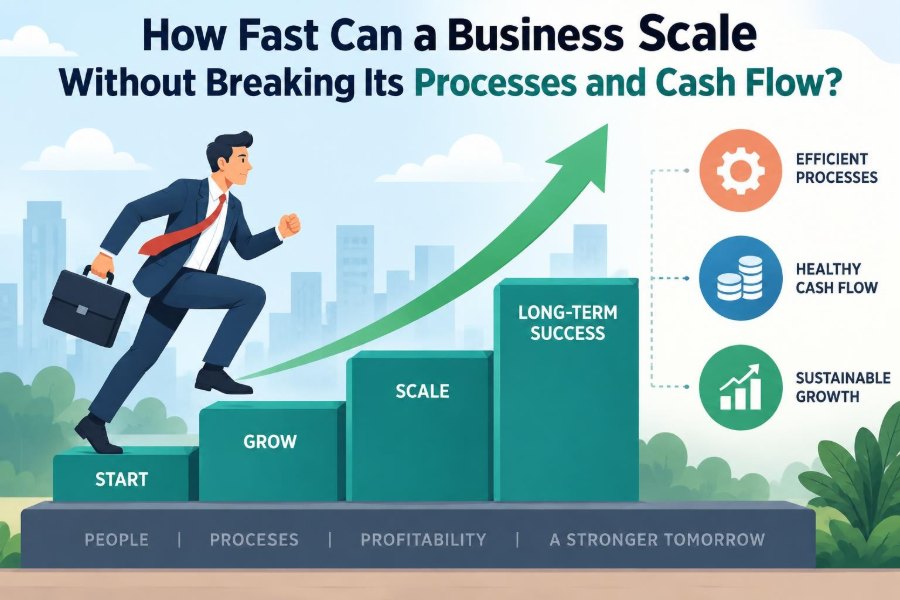
The fastest possible growth rate is rarely the right target. A sustainable rate is one that the business can finance, deliver, monitor, and improve without relying continuously on emergency workarounds.
That rate will change over time. Better systems, trained managers, stronger supplier relationships, improved data, and more reliable cash generation can raise capacity. Conversely, seasonal pressure, a major customer’s payment delay, or a key employee’s departure can lower it.
Strong businesses treat scaling as a sequence of capabilities to build, not simply a sales number to chase. They respect the connection between customer promises, operating capacity, working capital, and decision-making.
A business can scale quickly when its cash, people, processes, and controls are ready to carry the next level of demand together—not when revenue alone makes expansion look possible. Build that foundation, test each step, and let reliable delivery set the pace. 📊💵🚀