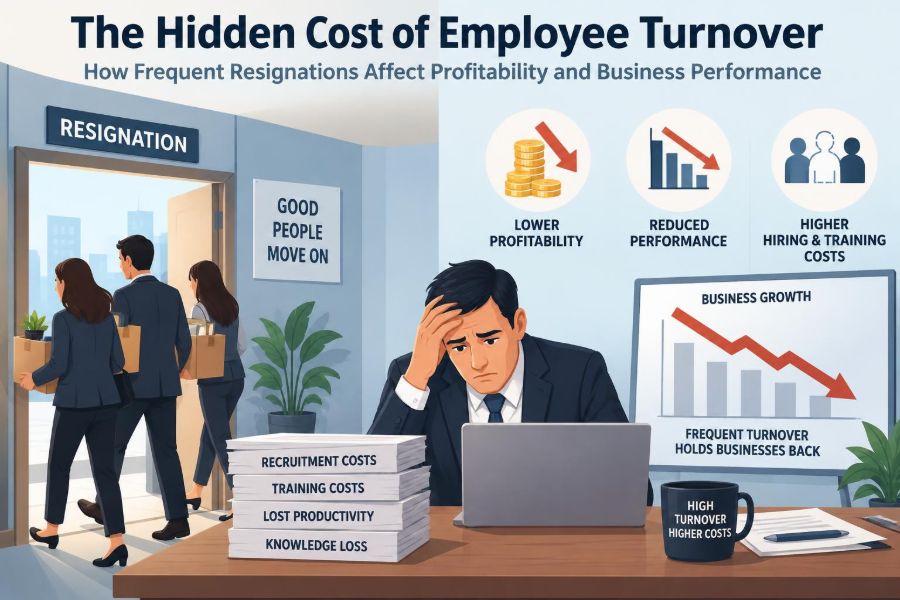

A capable employee gives notice on a busy Monday. Their manager starts redistributing work, a colleague postpones annual leave, and a customer is told that a familiar contact is no longer available. The resignation may look like one staffing issue, but its effects quickly spread.
Most organizations can see the obvious cost: advertising the vacancy, interviewing candidates, and paying someone to train a replacement. The less visible costs are often larger. Work slows down, relationships weaken, knowledge disappears, and remaining employees begin to wonder whether they should leave too.
For students, turnover is a useful example of how people management connects directly to operations and finance. For working professionals, it is a reminder that retention is not simply an HR objective; it is part of protecting service quality, capacity, and profitability.
Employee turnover is not always harmful. Some departures create room for new skills and better performance. The management challenge is to distinguish healthy movement from frequent, preventable resignations that steadily erode business performance.
🔎 What Employee Turnover Actually Means
Employee turnover is the rate at which employees leave an organization and are replaced over a period. It includes resignations, retirements, dismissals, contract endings, and other departures, although businesses often analyze these categories separately.
The most commercially significant category is usually voluntary turnover: employees choosing to resign. A business has limited control over some life changes, but patterns in voluntary exits can reveal problems with workload, leadership, pay, progression, or workplace culture.
🧭 Why a Resignation Is More Than an Empty Seat
A vacancy is not merely an unfilled position on an organization chart. It changes the flow of work around it. Tasks are delayed, handed to people with less context, or dropped because no one has enough time.
In a small team, one departure can remove a large share of practical capacity. In a larger business, the disruption may be less visible but can recur across departments, creating a persistent drag on execution.
💰 The Direct Costs Leaders Can See
Direct turnover costs are the easiest to identify because they appear in budgets and invoices. They commonly include recruitment advertising, agency fees, background checks, interview time, onboarding materials, equipment, and temporary cover.
There may also be payments for unused leave, overtime to maintain service, or relocation and sign-on costs for a hard-to-fill role. These costs matter, but treating them as the whole price of turnover creates a misleadingly low estimate.
🧊 The Hidden Costs Beneath the Surface
The larger burden often sits outside a recruitment budget. Managers spend time rearranging schedules, experienced employees answer questions, and customers wait while a new hire learns internal systems.
These costs are difficult to assign to one invoice, yet they are real because productive time is diverted. Think of turnover as an iceberg: recruitment spending is visible above the waterline, while lost output and disruption sit below it.
📉 Lost Productivity During the Vacancy
Until a role is filled, the organization must choose between doing less work, delaying work, or asking others to absorb it. Each option has a cost. Delayed work can slow sales, projects, invoicing, maintenance, or customer responses.
Overtime may preserve output in the short term, but it raises labor costs and can increase fatigue. Leaving work undone protects employees from overload, but may damage revenue or service reliability. There is no free option.
🚀 The Learning Curve of a New Hire
Hiring does not restore performance on the employee’s first day. New employees must learn the role, systems, priorities, products, informal routines, and decision-making boundaries. Even highly skilled hires need time to understand a particular organization.
The learning curve varies sharply by role. A standardized entry-level task may be learned relatively quickly, while a technical, sales, leadership, or relationship-based role can take much longer to reach full contribution.
🧠 Knowledge Leaves Before It Is Documented
Employees hold tacit knowledge: practical know-how that is rarely written down. It may include knowing which customer prefers a certain process, where a recurring system error originates, or which supplier can solve a problem quickly.
When this knowledge leaves, the business may not notice immediately. The loss becomes visible when an unusual issue occurs and no one remembers the workaround, history, or contact person needed to resolve it.
🤝 Customer Relationships Can Become Fragile
Customers often build trust with individuals as well as brands. If an account manager, adviser, technician, or support contact leaves without a smooth handover, customers may need to repeat their history and reassess the relationship.
That does not mean every departing employee takes customers with them. Strong systems and team-based account management can reduce the risk. Still, frequent changes make consistency harder, particularly where trust and personal expertise shape buying decisions.
⚙️ Service Quality Suffers Under Constant Change
High turnover can produce more errors, slower response times, inconsistent advice, and missed handoffs. New employees may follow procedures carefully but lack the judgement that comes from repeated experience.
Quality problems also consume management time. A complaint, rework request, or failed delivery is not only a service issue; it creates extra labor, may reduce repeat business, and can distract teams from improvement work.
📊 How Turnover Reaches the Profit and Loss Account
Turnover affects profitability through several routes at once: higher hiring expense, overtime, lower productivity, more rework, slower sales activity, and weaker customer retention. The exact path differs by business model.
For example, a retail operation may feel turnover through training and customer experience. A consulting firm may feel it through billable capacity and client continuity. A manufacturer may feel it through safety, quality, and production stability.
🧮 A Practical Way to Estimate the Cost
A useful internal estimate does not need false precision. Start by mapping the major components for a typical role, then use ranges where uncertainty is high. The goal is better decisions, not a deceptively exact number.
- Recruitment and selection time, including manager and interviewer hours
- Vacancy coverage, such as overtime, temporary labor, or delayed output
- Onboarding, training, supervision, and equipment
- Reduced productivity while the replacement becomes fully effective
- Likely quality, customer, or project disruption where relevant
Compare this estimate with the cost of retention actions. A modest investment in better management, development, or staffing may be more economical than repeatedly replacing capable people.
🧾 Why Turnover Rates Need Context
A turnover percentage alone does not diagnose a problem. A growing business may hire and lose people while changing its workforce mix. A seasonal employer may expect regular departures. A low rate can even hide stagnation if poor performance is never addressed.
Managers should examine who leaves, from where, when they leave, and what operational effects follow. The same overall rate can mean very different things in a call center, hospital, software firm, restaurant, or public agency.
🗂️ Measure the Departures That Matter Most
Useful analysis separates voluntary from involuntary turnover and examines patterns by role, location, manager, tenure, skill level, and business unit. It should also identify regretted loss: departures of people the organization wanted and needed to retain.
Short-tenure resignations deserve particular attention because they may indicate a mismatch between recruitment messages and everyday reality. Departures after promotion decisions, restructures, or leadership changes can also reveal specific pressure points.
🧪 Use Exit Information Carefully
Exit interviews can reveal valuable themes, but they are not a perfect record of why someone leaves. People may avoid conflict, simplify a complex decision, or speak more openly only after securing another role.
The best approach combines exit comments with other evidence: engagement discussions, absence patterns, workload data, pay positioning, internal mobility, and manager feedback. Look for recurring signals rather than treating one comment as proof.
🏗️ Work Design Can Push People Out
Some turnover starts with the design of the job itself. Roles with unclear priorities, impossible workloads, constant interruptions, little autonomy, or inadequate tools can exhaust employees even when compensation is competitive.
Managers should ask a practical question: can a competent person do this job well within normal working arrangements? If the answer is no, replacing the person does not solve the design problem.
👥 The Manager Effect Is Real but Not Simple
Employees often experience the organization through their immediate manager. Clear expectations, useful feedback, fair workload allocation, and respectful problem-solving can make demanding work sustainable.
However, blaming every departure on one manager is too simplistic. Managers may be operating under poor staffing levels, unclear policies, or unrealistic targets. Improving retention sometimes requires changing the system around the manager, not only coaching the individual.
💬 Pay Matters, but It Is Rarely the Only Reason
Compensation influences whether employees feel fairly treated and whether outside offers become attractive. Pay that lags the relevant labor market can make retention difficult, especially for scarce skills.
Yet pay rises alone may not fix poor leadership, limited progression, chronic overload, or a lack of flexibility. Employees generally assess the total employment experience: income, growth, dignity, workload, security, and the ability to manage life outside work.
🌱 Development and Internal Mobility Reduce Stagnation
People are more likely to consider leaving when they cannot see a credible next step. Development does not always mean promotion; it can include broader responsibilities, mentoring, certification, cross-functional projects, or opportunities to build valued skills.
Internal mobility also retains organizational knowledge. When employees can move to another team rather than leave entirely, the business keeps capability while giving the person a fresh challenge.
⚖️ Fairness Shapes Retention Decisions
Employees notice how work, recognition, promotion, flexibility, and difficult assignments are distributed. Perceived unfairness can be especially damaging because it affects trust, not just satisfaction.
Consistency does not require identical treatment in every case. It requires decisions that can be explained by relevant criteria and applied with care. Transparent processes reduce rumors and make management choices easier to understand.
🔥 The Turnover Contagion Risk
One resignation can change the behavior of those who remain. Colleagues may lose a trusted partner, inherit extra work, or conclude that advancement is limited. They may then become more open to external opportunities.
This pattern is sometimes called turnover contagion. It is not inevitable, but the risk rises when leaders communicate poorly, allow workload to accumulate, or treat departures as routine administrative events rather than team disruptions.
🛡️ Retention Is Not the Same as Keeping Everyone
A healthy organization does not try to prevent every exit. Some employees leave for positive personal reasons, some roles genuinely need different capabilities, and some turnover brings useful new perspectives.
The aim is intentional retention: keeping people whose skills, performance, and future contribution matter while addressing the conditions that cause preventable loss. Retention should support business goals, not become a numbers-only exercise.
🎯 Segment Roles by Business Risk
Not every vacancy has the same impact. A role may be difficult to replace because of scarce expertise, customer relationships, regulatory knowledge, leadership responsibility, or its position in a critical workflow.
Risk-based workforce planning helps leaders focus. Rather than applying one retention program everywhere, they can identify roles where a departure creates the greatest operational exposure and build deeper succession, documentation, and development plans.
📚 Build Knowledge Transfer into Normal Work
Waiting for notice to begin knowledge transfer is risky. By then, time is short and the departing employee may already be focused on finishing urgent tasks.
Useful practices include shared documentation, paired work, process checklists, recorded demonstrations where appropriate, cross-training, and regular reviews of single points of failure. Documentation should be usable, not a neglected folder full of outdated files.
🔄 Make Onboarding a Performance System
Onboarding is more than orientation and paperwork. It should give a new employee a clear understanding of priorities, relationships, tools, standards, and early milestones.
A strong plan balances support with accountability. Assigning a knowledgeable buddy, scheduling check-ins, and defining what good progress looks like can shorten uncertainty without expecting instant expertise.
📣 Respond Well When Someone Resigns
The way leaders handle a resignation affects both the departing employee and those staying. A calm, respectful response protects dignity and improves the chance of an orderly handover.
Managers should clarify transition priorities, communicate appropriate information to the team, recognize extra work fairly, and ask what would help maintain service. Pressuring someone to stay without addressing the underlying issue may only delay the departure.
🚫 Common Retention Mistakes
Organizations often react to turnover with visible but shallow fixes. A counteroffer may retain one employee temporarily, while a generic engagement campaign may overlook a workload or management problem in a specific team.
- Measuring only the overall turnover rate and missing high-risk roles
- Assuming pay is the cause without examining work design or management
- Promising career growth without creating real opportunities
- Overloading loyal employees after every departure
- Collecting exit feedback but never acting on repeated themes
- Relying on one person to hold essential operational knowledge
🧩 Balance Retention Spending with Business Reality
Retention initiatives use resources, and not every intervention will suit every organization. Higher pay may be necessary in a tight labor market, but a business must consider affordability and internal pay fairness. More staffing can relieve workload, but demand may be temporary.
Good decisions compare options: the expected cost of continued turnover, the cost of an intervention, its likely operational benefit, and its effect on equity. Pilot changes in a high-risk area when possible, then review what actually changed.
📅 Create a Practical Retention Review Cycle
Retention improves when it becomes a routine management topic rather than an emergency response after several resignations. A quarterly review can connect people data with operational evidence and upcoming business changes.
- Identify roles, teams, or employee groups with unusual departure patterns.
- Review workload, performance, customer impact, pay, progression, and manager capacity.
- Choose a small number of specific actions with named owners and deadlines.
- Track whether turnover, time to proficiency, quality, and workload indicators improve.
- Adjust the approach when evidence shows that the original diagnosis was incomplete.
📈 Leading Indicators Give Earlier Warning
Resignations are a lagging indicator: they tell leaders that a decision has already been made. Earlier signals may include rising absence, repeated overtime, lower internal applications, stalled development conversations, unresolved workload concerns, or declining quality.
None of these signals proves that employees will leave. They are prompts for conversation and investigation. Used thoughtfully, they allow managers to address problems before a resignation turns them into a costly vacancy.
🌟 The Core Principle: Retention Protects Performance
Frequent resignations damage profitability not because every departure is a crisis, but because repeated loss interrupts the capabilities that make work reliable: knowledge, relationships, coordination, judgement, and productive capacity.
The strongest response is not a single perk or a rushed counteroffer. It is a management system that designs workable jobs, supports capable managers, develops people, shares knowledge, measures meaningful patterns, and acts on evidence.
When employees can do worthwhile work with fair support and a believable future, the organization gains more than lower hiring costs. It gains stability, stronger service, and more capacity to improve rather than continually recover.
Managing employee turnover is ultimately about protecting the human capability that turns business plans into consistent results. 📊🤝🌱