
A customer pauses in front of two nearly identical water bottles. One costs substantially more. Is it better quality, a stronger brand, more convenient to buy, or simply priced too high? The answer may be different for each customer—and that uncertainty is exactly what makes pricing difficult.
For a business, price is more than the number on a shelf or invoice. It affects whether people try a product, how much revenue the company earns, the profit left after costs, and even what customers believe the brand represents.
Set a price too low, and a business may attract demand it cannot profitably serve. Set it too high, and customers may choose an alternative, postpone buying, or decide the product is not worth considering.
Good pricing is therefore not a guessing exercise. It is a disciplined decision that combines costs, customer value, competition, business goals, and careful learning over time.
🏷️ Price Is Both a Number and a Signal
Price is the amount a buyer gives up to obtain a product or service. Usually that means money, but the full customer cost can also include time, effort, delivery fees, setup difficulty, and risk.
It also sends a signal. A very low price may communicate affordability and efficiency, but it can sometimes suggest lower quality. A premium price can imply expertise, durability, or exclusivity—provided the experience supports that message.
🧭 Start With the Purpose of Pricing
Businesses should decide what they are trying to achieve before choosing a price. A price that makes sense for rapid market entry may be unsuitable for a company focused on premium positioning or short-term cash flow.
- Survival: covering immediate costs during difficult trading conditions.
- Profit: earning a sustainable return on the resources invested.
- Growth: attracting customers and building market share.
- Positioning: reinforcing an affordable, mainstream, or premium identity.
- Capacity management: reducing demand when supply is limited.
These goals can conflict. A lower price may support growth but reduce margin; a higher price may improve margin per sale but slow customer adoption.
🧮 Understand Fixed, Variable, and Total Costs
Costs establish an essential boundary for pricing. Fixed costs do not normally change in the short term when one more unit is sold: rent, insurance, salaried administration, and equipment leases are common examples.
Variable costs rise as output rises. Materials, packaging, sales commissions, payment-processing fees, and shipping may all be variable. Total cost is the combination of fixed and variable costs.
A café, for example, pays rent whether it sells one coffee or one hundred. Yet each additional coffee requires beans, milk, a cup, and labour time. Ignoring either type of cost creates a misleading picture.
📦 Calculate Unit Cost Carefully
A product’s unit cost is the estimated cost of making or acquiring one unit. Businesses commonly divide relevant total costs by expected sales volume, then add the direct variable cost per unit.
This estimate depends on volume. If a manufacturer spreads factory overhead across 10,000 units instead of 5,000, the allocated fixed cost per unit falls. That does not mean the factory became cheaper; it means costs were shared across more sales.
Use realistic volume assumptions. Pricing based on an optimistic sales forecast can leave a business with a price that fails to recover its costs when demand is weaker.
📈 Contribution Shows What Each Sale Adds
Contribution is the selling price minus the variable cost of one unit. It shows how much each sale contributes toward fixed costs and, after those are covered, profit.
Suppose a hypothetical notebook sells for $12 and has $5 in variable costs. Its contribution is $7. Selling more notebooks is useful only if that contribution is positive and demand can be served without creating larger hidden costs.
Contribution is especially helpful when a business has unused capacity. A temporary order at a lower price may still be worthwhile if it covers variable costs and does not displace more profitable regular sales.
⚖️ Use Break-Even Analysis as a Reality Check
Break-even is the sales level at which total revenue equals total cost. Below it, the business makes a loss; above it, it begins to generate profit, assuming the estimates hold.
The basic calculation is fixed costs divided by contribution per unit. It is not a promise, because real businesses face changing costs, returns, taxes, and fluctuating demand. Still, it reveals whether a proposed price requires an implausibly large sales volume.
A low-margin strategy often demands high volume. Management must ask whether its operations, distribution, staff, and market demand can actually support that volume.
💰 Markup and Margin Are Not the Same
These terms are often confused, with costly results. Markup expresses profit as a percentage of cost. Margin expresses gross profit as a percentage of selling price.
| Measure | Calculation | What it answers |
|---|---|---|
| Markup | (Selling price − cost) ÷ cost | How much was added to cost? |
| Gross margin | (Selling price − cost) ÷ selling price | What share of revenue remains after direct cost? |
If an item costing $80 is sold for $100, the markup is 25%, but the gross margin is 20%. Teams should state clearly which measure they mean before approving prices or targets.
👥 Customer Value Sets the Upper Boundary
Costs matter to the seller, but customers buy when they believe the benefits justify what they must give up. Perceived value is the buyer’s view of usefulness, quality, convenience, status, reliability, or problem-solving ability.
A software tool that saves a small accounting team several hours each month may have value beyond its technical production cost. Conversely, a beautifully made product has limited pricing power if customers do not understand why it helps them.
Value is not identical for every segment. A rushed business traveller may value flexible booking more than a leisure traveller who has time to search for the lowest fare.
🔍 Research Willingness to Pay
Willingness to pay is the maximum amount a particular customer would consider paying in a specific situation. It changes with need, income, alternatives, trust, and timing, so businesses should not treat it as one fixed number.
Useful evidence can come from customer interviews, observed purchase behaviour, sales conversations, competitor comparisons, small price tests, and feedback on rejected quotes. Ask what customers are trying to accomplish, not merely whether they “like” a price.
Stated preferences are imperfect. People may claim they would buy at one price but behave differently at checkout. Combining what people say with actual behaviour produces a stronger basis for decisions.
🧠 Price Elasticity Explains Demand Sensitivity
Price elasticity of demand describes how strongly demand changes when price changes. Demand is relatively elastic when a small price increase causes many customers to leave; it is relatively inelastic when demand changes less.
Products with many substitutes, low switching costs, and little differentiation tend to face greater sensitivity. Urgent, distinctive, or trusted offerings may face less sensitivity, although no product is entirely immune.
Elasticity is not constant. A price rise may have little effect at first but trigger a stronger response once a psychological threshold is crossed or a competitor’s alternative becomes clearly cheaper.
🏁 Competitors Create a Reference Point
Customers frequently compare prices, especially where products are easy to evaluate. Competitor prices help establish a reference range, but matching a rival automatically is rarely a complete strategy.
A lower-priced competitor may have lower costs, fewer services, a different customer segment, or a temporary promotion. A higher-priced competitor may include installation, warranties, stronger service, or brand trust.
Compare the whole offer: specifications, delivery, quality, financing, support, returns, and reputation. Comparing only the headline price can make a differentiated product appear overpriced when it is not.
🛍️ Substitutes Matter Beyond Direct Rivals
A direct competitor sells a similar product. A substitute solves the same customer problem in another way. A restaurant competes not only with nearby restaurants, but also with meal kits, grocery stores, home cooking, and the decision to skip the occasion.
Seeing substitutes broadens pricing analysis. If customers can solve the problem cheaply without buying at all, the business must make its additional value clear rather than merely watching the closest rival.
🎯 Segment Customers Instead of Assuming One Market
Markets are rarely uniform. Students, households, large organizations, frequent users, and occasional buyers may value the same product differently and face different budget constraints.
Segmentation can guide product versions, service levels, or legitimate discounts. For example, a software company may offer a simple plan for individuals and an advanced plan with security controls and support for organizations.
The aim is not to charge arbitrary prices. It is to align offers with distinct needs while being transparent, lawful, and fair in the market where the business operates.
🪜 Build a Clear Value Ladder
A value ladder offers choices at different levels: basic, standard, and premium. It helps customers select the combination of benefits that fits their priorities rather than forcing everyone into one price point.
Each step must have a credible difference. Extra features, faster service, greater flexibility, or lower risk can justify a higher tier. Cosmetic differences alone may create confusion and undermine trust.
A well-designed middle option often acts as a practical benchmark, helping customers evaluate what they gain by moving up or what they give up by choosing the entry level.
🚀 Penetration Pricing Can Accelerate Adoption
Penetration pricing means setting a relatively low introductory price to encourage trial, gain visibility, or build a customer base quickly. It can be effective when scale reduces unit costs or when customers are reluctant to switch.
The risk is expectation. Customers who enter because of a low price may resist later increases, and competitors may respond aggressively. The business needs a credible route to sustainable margins rather than assuming volume will solve every problem.
✨ Price Skimming Can Reward Early Value
Price skimming begins with a higher price, often for an innovative, scarce, or strongly differentiated product, then may fall over time as the market broadens. It can help recover development costs and serve early buyers who value being first.
This approach works poorly when alternatives are close, the product is easy to copy, or a high initial price harms long-term trust. Early customers may also feel disadvantaged if the price declines rapidly without clear reason.
➕ Cost-Plus Pricing Offers a Starting Point
Cost-plus pricing adds a chosen markup to cost. Its appeal is simplicity: it helps ensure the business considers cost recovery and can be practical in stable, repeatable operations.
Its weakness is that it begins inside the company rather than with the market. A cost-plus price can be too high for customers, too low for the value delivered, or based on unreliable volume estimates.
Use it as a financial floor or initial calculation, then test it against customer value, competition, and strategic objectives.
💎 Value-Based Pricing Starts With the Buyer
Value-based pricing starts by understanding the result customers receive and the alternatives they would otherwise use. It asks: what cost, risk, delay, or effort does this product reduce?
For business-to-business sales, value might include fewer errors, faster workflows, reduced downtime, or improved revenue opportunities. The seller must be careful not to claim savings it cannot demonstrate for the specific customer.
Value-based pricing requires strong market knowledge and clear communication. It is not simply charging the highest conceivable amount; it is capturing a reasonable share of value while leaving the buyer better off.
🧩 Bundle Products When the Combination Helps
Bundling combines products or services for one price: a computer with setup support, or a gym membership with classes. It can simplify buying, raise average order value, and help customers discover useful additions.
A bundle should provide a genuine advantage, such as convenience or a modest saving compared with separate purchases. Forced bundles can frustrate customers who need only one component and make price comparisons harder.
🧾 Account for Channel and Transaction Costs
The price customers see is not always the amount the producer keeps. Retailers, distributors, online marketplaces, affiliates, payment providers, and delivery partners may each take a fee or margin.
Channel partners also provide value: reach, fulfilment, trusted storefronts, or customer service. Businesses should map the full flow of money before committing to a retail price, wholesale price, or promotion.
Small transaction costs can be material for low-priced items. A fixed payment fee, for instance, consumes a larger share of a $5 sale than of a $500 sale.
🧷 Taxes, Fees, and Price Transparency Shape Trust
Customers judge the final amount, not just the advertised number. Mandatory fees, shipping charges, deposits, and applicable taxes can substantially change a purchase decision.
Clear pricing reduces unpleasant surprises and makes comparison easier. The legal requirements for displaying prices, taxes, discounts, and fees vary by jurisdiction, so businesses should obtain appropriate local advice rather than relying on general practice.
Transparency does not always mean every complex detail must appear first. It means material charges should be disclosed clearly before the customer is committed.
🧠 Psychological Pricing Influences Interpretation
People do not process prices as pure mathematics. A price ending in .99 may be perceived differently from the next whole number, while rounded prices can sometimes suit premium or simple offers.
Price framing matters too. “$20 per month” may feel more manageable than “$240 per year,” though customers should be able to understand the full commitment. Anchoring a premium option beside a standard option can make differences easier to evaluate.
These techniques cannot rescue weak value. If the final price feels misleading or the product disappoints, short-term conversion gains can become long-term reputational damage.
📅 Time, Capacity, and Seasonality Change the Right Price
For services with perishable capacity—hotel rooms, event seats, appointments, and airline seats—an unsold slot may have no value after the date passes. Prices may therefore change with expected demand and remaining capacity.
Seasonal businesses face similar decisions. Lower prices during quiet periods can attract demand, but excessive discounting may train customers to wait. The better answer may be a different package, added value, or targeted offer.
Dynamic pricing should be understandable and monitored carefully, particularly where customers may view sudden changes as unfair.
🔄 Promotions Should Have a Specific Job
Discounts can encourage trial, clear old inventory, reward loyalty, or respond to a temporary demand problem. They work best when the objective, audience, duration, and success measure are explicit.
A discount is not free marketing. It reduces contribution per sale and may attract customers who would have paid full price anyway. It can also make future full-price sales harder if promotions become constant.
Consider alternatives such as a free trial, bonus service, bundle, limited edition, or loyalty benefit. These may add value without permanently lowering the reference price.
⚠️ Avoid a Destructive Price War
A price war occurs when competitors repeatedly undercut each other. Buyers may benefit temporarily, but all firms can lose margin, service quality, investment capacity, and eventually market stability.
Before matching a lower price, investigate why it exists. Is the rival clearing stock, using a different business model, or serving another segment? A deliberate response may involve differentiation, narrower targeting, improved efficiency, or selective matching rather than a broad cut.
Businesses must also follow competition and consumer-protection rules. Agreements among competitors to fix prices are a serious legal concern in many places.
🧪 Test Prices Ethically and Learn
Pricing improves through evidence. A business might test different packages, messages, or prices in limited settings, then compare conversion, revenue, repeat buying, refunds, support demand, and customer feedback.
Tests need care. Change one meaningful variable at a time where possible, allow enough time to observe behaviour, and avoid drawing large conclusions from a tiny or unusual sample. Major price changes should also be communicated responsibly.
Learning is especially valuable for new products, where past sales data may not reveal how customers will respond.
📊 Track the Metrics That Reveal Quality of Revenue
Revenue alone can hide a weak pricing decision. A promotion may lift sales while reducing profit, increasing returns, or overwhelming the support team.
- Gross margin and contribution per sale
- Sales volume and conversion rate
- Average order value and product mix
- Repeat purchase, churn, and refund patterns
- Customer acquisition cost and retention value where relevant
- Capacity use, stock availability, and service quality
Review these measures together. A price is successful when it supports a healthy economic model and a customer experience the business can sustain.
🗣️ Equip Sales Teams to Explain the Price
When buyers question price, sales staff should not immediately offer a discount. They should first understand the customer’s concern: budget timing, uncertainty about fit, comparison with another option, or a missing feature.
Useful price conversations connect the offer to outcomes, clarify what is included, and explain trade-offs honestly. If the customer genuinely needs a lower-cost option, a smaller package may be better than cutting the price of the full solution.
Consistency matters. Uncontrolled discounting can damage margins and create resentment among customers who paid more for the same deal.
🛠️ Create a Practical Pricing Process
A repeatable process reduces intuition-driven decisions. It also brings finance, marketing, operations, and sales into the same conversation.
- Define the target customer and the problem being solved.
- Set the commercial objective for this product and period.
- Calculate variable costs, fixed-cost implications, and required contribution.
- Assess customer value, alternatives, competitor offers, and demand sensitivity.
- Design the price architecture: base price, tiers, bundles, terms, and discounts.
- Check capacity, channels, taxes, fees, and legal requirements.
- Launch, measure outcomes, gather feedback, and revise when evidence justifies it.
The process should be repeated as costs, competitors, customer expectations, and strategic priorities change.
🚫 Common Pricing Mistakes to Avoid
One common mistake is pricing solely from cost. Another is copying competitors without understanding their offer or economics. Both approaches overlook the customer’s view of value.
Other errors include treating all customers as identical, hiding unavoidable fees, granting discounts without rules, and assuming high sales equal high profit. Businesses also underestimate the operational effect of a low-price offer that creates more demand than the team can serve.
Pricing mistakes are often communication mistakes too. If customers cannot see what makes an offer worth its price, even a well-calculated figure can fail.
🌱 Review Prices Without Constantly Changing Them
Prices should not be permanent, but frequent unexplained changes can confuse customers and complicate operations. Establish a review rhythm that reflects the business: quarterly checks may suit some markets, while volatile input costs may require closer monitoring.
Review triggers can include supplier-cost changes, exchange-rate exposure, demand shifts, new competitors, capacity constraints, changes in service scope, or evidence that a product is underpriced relative to value.
When increasing prices, explain what has changed where appropriate, give reasonable notice, and ensure the customer experience continues to justify the new level.
🧭 The Core Principle: Align Price With Value and Viability
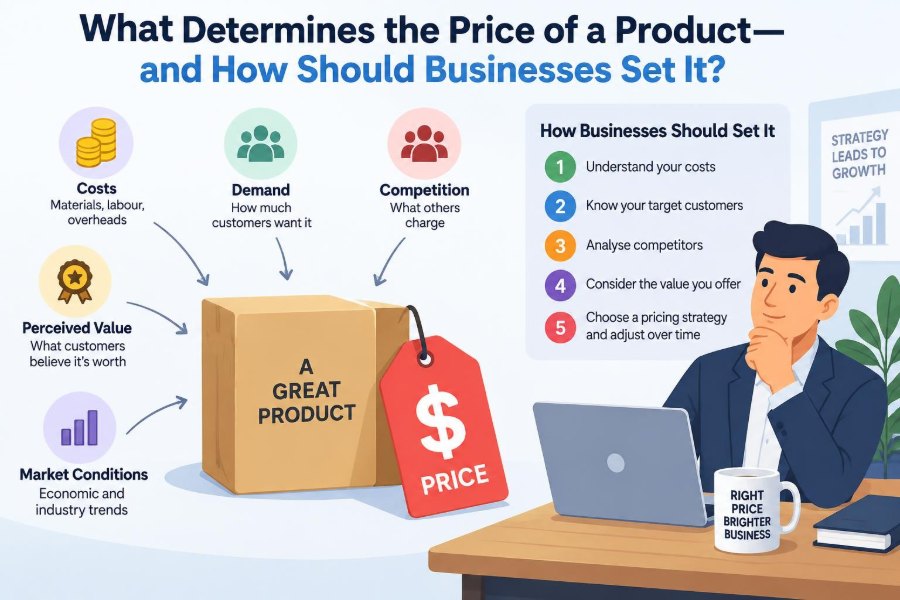
There is no universally correct price. The strongest choice sits at the intersection of what customers are willing to pay, what competitors and substitutes make realistic, what the business needs to earn, and what it can reliably deliver.
Costs protect financial viability. Customer value creates willingness to buy. Competition provides context. Strategy decides which trade-offs the business is prepared to make. None of these factors should be considered in isolation.
A thoughtful price is therefore a hypothesis: it expresses what a business believes about customers, value, and economics, then improves as real market evidence arrives.
Businesses set better prices when they combine disciplined cost analysis with a clear understanding of customer value, competitive alternatives, and long-term strategy—not when they simply add a number and hope. 📊 🤝 💡