
A café can be busy from opening until closing, with customers lining up for coffee, sandwiches, and pastries. At the end of the day, the owner may see strong sales on the register and still wonder why there is so little money left in the bank.
The same puzzle appears in software firms, retailers, manufacturers, freelance businesses, and large corporations. Revenue is visible and satisfying: it is the total value of what a business sold. Profit is less obvious because many claims on that revenue arrive before the owner, shareholders, or managers see the final result.
Understanding where revenue goes changes the questions people ask. Instead of assuming that higher sales automatically solve a problem, managers can examine prices, direct costs, payroll, rent, debt, taxes, inventory, and cash timing.
The bottom line is not one number produced by luck. It is the outcome of a chain of operating and financial decisions. Following that chain makes financial statements far more useful for everyday business management.
🧭 Revenue Is the Starting Point, Not the Reward
Revenue, sometimes called sales or turnover, is the income earned from providing goods or services before most expenses are deducted. A clothing store that sells a jacket for $100 records $100 of revenue, even though it paid a supplier, staff, and a landlord along the way.
Revenue answers, “How much did customers buy?” It does not answer, “How much did the business keep?” Confusing those questions can make a growing business appear healthier than it is.
Some businesses report revenue when a sale is earned rather than when cash arrives. This accounting approach can be useful for measuring performance, but it also means revenue and cash in the bank may differ.
🧾 Sales Returns, Discounts, and Allowances Reduce the Top Line
Not every listed sale remains a completed sale. Customers may return products, receive refunds, use promotional discounts, or receive an allowance because an item was damaged or delivered late.
Net revenue is the amount left after these reductions. A retailer with $50,000 in ticket-price sales may have meaningfully less net revenue after seasonal promotions and returns.
Discounting can be a sensible tool to clear stock, win a contract, or encourage repeat buying. The risk comes when managers look only at sales volume and overlook whether a discount has removed the margin that would have made the sale worthwhile.
🏷️ Price Determines the Room Available for Profit
Price is one of the first decisions shaping profit because every discount or increase flows through every unit sold. A small price change can have a large effect when sales volume is high.
That does not mean a business should simply charge more. Customers compare alternatives, assess quality, and react to changes in value. The practical goal is to set a price that reflects customer value while covering the full economic cost of serving the customer.
Managers should distinguish between a price that wins revenue and a price that supports a viable business model. Those are not always the same price.
📦 Cost of Goods Sold Takes Its Share
Cost of goods sold, often shortened to COGS, includes costs directly tied to producing or acquiring what a business sells. For a bakery, this can include flour, butter, packaging, and ingredients. For a retailer, it is usually the purchase cost of inventory sold.
For a manufacturer, COGS may include direct materials, production wages, and production-related overhead, depending on the accounting system. A consulting firm or software company may instead describe similar direct delivery costs as cost of revenue or cost of services.
COGS matters because it reveals how much of each sales dollar is consumed before the business pays its wider operating expenses.
📈 Gross Profit Shows the Economics of the Core Offer
Subtracting COGS from net revenue produces gross profit. It shows how much remains from sales to pay for administration, marketing, technology, financing, taxes, and any eventual profit.
Gross profit is often expressed as a gross margin: gross profit divided by net revenue. If a business sells a product for $100 and its direct cost is $60, gross profit is $40 and gross margin is 40%.
A strong gross margin does not guarantee a profitable company, but a weak one leaves little room for error. Low-margin businesses usually need efficient operations, high volume, or both.
🔍 Direct Costs Are Not Always Obvious
Some costs are easy to connect to a sale, such as a retailer’s wholesale purchase price. Others require judgment. Shipping, merchant payment fees, installation labor, customer support, sales commissions, and cloud-computing usage may rise as customers buy more.
Classifying costs consistently matters more than finding a universally perfect label. If a business treats a delivery cost as an operating expense one quarter and as COGS the next, trend comparisons become less reliable.
The key managerial question is practical: what does it truly cost to deliver one more sale? That answer helps with pricing, product decisions, and contract negotiations.
🚚 Inventory Can Protect Sales or Tie Up Cash
Inventory allows a business to meet demand quickly, but it requires cash before the item is sold. A store may pay suppliers weeks or months before a customer makes a purchase.
Too little inventory can lead to stockouts and lost sales. Too much can create storage costs, damage, obsolescence, markdowns, and cash pressure. Fashion, technology, food, and seasonal goods carry particularly visible risks of becoming less valuable over time.
On the income statement, inventory generally becomes COGS only when sold. In day-to-day management, however, unsold inventory may already be straining the company’s cash position.
👥 Payroll Supports Delivery, Service, and Growth
People costs are usually among the largest expenses a business faces. They include wages and salaries, but the full cost of employment can also include benefits, payroll taxes, training, recruitment, overtime, and employer contributions required in the relevant location.
Payroll is not simply a cost to minimize. Skilled employees may improve quality, reduce rework, retain customers, and develop better processes. Cutting staff without understanding workloads can reduce expenses briefly while damaging sales or service later.
A better approach is to connect roles to outcomes: customer capacity, production output, revenue generation, risk control, and the quality standards the business promises.
🏢 Occupancy and Facilities Create Fixed Commitments
Rent, utilities, maintenance, insurance, security, and property-related charges often continue regardless of daily sales. These are commonly described as fixed costs because they do not change quickly with the number of units sold.
A restaurant cannot instantly reduce its lease payment on a quiet Tuesday. A manufacturer may need to maintain a facility even during a temporary demand decline. This makes fixed commitments especially important when forecasting.
Location can still be worth the expense if it brings customer traffic, logistics advantages, or talent access. The question is whether the benefit is large enough to justify the commitment across good months and weak ones.
📣 Marketing Costs Money Before It Produces Results
Advertising, content production, events, sponsorships, agency fees, sales promotions, and customer research can all sit between gross profit and operating profit. Their purpose is to create awareness, demand, or stronger customer relationships.
Marketing should not be judged only by immediate sales. Some efforts build recognition or support a longer buying cycle. Yet “brand building” should not become a vague excuse for spending without clear learning goals.
Useful review questions include whether a campaign reached an intended audience, whether leads were suitable, whether customers returned, and whether the business could repeat the result at a sensible cost.
🧑💼 Selling and Administrative Expenses Keep the Business Running
Selling, general, and administrative expenses, often called SG&A, cover many functions that support the organization rather than a single product. Examples include management salaries, finance, legal support, office supplies, human resources, and professional services.
These costs can look indirect, but they are often essential. Accurate bookkeeping supports decisions; legal review can reduce contractual risk; administration enables payroll and supplier payments.
Problems arise when overhead grows automatically with ambition rather than with a clear need. Regularly reviewing responsibilities, software subscriptions, vendors, and approval layers can uncover spending that no longer serves the business.
💻 Technology Spending Can Be an Expense or an Investment
Businesses pay for point-of-sale systems, cybersecurity, customer relationship management tools, accounting platforms, data storage, and specialist software. Some costs are recurring operating expenses, while certain longer-lived assets may be treated differently under applicable accounting rules.
From a management perspective, the accounting label is only part of the story. A system that eliminates manual errors or gives sales staff better customer information may improve profit over time. A tool no one uses is simply an ongoing drain.
Before approving technology, managers should identify the operational problem, ownership, adoption plan, ongoing cost, and a realistic way to assess whether it delivered value.
🛠️ Depreciation Spreads the Cost of Long-Lived Assets
A delivery vehicle, machine, computer equipment, or fit-out may provide value for more than one accounting period. Depreciation allocates part of that cost as an expense over the asset’s expected useful life.
Depreciation is often called a non-cash expense because the cash payment for the asset may have occurred earlier. That does not make it imaginary. It reflects the consumption, wear, or aging of an asset used to earn revenue.
Managers should remember both perspectives: depreciation affects reported profit, while the actual purchase can affect cash heavily at the time it is made.
🧪 Research, Development, and Improvement May Precede Revenue
Businesses often spend before they can sell. Product design, prototypes, process improvements, testing, staff learning, and market research may be necessary to create a future offering or keep pace with competitors.
These costs can reduce current-period profit even when the decision is strategically sound. Conversely, refusing to invest may make current profit look better while leaving the company with outdated products or inefficient processes.
The challenge is disciplined judgment. Management should define what is being tested, what evidence would justify further investment, and when it will stop funding an idea that is not working.
⚖️ Operating Profit Reveals the Core Business Result
After deducting operating expenses from gross profit, a business reaches operating profit, often called operating income or earnings before interest and taxes. It indicates whether the core operations generated more than they consumed.
Operating profit helps separate day-to-day performance from financing decisions and income taxes. That makes it useful when comparing businesses with different borrowing levels or tax situations.
It should still be interpreted carefully. Different industries classify costs differently, and one-off items can distort a single period. Trends, explanations, and cash flow provide the fuller picture.
🏦 Interest Expense Reflects the Cost of Borrowing
When a business borrows for equipment, property, working capital, or expansion, lenders usually charge interest. Interest expense comes after operating profit because it relates to how the business is financed rather than how it produces and sells its offer.
Debt can be useful when it funds an asset or opportunity that supports sustainable returns. It can become risky when repayments consume cash needed for payroll, suppliers, maintenance, or an economic downturn.
A profitable operating model can still leave little for owners if borrowing costs are high. That is why managers monitor payment schedules and lending terms, not merely the loan balance.
🧾 Taxes Come After Accounting Profit, With Important Nuance
Income taxes are generally based on taxable profit under the rules that apply to the business. Taxable income may not match accounting profit exactly because tax rules can treat expenses, allowances, losses, and timing differently.
Businesses also handle other taxes that affect prices, payroll, property, or transactions. Their treatment varies by jurisdiction and legal structure, so a general income statement cannot replace professional tax advice.
Good planning is not the same as trying to avoid legitimate obligations. It means forecasting liabilities, keeping records, using permitted rules appropriately, and avoiding a surprise bill that disrupts cash flow.
🏁 Net Profit Is What Remains After All Recognized Expenses
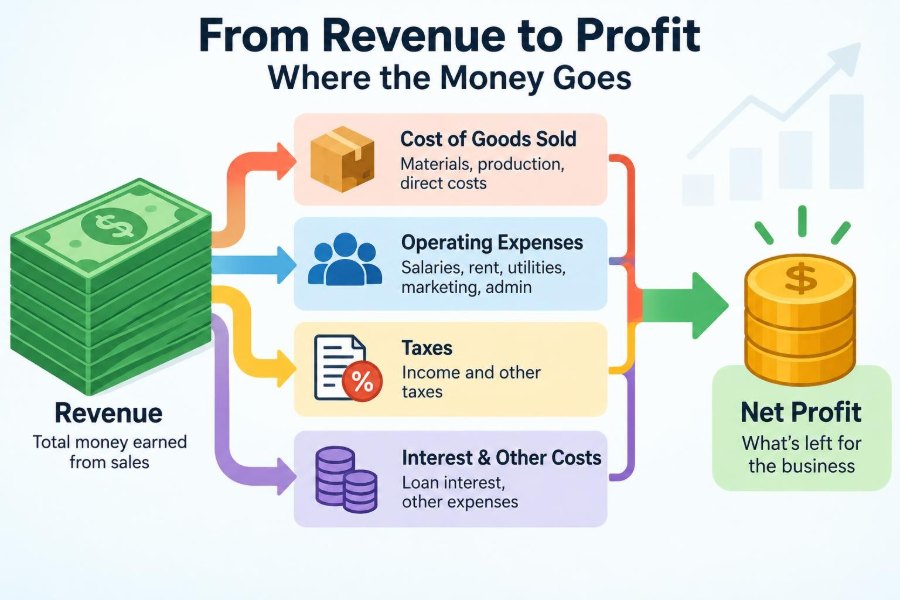
Net profit, or net income, is the amount remaining after revenue has absorbed COGS, operating expenses, interest, taxes, and other recognized items. This is the familiar “bottom line.”
Net profit can be retained in the business, used to repay debt, distributed to owners when appropriate, or invested in future growth. It is not automatically available as spare cash.
A positive bottom line matters because a business needs an economic surplus over time to replace assets, handle uncertainty, reward investment, and keep operating independently.
💵 Profit and Cash Flow Are Different Measures
Profit follows accounting rules about when revenue is earned and expenses are recognized. Cash flow tracks money actually entering and leaving the business. The two can move together, but they do not always do so in the same period.
A business may report a profit after invoicing customers who have not yet paid. It may also spend cash on inventory or equipment that does not immediately appear as an expense in the same way.
This distinction explains why a profitable company can still struggle to meet obligations. Managers need both an income statement and a cash-flow view.
⏱️ Working Capital Determines the Timing Pressure
Working capital concerns short-term operating assets and liabilities, including cash, receivables, inventory, and amounts owed to suppliers. It is the financial space that allows the business to operate between paying costs and collecting from customers.
Consider a hypothetical wholesaler that pays a supplier in 30 days but allows customers 60 days to pay. Even with profitable orders, it may need cash or financing to bridge that gap.
Improving invoicing, collecting overdue accounts, managing inventory, and negotiating sensible supplier terms can release pressure without changing the core product at all.
🧮 A Simple Walk Through the Profit Bridge
A profit bridge follows revenue as it is reduced by successive categories of cost. The example below is hypothetical and deliberately simplified; real statements contain more detail and classifications vary.
| Step | Illustrative amount | What it represents |
|---|---|---|
| Net revenue | $100,000 | Sales after returns and discounts |
| Less: cost of goods sold | ($55,000) | Direct product or delivery costs |
| Gross profit | $45,000 | Amount available for operating costs |
| Less: operating expenses | ($34,000) | Payroll, rent, marketing, administration, and similar costs |
| Operating profit | $11,000 | Result from core operations |
| Less: interest and taxes | ($4,000) | Financing and tax costs |
| Net profit | $7,000 | Bottom-line accounting result |
The point is not that every business should have these proportions. It is that $100,000 of revenue may produce a much smaller residual after all claims are recognized.
📊 Profit Margins Make Businesses Easier to Compare
Raw profit dollars are useful, but margins show the share of revenue retained at each stage. Gross margin, operating margin, and net margin reveal different parts of the business model.
A business with a modest net profit in dollars may have a stronger margin than a larger competitor. Equally, a company can report high revenue while retaining very little due to direct costs, overhead, financing, or pricing pressure.
Comparisons work best when businesses have similar models and use broadly consistent accounting. A supermarket, a software provider, and a construction contractor naturally have different cost structures.
⚙️ Fixed and Variable Costs Change Decision-Making
Variable costs tend to rise with sales or production, such as materials, packaging, transaction fees, or sales commissions. Fixed costs tend to remain stable within a relevant range, such as a lease or a manager’s salary.
This distinction helps explain why additional sales can sometimes improve profit quickly: once fixed costs are covered, each additional unit may contribute toward profit after its variable cost. This is the logic behind contribution margin.
But capacity has limits. A business may need another shift, machine, warehouse, or supervisor after growth reaches a threshold, causing a new step up in fixed cost.
🎯 Break-Even Analysis Identifies the Minimum Sustainable Volume
Break-even analysis estimates the sales level at which total contribution covers fixed costs, leaving neither operating profit nor operating loss. It is a planning tool, not a prediction.
For example, if a service earns $80 after its direct delivery costs and monthly fixed operating costs are $8,000, the business would need roughly 100 such sales to cover those fixed costs before considering additional complexities.
Managers can test scenarios: What if price falls? What if materials cost more? What if demand is lower than expected? The exercise exposes which assumptions deserve the closest monitoring.
🔄 Customer Mix Can Matter More Than Total Sales
Not all revenue is equally profitable. One customer may buy a standardized product, pay promptly, and need little support. Another may demand customization, extended payment terms, frequent returns, and substantial service time.
Sales teams may celebrate both contracts because both add revenue. Management should also examine the full cost to acquire, serve, and retain each type of customer.
This does not mean rejecting demanding customers automatically. A complex account may be strategically valuable. It means pricing and service levels should reflect the resources it consumes.
🧱 Growth Can Lower Profit Before It Raises It
Expansion commonly requires hiring ahead of demand, entering new locations, building inventory, training teams, and spending on marketing. These moves can reduce short-term profit even if they create future capacity.
The danger is assuming all growth spending is justified because it is labelled “investment.” A sound growth plan links expenditure to a credible demand case, milestones, and a cash plan for the period before returns arrive.
Growing revenue while losing more on every added sale is not healthy scale. Growth should eventually strengthen the unit economics, customer value, or strategic position of the business.
🚨 One-Off Items Can Cloud the Picture
A settlement, restructuring charge, asset sale, unusual repair, or other non-recurring event can affect reported profit. Such items deserve explanation because they may not represent ordinary operating performance.
However, calling costs “one-off” too freely is misleading. If a business regularly incurs restructuring charges, emergency repairs, or write-downs, they may be part of its real economic pattern.
When reviewing results, ask what is recurring, what is exceptional, and whether an apparently exceptional event exposes a deeper operational weakness.
🧠 Common Mistakes When Reading the Bottom Line
Financial statements become more useful when readers avoid a few common shortcuts:
- Treating revenue as profit: sales do not show what was spent to earn them.
- Ignoring cash timing: profitable invoices do not pay wages until customers actually pay.
- Focusing only on percentage changes: a rising margin may still produce too little cash or profit in total dollars.
- Cutting every cost equally: reducing essential quality, maintenance, or customer support can create larger losses later.
- Comparing unlike businesses: margins and cost categories need industry and business-model context.
Good interpretation combines numbers with operational knowledge rather than treating any single metric as a verdict.
📝 A Practical Monthly Profit Review
A monthly review need not be complicated, but it should be consistent. Start with actual net revenue, then compare gross profit and major expenses against the prior period, budget, or reasonable plan.
- Identify the largest favorable and unfavorable changes.
- Separate volume changes from price, mix, and cost changes.
- Check whether receivables, inventory, and payables are creating cash pressure.
- Ask whether unusual items are genuinely temporary.
- Assign an owner and next action for each material issue.
The purpose is not to punish managers for a variance. It is to learn early enough to adjust pricing, purchasing, staffing, collections, or spending.
🤝 Better Decisions Come From Connecting Finance to Operations
Profit reporting is most valuable when it leads to specific operational questions. A falling gross margin may point to supplier prices, production waste, discounting, or an unprofitable product mix. Rising administrative expense may reflect needed capability or unchecked complexity.
Finance teams provide structure and measurement, while operational teams understand customers, processes, and constraints. Neither perspective is sufficient alone.
When teams share a common view of the profit bridge, conversations become more concrete: which cost moved, why did it move, and what trade-off follows from changing it?
🌟 The Core Principle: Revenue Must Serve Every Claim Before It Becomes Profit
Revenue first absorbs returns and discounts, direct delivery costs, people, facilities, marketing, administration, asset use, financing, taxes, and the timing demands of working capital. Net profit is the remainder after that sequence, not a percentage automatically attached to sales.
The healthiest businesses do not chase the bottom line by cutting blindly or chase revenue without regard to cost. They understand their unit economics, protect customer value, manage cash carefully, and make deliberate choices about where each revenue dollar should go.
For students, this framework turns an income statement into a story of business choices. For working professionals, it provides a practical lens for asking better questions before celebrating sales growth or reacting to a disappointing result.
Business profit becomes clearer when you follow each dollar of revenue through the commitments required to earn, deliver, finance, and sustain it. 📊💼💡