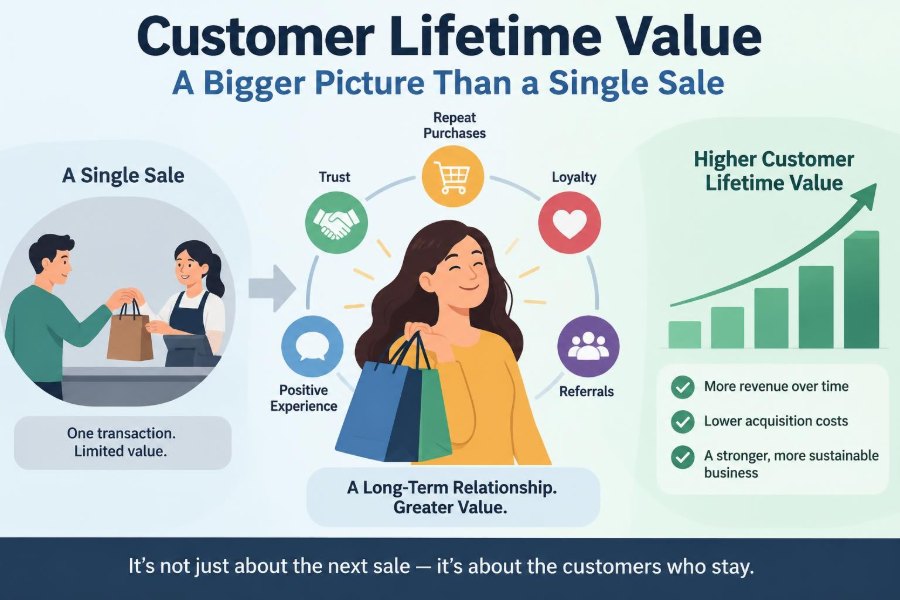

A local coffee shop runs a promotion that brings in a rush of first-time visitors. The owner sees a busy counter, a strong day of sales, and a successful campaign. Yet many of those customers may never return, while a smaller group quietly buys coffee several times each week for years.
The same pattern appears in software subscriptions, online retail, banking, gyms, consulting, and business-to-business sales. A company can celebrate a large order and still lose money if the cost of winning and serving that customer exceeds the value of the relationship.
This is why managers look beyond the transaction in front of them. They ask a more useful question: what is a customer likely to contribute over the full period they remain a customer?
Customer lifetime value, often shortened to CLV or LTV, turns that question into a decision-making tool. It does not make the future certain. It gives businesses a disciplined way to connect customer behavior, costs, retention, and growth.
🧭 Customer Lifetime Value in Plain Language
Customer lifetime value is the estimated economic value a business receives from a customer relationship over time. Depending on the purpose of the analysis, it may refer to total revenue, gross profit, or contribution margin generated by that customer.
A useful CLV measure usually focuses on profit rather than sales alone. Revenue is the money collected; profit reflects the money left after relevant costs, such as the product, delivery, support, returns, and payment processing.
CLV is an estimate, not a promise. Its purpose is to improve choices under uncertainty, especially choices about acquisition spending, customer service, pricing, and retention.
🔍 Why a Single Sale Gives an Incomplete Picture
A single sale records a moment. It does not reveal whether the customer will buy again, recommend the business, require expensive support, return the product, or stop purchasing after a discount expires.
Consider two hypothetical customers who each make a first purchase worth the same amount. One returns monthly, buys higher-margin items, and needs little assistance. The other buys once during a promotion and returns the product. Their first-sale revenue looks identical, but their economic value is very different.
Managers who rely only on current sales can unintentionally reward campaigns that create activity rather than durable value.
💰 Revenue, Gross Profit, and Contribution Margin
Before calculating CLV, a business must decide what kind of value it means. This choice prevents misleading comparisons.
| Measure | What it includes | Best use |
|---|---|---|
| Revenue CLV | Customer payments over time | Top-line demand planning |
| Gross profit CLV | Revenue minus direct product or service costs | Comparing product economics |
| Contribution-margin CLV | Gross profit minus variable costs to serve | Marketing and retention decisions |
For example, free shipping, commissions, usage-based infrastructure, packaging, and transaction fees can materially change the value of a customer. A high-revenue customer is not automatically a high-value customer.
🧮 A Simple Starting Formula
A simple historical approach estimates lifetime value as:
Average purchase value × purchase frequency × average customer lifespanIf a customer typically spends a certain amount per purchase, buys several times in a year, and remains active for several years, multiplying those figures produces a rough revenue estimate. Replacing purchase value with average margin makes the result more economically useful.
This model is easy to explain and may be enough for a small firm beginning to track customer behavior. Its weakness is that it treats averages as stable and assumes the past will resemble the future.
📅 The Role of Purchase Frequency
Frequency often matters as much as order size. A customer who makes modest, frequent purchases can be more valuable than one who places a large order only once.
Frequency should be measured over a sensible period for the business. A weekly food purchase, an annual insurance renewal, and a multi-year industrial equipment order should not be evaluated on the same timetable.
Managers should also separate genuine repeat demand from forced frequency. If a product requires frequent replacement because it fails quickly, repeat buying may signal a quality problem rather than customer loyalty.
🧺 Average Order Value Is Only One Lever
Average order value measures the typical amount spent per transaction. It can rise through bundles, larger pack sizes, complementary products, premium options, or better merchandising.
However, increasing order value is not always a win. A pushy upsell can reduce trust, increase returns, or make customers feel that a business is optimizing the transaction rather than solving their problem.
The better question is whether the added purchase improves the customer outcome. A relevant accessory for a new device may create value; an unrelated add-on at checkout may simply create friction.
⏳ Customer Lifespan and Retention
Customer lifespan is the period during which a person or organization remains active. Retention is the ability to keep customers purchasing, renewing, or using a service over time.
In a subscription business, churn is commonly the share of customers who cancel or fail to renew during a period. In a retail business without formal subscriptions, inactivity rules are needed: for example, a customer may be considered inactive after an appropriate interval with no purchase.
Definitions matter. A customer who buys seasonal products may appear inactive for months but still be behaving normally for that category.
🔁 Why Retention Can Change the Economics
Acquisition costs tend to occur early in the relationship. The value from repeat purchases arrives later. As a result, a company may lose money on the first order but earn a healthy return after several successful renewals or repeat purchases.
This does not mean businesses should accept losses indefinitely. It means that a first-order result should be interpreted alongside a realistic retention path and service costs.
A retention improvement can raise CLV because it gives the business more opportunities to earn margin from the same acquisition effort. But the improvement must be real, sustained, and measured against the cost of retaining customers.
🎯 Customer Acquisition Cost Must Be Compared Carefully
Customer acquisition cost, or CAC, is the spending required to gain a new customer. It can include advertising, sales commissions, promotional incentives, agency fees, and the relevant portion of sales labor.
A common comparison is CLV relative to CAC. If expected lifetime contribution is lower than the cost of acquiring the customer, growth may be unprofitable even when sales are rising.
Neither number should be treated casually. Including every corporate cost in CAC can make campaign comparisons unhelpful, while excluding major sales costs can make acquisition look artificially cheap.
🛣️ Payback Period Adds a Time Dimension
Two customer groups may have similar lifetime value but very different payback periods. Payback period is the time it takes for contribution from a customer to recover the cost of acquiring that customer.
This matters because businesses must fund spending before later profits arrive. A fast-growing company with long payback periods can face cash pressure even if its longer-term economics appear positive.
For a subscription service, managers might estimate how many months of retained contribution are needed to cover acquisition cost. For a retailer, they may use purchase cycles instead of months.
📉 Discounting Future Cash Flows
Money received now is generally more useful than the same amount received years later. It can be reinvested, and future payments are less certain. Discounting is the method of adjusting expected future cash flows to reflect that difference.
More advanced CLV models calculate the present value of expected future margin rather than simply adding it all together. This is especially useful for long contracts, major investments, or relationships extending over many years.
Discounting improves conceptual accuracy, but a complicated model is not automatically better. If retention data and cost data are unreliable, false precision can hide weak assumptions.
🧪 Historical and Predictive CLV Serve Different Purposes
Historical CLV summarizes what customers have actually contributed so far. It is concrete and easy to audit, but it says little about what a new customer may do next.
Predictive CLV uses patterns in prior behavior to estimate future purchases, retention, and margins. It can support targeting and budgeting, but it depends on assumptions and may perform poorly when markets, products, or customer behavior change.
The practical choice is often both: use historical data to understand reality and predictive estimates to make forward-looking decisions, then compare predictions with results.
👥 Segmentation Makes Averages More Useful
An overall average can conceal major differences among customers. A business that serves students, families, and corporate buyers may see different purchase rhythms, margins, support needs, and retention patterns in each group.
Segmentation divides customers into meaningful groups, such as acquisition channel, product line, geography, contract type, tenure, or usage behavior. The goal is not to create as many groups as possible. It is to identify differences that lead to better decisions.
A campaign might look weak in aggregate but attract a segment with strong long-term retention. Conversely, high initial spending from another segment may fade quickly after a promotion.
🧩 Cohort Analysis Reveals the Customer Journey
A cohort is a group of customers who share a starting characteristic, often the month or quarter in which they first purchased. Cohort analysis tracks how those groups behave over time.
Instead of blending all customers together, a manager can compare whether newer cohorts return at the same rate as earlier ones. This can reveal the effects of changed pricing, product quality, onboarding, or acquisition channels.
Cohorts are especially useful when a business is growing quickly. Overall revenue may rise simply because many new customers are arriving, even while the retention of each new group is deteriorating.
📣 Acquisition Channel Shapes Customer Quality
Customers acquired through search, referrals, events, partners, retail locations, or paid social media may behave differently because they arrived with different expectations and levels of intent.
It is tempting to judge channels by low cost per first purchase. A cheaper channel may nevertheless produce customers who use discounts once and disappear. A more expensive channel may attract customers who understand the offering and remain profitable longer.
Channel analysis should therefore track not just leads or first orders, but retention, margin, refund rates, service demand, and estimated CLV for each source.
🤝 Customer Experience Is Part of the Financial Model
Customer experience can feel separate from finance, but it affects CLV through repeat behavior. Confusing onboarding, unreliable delivery, hard-to-reach support, and unclear billing can all shorten a relationship.
At the same time, spending heavily on every service interaction is not automatically justified. The challenge is to remove recurring friction and focus help where it changes outcomes for customers and the business.
For example, a clearer setup guide may reduce avoidable support contacts while helping new users reach value sooner. That can improve both customer satisfaction and cost-to-serve.
🧠 Onboarding Often Determines the Next Purchase
Onboarding is the process that helps a new customer begin using a product or service successfully. It is particularly important when value is not obvious at the moment of purchase.
A business software customer who never completes setup may cancel despite an effective sales process. A buyer of a complex household product may not return if instructions are confusing or if the first use disappoints.
Good onboarding identifies the first meaningful outcome a customer needs and removes obstacles to reaching it. Welcome messages, training, product guidance, and proactive support should be tested for usefulness rather than added as routine decoration.
🛠️ Product Quality and Reliability Protect Value
CLV cannot be sustainably improved by communication alone if the core product repeatedly fails to meet expectations. Quality problems can trigger returns, warranty costs, support demand, negative word of mouth, and lost future purchases.
Managers should investigate why customers leave before assuming that more retention messaging will solve the problem. Exit feedback, return reasons, support tickets, usage patterns, and account conversations can identify recurring friction.
Not every departure is preventable. A customer may relocate, change needs, or reduce spending. The aim is to distinguish unavoidable churn from problems the business can reasonably address.
💬 Loyalty Is More Than a Points Program
Loyalty programs can encourage repeat purchases through points, tiers, rewards, or member benefits. They may be useful when they simplify repeat behavior or provide benefits customers genuinely value.
But a program does not create loyalty merely by assigning points to transactions. Deep loyalty comes from reliable value, a fair price for the outcome delivered, trust, convenience, and a relationship that feels worth continuing.
Rewards should be assessed as an investment. If discounts are given to customers who would have purchased anyway, the program may reduce margin without improving long-term behavior.
📈 Pricing Can Raise or Reduce Lifetime Value
Price affects order value, margin, customer expectations, and retention. A lower introductory price can reduce barriers to trial, but it can also attract customers who leave when the offer ends.
A price increase may improve margin per customer while reducing conversion or renewal. The net effect on CLV depends on how customers respond, not merely on the new price list.
Businesses should avoid assuming that higher prices always create higher value or that lower prices always improve loyalty. Testing, segment analysis, and clear communication are more reliable than intuition alone.
🌱 Expansion Revenue Should Follow Customer Value
Expansion revenue comes from an existing customer buying more: additional units, upgraded plans, related products, or broader service coverage. It can increase CLV efficiently because the relationship already exists.
Still, expansion should follow demonstrated customer need. Selling features that are unused or poorly matched may lead to dissatisfaction, downgrades, and damaged trust.
A sensible approach uses customer context. A growing team may benefit from more user seats; a customer struggling with basic adoption may need help succeeding before being offered an upgrade.
⚖️ Not Every High-Value Customer Is Worth Chasing
Some customers generate substantial revenue but also create unusually high costs, payment risk, constant customization demands, or pressure on staff. Their apparent value can shrink when full service costs are considered.
Businesses should avoid treating CLV as a reason to favor customers unfairly or ignore smaller accounts. The metric should support responsible resource allocation, not excuse poor conduct or neglect.
There is also strategic value that may not fit neatly into a model. A small customer might provide important learning, stabilize demand, or open a new market. Quantitative measures inform judgment; they do not replace it.
🧾 Data Quality Determines Model Quality
CLV calculations depend on customer records, transaction histories, costs, cancellations, refunds, and activity data. Duplicate accounts, missing identifiers, inconsistent definitions, and disconnected systems can distort results.
A basic data foundation includes a consistent customer ID, reliable transaction dates, a clear definition of active status, and rules for assigning costs. Documentation matters so that different teams do not calculate the same metric in incompatible ways.
Privacy and data governance also matter. Customer data should be collected, stored, accessed, and used in line with applicable requirements and the organization’s own commitments.
🚫 Common CLV Calculation Mistakes
- Using revenue as profit: this overlooks product, fulfillment, support, and payment costs.
- Assuming all customers behave like the average: meaningful segments can have very different economics.
- Ignoring refunds and churn: booked sales may not become durable value.
- Counting acquisition costs inconsistently: channel comparisons then become unreliable.
- Trusting a forecast after conditions change: new competition, pricing, or product changes can alter behavior.
The remedy is not perfection. It is transparent definitions, regular review, and a willingness to revise assumptions when evidence changes.
🧱 Avoid Building a Model Too Complex to Use
Advanced models can incorporate probability of repurchase, product-level margins, seasonal effects, discounts, service costs, and future cash-flow adjustments. These features can be valuable in data-rich businesses with decisions that justify the effort.
Yet a model that only a specialist understands may fail to guide everyday work. Sales, marketing, operations, and customer-success teams need measures they can interpret and influence.
Start with a simple, documented model. Add complexity when it materially improves a real decision, such as allocating a budget across channels or identifying customers who need intervention.
📊 A Practical CLV Dashboard
A useful dashboard does not need dozens of metrics. It should show the link between acquisition, retention, margin, and cash recovery.
- New customers by acquisition source
- Repeat purchase or renewal behavior by cohort
- Average order value and contribution margin
- Refunds, cancellations, and service costs
- Estimated CLV, CAC, and payback period by key segment
Trend lines are often more informative than a single report. Managers should ask what changed, which group changed, and whether the change reflects customer behavior, measurement rules, or temporary conditions.
🗺️ Using CLV in Day-to-Day Decisions
CLV becomes useful when it changes action. Marketing teams can set different acquisition bids for segments with different expected value. Product teams can prioritize improvements that remove major retention friction. Service teams can identify moments where timely help protects a valuable relationship.
It can also improve planning. Finance can evaluate whether a growth plan creates healthy payback. Sales leaders can consider whether incentive plans reward profitable, retained customers rather than only signed contracts.
The metric should encourage cross-functional conversations, because no single department controls the entire customer relationship.
🔄 A Sensible Improvement Cycle
Improving customer lifetime value is usually an iterative process rather than a one-time project. Begin with a clear question, such as whether a new onboarding sequence improves second purchases or whether a channel produces retained customers.
- Define the customer group and the behavior to improve.
- Measure a baseline using consistent rules.
- Make a focused change rather than many unrelated changes.
- Observe results over an appropriate purchase or renewal cycle.
- Compare benefits with the costs and risks of the change.
- Keep, revise, or stop the initiative based on evidence.
This approach prevents teams from declaring success based solely on immediate clicks, sign-ups, or first sales.
🌍 Ethical Limits Matter in Value Optimization
Businesses should not use CLV to manipulate customers into spending against their interests, make cancellation unnecessarily difficult, or target vulnerable people with unsuitable offers. Short-term extraction can damage trust, invite complaints, and weaken the relationship the metric is meant to measure.
Ethical practice means providing clear information, honoring choices, protecting data, and making retention efforts genuinely useful. A customer who leaves easily but returns later because they trust the business may be more valuable than one who stays only because exit is frustrating.
Long-term value and fair treatment are not opposites. Durable relationships depend on mutual benefit.
🏁 The Core Principle Behind Lifetime Value
Customer lifetime value matters because a business is rarely built one isolated transaction at a time. It is built through repeated exchanges in which customers receive enough value to continue choosing the organization, and the organization earns enough margin to keep serving them well.
CLV brings together the questions that a single-sale metric leaves unanswered: Who stays? What does it cost to serve them? Which channels bring a good fit? When does acquisition pay back? Where does the experience break down?
The strongest use of CLV is not to chase the largest number. It is to make more balanced decisions about customer value, business economics, and the quality of relationships over time.
A sale starts a customer relationship; lifetime value helps a business understand whether it can sustain and improve that relationship for both sides. 📊🤝🌱