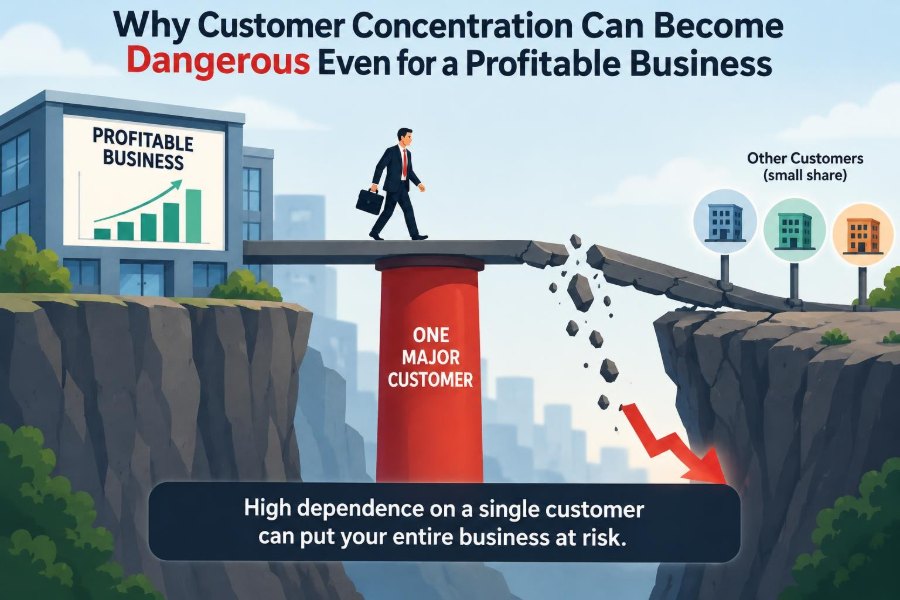

A company can be growing, profitable, well regarded, and still more fragile than it appears.
Imagine a manufacturer whose largest customer places steady, high-volume orders every quarter. The relationship has lasted for years, invoices are paid on time, and the customer’s business seems healthy. Management sees a success story: dependable revenue, efficient operations, and strong margins.
Then the customer changes suppliers, brings production in-house, delays a product launch, or simply negotiates harder at renewal. What looked like a stable source of profit can quickly become a cash-flow problem, an operational crisis, and a strategic emergency.
This is the risk of customer concentration: relying on a small number of customers for a large share of revenue. It does not mean the business is failing. It means one relationship may carry more weight than the company can safely absorb.
📌 What Customer Concentration Means
Customer concentration occurs when one customer, or a small group of customers, accounts for a substantial portion of a company’s sales. It can be measured by revenue, gross profit, accounts receivable, order volume, or even reliance on a customer’s referral network.
A business may have hundreds of customers and still be concentrated if a few major accounts generate most of its income. Conversely, a small specialist firm with only several clients may be less exposed if revenue is distributed reasonably evenly among them.
The issue is not the customer count alone. The core question is: how much would the business lose if one important buyer changed course?
💰 Profitability Does Not Equal Resilience
Profit measures whether a business earns more from its operations than it spends over a period. Resilience measures whether it can continue operating when conditions change. These are related, but they are not the same thing.
A concentrated business can report excellent profits because a major customer creates predictable demand and allows efficient production. Yet those same profits may depend on an assumption that the customer will keep buying at similar volumes, prices, and payment terms.
If that assumption fails, past profitability offers limited protection. The company may have to cut costs, carry unused capacity, or accept lower-margin work simply to replace lost volume.
🎯 Why Large Customers Are So Attractive
Large accounts are not inherently bad. They often help firms reach scale faster than a scattered base of small customers could. A single major buyer can support investment in equipment, staff, inventory systems, quality controls, or product development.
They may also reduce selling costs. Winning one enterprise contract can require significant effort, but managing it may be more efficient than handling dozens of smaller accounts with different needs and ordering patterns.
The danger begins when a sensible commercial opportunity turns into dependency. A business should be able to appreciate a large customer without quietly building its entire operating model around that customer’s continued approval.
⚖️ When a Valuable Relationship Becomes Dependency
Dependency develops when losing an account would make it difficult to meet payroll, service debt, maintain production, or preserve a viable business model. The threshold differs by industry, cost structure, contract length, and the ease of finding replacement customers.
For example, a software provider with reusable technology may be able to redirect its sales team toward similar clients. A manufacturer that bought specialized machinery solely for one customer’s specifications may have far fewer options.
Management should distinguish between a large account and an irreplaceable account. The first may be strategically useful. The second requires deliberate risk management.
🧮 Measuring Revenue Exposure
The simplest starting point is to calculate each customer’s share of total revenue. If annual sales are $10 million and one customer generates $3 million, that customer represents 30% of revenue.
Review this figure over time rather than treating it as a one-off calculation. Concentration may rise gradually because one account grows quickly while the rest of the customer base stays flat. A business can become exposed even while total revenue is increasing.
A useful internal dashboard often shows the largest customer, the top five customers, and the percentage of revenue outside those groups. It should also identify whether the trend is improving, stable, or worsening.
📈 Look Beyond Revenue to Gross Profit
Revenue concentration can understate or overstate the real economic risk. A customer responsible for 15% of sales may contribute 35% of gross profit because its orders have unusually strong margins. Losing it would hurt more than revenue alone suggests.
The reverse is also possible. A very large customer may demand low prices, extensive support, customized packaging, or frequent delivery. It could account for impressive sales but create modest profit after direct costs are considered.
Assess concentration using both sales and gross profit, which is revenue remaining after direct costs of delivering the product or service. This reveals which accounts truly support the business.
🏦 Cash Flow Can Be More Exposed Than Sales
Even a profitable company can run into trouble if a dominant customer pays late. When a large invoice is delayed, the effect on working capital can be immediate: suppliers still need payment, employees still expect wages, and tax obligations still arrive.
Accounts receivable concentration matters especially in businesses with long payment cycles. If one buyer represents much of the money owed to the company, a dispute, insolvency, or change in payment policy can create a sharp liquidity squeeze.
Track who owes the company money, not only who placed the orders. Revenue recorded in financial statements is not the same as cash available in the bank.
🔗 Operational Dependence Often Follows
Revenue dependence frequently creates operational dependence. A company may hire teams dedicated to one client, set up a separate warehouse area, build custom integrations, or maintain inventory that only one buyer can use.
These choices can make service better and deepen the relationship. But they can also create fixed costs that remain after orders disappear. The business is then left with excess staff, assets, and processes designed for demand that no longer exists.
Ask whether people, equipment, inventory, and systems could be redeployed within a reasonable time. If not, the business has a larger exposure than its revenue share suggests.
🧩 Customization Can Create Switching Barriers—on Both Sides
Customized work is sometimes viewed as protection because it makes it harder for the customer to switch suppliers. That can be true, particularly when the supplier has specialized knowledge or an embedded technical role.
However, customization can also trap the supplier. A product designed around one buyer’s specifications may have little resale value elsewhere. Custom software features, tooling, compliance processes, and dedicated inventory can all become stranded investments.
The best commercial arrangements identify which customized assets remain useful if the relationship ends. Reusable capabilities create flexibility; customer-specific assets require a stronger return and clearer contractual safeguards.
🤝 Bargaining Power Slowly Shifts
When a customer knows it is essential to a supplier, bargaining power can move toward the customer. This does not require bad behavior. A procurement team may simply recognize that the supplier is highly motivated to retain the account.
Over time, this can show up in requests for lower prices, longer payment terms, higher service levels, exclusivity, more favorable warranties, or investment in new capacity before a contract is secured.
The supplier may accept each request because losing the customer feels unthinkable. The cumulative result is often lower margins and more risk, even though reported revenue remains high.
📝 Contract Terms Matter More Under Concentration
A concentrated relationship needs more than goodwill. Contracts should make clear the scope of work, pricing method, volume commitments where appropriate, notice periods, intellectual property rights, payment terms, and responsibility for customer-specific investments.
No contract can eliminate commercial risk. A customer may still reduce purchases if demand falls, and legal rights can be costly or impractical to enforce. But unclear terms create additional uncertainty precisely when the company can least afford it.
Where major assets or hiring decisions depend on an account, leaders should seek commercial and legal advice suited to their jurisdiction and circumstances. Standard terms may not adequately protect a highly customized arrangement.
🚪 A Customer Can Leave for Ordinary Reasons
Businesses sometimes interpret a customer departure as a failure of service. Sometimes it is. But many departures occur for reasons outside the supplier’s control: a merger, a new executive team, a change in strategy, a product cancellation, a geographic exit, or an internal decision to produce the work.
A buyer may also consolidate vendors after a procurement review. The supplier can be competent and competitive yet still lose because the customer wants fewer partners.
This is why concentration risk should not be managed solely through account service. Excellent relationships reduce avoidable losses, but they cannot control the customer’s wider business decisions.
🏭 Industry Structure Shapes the Risk
In some sectors, concentration is partly unavoidable. Aerospace suppliers, defense contractors, large retailers, automotive component firms, and enterprise technology vendors may operate in markets dominated by a limited number of buyers.
In these settings, the goal is not necessarily to avoid large accounts. It is to understand the structural exposure and build safeguards around it. A company may diversify across programs, product lines, regions, buyer groups, or end markets even when the number of direct customers remains small.
Judging concentration requires context. A percentage that seems high in one industry may be normal in another, but normal does not mean risk-free.
🌐 Hidden Concentration Can Sit Behind Different Customers
Revenue can look diversified while the underlying exposure is not. Several distributors may all sell into the same retailer. Multiple direct customers may rely on the same construction market, government budget, or consumer product category.
This is sometimes called common-cause exposure: apparently separate revenue streams are affected by the same event. A downturn, regulation change, or supply disruption can reduce all of them at once.
Map the final end market where possible. Diversification is stronger when customers, industries, geographies, and demand drivers are genuinely different rather than merely listed under different names.
📉 Growth Can Make Concentration Worse
Fast growth is often celebrated, but growth from one customer can increase fragility. Suppose a company doubles sales because a major client launches a successful product. The business may need to hire rapidly, expand facilities, and commit to suppliers.
If the customer’s demand later normalizes, the company may be left with a cost base built for a peak rather than a sustainable level. The larger revenue base can conceal the fact that risk has become more concentrated.
Before scaling, leaders should test whether the expansion works under lower-volume scenarios. This does not mean refusing growth; it means matching commitments to the reliability of demand.
🔍 Concentration Risk Can Be Visible in the Sales Pipeline
A pipeline full of opportunities does not automatically solve dependence. Prospective deals may be early-stage, low probability, too small, or aimed at the same end market as the dominant customer.
Review the pipeline by expected timing, likely margin, customer type, and strategic fit. A realistic view separates qualified opportunities from hopeful conversations.
It is also useful to ask whether sales activity is overly focused on servicing the largest account. If senior staff spend most of their time protecting one relationship, new-customer development may quietly weaken.
🛒 Sales Teams May Avoid Diversification Without Realizing It
Winning new business is hard. Expanding an existing major account is usually easier because trust, systems, and buying processes are already established. Sales incentives that reward only near-term revenue can therefore encourage concentration.
This is not a flaw in salespeople. It is a predictable response to the incentives and resources they are given. Management must decide whether customer acquisition and market expansion deserve protected time, budget, and leadership attention.
A balanced approach rewards healthy growth from key accounts while also valuing new logos, broader market coverage, and recurring revenue sources that reduce dependency.
🧱 Fixed Costs Raise the Stakes
Concentration becomes more dangerous when a business has high fixed costs—expenses that continue even if sales fall. Lease payments, salaried specialists, debt repayments, software platforms, and dedicated machinery do not disappear when one customer reduces orders.
A consulting firm relying on contractors may be able to adjust capacity faster than a factory running specialized equipment. Neither model is automatically safer; the point is to understand how quickly costs can be changed.
Calculate the level of sales needed to cover fixed costs after the loss of a major account. That exercise turns an abstract concern into a concrete management question.
🧯 Scenario Planning Reveals the Real Exposure
Scenario planning asks, “What would we do if this happened?” It is more useful when it produces operational choices rather than a generic warning.
Consider several plausible cases: the largest customer cuts volume, delays payment, requests a price reduction, gives notice, or shifts a product line elsewhere. For each case, estimate the effect on cash, people, capacity, inventory, and debt obligations.
- What costs could be reduced within 30, 60, or 90 days?
- Which assets could serve other customers?
- Which prospects could realistically convert quickly?
- Who has authority to communicate with lenders, suppliers, and employees?
The objective is not to predict the future perfectly. It is to avoid making first-time decisions in a crisis.
💼 Build Financial Buffers for Uneven Demand
Cash reserves, available credit, prudent debt levels, and disciplined working-capital management can give a concentrated company time to respond. They do not replace diversification, but they reduce the chance that a temporary shock becomes a survival threat.
Businesses should be cautious about treating unusually strong cash flow from one customer as permanently available for fixed commitments. Using it for flexible investments, reserves, or debt reduction may preserve more options than locking it into irreversible overhead.
The appropriate buffer depends on volatility, contract certainty, access to finance, and the company’s ability to reduce costs. There is no universal reserve amount that fits every business.
🧭 Diversify Deliberately, Not Randomly
Customer diversification is not the same as selling to anyone willing to buy. Taking on poorly matched customers can create credit problems, service strain, or low-margin complexity without providing meaningful protection.
Better diversification targets customers that use the company’s core capabilities but have different demand cycles, locations, or decision makers. A packaging supplier, for example, might broaden across food, personal care, and industrial users rather than rely on several brands owned by one parent group.
The aim is a portfolio of revenue sources that strengthens the business, not a long list of accounts that are costly to serve.
🪜 Create a Practical Diversification Plan
A useful plan defines where new revenue should come from and what must change to win it. It may involve adapting an offer, building a channel partnership, hiring a salesperson with sector knowledge, or reducing barriers that make the company too tailored to one client.
- Identify capabilities that can be sold beyond the dominant customer.
- Select a small number of attractive segments with distinct demand drivers.
- Set realistic sales targets and time horizons for each segment.
- Track concentration alongside revenue growth in management reviews.
- Reassess investments that make the company less flexible.
Diversification usually takes time. Starting before a relationship weakens is far easier than trying to replace revenue after it is gone.
🧠 Deepen Account Knowledge Without Becoming Captive
Strong account management remains valuable. Understand the customer’s strategy, procurement process, operational pain points, and likely changes in demand. This can uncover opportunities and provide earlier warning of potential shifts.
However, account knowledge should not mean one employee holds all the relationship history. Document key contacts, agreements, service requirements, and risks. Build multiple relationships within the customer organization where appropriate.
A supplier is more resilient when it has informed, professional relationships and a clear value proposition—not when it relies on a single personal connection or an assumption of loyalty.
👥 Governance Keeps the Risk Visible
Customer concentration deserves regular attention from owners, senior leaders, and boards where they exist. It can be overlooked because the customer is associated with success, and raising concerns may seem unnecessarily pessimistic.
Regular governance questions can keep the issue visible:
- Has the customer’s share of revenue, profit, or receivables changed?
- Are contract protections and renewal dates understood?
- What customer-specific commitments have been made?
- Is diversification progressing at the intended pace?
Clear reporting prevents concentration from becoming an uncomfortable fact that everyone notices but nobody owns.
🚩 Warning Signs That Deserve Attention
Risk rarely announces itself in one dramatic moment. It often appears through smaller changes: shorter forecasts, delayed purchase orders, more aggressive price discussions, reduced communication, quality disputes, leadership turnover, or repeated requests for special concessions.
None of these signals proves that a customer will leave. Overreacting can damage a relationship. But ignoring patterns is equally unwise, particularly when the customer already represents a large share of the business.
Create a simple escalation process so account managers can share concerns early. Leaders need facts, not rumors, and they need enough time to respond constructively.
🛑 Common Mistakes in Managing Concentration
One common mistake is assuming a long relationship guarantees future revenue. Duration can indicate trust, but it does not eliminate commercial change. Another is measuring only revenue while ignoring margin, receivables, and dedicated costs.
Businesses also make trouble for themselves by accepting every special request from a major customer. A concession may be sensible, but it should be evaluated as part of the total economics and risk of the relationship.
Perhaps the most costly mistake is postponing diversification because the company is busy. The very period when a large customer is stable and profitable is often the best time to build alternatives.
🔄 Diversification Has Costs and Trade-Offs
A broader customer base can increase sales and reduce dependency, but it may also add administrative work, marketing expense, credit checks, product variation, and service complexity. Smaller customers may order less predictably or require more support per dollar of revenue.
There can also be a trade-off between depth and breadth. A firm that spreads itself too thin may fail to serve its most valuable accounts well. The answer is not to neglect major customers; it is to avoid allowing them to become the only foundation.
Good risk management balances relationship depth with portfolio breadth. The right mix depends on the business model and the ability to serve different customers profitably.
🧪 A Hypothetical Example: The Specialized Supplier
Consider a hypothetical precision-parts supplier earning most of its revenue from a single medical-device company. The account has funded modern equipment and provides steady orders, so the supplier has been profitable for several years.
When the customer redesigns a product, it reduces demand for one component. The supplier does not immediately fail, but its specialized machines sit partly idle, technicians have limited work, and cash flow tightens because the customer also extends payment timing during the transition.
The lesson is not that the supplier should have rejected the account. Its error would be treating customer success as a substitute for contingency planning, reusable capacity, and a broader market strategy.
📊 Useful Metrics for a Management Dashboard
A concise dashboard can make concentration manageable rather than mysterious. The exact format varies, but it should connect commercial dependence with financial and operational exposure.
| Metric | What it helps reveal |
|---|---|
| Largest customer share of revenue | Direct sales dependence |
| Largest customer share of gross profit | Economic importance beyond sales volume |
| Receivables by customer | Cash-flow exposure if payment is delayed |
| Customer-specific fixed costs | Costs that remain if demand falls |
| Revenue by end market | Hidden exposure across related customers |
| Qualified pipeline outside major accounts | Whether diversification is becoming real |
Metrics are useful only when someone acts on them. Review trends, discuss causes, and assign responsibility for the response.
🌱 The Healthiest Goal Is Strategic Optionality
Strategic optionality means having credible choices when circumstances change. A business with optionality can serve other markets, redirect capable employees, use assets in several ways, finance a transition, and pursue new customers without desperation.
Customer concentration reduces optionality when it makes the company’s people, cash, products, and decisions dependent on one buyer. Diversification restores it, not by making the business immune to setbacks, but by making a single setback less decisive.
This is a useful way to frame the issue. The goal is not to distrust an important customer. It is to ensure that the business retains the power to choose its next move.
🏁 The Core Principle: Success Should Not Create Fragility
A major customer can be a source of growth, learning, efficiency, and profit. Many strong companies are built through important anchor relationships. The relationship becomes dangerous only when its loss would leave the supplier without enough cash, capacity flexibility, bargaining power, or alternative demand.
Leaders should measure the exposure honestly, understand the operational commitments behind the revenue, plan for plausible disruptions, and invest steadily in appropriate diversification. That work is not a sign of weak confidence in a customer; it is a sign of sound management.
The most durable businesses value their largest customers while ensuring no single customer controls their future.
Profit is a valuable achievement, but resilience determines whether that achievement can endure when a vital relationship changes. Build the relationship well, monitor the dependency carefully, and preserve choices before they are urgently needed. 📊 🤝 🌱