
A sales manager approves a discount to win a major account. The customer signs, quarterly revenue rises, and the decision is praised. Six months later, margins are thin, the customer demands the same terms again, and the team is left wondering whether the “win” was actually wise.
Elsewhere, an operations manager spends money on backup equipment that is never used. The investment looks wasteful—until a supplier disruption hits competitors and the company continues serving customers without interruption.
These situations expose a persistent management problem: outcomes are visible, memorable, and easy to score. The quality of the reasoning that produced them is harder to see, especially when uncertainty, timing, and luck all play a role.
Managers should be accountable for results. But organizations make better decisions when they also evaluate the process: what was known, what was assumed, what alternatives were considered, and whether the choice made sense at the time.
🎯 The difference between an outcome and a decision
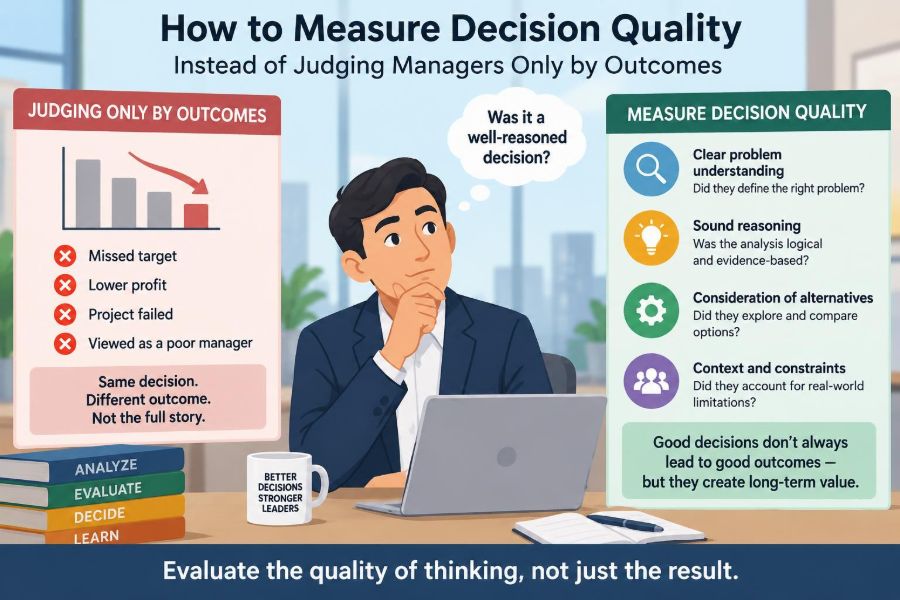
An outcome is what happened after a choice: revenue increased, a project launched late, an employee left, or a risk did not occur. A decision is the choice made using the information, constraints, goals, and judgment available at that moment.
The two are related, but they are not identical. A sound decision can produce a poor result because a competitor changes prices, demand falls, or a supplier fails. An unsound decision can look successful when circumstances happen to be favorable.
Evaluating decision quality means asking, “Was this a reasonable choice given what we knew and could reasonably have found out?” That question is not an excuse for failure. It is a way to distinguish competent judgment from fortunate results.
🎲 Why outcomes are often noisy signals
Business outcomes are shaped by many forces outside one manager’s control: market conditions, customer behavior, regulation, weather, exchange rates, competitor actions, and simple timing. This is often called noise: random or external variation that obscures the signal of management skill.
Consider a product launch. Strong execution may still meet weak demand because customers are cutting spending. Another launch might sell quickly because a social-media trend unexpectedly favors it, even if the company had little evidence that the product solved a meaningful customer problem.
When organizations treat every result as a pure score of individual competence, they risk rewarding luck and punishing disciplined judgment.
🧠 The trap of outcome bias
Outcome bias is the tendency to judge a decision by its final result rather than by the quality of the process used to make it. It feels natural because the result is concrete. Yet it creates distorted lessons.
If a risky shortcut succeeds once, leaders may call it bold leadership. If the same shortcut fails later, they may call it reckless. The underlying method did not change; only the visible result did.
Outcome bias can quietly teach people to tell a good story after the fact instead of doing careful analysis before acting. Over time, that weakens organizational learning.
🔍 Start with the decision context
Fair evaluation begins by reconstructing the context. Reviewers should ask what information was available when the manager acted—not what became known weeks or months later.
This prevents hindsight bias, the tendency to believe an event was obvious after it occurred. Once a project fails, warning signs often seem unmistakable. But were they clear, credible, and available to the manager beforehand?
A useful review records the decision date, time pressure, authority limits, resources, competing priorities, and information available. Context does not remove accountability; it makes accountability accurate.
🧭 Define the decision before judging it
Vague labels such as “the expansion decision” or “the hiring decision” make evaluation difficult. Define the specific choice: open one pilot location, delay expansion for one quarter, hire a candidate at a stated salary, or keep a supplier under a revised contract.
Then identify the decision owner. Many business choices are made by groups, with recommendations, approvals, and execution spread across several roles. Holding one manager responsible for a collective choice can produce both unfair performance reviews and poor diagnosis.
Clarity also separates a flawed choice from flawed implementation. Choosing a sensible strategy and executing it poorly are different problems requiring different remedies.
🏁 Clarify the objective and trade-offs
A high-quality decision serves a stated objective. “Increase sales” is usually too broad. A more useful objective might be “increase recurring revenue while protecting gross margin and avoiding dependence on a single customer.”
Managers frequently face legitimate trade-offs: speed versus analysis, growth versus cash preservation, consistency versus flexibility, and local optimization versus enterprise-wide value. Evaluation should examine whether those trade-offs were recognized and made deliberately.
If the objective was never clear, a manager can be criticized from any direction after the result is known. Clear objectives make both autonomy and accountability more realistic.
📏 Use decision criteria before the result arrives
Decision criteria are the standards used to compare options. They might include expected financial value, customer impact, operational capacity, strategic fit, legal exposure, reversibility, and effects on employees.
Whenever possible, agree on these criteria before selecting an option. Predefined criteria reduce the temptation to redefine success after the outcome is visible.
| Decision area | Useful criteria | Common distortion to avoid |
|---|---|---|
| New market entry | Demand evidence, cash needs, local capability, downside exposure | Focusing only on headline revenue |
| Hiring | Role requirements, evidence of skill, team fit, compensation range | Judging only by early charisma |
| Technology investment | User need, integration effort, security, adoption plan, total cost | Confusing new features with business value |
| Supplier choice | Quality, resilience, price, service levels, switching costs | Selecting solely on unit price |
📚 Separate facts, assumptions, and unknowns
Many weak decisions fail not because assumptions exist, but because assumptions are presented as facts. A disciplined manager labels the difference clearly.
- Facts are verifiable inputs, such as signed contracts, current inventory, or documented costs.
- Assumptions are beliefs used for planning, such as expected adoption rates or competitor response.
- Unknowns are material issues that cannot yet be estimated with confidence.
This distinction improves review quality. If an outcome disappoints, leaders can ask whether the manager ignored available facts, made a reasonable assumption that proved wrong, or failed to identify a critical unknown.
🔎 Test the quality of the evidence
Not all evidence deserves equal weight. Customer interviews can reveal needs, but a small, enthusiastic sample may not represent the broader market. Historical sales data may be reliable, but it may also describe conditions that no longer exist.
Good decision making considers source quality, recency, relevance, incentives, and missing data. It does not require perfect information, which is rarely available. It requires proportionate diligence for the stakes involved.
A manager deciding on office supplies does not need the same evidence standard as a manager approving a multi-year outsourcing contract. The expected cost of being wrong should shape the depth of analysis.
⚖️ Look for alternatives, not just a preferred answer
A decision process is stronger when it considers credible alternatives. The point is not to generate a long list for appearance’s sake; it is to avoid treating the first attractive proposal as the only option.
For example, a team considering a new software platform might compare buying a system, improving the existing workflow, using a temporary manual process, running a limited pilot, or delaying until another dependency is resolved.
The “do nothing” option should also be explicit. Sometimes waiting has real costs, but sometimes it preserves flexibility while the organization learns more.
🧮 Think in probabilities, not certainties
Managers often need to act before they can know the future. The better question is rarely “Will this work?” It is “What are the plausible outcomes, how likely are they, and what would each mean for us?”
This is probabilistic thinking. It encourages managers to express confidence honestly instead of offering false certainty. A forecast can be useful even when it is wrong if it made assumptions visible and defined the range of plausible results.
When reviewing decisions, compare the outcome with the predicted range, not merely with a single optimistic target. A result near the lower end of a realistic range is different from a result that no one considered possible.
📉 Evaluate downside risk and resilience
Expected upside is only half the picture. Strong decision making also asks what happens if the plan fails and whether the organization can absorb that failure.
A choice with modest expected returns may be unacceptable if it threatens cash flow, customer trust, regulatory compliance, or employee safety. Conversely, a high-upside experiment may be appropriate when losses are capped and learning value is high.
Evaluate whether managers identified meaningful risks, assigned owners, created contingency actions, and escalated issues that exceeded their authority. Risk management is not predicting every surprise; it is preparing intelligently for foreseeable exposure.
🔁 Reversibility should change the decision process
Some decisions are easy to reverse: altering a campaign message, pausing a pilot, or adjusting a meeting format. Others are difficult to reverse: selling a major asset, entering a long contract, or making a public commitment that changes customer expectations.
Irreversible or costly-to-reverse decisions deserve slower analysis, broader consultation, and clearer approval thresholds. Reversible decisions often benefit from speed and experimentation.
A common management error is applying the same process to both. Excessive review slows low-risk learning, while casual approval exposes the organization to commitments it cannot easily unwind.
🧪 Use small tests when uncertainty is high
A pilot, prototype, controlled rollout, or limited customer trial can improve decision quality by replacing assumptions with evidence. It is particularly valuable when demand, usability, or operational feasibility is uncertain.
A useful experiment has a specific question, a limited scope, a time frame, and criteria for interpreting the result. “Try it and see” is not enough if no one has decided what success, failure, or revision would look like.
Not every decision can be tested. Acquisitions, crisis responses, and some compliance actions may require a single commitment. But managers should look for ways to test the most uncertain assumption before committing fully.
🗒️ Keep a decision record
A short decision record creates a durable account of how and why a choice was made. It is not bureaucracy for its own sake. It protects the organization from selective memory after results appear.
A practical record can include:
- the decision and decision owner;
- objective, constraints, and success measures;
- key facts, assumptions, and unknowns;
- options considered and reasons for the choice;
- main risks, safeguards, and review date;
- expected outcomes or ranges.
The format can be one page for routine choices or more detailed for major commitments. What matters is that the reasoning is visible before hindsight reshapes the narrative.
⏳ Review decisions at the right intervals
A decision should not be assessed only at annual appraisal time. Some choices need an early implementation review, followed by a later outcome review when results have had time to emerge.
Timing matters. Reviewing a brand strategy after two weeks may say little about its market impact. Waiting two years to review a supplier transition may allow problems to become expensive habits.
Set review dates when the decision is made. This turns evaluation into a planned management activity rather than an emotional response to good or bad news.
🧩 Separate decision quality from execution quality
A manager can make an excellent choice and execute it badly. For instance, selecting a suitable customer relationship system may be sound, while failing to train users or clean data undermines the result.
The reverse can also happen: a team executes a weak strategy efficiently. Meeting every project milestone does not make the underlying strategic choice good.
Performance reviews should assess both dimensions. This helps leaders identify whether the remedy is better analysis, stronger project management, clearer ownership, additional resources, or a change in strategy.
👥 Account for collaboration and dissent
Many consequential decisions benefit from challenge. A manager who invites informed dissent is not necessarily indecisive; they may be reducing blind spots before committing.
Evaluate whether relevant perspectives were sought, especially from people close to customers, operations, finance, risk, or implementation. The goal is not consensus on every issue. It is ensuring that material objections were heard and addressed.
Psychological safety matters here. If employees believe disagreement will be punished, decision documents may show artificial agreement while serious concerns remain unspoken.
🚦 Distinguish a bad decision from a bad bet
A bad decision may rely on ignored evidence, unclear objectives, unexamined assumptions, or risks that were foreseeable and unmanaged. A bad bet is a reasonable choice that loses because one of several plausible outcomes occurs.
Imagine a hypothetical manager who insures a critical shipment at a sensible cost after assessing disruption risk. If the shipment arrives safely, the insurance may look unnecessary. If it is delayed, the protection may prove valuable. Either way, the decision should be judged by the exposure it addressed, not by whether the event happened.
This distinction is central to mature accountability. Otherwise, managers learn to avoid defensible risks merely because unlucky outcomes damage reputations.
🏆 Do not confuse good outcomes with good management
Good outcomes deserve recognition, but they should trigger curiosity as well as celebration. What exactly produced the result? Was it repeatable skill, favorable conditions, an unusually strong employee, or a one-time opportunity?
Leaders can ask whether the manager’s method could be used again in a different setting. If the answer depends on hidden luck or an exceptional circumstance, the organization should be careful about copying it.
This approach does not diminish success. It extracts a more useful lesson from it.
📌 Build a practical decision-quality scorecard
Organizations can use a simple scorecard for significant decisions. It should guide discussion, not create a misleadingly precise mathematical ranking.
| Dimension | Review question |
|---|---|
| Problem framing | Was the decision clearly defined with a relevant objective? |
| Evidence | Was information credible, sufficient, and proportionate to the stakes? |
| Alternatives | Were realistic options and trade-offs considered? |
| Judgment under uncertainty | Were assumptions, probabilities, and unknowns made visible? |
| Risk and reversibility | Were downside exposure and contingency plans addressed? |
| Execution readiness | Were ownership, capability, and implementation dependencies understood? |
| Learning | Was the decision reviewed and lessons captured without blame? |
Use descriptive ratings such as “strong,” “adequate,” and “needs improvement,” supported by evidence. A single score can hide the most useful insight: where the process needs to improve.
🗣️ Ask better questions in performance reviews
Performance conversations often begin with “Why did this fail?” A better opening is “Walk me through the decision you faced and what you knew at the time.” This invites analysis rather than defensiveness.
Useful questions include:
- What problem were you trying to solve, and for whom?
- Which assumptions mattered most, and how did you test them?
- What alternative did you reject, and why?
- What risk would you handle differently next time?
- What part of the outcome was within your control?
Managers should still explain missed commitments. The difference is that the conversation identifies controllable improvements instead of treating every disappointing outcome as evidence of poor judgment.
🪞 Encourage calibration, not confidence theater
Organizations sometimes reward managers who sound certain, even when the evidence is weak. This encourages confidence theater: projecting certainty to appear capable.
Better leaders are calibrated. They communicate what they know, what they do not know, and what would change their view. A manager who says, “I am moderately confident because these two assumptions remain untested,” may be demonstrating stronger judgment than one who promises success without qualification.
Calibration can be improved through regular forecasting and review. Over time, managers see whether their confidence levels match reality and learn where they tend to overestimate or underestimate risk.
🧯 Avoid turning process review into bureaucracy
Measuring decision quality can fail if it becomes a ritual of forms, meetings, and approval gates that add little insight. Managers then optimize paperwork rather than judgment.
Match the process to the decision. A routine, low-cost choice may need only a brief rationale. A high-impact, uncertain, or hard-to-reverse choice may need evidence review, scenario analysis, and senior challenge.
The test is practical: does this step improve the quality of the choice or the organization’s ability to learn? If not, simplify it.
⚠️ Watch for common evaluation mistakes
Even well-intentioned leaders can undermine a decision-quality approach. Several mistakes appear repeatedly:
- Demanding certainty: treating honest uncertainty as weakness encourages concealed risk.
- Rewarding only wins: this promotes luck-seeking and discourages responsible experimentation.
- Excusing every failure: process evaluation is not immunity from accountability for poor analysis or neglected execution.
- Using hindsight as evidence: facts discovered later should not be treated as information available earlier.
- Ignoring incentives: managers may make distorted choices when rewards favor short-term metrics over durable value.
A balanced system is demanding about reasoning, transparency, implementation, and learning while remaining realistic about uncertainty.
💼 Adapt the method to different management levels
Frontline managers often make fast operational decisions with immediate customer or employee consequences. Their decision quality may depend on escalation judgment, policy knowledge, and situational awareness.
Middle managers frequently translate strategy into staffing, budgets, and cross-functional priorities. They need to surface dependencies and trade-offs that senior leaders may not see.
Senior executives make fewer but more consequential decisions, often with long feedback cycles. Their evaluation should place particular weight on strategic framing, capital allocation, risk appetite, and the quality of challenge around them.
🌱 Create incentives for learning
People will document assumptions and report bad news only if the organization treats learning as valuable. If every miss leads to automatic blame, decision records become polished defenses rather than honest accounts.
Leaders can model the right behavior by discussing their own revised views, acknowledging uncertainty, and rewarding managers who stop weak initiatives early when evidence changes. Ending a project is not always failure; it can be disciplined resource allocation.
At the same time, learning must lead to action. Captured lessons should influence future criteria, budgets, training, and decision rights—not sit unused in a retrospective document.
🔄 Use patterns across decisions, not isolated verdicts
One decision rarely reveals a manager’s full capability. A stronger assessment looks for patterns across multiple choices: recurring untested assumptions, consistently thoughtful risk analysis, chronic delays, effective use of pilots, or repeated failure to involve key stakeholders.
Patterns help separate a temporary setback from a capability gap. They also make coaching more specific. “Improve judgment” is vague; “validate customer demand before committing production capacity” is actionable.
This longer view is especially important for managers working in volatile environments, where any single quarter can be heavily influenced by events beyond their control.
🛠️ A simple implementation path
Organizations do not need to redesign every performance system at once. Start with a small set of material, recurring decisions: major hires, pricing exceptions, capital requests, product investments, or supplier commitments.
- Define what counts as a material decision and who owns it.
- Create a short decision-record template suited to that category.
- Train reviewers to identify hindsight and outcome bias.
- Schedule reviews at meaningful intervals.
- Use lessons to improve criteria, authority limits, and coaching.
After the process becomes useful in one area, adapt it carefully. The goal is a better management habit, not a universal form.
🧠 The core principle: judge the process and learn from the result
Results matter because organizations exist to create value, serve customers, and meet commitments. Ignoring outcomes would be as misguided as judging only by them.
The more balanced approach is to judge managers on two connected questions: Did they use a sound, transparent, proportionate decision process? And what did the result teach us about the assumptions, execution, and environment?
This approach creates stronger accountability, not weaker accountability. It expects managers to think clearly, seek evidence, manage risk, explain trade-offs, and adapt when reality changes. It simply refuses to confuse luck with skill.
The best organizations reward disciplined judgment, examine outcomes honestly, and use the gap between expectation and reality to make the next decision better. That is how performance management becomes a system for learning rather than a scoreboard for hindsight. 📊🧭🌱