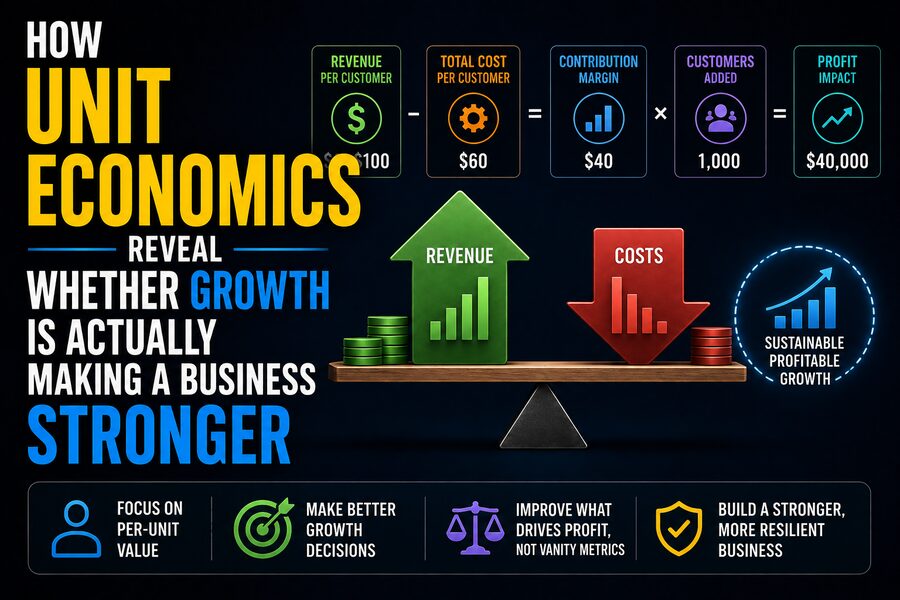

Fast growth can look impressive.
Revenue rises. Customer counts increase. Website traffic climbs. New markets open. Hiring accelerates. Investors may celebrate a company that is doubling sales every year. 🚀
But growth by itself does not prove that a business is becoming healthier.
A company can grow rapidly while losing more money on every additional customer. It can increase sales while depending on expensive discounts, unsustainable advertising, heavy subsidies, or costly support operations. In extreme cases, faster growth can actually make the business weaker because every new transaction creates another economic loss.
This is why founders, investors, and finance teams pay close attention to unit economics.
Unit economics examine the revenue and costs associated with a single economic unit of the business—such as one customer, one order, one subscription, one delivery, or one product sold.
Instead of asking only:
“How quickly are we growing?”
unit economics ask:
“Does each additional unit of growth create economic value?” 💰
That question can reveal whether expansion is building a stronger business or simply scaling losses.
🧩 1. What Is a “Unit” in Unit Economics?
The meaning of a unit depends on the business model.
For a software subscription company, the unit may be one customer.
For an e-commerce company, it may be one order.
For a food-delivery platform, it might be one delivery.
For a hotel, it could be one occupied room night.
For a marketplace, the unit might be one transaction.
For a consumer product company, it may simply be one item sold.
The key is choosing a unit that reflects how the company actually earns revenue and incurs variable costs.
Once the unit is defined, the company can study whether the economics of producing, acquiring, serving, and retaining that unit are attractive. 🔍
💵 2. Revenue Growth Can Hide Weak Economics
Imagine two companies.
Company A earns $100 from a new customer and spends $40 acquiring and serving that customer.
Company B also earns $100 from a new customer but spends $130 to acquire and serve that customer.
Both may report the same revenue growth.
But economically, they are very different.
Company A earns a positive contribution from each new customer.
Company B loses money every time it grows.
If Company B doubles its customer base, it may also dramatically increase its losses.
This is why topline revenue alone can be misleading.
Growth is valuable only when the underlying economics eventually support sustainable profit or strategic value.
🎯 3. Customer Acquisition Cost: What Does It Cost to Win a Customer?
One of the most important unit-economics metrics is Customer Acquisition Cost, or CAC.
A simplified formula is:
CAC = Sales and Marketing Cost ÷ Number of New Customers Acquired
Suppose a company spends $100,000 on marketing and sales in one month and acquires 1,000 new customers.
Its CAC is:
$100,000 ÷ 1,000 = $100 per customer
That means the company is effectively spending $100 to acquire each new customer.
CAC becomes meaningful when compared with how much economic value that customer generates over time. 📈
💰 4. Customer Lifetime Value Measures Long-Term Economic Value
Another key metric is Customer Lifetime Value, often abbreviated LTV or CLV.
LTV estimates how much gross profit or contribution margin a customer generates during the entire relationship with the business.
A simplified subscription formula might be:
LTV = Average Monthly Gross Profit per Customer ÷ Monthly Churn Rate
Suppose a software company earns $50 in monthly gross profit per customer and loses 2% of customers each month.
A rough estimate would be:
$50 ÷ 0.02 = $2,500 LTV
This suggests the average customer may generate about $2,500 in gross profit over their lifetime.
The company can then compare that value with CAC.
⚖️ 5. The LTV-to-CAC Ratio Shows Whether Acquisition Makes Sense
A widely used metric is:
LTV ÷ CAC
Suppose:
- LTV = $2,500
- CAC = $500
Then:
LTV/CAC = 5.0
This means the company expects to generate roughly five dollars of lifetime gross profit for every dollar spent acquiring the customer.
That sounds attractive.
Now imagine:
- LTV = $800
- CAC = $1,000
Then:
LTV/CAC = 0.8
The company is spending more to acquire customers than those customers are expected to generate in gross profit.
Scaling that model would be dangerous.
A healthy LTV-to-CAC ratio varies by industry, but the fundamental principle is universal:
Customer value must meaningfully exceed acquisition cost.
⏳ 6. CAC Payback Period Shows How Quickly Acquisition Spending Is Recovered
Even if LTV is high, a business can still run into cash-flow problems if it takes too long to recover customer acquisition costs.
That is why companies track CAC payback period.
A simplified formula is:
CAC Payback Period = CAC ÷ Monthly Gross Profit per Customer
Suppose:
- CAC = $600
- Monthly gross profit per customer = $100
The payback period is approximately:
6 months
That means the company recovers its acquisition spending after about half a year.
A company with a shorter payback period can often reinvest cash into growth more quickly.
A business with a three-year payback period may require enormous external funding to keep expanding. 💳
📉 7. Gross Margin Is a Foundation of Strong Unit Economics
Revenue is not the same as economic contribution.
Suppose a business sells a product for $100.
If producing and delivering it costs $70, gross profit is only $30.
The gross margin is:
($100 − $70) ÷ $100 = 30%
That $30 must still help cover:
- Marketing
- Salaries
- Rent
- Software
- Research
- Administration
- Interest
- Taxes
A company with weak gross margins has less room to fund growth.
This is why two companies with identical revenue can have completely different economics.
High-margin software businesses may retain a large portion of each revenue dollar, while logistics or retail businesses may operate with much thinner margins.
📦 8. Contribution Margin Goes Deeper Than Gross Margin
For many businesses, gross margin does not capture every cost that increases with each additional transaction.
This is where contribution margin becomes useful.
A simple formula is:
Contribution Margin = Revenue − Variable Costs
Variable costs might include:
- Payment processing fees
- Shipping
- Packaging
- Customer support
- Delivery incentives
- Transaction fees
- Sales commissions
- Refunds
- Cloud infrastructure tied to usage
Suppose an online marketplace earns $25 in revenue from a transaction but incurs $18 in variable costs.
Contribution margin is:
$7 per transaction
If the contribution margin is negative, scaling transaction volume can increase losses.
That is a major warning sign. ⚠️
🚚 9. Negative Unit Economics Can Make Growth Dangerous
Consider a delivery startup.
It charges the customer $12 per delivery.
But each delivery costs:
- Driver payment: $8
- Insurance and support: $2
- Payment processing: $1
- Promotions: $4
Total variable cost:
$15
Revenue:
$12
Contribution margin:
−$3
Every delivery destroys $3 of value.
If the company completes:
- 10,000 deliveries → loses $30,000
- 100,000 deliveries → loses $300,000
- 1,000,000 deliveries → loses $3,000,000
In this situation, growth magnifies the problem.
The company must improve pricing, reduce costs, increase order density, reduce promotions, or create additional revenue streams before scale becomes beneficial.
📈 10. Positive Unit Economics Can Make Growth Powerful
Now imagine the business improves operations.
Revenue per delivery rises to $14.
Costs fall to:
- Driver payment: $7
- Support and insurance: $1.50
- Payment processing: $0.50
- Promotions: $1
Total variable cost:
$10
Contribution margin:
$4
Now every additional delivery contributes $4 toward fixed costs and profit.
At sufficient scale, those positive unit economics can help cover headquarters costs, engineering salaries, management, and other fixed expenses.
Growth now strengthens the company instead of weakening it. 💪
🔄 11. Retention Can Matter More Than Acquisition
A business may have excellent customer acquisition but poor retention.
That can destroy unit economics.
Suppose a subscription company spends $200 to acquire a customer.
If the customer stays for two years, acquisition cost may be easily recovered.
If the customer cancels after one month, the economics may be terrible.
This is why churn is critical.
Churn measures how quickly customers leave.
High churn reduces customer lifetime and therefore lowers LTV.
A business that retains customers longer can often afford higher CAC because each customer generates more long-term value.
🧲 12. Retention Compounds Growth
Strong retention has another benefit.
If most existing customers stay while new customers are added, the customer base compounds.
For example:
Month 1: 1,000 customers
Month 2: 1,100 customers
Month 3: 1,210 customers
But if churn is severe, growth resembles filling a leaking bucket. 🪣
The company spends money acquiring customers while many existing users disappear.
In such cases, reported new-customer growth may hide weak underlying retention.
Unit economics force the company to examine not only acquisition but also customer durability.
🧾 13. Average Revenue Per User Matters
Another useful metric is Average Revenue Per User, or ARPU.
A simple formula is:
ARPU = Total Revenue ÷ Number of Customers
If 10,000 customers generate $500,000 in monthly revenue:
ARPU = $50 per month
ARPU can improve through:
- Higher prices
- Premium plans
- Add-ons
- Cross-selling
- Increased usage
- Reduced discounting
Increasing ARPU while maintaining retention can dramatically strengthen unit economics.
However, aggressive price increases can also increase churn.
The relationship must be monitored carefully.
🛒 14. E-Commerce Businesses Often Analyze Economics Per Order
Subscription companies often focus on customers.
E-commerce companies may examine economics per order.
Suppose an online retailer sells a product for $80.
Costs include:
- Product cost: $35
- Shipping: $8
- Packaging: $2
- Payment fee: $3
- Expected returns: $5
Contribution per order:
$27
If acquiring the customer costs $40, the first order alone does not recover CAC.
But if the average customer makes four purchases, the lifetime economics may still be attractive.
This is why repeat purchase behavior can be critical in retail.
🔁 15. Cohort Analysis Makes Unit Economics More Accurate
Overall averages can hide major differences between groups of customers.
A cohort is a group of customers acquired during the same period or through a similar channel.
For example:
- January customers
- February customers
- Paid-search customers
- Referral customers
- Enterprise customers
- Small-business customers
A company may discover that customers from referrals have:
- Lower CAC
- Higher retention
- Higher LTV
while customers acquired through paid social media have:
- Higher CAC
- Lower retention
- Lower LTV
This information can change marketing strategy.
Instead of simply spending more everywhere, the company can direct resources toward the channels with stronger economics. 🎯
🧠 16. Blended Metrics Can Hide Weak Segments
Suppose a company reports an average CAC of $100.
That sounds manageable.
But the average may conceal major differences:
- Organic search CAC: $20
- Referrals: $30
- Paid search: $150
- Paid social: $400
If the business scales mostly through the $400 channel, future unit economics may become much worse than historical averages suggest.
This is why strong financial analysis looks beyond blended company-wide metrics.
Founders should examine unit economics by:
- Geography
- Customer type
- Product
- Channel
- Cohort
- Sales team
- Contract size
The more granular the analysis, the easier it becomes to identify what kind of growth is actually valuable.
📣 17. Marketing Efficiency Often Declines at Scale
A common startup assumption is that if $1 million of advertising produced strong growth, $10 million will produce ten times as much.
Reality is often different.
The cheapest and most responsive customers are frequently acquired first.
As marketing expands, the company reaches less interested audiences.
CAC may rise.
This phenomenon is called diminishing marginal efficiency.
For example:
First 1,000 customers → CAC $50
Next 10,000 → CAC $90
Next 100,000 → CAC $160
Growth projections that assume constant CAC can therefore be dangerously optimistic.
🏭 18. Economies of Scale Can Improve Unit Economics
Growth can also make unit economics better.
Larger businesses may negotiate lower supplier prices.
Warehouses may operate more efficiently.
Delivery routes may become denser.
Payment-processing fees may decline.
Cloud infrastructure may become cheaper per transaction.
Brand awareness can reduce customer acquisition costs.
These effects are called economies of scale.
A business with weak early economics may become attractive if there is a realistic and demonstrated path to lower unit costs at scale.
The important word is demonstrated.
Companies should not simply assume future scale will magically solve current losses.
🧮 19. Fixed Costs and Variable Costs Must Be Separated
Unit economics usually focus heavily on variable or directly attributable costs.
But businesses also have fixed costs.
Examples include:
- Headquarters rent
- Executive salaries
- Core engineering teams
- Legal expenses
- Accounting
- Corporate software
These costs may not increase directly with each additional transaction.
Suppose a business earns $10 contribution margin per customer but has $1 million per month in fixed costs.
It needs approximately:
100,000 customers × $10 = $1,000,000
just to cover those fixed costs.
This concept helps determine the break-even point.
🎯 20. Break-Even Analysis Shows the Scale Required for Profitability
A simplified break-even formula is:
Break-Even Units = Fixed Costs ÷ Contribution Margin per Unit
Suppose:
- Monthly fixed costs = $500,000
- Contribution margin per customer = $50
Then:
Break-even customers = 10,000
Below 10,000 customers, the business loses money.
Above 10,000, additional customers begin contributing to operating profit, assuming the economics remain stable.
This makes unit economics directly useful for planning.
The company can estimate how much scale is necessary before the business becomes self-sustaining.
💳 21. Cash Flow Can Differ From Accounting Economics
A business can have attractive lifetime economics and still run out of cash.
Imagine a company spends $1,000 today to acquire a customer who will generate $3,000 of gross profit over three years.
Economically, that sounds excellent.
But the company pays CAC immediately and receives the customer revenue gradually.
If it acquires millions of customers quickly, enormous amounts of cash may be required before the future revenue arrives.
This is why payback period matters alongside LTV/CAC.
Fast-growing businesses need to understand both:
Is the customer profitable over time?
and:
Can we afford to finance the time before that profit arrives? ⏳
📉 22. Discounts Can Create Artificial Growth
Promotions can rapidly increase sales.
But discounted growth may not reflect sustainable demand.
Suppose a subscription normally costs $50 per month.
A company offers the first six months for $10.
Sign-ups surge.
Revenue growth looks impressive.
But if customers cancel when the price returns to $50, the cohort may have terrible lifetime economics.
Companies therefore need to separate:
- Promotional customers
- Full-price customers
- Organic customers
- Paid customers
Growth driven entirely by subsidies can disappear once subsidies stop.
🧪 23. Unit Economics Should Be Tested Before Scaling Aggressively
A startup does not need perfect economics from its first day.
Early companies often experiment.
They may intentionally spend heavily to learn:
- Which customers value the product
- Which pricing works
- Which channels scale
- Which features improve retention
- Which operational processes reduce cost
But before aggressively scaling, the company should develop evidence that economics improve with maturity.
Scaling an unproven model can burn cash very quickly.
It is often safer to improve the economic engine first and then accelerate growth. 🚦
🏦 24. Investors Use Unit Economics to Judge Growth Quality
Investors often look beyond headline growth rates.
They want to understand the quality of that growth.
Questions may include:
- What is CAC?
- How is CAC changing over time?
- What is customer retention?
- What is gross margin?
- What is contribution margin?
- How long is CAC payback?
- What is LTV/CAC?
- Which acquisition channels are most profitable?
- Does the model improve at scale?
A company growing 40% annually with strong unit economics may be more valuable than one growing 150% while losing large amounts on every customer.
Growth quality matters.
📊 25. Different Industries Require Different Unit Metrics
There is no universal unit-economics formula.
A SaaS business might focus on:
- CAC
- LTV
- Churn
- ARPU
- Gross margin
- Payback period
A marketplace might focus on:
- Gross merchandise value
- Take rate
- Contribution per transaction
- Buyer acquisition cost
- Seller acquisition cost
A delivery business may track:
- Revenue per delivery
- Driver cost
- Distance
- Delivery density
- Contribution margin
A manufacturing business may examine:
- Revenue per unit
- Material cost
- Labor cost
- Scrap rate
- Distribution expense
The correct metrics depend on how value is created.
🚨 26. Warning Signs of Weak Unit Economics
Several patterns should make operators cautious.
These include:
- CAC rising faster than customer value
- Negative contribution margin
- Long payback periods
- High churn
- Heavy discount dependence
- Low repeat purchase rates
- Increasing support costs per customer
- Falling gross margins
- Growth concentrated in low-quality channels
None automatically proves a business will fail.
But together, they may indicate that scaling will worsen financial performance rather than improve it.
✅ 27. Signs That Growth Is Strengthening the Business
Healthy growth often shows the opposite pattern.
The company may see:
- Stable or declining CAC
- Improving retention
- Higher customer lifetime value
- Increasing contribution margins
- Faster payback
- Strong repeat purchase rates
- Better supplier economics
- Increasing operational efficiency
In such a business, each additional customer helps cover fixed costs and can improve profitability.
Growth becomes an economic advantage rather than merely a vanity metric. 💪📈
🧠 28. Unit Economics Connect Strategy With Finance
Unit economics are not just accounting ratios.
They influence major strategic decisions.
A company can use them to decide:
- Which customers to target
- Which markets to enter
- Which marketing channels to expand
- How aggressively to discount
- Whether to raise prices
- Which product features improve retention
- Where operational costs must fall
They turn growth strategy into measurable economics.
Instead of asking, “Can we get more customers?” management can ask:
“Which customers should we acquire, at what cost, and with what expected economic return?”
That is a much stronger way to manage growth.
🏁 Conclusion
Unit economics reveal whether a business is creating value one customer, order, subscription, delivery, or transaction at a time.
Metrics such as CAC, LTV, gross margin, contribution margin, churn, ARPU, and CAC payback period show what is happening underneath headline revenue growth. 📊
If every new customer generates attractive lifetime profit and pays back acquisition cost quickly, growth can strengthen the business.
If every additional transaction loses money, faster growth can simply accelerate cash burn.
This is the fundamental insight:
Scale does not automatically fix a bad economic model. Scale multiplies whatever economics already exist.
Positive unit economics can turn growth into a powerful engine of profitability.
Negative unit economics can turn growth into a faster path toward financial stress.
The strongest companies therefore do not ask only how quickly they are expanding. They continually examine whether each new unit of growth is becoming more valuable, more efficient, and more durable.
That is what unit economics ultimately reveal: whether growth is merely making a business bigger—or actually making it stronger. 🚀💰📈