
Every organization depends on people who hold critical knowledge, relationships, authority, and decision-making responsibility. A chief executive may understand the company’s long-term strategy better than anyone else. A plant manager may know how to keep an operation running during emergencies. A sales director may personally manage several major customer relationships. A technical leader may be the only person who fully understands a complex system.
As long as these people remain in their roles, the business may operate smoothly.
But what happens if one of them suddenly resigns, retires, becomes seriously ill, accepts another job, or is otherwise unable to continue? ⚠️
Without preparation, the organization can face confusion at exactly the moment it needs stability. Decisions may be delayed, employees may become uncertain, customers may worry, and valuable knowledge may disappear with the departing leader.
Succession planning is the process businesses use to prepare for these transitions before they become emergencies. 🧭🏢
Instead of asking, “Who can replace this person?” only after a vacancy occurs, succession planning asks much earlier:
Which roles are critical, who could eventually fill them, and what must we do now to make that transition successful?
Done properly, succession planning helps a company preserve leadership continuity, retain institutional knowledge, develop future leaders, and continue operating even when important people leave.
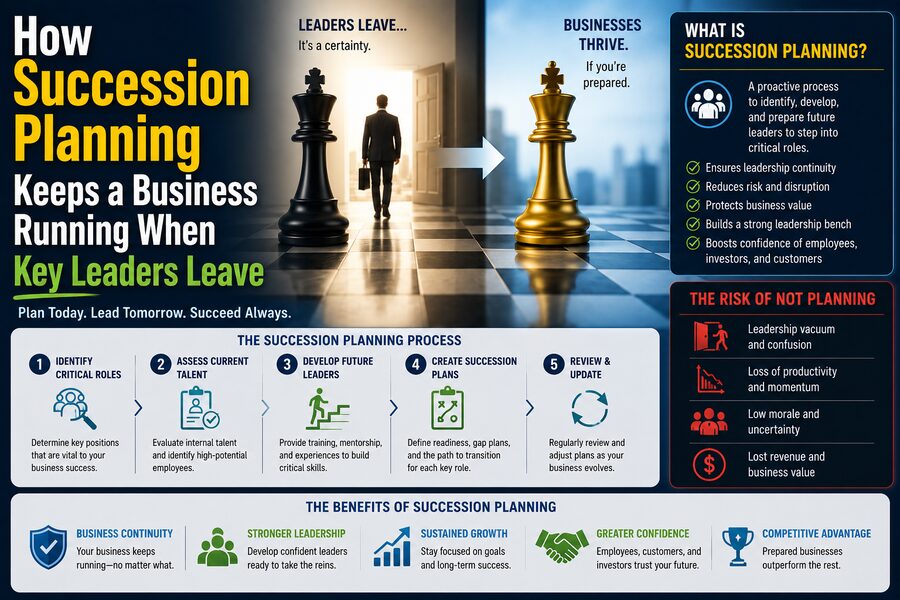
🧠 What Is Succession Planning?
Succession planning is a structured process for identifying important roles and preparing qualified people to assume those responsibilities when necessary.
It is commonly associated with senior executives such as:
- Chief executive officers
- Chief financial officers
- Chief operating officers
- Division presidents
- Senior vice presidents
But succession planning should not be limited to the executive suite.
A business may also depend heavily on:
🔧 Specialized engineers
🏭 Operations managers
💻 Technology architects
📊 Finance leaders
🤝 Major-account managers
🧪 Technical experts
📦 Supply-chain managers
A role is critical when its sudden vacancy could significantly disrupt operations, strategy, customer service, compliance, safety, or revenue.
Succession planning therefore focuses on business continuity, not simply job titles.
⚠️ Why Losing One Leader Can Create a Large Problem
A leader usually contributes more than the tasks listed in a job description.
Over many years, that person may accumulate knowledge about:
- Why past decisions were made
- Which customers require special attention
- Which employees are ready for greater responsibility
- Which risks are hidden inside operations
- Which suppliers are reliable
- How informal decision-making really works
- Which strategic projects are politically sensitive
- What mistakes the organization has made before
This is sometimes called institutional knowledge.
If a leader leaves abruptly and none of this knowledge has been transferred, the organization may lose far more than one employee.
It loses part of its memory. 🧠
🚨 The Difference Between Planned and Unplanned Departures
Some leadership transitions can be anticipated.
Examples include:
👴 Retirement
📅 End of a fixed-term appointment
🏢 Planned organizational restructuring
📈 Promotion to another position
These transitions may allow months or even years of preparation.
Other departures happen suddenly:
⚠️ Unexpected resignation
🏥 Serious illness
🚗 Accident
🧾 Termination
🤝 Acquisition-related change
A strong succession plan prepares for both.
The business should ideally have:
A long-term successor development plan
and:
An emergency replacement plan
These serve different purposes.
🆘 Emergency Succession Planning
Emergency succession planning answers the immediate question:
Who takes responsibility tomorrow if this leader is suddenly unavailable?
Suppose a CEO cannot continue working.
The board should not begin its first discussion about leadership continuity after the crisis occurs.
An emergency plan may identify an interim CEO, define what authority that person receives, and establish how employees, customers, investors, and partners will be informed.
Similar plans can exist for other critical functions.
For example, a manufacturing company might identify a deputy plant manager who can immediately assume operational authority if the plant manager becomes unavailable.
The objective is continuity.
The interim leader does not necessarily need to become the permanent successor.
Their first responsibility is to keep the organization stable while a longer-term decision is made. 🛡️
🌱 Long-Term Succession Planning
Long-term succession planning is more developmental.
Instead of simply identifying a temporary replacement, the organization asks:
Who could realistically perform this role several years from now?
Potential successors may need additional:
📚 Training
📊 Financial experience
🌍 International exposure
👥 People-management responsibility
🧠 Strategic decision-making experience
🤝 Customer relationships
The business then deliberately gives them opportunities to build those capabilities.
Succession planning therefore becomes closely connected to leadership development.
🎯 Step 1: Identify Critical Roles
The first step is determining which positions truly require succession planning.
Not every job needs a named successor.
Businesses should focus on roles where a vacancy could create significant disruption.
Questions might include:
- Would operations stop if this person disappeared?
- Does this role hold unique regulatory responsibility?
- Does the individual manage critical customer relationships?
- Is specialized technical knowledge concentrated here?
- Would replacing this role take many months?
- Does this person control strategically important decisions?
This produces a map of the organization’s key-person risk.
🔍 Step 2: Define What Success in the Role Requires
A common succession-planning mistake is assuming the next leader should simply resemble the current one.
But businesses change.
The skills that made someone successful ten years ago may not be the skills needed for the next decade.
Suppose a traditional retail company is moving aggressively into e-commerce.
Its future chief executive may need stronger experience in:
💻 Digital platforms
📊 Data analytics
🚚 Omnichannel logistics
🤖 Technology investment
than the current CEO required when taking the role.
Succession planning should therefore define the future requirements of the position, not merely copy the profile of the current incumbent.
👥 Step 3: Identify Potential Successors
Once role requirements are clear, organizations can identify employees with the potential to assume greater responsibility.
This process should examine more than current performance.
An excellent specialist is not automatically an excellent executive.
A strong successor may need:
- Leadership judgment
- Communication ability
- Strategic thinking
- Emotional maturity
- Decision-making under uncertainty
- Ability to develop others
- Financial understanding
- Credibility across teams
The company may identify more than one potential successor for an important role.
This creates depth.
If only one person is considered capable of taking over, the company still has significant succession risk.
📊 Performance and Potential Are Different
Succession planning often distinguishes between performance and potential.
Performance asks:
How well is this person doing in their current job?
Potential asks:
How capable are they of successfully handling larger or more complex responsibilities in the future?
Someone can perform extremely well today but have limited interest or capability for a much larger leadership role.
Another employee may still be developing in a current position but show strong potential for broader responsibility.
Businesses need both perspectives.
Promoting solely based on current performance can lead to poor leadership decisions.
🧭 Step 4: Assess Readiness
Potential successors are often grouped according to how quickly they could assume a role.
For example:
✅ Ready Now
Could take over with minimal additional preparation.
⏳ Ready in 1–2 Years
Needs some development but could become a credible successor relatively soon.
🌱 Ready in 3–5 Years
Shows strong potential but requires substantial experience.
This framework helps leaders see where the succession pipeline is strong and where gaps exist.
If a critical role has no “ready now” candidate, the organization may need to create an emergency plan while accelerating development.
🧑🏫 Step 5: Develop Future Leaders Deliberately
Potential successors should not simply wait until a vacancy appears.
They need opportunities to practice the capabilities their future roles will require.
Development methods may include:
🔄 Job rotations
🌍 International assignments
📊 Budget responsibility
👥 Larger team leadership
🚀 Strategic projects
🤝 Major-customer exposure
🧠 Executive mentoring
🏢 Cross-functional assignments
For example, a future CEO candidate who has spent an entire career in engineering might need significant exposure to finance, sales, investor communication, and organizational strategy.
The goal is to reduce the gap between potential and readiness.
🔄 Job Rotation Builds Broader Leaders
Job rotation can be especially valuable.
A manager might move from:
Operations → Commercial → Corporate Strategy
over several years.
Each assignment provides a different view of the business.
Someone who has managed only one department may become overly focused on that function’s priorities.
A future enterprise leader must understand how decisions affect the entire organization.
Cross-functional experience helps build that perspective. 🌐
🧠 Knowledge Transfer Is a Critical Part of Succession
A replacement needs more than authority.
They need knowledge.
Businesses should therefore deliberately transfer important information before a leader leaves.
This may include:
📝 Documenting key processes
🤝 Introducing successors to customers
📊 Sharing strategic assumptions
🗃️ Recording historical decisions
🔐 Transferring access and permissions
👥 Explaining important internal relationships
Some knowledge is easy to document.
Other knowledge is tacit—it exists largely in a person’s experience.
For example:
“Supplier A looks cheaper, but Supplier B is far more reliable during peak season.”
That insight may never appear in a formal procedure.
Mentoring and overlap periods help transfer this type of knowledge.
🤝 Relationships Also Need to Be Transferred
Leadership roles often depend heavily on relationships.
A sales executive may have built trust with a major customer over ten years.
A chief financial officer may regularly communicate with lenders and investors.
A plant manager may have strong relationships with regulators and local authorities.
If the leader leaves without introducing a successor, stakeholders may feel abandoned or uncertain.
Good succession planning gradually transfers these relationships.
A future leader may begin attending meetings months or years before the transition.
By the time succession occurs, stakeholders already know and trust the replacement.
🏢 Boards Play a Major Role in CEO Succession
CEO succession is particularly important because the chief executive affects nearly every part of the company.
In many corporations, the board of directors is responsible for selecting and overseeing the CEO.
A responsible board should regularly discuss:
- Emergency CEO succession
- Long-term internal candidates
- External talent options
- Leadership development
- Future strategic requirements
- Transition communication
CEO succession should not be treated as a once-per-decade event.
It should be an ongoing governance responsibility. 🏛️
🌍 Internal vs. External Successors
Companies can fill leadership roles internally or externally.
Both approaches have advantages.
👥 Internal Successors
Internal candidates already understand:
- Company culture
- Internal systems
- Products
- Employees
- Customers
They may transition quickly and preserve continuity.
Internal promotion also signals to employees that advancement is possible.
🌐 External Successors
An outside leader may bring:
- New ideas
- Different industry experience
- Specialized capabilities
- Greater willingness to challenge established practices
External hiring can be valuable when the company needs significant transformation.
The best choice depends on the organization’s situation.
Succession planning should help leaders make this decision deliberately rather than reactively.
⚖️ Continuity vs. Change
A succession decision often involves balancing continuity and transformation.
Suppose a company is performing extremely well.
An internal successor who understands the existing strategy may be ideal.
Now imagine the company has lost market share for several years and needs major restructuring.
In that case, the board may prefer an external leader with turnaround experience.
Succession planning should therefore be connected to strategy.
The question is not merely:
“Who is available?”
It is:
“Who is best suited to lead the business where it needs to go next?” 🎯
📉 What Happens When Succession Planning Is Weak?
Poor succession planning can create multiple problems at once.
A sudden departure may lead to:
⚠️ Leadership vacuum
📉 Slow decisions
👥 Employee anxiety
💸 Customer concern
🧠 Knowledge loss
🚪 Additional resignations
📊 Investor uncertainty
Employees may begin wondering:
“Who is actually in charge?”
Top performers may leave if they lose confidence in the organization’s direction.
Major customers may worry that service quality will deteriorate.
The operational effects of one leadership vacancy can therefore spread far beyond the empty office.
🌀 Leadership Vacuums Encourage Internal Conflict
When authority becomes unclear, people may compete to fill the gap.
Two senior executives may both believe they should lead.
Departments may begin following different priorities.
Decisions may be delayed because nobody knows who has final approval.
An explicit succession plan reduces ambiguity.
People know:
Who has authority
and:
How long that arrangement is expected to last
That clarity can be extremely valuable during uncertain periods.
🧲 Succession Planning Helps Retain High-Potential Employees
Talented employees often want to know whether they have a future inside the company.
If they see no opportunity for advancement, they may accept offers elsewhere.
Succession planning can help organizations create visible development pathways.
A manager may learn that becoming a division leader requires:
- Managing a larger team
- Gaining profit-and-loss responsibility
- Leading a cross-functional project
Now the path is concrete.
This can improve engagement and retention—especially when development opportunities are real rather than merely promised.
🔐 Succession Planning Reduces Key-Person Risk
Key-person risk occurs when too much of an organization’s success depends on one individual.
Imagine one engineer is the only person who understands a critical software platform.
If that person leaves, the company may struggle to maintain the system.
Succession planning addresses this by:
📝 Documenting knowledge
👥 Cross-training employees
🤝 Sharing relationships
🔄 Delegating responsibilities
🧑🏫 Developing backups
The goal is not to make employees replaceable in a simplistic sense.
It is to make the business resilient.
🏭 Succession Planning Matters in Small Businesses Too
Succession planning is often associated with large corporations, but it can be even more important for small businesses.
A founder may personally control:
- Customer relationships
- Pricing decisions
- Banking relationships
- Supplier negotiations
- Hiring
- Strategic knowledge
If the founder suddenly becomes unavailable, the entire organization can struggle.
Family-owned businesses face an additional challenge when ownership and management succession are closely connected.
They may need to plan separately for:
👔 Who runs the company
and:
📜 Who owns the company.
Those are not necessarily the same decision.
👨👩👧 Family Businesses Need Special Care
Family businesses can face emotional and governance challenges during succession.
A founder may assume that a child will eventually take over.
But important questions remain:
- Does that person want the role?
- Are they qualified?
- How will other family members react?
- How will ownership be divided?
- What happens if multiple relatives want control?
- How will non-family executives be treated?
Ignoring these questions can create conflict that harms both the family and the company.
Formal governance, clear criteria, and early communication can reduce these risks.
💼 Succession Planning and Ownership Transition
Leadership succession and ownership succession are related but distinct.
A founder could sell the company but remain CEO temporarily.
Alternatively, ownership could remain within a family while a professional external executive manages the business.
Private companies therefore may need plans involving:
📜 Estate planning
💰 Share transfers
🤝 Buy-sell agreements
🏦 Financing
👔 Management transition
These issues often require legal, tax, and financial expertise alongside leadership planning.
📊 Succession Planning Should Be Reviewed Regularly
A succession plan becomes outdated quickly.
Employees leave.
Strategies change.
New leaders emerge.
Roles become more or less important.
A candidate who looked promising two years ago may no longer be suitable.
Organizations should therefore review succession plans periodically.
Many companies do this annually as part of talent planning.
For critical roles, discussions may happen even more frequently.
Succession planning is a process, not a document placed in a drawer. 🗂️
🔍 What Should a Succession Review Examine?
A useful review might ask:
- Which roles are most critical?
- Who currently holds them?
- Who could assume each role immediately?
- Who could become ready within several years?
- What development does each candidate need?
- Where do we have no credible successor?
- Which employees are at risk of leaving?
These questions turn succession planning into a practical risk-management exercise.
📌 Succession Charts Are Useful—but Not Enough
Some organizations create succession charts showing:
Current leader → potential successors → readiness
These charts are useful for visibility.
But listing names does not create readiness.
A candidate identified as “ready in two years” needs concrete development actions.
For example:
Candidate: Operations Director
Future role: COO
Gap: Limited commercial experience
Development action: Lead pricing transformation project
Now succession planning becomes actionable.
🤖 Data Can Support Succession Decisions
Modern HR systems can help companies analyze talent information such as:
📊 Performance history
🎓 Skills
🔄 Internal moves
📚 Training
👥 Team leadership
📈 Retention risk
Analytics may help identify employees with relevant experience.
However, succession decisions should not be delegated entirely to algorithms.
Leadership potential involves judgment, motivation, context, and interpersonal capability that may be difficult to reduce to a score.
Technology can support decision-making, but management responsibility remains essential.
⚠️ Bias Can Distort Succession Planning
Succession discussions can be vulnerable to bias.
Leaders may prefer candidates who:
- Have similar backgrounds
- Communicate in familiar ways
- Have worked closely with them
- Follow traditional career paths
This can cause organizations to overlook strong candidates.
Structured criteria, multiple evaluators, and broader talent reviews can improve fairness and decision quality.
A strong succession system should search for the best future leader—not simply the person most similar to the current one.
🧭 Succession Planning Supports Strategic Change
Succession planning becomes most powerful when connected to long-term business strategy.
Suppose a manufacturer wants 50% of future revenue to come from digital services.
Its next generation of leaders may need stronger experience in:
💻 Software
📊 Data
🔐 Cybersecurity
🌍 Digital business models
If succession planning ignores this strategic shift, the company could develop leaders perfectly suited to yesterday’s business.
Talent planning should therefore ask:
What leadership capabilities will our future strategy require?
This links people development directly to competitive advantage.
🧪 Scenario Planning Can Improve Succession Readiness
Organizations can test succession plans using hypothetical scenarios.
For example:
“The CFO resigns tomorrow. What happens?”
The company then walks through:
- Who becomes interim CFO?
- Who can approve payments?
- Who communicates with banks?
- Who handles financial reporting?
- Who informs the board?
- Who has system access?
If nobody knows the answers, the plan is not operationally ready.
Scenario exercises can reveal gaps before a real crisis occurs. 🧪
📣 Communication During a Transition Matters
Even a well-planned succession can fail if communication is poor.
Employees may worry about layoffs or strategy changes.
Customers may wonder whether service will deteriorate.
Investors may question financial stability.
A transition communication plan should explain:
📌 Who is leaving
📌 Who is taking responsibility
📌 When the change occurs
📌 Whether strategy is changing
📌 How stakeholders will be supported
Clear communication reduces uncertainty and prevents rumors from filling the information gap.
🤝 The Outgoing Leader Has an Important Role
When departure is planned, the outgoing leader can help make succession successful.
They may:
🧠 Transfer knowledge
🤝 Introduce key relationships
📊 Explain strategic priorities
👥 Mentor the successor
🗂️ Document important decisions
However, the outgoing leader must eventually allow the successor to lead.
A transition can become awkward if the predecessor continues making decisions after authority has formally changed.
Good succession includes a clear transfer of responsibility.
🌱 The Successor Needs Support After Promotion
Promotion does not end the succession process.
A new leader may face unfamiliar challenges.
For example, someone promoted from division head to CEO must suddenly manage:
- Board relationships
- Investors
- Corporate reputation
- Enterprise-wide capital allocation
- Executive-team dynamics
Organizations can support newly promoted leaders through:
🧑🏫 Coaching
🤝 Mentoring
📊 Structured feedback
🏢 Board support
📅 Transition plans
The first months after succession can strongly influence whether the new leader succeeds.
📉 Measuring Succession Planning Effectiveness
Companies can track indicators such as:
📈 Percentage of critical roles with ready successors
👥 Internal promotion rate
⏱️ Time required to fill leadership vacancies
🚪 Retention of high-potential employees
📚 Completion of development plans
🎯 Performance of promoted successors
No single metric captures everything.
But measurement helps reveal whether succession planning is producing genuine readiness or merely attractive charts.
🚀 Succession Planning Creates Organizational Resilience
A resilient business can continue functioning even when circumstances change unexpectedly.
Succession planning contributes to that resilience because it reduces dependence on individuals.
The company develops:
🧠 Shared knowledge
👥 Leadership depth
🔄 Cross-functional experience
🛡️ Emergency backups
📊 Clear authority structures
When one leader leaves, the organization does not need to rebuild itself from scratch.
It already has people prepared to carry responsibilities forward.
✅ Conclusion
Succession planning keeps businesses running when key leaders leave by preparing for transitions before they become emergencies.
Instead of relying on one indispensable individual, the organization identifies critical roles, defines the capabilities those roles require, develops potential successors, transfers knowledge, and creates emergency leadership arrangements. 👔🔄
Strong succession planning protects much more than an organizational chart.
It protects:
🧠 Institutional knowledge
🤝 Customer relationships
📊 Strategic continuity
👥 Employee confidence
🏭 Operational stability
💰 Business value
It also helps companies build stronger future leaders by deliberately giving talented employees the experience they need before promotion.
The most important principle is simple:
Leadership transitions are inevitable—even when their timing is unpredictable.
People retire. Careers change. Organizations restructure. Emergencies happen.
A business that waits until a key leader leaves before deciding what comes next is accepting unnecessary risk.
A business with a strong succession plan has already asked the critical questions:
Who can take over? What do they still need to learn? What knowledge must be transferred? And how will the organization continue operating during the transition?
When those answers are prepared in advance, the departure of an important leader can remain a manageable transition rather than becoming a business crisis. 🏢🛡️