
A marketing team is deciding between two email subject lines. A product manager is unsure whether a shorter sign-up form will help or hurt. A retailer wonders whether free shipping should be shown on the product page or saved for checkout.
Each choice may look small, but it can affect revenue, customer trust, workload, and the overall experience people have with a business. Relying only on seniority, taste, or the loudest opinion can turn these decisions into expensive debates.
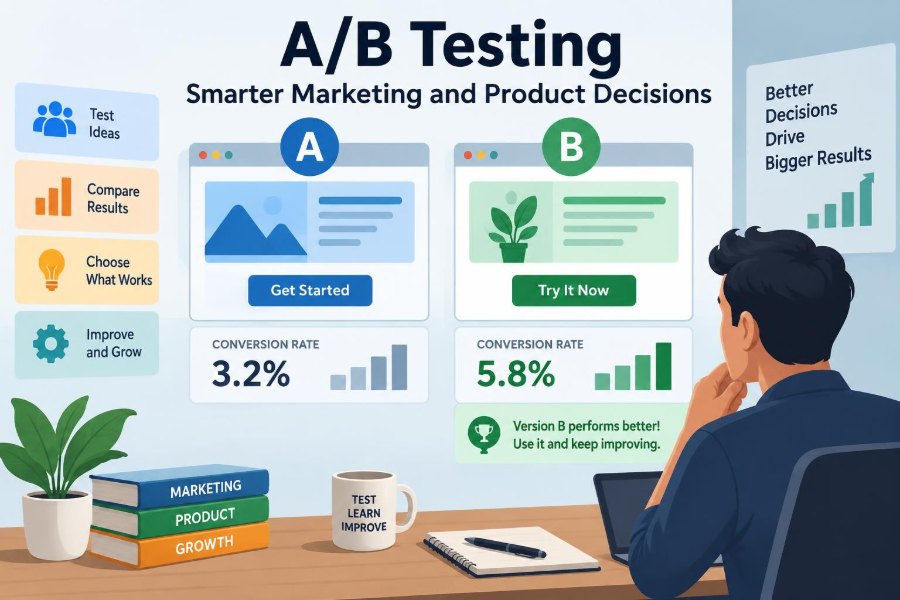
A/B testing offers a practical alternative: show different versions to comparable groups of people, measure a meaningful outcome, and use the evidence to make a better-informed decision.
It is not a button that automatically produces truth. Good tests require a clear question, careful design, enough data, and sound judgment. Used well, however, they turn uncertainty into structured learning. 🧪
🔍 1. What A/B Testing Actually Is
An A/B test, also called a split test, compares two versions of a marketing message, page, product feature, or process. Version A is usually the current version, often called the control, while Version B contains a planned change.
People are assigned to one version or the other, ideally at random. The business then compares a preselected outcome, such as purchases, completed forms, or successful onboarding steps.
The key idea is simple: change one decision, observe what happens, and avoid mistaking a preference for evidence.
🎯 2. Why Businesses Test Instead of Guess
Business teams have useful instincts, but instincts are shaped by personal experience, internal politics, and selective memory. Customers may react differently from the people building the campaign or product.
Testing helps answer questions that discussion alone cannot settle. It also gives teams a common basis for action, which can reduce unproductive arguments.
- Does a clearer call to action increase completed applications?
- Does a new product tutorial help users reach an important first success?
- Does a discount message create profitable sales or merely reduce margin on purchases that would have happened anyway?
A test does not replace strategy. It helps teams improve the many decisions required to execute strategy.
🧭 3. Start With a Decision, Not a Tool
Testing platforms can make experimentation look effortless, but a useful test starts before any software is opened. Teams should first state the business decision they need to make.
For example, “Which homepage message should we use for new visitors?” is a decision. “Let’s test something on the homepage” is not yet a focused question.
A clear decision prevents teams from collecting data simply because it is available. It also makes the result easier to act on when the test ends.
💡 4. Turn an Idea Into a Testable Hypothesis
A hypothesis explains what will change, for whom, why it may change behavior, and what result is expected. It should be specific enough that the team could later say whether the evidence supported it.
A strong example is: “For first-time visitors, replacing technical language with a plain-language benefit statement will increase trial starts because visitors will understand the offer more quickly.”
This is stronger than saying, “The new copy seems better.” It identifies an audience, a treatment, a mechanism, and an outcome.
👥 5. Choose the Right Audience
Not every customer should be included in every experiment. A change designed for first-time visitors may be irrelevant to long-term customers, while a feature test may only apply to users of a particular plan.
Define who is eligible before the test starts. Useful criteria can include location, device type, customer lifecycle stage, traffic source, account status, or product usage.
Audience choices affect both fairness and interpretation. A result from one segment should not automatically be generalized to every other segment.
🎲 6. Random Assignment Makes Comparisons Fairer
Randomization means eligible participants are assigned to A or B by chance. When it works properly, factors such as purchase intent, time of day, device preferences, and prior familiarity should be broadly balanced across the groups.
That balance is what allows a team to attribute an observed difference more confidently to the tested change rather than to who happened to see it.
Without random assignment, comparisons can be misleading. For instance, showing a new landing page only to paid-ad visitors and the old page only to direct visitors mixes page design with traffic quality.
🧱 7. Understand the Control and the Treatment
The control provides a baseline. It is commonly the current customer experience, although it can be another deliberately chosen standard.
The treatment is the alternative being evaluated. A disciplined test makes it possible to describe the treatment precisely: what changed, where it appeared, and under what conditions.
Teams sometimes call the alternative “the winner” before data exists. Better language is “variant” or “treatment,” because the purpose of the test is to discover whether it deserves that label.
📏 8. Select One Primary Metric
The primary metric is the main outcome that determines whether the test achieved its goal. For a checkout test, it might be completed purchases. For onboarding, it might be activation after account creation.
Choosing the metric in advance protects teams from searching through many numbers until one appears favorable. That practice can make random variation look like a meaningful result.
The primary metric should connect to the original decision. More clicks are not necessarily valuable if they do not lead to qualified leads, completed tasks, or sustainable revenue.
🛡️ 9. Add Guardrail Metrics
A change can improve one number while creating damage elsewhere. Guardrail metrics monitor outcomes the business does not want to worsen, such as cancellation rates, refund requests, support contacts, page performance, or customer complaints.
Consider a button that creates urgency and increases immediate purchases. If it also leads customers to misunderstand terms and request more refunds, the business needs to see both effects.
Guardrails encourage responsible optimization. The best variant is rarely the one that pushes a single number upward at any cost.
🧮 10. Know the Difference Between a Metric and a Business Goal
Metrics are measurements. Business goals are broader outcomes a company wants to achieve, such as profitable growth, customer retention, accessibility, or a simpler customer experience.
A team may track conversion rate because it is measurable and close to a goal, but conversion rate is not automatically the goal itself. A conversion that produces a poor-fit customer may create future costs.
Before testing, ask: “If this metric improves, would we genuinely consider the business better off?” If the answer is uncertain, the measurement plan needs more thought.
📊 11. Calculate Conversion Rate Carefully
Many marketing tests use conversion rate, which is the proportion of eligible participants who complete a defined action. The basic calculation is:
conversion rate = number of conversions / number of eligible participantsIf 100 people are shown a page and 12 complete the intended action, the conversion rate is 12%. The denominator matters: it should include the people who had a real opportunity to convert.
Teams should also define the conversion event clearly. “Purchase” may mean an order submitted, a payment approved, or an order that remains valid after cancellations, depending on the decision.
🧪 12. Change One Main Thing at a Time
In a straightforward A/B test, the versions should differ in one main, interpretable way. If a team changes the headline, images, price display, page layout, and checkout steps all at once, a result cannot reveal which change caused the difference.
Sometimes a broad redesign is necessary. In that case, the test can still answer whether the package performs better overall, but it provides less detailed learning for future design choices.
Keeping the change focused makes results more actionable and easier to explain across the organization.
🧩 13. When Multivariate Testing Is Different
Multivariate testing studies combinations of several elements, such as multiple headlines and multiple calls to action. It can help teams explore interactions between design choices.
However, it is more complex than a basic A/B test. More combinations usually require more traffic and more careful interpretation.
| Approach | Best use | Main challenge |
|---|---|---|
| A/B test | Comparing one focused alternative with a control | Limited insight if many elements change together |
| Multivariate test | Examining combinations of several page elements | More variants and data are needed |
| Sequential tests | Improving one major decision, then the next | Learning takes more rounds |
For many teams, simple sequential tests are more practical than attempting a complex experiment too early.
⏳ 14. Give the Test Enough Time and Traffic
Small samples are volatile. A few extra purchases, clicks, or cancellations can make one version appear much better than another even when the underlying difference is weak or nonexistent.
Before launch, teams should estimate the sample needed based on their baseline performance, the smallest improvement worth detecting, and the level of uncertainty they can accept. Analytics or experimentation specialists can help with this planning.
Tests should also cover a representative period. A weekday-only result may not describe behavior during weekends, paydays, holidays, or campaign peaks.
🛑 15. Do Not Stop at the First Encouraging Result
Checking a dashboard repeatedly and ending a test when one version briefly looks ahead is often called peeking. It increases the risk of treating a temporary fluctuation as a real effect.
Set a stopping rule before the test begins. It might include a planned sample size, a minimum duration, and criteria for interpreting the primary metric and guardrails.
This does not mean teams must ignore serious problems. If a variant creates a clear customer harm, technical failure, or legal concern, it should be paused immediately.
📈 16. Statistical Significance Is Not the Whole Story
Statistical analysis helps assess whether an observed difference is plausibly more than random variation under a chosen model. It is useful, but it does not tell leaders everything they need to know.
A result can be statistically detectable yet too small to justify design work, operational complexity, or a loss in brand clarity. Conversely, an important business effect may deserve further investigation even if the first test remains uncertain.
Interpret results through three lenses: confidence in the evidence, size of the effect, and practical value of acting on it.
💰 17. Measure Practical Impact, Not Just Percentages
Relative changes can sound dramatic without showing the underlying scale. An improvement should be considered alongside the number of affected customers, expected value per outcome, implementation cost, and possible downstream effects.
For example, a variant that adds a small lift to a highly visited page may matter considerably. The same lift on a rarely used internal screen may not be worth prioritizing.
Business decisions should connect experimental results to resources and opportunity costs. Every implementation competes with other possible improvements.
🧭 18. Segment Results With Care
After examining the overall result, teams often want to know whether the effect differs by device, region, new versus returning visitor, or customer type. This can reveal useful patterns.
But extensive segmentation creates many comparisons, and some apparent differences will occur by chance. A subgroup finding is more credible when it was planned in advance, is large enough to assess, and makes sense in light of customer behavior.
Treat unexpected segment patterns as hypotheses for follow-up, not automatic proof that a tailored rollout is needed.
📣 19. Common Marketing Uses of A/B Testing
Marketing teams use experiments across the customer journey, from the first advertisement to post-purchase communication. The question should always be connected to a meaningful customer or commercial outcome.
Examples
- Email subject lines, send times, message structure, and calls to action.
- Landing-page headlines, forms, value propositions, and trust-building information.
- Advertising creative, offer framing, audience-specific messages, and lead-capture flows.
- Checkout reminders, cart-recovery messages, and loyalty-program invitations.
Good marketing tests improve relevance rather than merely increasing pressure. A customer who understands an offer is more likely to make an informed choice.
🧑💻 20. Common Product Uses of A/B Testing
Product teams use A/B tests to learn whether a change helps users complete tasks and derive value. These tests can involve onboarding, search, navigation, notifications, feature discovery, and workflow design.
A product experiment might compare two ways of introducing a new feature. The relevant outcome is not simply whether users see the announcement, but whether they successfully use the feature and continue to benefit from it.
Product teams should avoid treating every user action as a conversion opportunity. Sometimes the best result is fewer steps, fewer errors, or a calmer experience. 🙂
🔄 21. Test the Full Customer Journey
Local optimization can create a weak overall journey. A promotional message may raise clicks to a page while attracting people who are not ready for the offer, leaving sales teams with lower-quality leads.
Map where the tested action sits in the journey: awareness, consideration, purchase, onboarding, use, renewal, or support. Then identify what happens next.
This broader view helps teams avoid optimizing a doorway while ignoring whether customers can successfully continue through the building.
⚖️ 22. Use Ethical Boundaries
Not every possible test should be run. Businesses have responsibilities to customers, employees, and communities, especially when tests involve pricing, vulnerable audiences, health-related decisions, financial consequences, or sensitive personal information.
Experiments should not rely on deception that creates material harm, deliberately obscure important terms, or make some customers bear unreasonable risk. Privacy obligations and internal review procedures also matter.
Ethical testing asks not only “Can we measure this?” but also “Is it fair to expose people to this variation?”
🔒 23. Protect Privacy and Data Quality
Reliable experiments depend on reliable data. Teams need consistent event definitions, accurate assignment records, appropriate access controls, and processes for detecting tracking failures.
Privacy should be designed into the work. Collect only data that is needed, handle personal information carefully, and ensure experimentation practices align with applicable laws and company policies.
A polished dashboard cannot repair flawed tracking or inappropriate data use. Data governance is part of experimental discipline, not an administrative afterthought.
🚧 24. Watch for Technical and Operational Confounders
A confounder is another factor that makes it difficult to isolate the effect of the tested change. A broken payment method, uneven traffic allocation, slow page loading, or an overlapping promotion can distort results.
Before launching, conduct quality assurance checks across relevant devices and browsers. During the experiment, monitor whether assignment ratios, event tracking, and performance look normal.
Record major outside events as well. A product outage or a sudden campaign change may affect interpretation even if the test itself was implemented correctly.
🗂️ 25. Keep an Experiment Record
Each test should leave behind a concise record. This prevents teams from repeating failed ideas, forgetting important context, or overstating what a result proved.
Useful items to document
- The decision, hypothesis, audience, control, and treatment.
- The primary metric, guardrails, planned duration, and stopping rule.
- Implementation details, unexpected events, and data-quality checks.
- The result, interpretation, final decision, and next question.
An experiment library becomes organizational memory. Over time, it reveals recurring customer patterns and improves the quality of future hypotheses.
🤝 26. Build an Experimentation Culture
A healthy testing culture values learning over being personally right. Leaders can support it by asking teams to state assumptions, celebrate well-run tests with null results, and avoid blaming people when evidence contradicts a favored idea.
Cross-functional collaboration is especially important. Marketing, product, design, engineering, analytics, legal, and customer support may each see risks or opportunities that others miss.
The goal is not to test everything endlessly. It is to make important uncertain decisions with more humility and better evidence.
🏁 27. The Core Principle: Learn Before You Scale
The central principle of A/B testing is straightforward: when a meaningful decision is uncertain, compare credible alternatives in a controlled way before committing broadly.
That principle requires more than declaring a winner. Teams need a relevant question, fair assignment, appropriate measures, sufficient evidence, ethical limits, and a willingness to consider the full customer impact.
A/B testing works best as a cycle: form a hypothesis, test it carefully, interpret the outcome, act proportionately, and use what was learned to ask a better next question.
The most valuable outcome is not simply finding a winning version; it is building a business that makes decisions by learning from customers rather than guessing about them. 🧪📈🤝