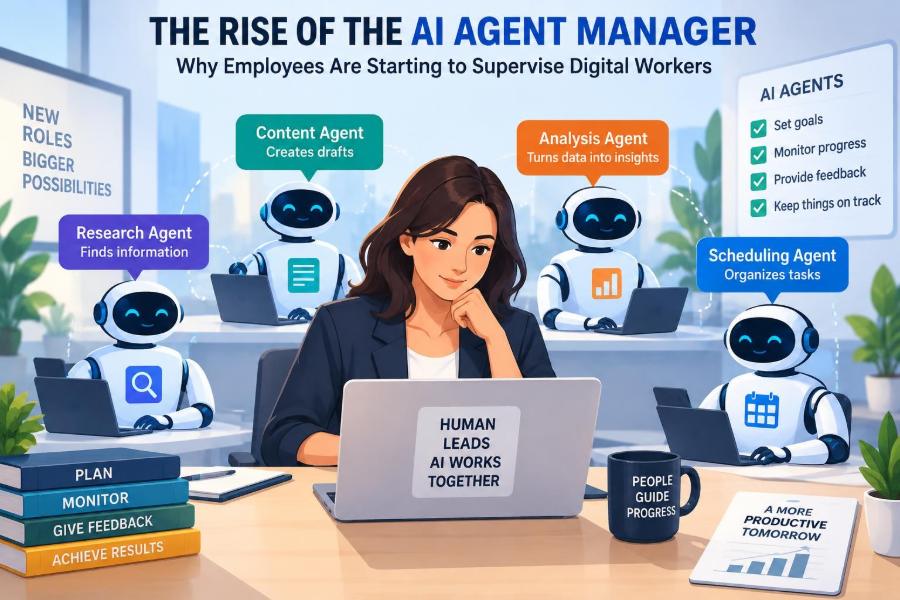

It is 9:10 on a Monday morning. A marketing coordinator opens a dashboard, sees that a digital agent has drafted six campaign variants, and notices that two use an outdated product claim. Instead of writing every email from scratch, the coordinator reviews the work, corrects the source material, and decides which version should move forward.
That is a small but meaningful change in the shape of work. The employee is still accountable for the campaign, but part of the production work has been delegated to software that can plan, draft, search, classify, and sometimes take actions in connected systems.
For students, this changes the skills worth developing. For working professionals, it changes what a productive day may look like: less time spent completing each routine step and more time defining goals, checking evidence, handling exceptions, and making judgments.
The emerging role is often described as the AI agent manager. It does not necessarily mean managing a separate team of robots. It means learning to supervise digital workers responsibly, so their speed supports rather than weakens human decision-making.
🤖 What Makes an AI Agent Different
An AI agent is software that can pursue a defined objective through a sequence of steps. Unlike a basic chatbot that answers a single prompt, an agent may break a task into sub-tasks, use approved tools, retrieve information, generate a result, and report back.
For example, an approved support agent might read a customer question, find relevant help-center content, draft a reply, and route a complicated case to a person. The degree of autonomy varies widely. Some agents only recommend actions; others can execute limited actions after rules are set.
🧑💼 Why “Manager” Is the Right Word
Management is not simply assigning work. It includes setting a goal, supplying resources, establishing boundaries, monitoring progress, evaluating quality, and being accountable for the outcome. Those are the same activities required when an employee delegates tasks to an AI agent.
Calling this work “prompting” understates it. A well-written request may start the process, but supervision continues after the first response. The manager must determine whether the agent used reliable inputs, followed policy, and produced work suitable for the real business context.
📈 Why This Role Is Emerging Now
Organizations have long used automation for predictable work such as payroll calculations or routing forms. Newer AI systems can handle language-heavy and less structured tasks, including summarizing documents, drafting communications, extracting information, and proposing plans.
At the same time, many systems are being connected to business software. An agent can potentially access a knowledge base, calendar, customer relationship system, spreadsheet, or ticket queue. That connectivity increases usefulness, but it also turns supervision from a nice extra into an operational requirement.
🔄 From Doing Every Task to Designing the Workflow
Traditional knowledge work often rewards the person who can personally complete the most tasks. Agent-supported work shifts attention toward designing a reliable workflow: what the agent does, what information it may use, when it must pause, and what a person must approve.
Think of a restaurant manager who does not cook every dish but creates standards for ingredients, preparation, checks, and service. Likewise, an AI agent manager creates conditions under which good work can be produced repeatedly rather than relying on a single impressive output.
🧭 Start With a Clear Outcome
Agents perform poorly when asked to “improve customer service” or “find growth opportunities” without a usable definition of success. A manager translates a broad ambition into an observable outcome, such as preparing a weekly list of unresolved tickets that meet stated priority criteria.
Good task definitions specify the audience, scope, deadline, desired format, and decision that the output will support. They also say what should happen when information is missing. Clear outcomes reduce unnecessary activity and make later review more consistent.
🧩 Break Work Into Delegable Parts
Not every part of a job should be handed to an agent. A useful first step is mapping a workflow into discrete activities: gathering information, checking completeness, categorizing items, drafting material, calculating, deciding, communicating, and recording a final action.
Information gathering and first drafts are often easier to supervise than high-stakes decisions. A hiring manager, for instance, might use an agent to organize interview notes but should be cautious about allowing it to rank people or make employment recommendations without careful safeguards.
🛠️ Match the Agent to the Task
Different tasks call for different capabilities. A simple rules-based automation may be safer and more reliable for renaming files than a generative AI system. A retrieval-based assistant may be appropriate for answering questions from an approved policy library, while an agent with tool access may handle a controlled update process.
| Task type | Useful agent role | Human supervision focus |
|---|---|---|
| Routine classification | Sort and label incoming items | Check edge cases and sample accuracy |
| Research preparation | Gather and summarize approved sources | Verify claims and missing context |
| Content drafting | Create first versions and variations | Protect tone, facts, and brand standards |
| System action | Prepare or execute limited updates | Confirm permissions, approvals, and audit trail |
The question is not whether one agent is “smart.” It is whether its capabilities, permissions, and failure modes fit a specific process.
📚 Give Agents Reliable Context
An agent cannot infer every detail that experienced employees know. It needs access to current instructions, definitions, examples, and source materials. Without this context, it may produce plausible work based on generic patterns rather than the organization’s actual rules.
Context should be curated, not dumped indiscriminately into a system. Outdated policies, conflicting documents, or sensitive files can make outputs worse and create governance problems. A manager needs to know which source is authoritative and when it was last reviewed.
📝 Instructions Are Operating Procedures
Effective instructions resemble a concise operating procedure. They identify the task, the allowed sources and tools, the required output, the prohibited actions, and the escalation path for unusual cases.
A vague instruction such as “respond helpfully” leaves major choices undefined. A stronger instruction might say to answer only from an approved knowledge base, avoid making refund commitments, label uncertainty clearly, and route billing disputes to a human queue.
🧱 Guardrails Define Safe Boundaries
Guardrails are constraints that limit what an agent can do or what information it can access. They may include permission controls, spending limits, required approvals, blocked actions, fixed templates, or restrictions on which databases the agent may query.
Guardrails matter most when agents can act rather than merely draft. An agent that can alter prices, contact customers, or update records should have narrower authority than a person who understands the wider commercial and ethical consequences of those actions.
👀 Supervision Is Not One Final Check
Reviewing only the final output can miss problems introduced earlier in the workflow. The agent may have used the wrong data source, misunderstood an instruction, or taken an unapproved intermediate action before presenting a polished summary.
Good supervision therefore includes checkpoints. Managers may review the plan before execution, inspect a sample during a high-volume run, and assess results afterward. The appropriate level of review depends on consequence, uncertainty, reversibility, and the agent’s proven reliability in that narrow task.
✅ Build a Quality Standard Before Running at Scale
It is hard to judge work consistently when “good” has not been defined. Before scaling a task, create a simple rubric: accuracy, completeness, relevance, tone, formatting, policy compliance, and appropriate handling of uncertainty can all be useful criteria.
Reviewers should compare outputs against real examples, not just personal impressions. If two managers would make different decisions about the same result, the workflow may need clearer standards. This is a management problem, not merely a technology problem.
🔍 Verify Facts, Not Just Fluency
Generative systems can present incorrect information in polished, confident language. This is often called hallucination: an output that appears credible but is unsupported, mistaken, or invented. Fluency should never be treated as evidence.
Verification is especially necessary for claims about prices, policies, contracts, regulations, customers, and technical instructions. A practical rule is to trace important statements back to a reliable source. If the system cannot show the basis for a claim, a human should treat it as unverified.
⚖️ Keep Human Judgment Where Stakes Are High
Some decisions involve rights, safety, dignity, significant financial effects, or legal obligations. In these settings, an agent may help organize information, but human review should remain central. A recommendation is not the same as a decision.
High stakes are not limited to dramatic situations. A mistaken benefits explanation, a biased screening pattern, or an incorrect account action can materially affect someone. Managers must consider who bears the cost if the agent is wrong, not just how much time it saves when correct.
🔐 Protect Data and Access
Agent management includes information governance. Before connecting an agent to a system, ask what data it will see, why it needs that data, who can authorize access, how information is retained, and whether the access is broader than necessary.
Least-privilege access means giving a tool only the minimum permissions needed for its defined job. An agent that summarizes internal meeting notes does not automatically need permission to download every personnel file or change calendar invitations.
🧾 Create an Audit Trail
An audit trail is a record of what happened: instructions used, sources accessed, actions proposed or taken, approvals granted, and changes made. It helps teams investigate errors, answer questions, and improve the process without relying on memory.
Not every low-risk draft requires elaborate documentation. But when an agent affects customer records, financial information, regulated work, or operational decisions, traceability becomes far more valuable. Accountability is difficult when no one can reconstruct the path from input to action.
🚦 Set Escalation Rules for Exceptions
The best workflows do not expect agents to solve everything. They identify conditions that require a person: conflicting data, an unfamiliar request, low confidence, sensitive language, a policy exception, or a possible security issue.
Escalation rules should be explicit. “Ask for help when needed” is less useful than “route to a supervisor if the request involves a contract term, a complaint alleging harm, or a fact not contained in the approved source.”
📊 Measure Work at the Process Level
Counting outputs alone can create the wrong incentives. If an agent closes many tickets quickly but increases reopens, complaints, or correction work, the apparent productivity gain may be misleading.
Useful measures combine speed with quality. Depending on the workflow, managers may track rework, error patterns, escalation rates, time saved after review, customer outcomes, and whether employees can handle more valuable work as a result.
🧪 Pilot Before Expanding
A controlled pilot lets a team discover where an agent helps and where it creates friction. Start with a bounded task, a limited user group, clear success criteria, and an easy way to stop or reverse actions if problems appear.
During a pilot, compare agent-assisted work with the existing process. Review failures closely. A small number of recurring mistakes may reveal a weak instruction, poor source material, an unsuitable task, or a missing guardrail.
🔁 Treat Feedback as Workflow Improvement
When an agent makes a mistake, the response should be more thoughtful than simply telling it to “be better.” Classify the failure. Was the source inaccurate? Was the request ambiguous? Did the system lack a required tool? Did a reviewer overlook an obvious warning?
That classification supports targeted improvement. The team may revise a template, narrow the task, update a knowledge base, add a review gate, or decide that the activity should remain fully human-led. Learning comes from changing the system around the work.
🗣️ Learn to Communicate With Digital Workers
Managing agents rewards precise communication, but it does not require mystical language. State the business purpose, define the deliverable, provide examples where helpful, specify constraints, and request an explanation or source list when verification matters.
A useful habit is asking the agent to surface assumptions before it proceeds. For a complex task, request a short plan, then review it. This can expose misunderstandings early, when correction is easier and less costly.
🧠 Domain Knowledge Becomes More Valuable
AI can generate generic material quickly, but it does not replace the need to understand the field in which work occurs. A skilled accountant, nurse, operations planner, or sales professional sees meaningful exceptions and risks that a general-purpose system may miss.
Domain expertise helps managers recognize when an answer is technically possible but commercially unwise, ethically questionable, or inconsistent with practice. The ability to ask better questions and assess better answers becomes a major source of value.
🤝 Redesign Teams, Not Just Individual Tasks
When agents take on portions of routine work, teams may need different handoffs and roles. One person may maintain knowledge sources, another may monitor quality, and subject-matter experts may handle escalations. These responsibilities should be visible rather than treated as invisible extra work.
Organizations should also be realistic about capacity. Agent use can reduce some repetitive effort, but it can introduce setup, review, training, and governance work. Benefits are strongest when leaders redesign the process rather than adding agent supervision on top of an already overloaded job.
🌱 Entry-Level Work Will Change, Not Disappear Uniformly
Many early-career roles have traditionally built skill through drafting, researching, reconciling information, and observing experienced colleagues. If agents take on portions of that work, employers need deliberate ways for newcomers to learn the underlying judgment rather than merely approve outputs they do not understand.
For students, the response is not to avoid basic skills. Writing clearly, checking sources, understanding spreadsheets, organizing projects, and learning a profession’s standards remain essential. Someone cannot responsibly supervise work they are unable to evaluate.
⚠️ Avoid Automation Bias
Automation bias occurs when people place too much trust in a system’s recommendation, especially when it looks polished or appears to save time. It can lead reviewers to skim rather than think, or to assume that an agent has checked something it has not.
Counter this tendency with active review habits: inspect source evidence, test a sample of outputs, ask what could be wrong, and encourage employees to challenge the system without being seen as resistant to innovation. Healthy skepticism is part of competent supervision.
🧯 Plan for Failures and Recovery
Every delegated process needs a recovery path. What happens if the agent uses stale information, sends an incorrect draft, duplicates a request, or performs an action that must be undone? The answer should be designed before a serious incident occurs.
Recovery plans may include pausing the agent, notifying affected people, correcting records, documenting the incident, and reviewing permissions. Reversible actions and small initial limits make failures easier to contain while a team learns.
💡 A Practical First Assignment
A good first use case is usually repetitive, bounded, low consequence, and easy to review. For example, a project coordinator might ask an agent to turn meeting notes into a draft action list, clearly marking uncertain owners or deadlines for human confirmation.
That task provides a real benefit without allowing the agent to commit the organization to external promises. The coordinator can compare the draft with the original notes, identify recurring gaps, and refine the instructions over several cycles.
🪜 A Simple Management Cycle
Employees can use a repeatable cycle when supervising digital workers:
- Define: State the outcome, scope, and limits.
- Prepare: Provide approved context, tools, and permissions.
- Direct: Give clear operating instructions and escalation rules.
- Review: Check plans, samples, evidence, and final outputs.
- Improve: Record failures and adjust the workflow.
This cycle works whether the agent creates a single draft or supports a complex, recurring process. The more consequential the task, the more deliberate each stage should become.
🎯 The Core Principle: Delegate Tasks, Keep Accountability
The rise of the AI agent manager is not mainly about replacing human effort with software. It is about separating routine execution from the responsibilities that require context, judgment, accountability, and care.
Strong managers do not assume an agent is correct because it is fast. They choose appropriate tasks, define standards, protect sensitive information, verify meaningful claims, and make sure a person can intervene when circumstances fall outside the rules.
That approach creates a healthier relationship with automation: digital workers can extend human capacity, while people remain responsible for the decisions and consequences that matter most.
The valuable professional of the future will not merely use AI tools; they will know how to direct, question, evaluate, and govern them responsibly. 👥🤖📚