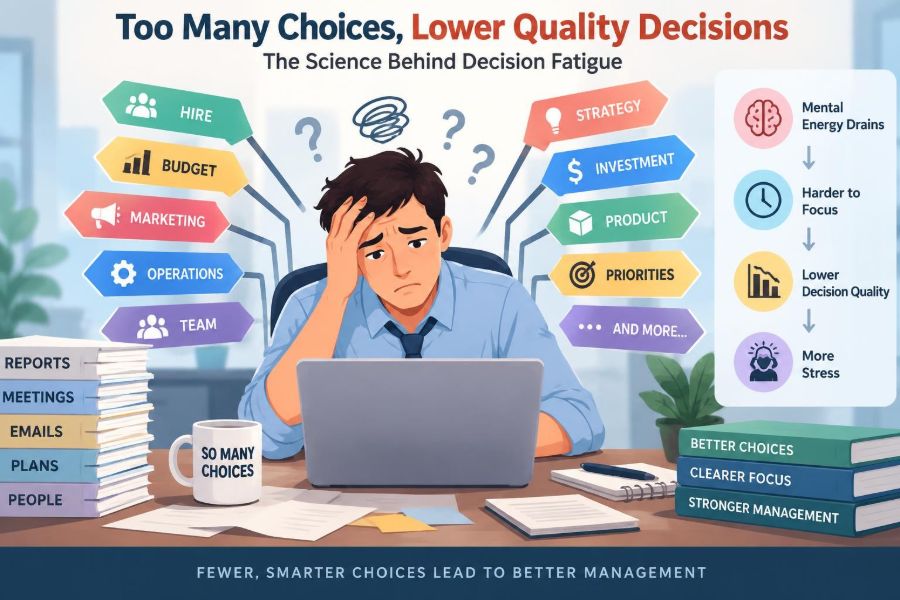

It is 4:30 p.m. A manager has already approved a purchase request, resolved a customer escalation, chosen between two project timelines, answered dozens of messages, and sat through a hiring interview. Then a team member asks a reasonable question: “Which option should we take?”
Nothing about the final choice is unusually difficult. Yet the manager feels impatient, postpones the decision, or chooses the first option that sounds acceptable. The problem may not be a lack of skill or commitment. It may be that the day has consumed too much decision-making capacity.
This experience is often described as decision fatigue: a decline in the quality, consistency, or willingness to make choices after repeated decisions. For managers, whose work is largely a sequence of judgments, priorities, trade-offs, and approvals, it can quietly affect teams and results.
Understanding the mechanism does not mean trying to eliminate all choices. It means designing work so that attention and judgment are reserved for the decisions that genuinely need them.
🧠 What Decision Fatigue Actually Means
Decision fatigue is the tendency for decision-making to become more effortful or less reliable after a person has made many choices, especially choices involving uncertainty, conflict, consequences, or competing goals. It is not a diagnosis, and it is not simply ordinary tiredness.
A person experiencing it may avoid choosing, rely on a familiar default, act impulsively, become overly cautious, or apply less careful reasoning. Different people show different patterns, which is why it can be difficult to spot from the outside.
🔋 Why Management Work Drains Judgment
Management decisions rarely stand alone. A staffing choice affects workload, morale, budgets, and delivery. A change in scope affects clients, schedules, and quality. Even small approvals can require remembering context and anticipating downstream effects.
Managers also make social judgments: when to challenge an employee, when to provide autonomy, and how firmly to communicate a boundary. This continuous switching between operational, strategic, and interpersonal thinking creates a substantial mental load.
🧭 Choice Overload and Decision Fatigue Are Different
Choice overload occurs when the number or complexity of options makes a particular choice difficult. For example, a procurement team comparing fifteen near-identical software packages may struggle because the option set is unwieldy.
Decision fatigue is broader and cumulative. A manager may be tired of deciding after a day of small, unrelated choices, even if the final decision has only two options. Choice overload can contribute to decision fatigue, but the terms are not interchangeable.
⚖️ The Hidden Cost of Small Decisions
Choosing a meeting time, deciding who answers a message, selecting a report format, and approving routine expenses may seem trivial. But each one requires some combination of attention, memory, comparison, and accountability.
The issue is not that every small choice has equal weight. Rather, a workplace full of unnecessary micro-decisions repeatedly interrupts higher-value thinking. The cumulative cost can be greater than the cost of any one decision.
🔍 What Makes a Choice Mentally Expensive
Some decisions demand more mental effort than others. They become costly when information is incomplete, the criteria conflict, the stakes are unclear, or a manager expects to justify the outcome to others.
- Ambiguity: no option is clearly best.
- Reversibility: it is unclear whether the decision can be changed later.
- Social risk: someone may feel disappointed, excluded, or treated unfairly.
- Time pressure: analysis must happen before sufficient facts are available.
- Context switching: the decision arrives while attention is committed elsewhere.
A short choice with several of these features can drain more energy than a longer, well-structured decision.
🧩 Cognitive Load: The Working Memory Problem
Cognitive load is the mental demand placed on working memory, the limited system used to hold and manipulate information in the moment. When a manager is comparing priorities, remembering constraints, and anticipating objections at once, working memory becomes crowded.
Under high load, people often simplify. Simplification can be useful, but it becomes risky when it causes a manager to overlook a stakeholder, a dependency, or an alternative that would have changed the outcome.
🚦The Two Common Responses: Avoidance and Impulse
Decision fatigue does not always make people indecisive. One manager may delay a difficult call, request more information than necessary, or leave an issue unresolved. Another may decide quickly just to remove the discomfort.
Both responses can be understandable shortcuts. Avoidance protects a person from immediate mental strain; impulsiveness removes a choice from the queue. Neither is automatically wrong, but either can reduce management quality when used without regard to the decision’s stakes.
📉 Satisficing: Choosing “Good Enough” Too Early
Satisficing means selecting an option that meets an acceptable threshold rather than searching for the best possible option. In a busy workplace, this is often sensible. A manager does not need a perfect vendor for a low-risk office supply order.
The danger comes when a fatigued manager satisfices on a decision that deserves more scrutiny, such as a role redesign or a customer commitment. The useful question is not “Did we optimize?” but “Did this decision receive effort proportional to its consequences?”
🧱 Defaults Can Help or Harm
Defaults reduce effort by providing a preselected path. A standard contract template, a regular meeting cadence, or a defined approval limit can prevent routine work from consuming judgment.
However, defaults can also become invisible. Teams may keep using an outdated process because changing it feels harder than accepting its flaws. Good management distinguishes between helpful standardization and mindless repetition.
🧠 Mental Shortcuts Are Not Always Mistakes
People use heuristics, or mental shortcuts, to make decisions efficiently. “Use the established vendor unless the price difference is material” is a heuristic. So is “Escalate any issue that could affect customer safety.”
These rules become harmful only when they are poorly designed or applied outside their intended context. A clear heuristic can protect managers from decision fatigue by turning recurring judgment calls into consistent, reviewable practice.
📬 The Approval Trap
Some organizations route too many decisions upward. Managers are asked to approve minor purchases, wording changes, scheduling conflicts, and routine exceptions because employees fear making a mistake or lack formal authority.
This creates a bottleneck and trains the organization to wait for permission. It also leaves managers with less time and attention for the decisions that actually require their experience, cross-functional view, or accountability.
👥 Delegation Is a Decision-Quality Tool
Delegation is often framed as a way to save time. It is also a way to improve the quality of organizational decisions by locating choices close to relevant information.
Effective delegation does not mean saying, “Handle it,” without support. It means specifying the outcome, boundaries, available resources, and escalation points. A team member can then decide independently without creating avoidable risk.
🗺️ Clarify Decision Rights Before Pressure Arrives
Decision rights define who recommends, who decides, who must be consulted, and who needs to be informed. Without this clarity, meetings become negotiations about authority rather than discussions about evidence.
A simple responsibility map can help, particularly for recurring cross-functional work. The purpose is not bureaucracy; it is to prevent five people from reconsidering a choice that one accountable person should make.
📌 Separate Reversible from Hard-to-Reverse Decisions
A useful triage method is to ask whether a decision is easy to reverse. A trial run of a new meeting format can usually be changed quickly. Signing a long-term lease or publicly promising a delivery date is harder to unwind.
Reversible decisions usually deserve speed, local ownership, and learning. Hard-to-reverse decisions deserve clearer criteria, broader input, and protected thinking time. Treating both categories with identical caution wastes capacity.
⏰ Put High-Judgment Work Where Energy Is Strongest
Many people have predictable periods of sharper concentration, though the timing varies. Managers can use that pattern by protecting a block for strategy, performance conversations, difficult trade-offs, or complex analysis.
This is not an argument for rigid schedules. Emergencies happen. It is a reason to avoid filling the most focused part of every day with low-value status updates and fragmented administrative tasks.
📥 Batch the Decisions That Do Not Need Instant Answers
Constantly responding to small requests forces repeated context switches. Where practical, managers can batch routine approvals, expense reviews, low-risk questions, or inbox triage into defined windows.
Batching works best when the team knows what qualifies and when to expect a response. Otherwise, employees may experience it as delay rather than a predictable operating rhythm.
📋 Use Criteria Before You Compare Options
Starting with options can invite endless debate because every proposal emphasizes different advantages. Starting with criteria creates a shared basis for comparison.
For instance, before choosing a project management tool, a team might agree that integration, adoption effort, data security, cost, and reporting are the relevant criteria. The group can then assess each option against the same questions instead of arguing from preference alone.
📊 A Simple Decision Matrix for Repeatable Comparisons
A decision matrix can make trade-offs visible when several options must be compared. It does not produce objective truth; the weights and ratings still involve judgment. Its value is that it exposes assumptions that might otherwise remain hidden.
| Decision element | Question to ask | Example |
|---|---|---|
| Criterion | What outcome matters? | Implementation speed |
| Weight | How much does it matter here? | High for an urgent project |
| Evidence | What supports the rating? | Vendor demonstration and user test |
| Risk | What could the score miss? | Training burden after launch |
Use a matrix for consequential comparisons, not every everyday choice. Over-formalizing low-stakes decisions can become its own form of friction.
📝 Externalize What Is in Your Head
When choices remain only in a manager’s mind, working memory has to hold the options, assumptions, open questions, and next steps. A short decision brief moves that material into a visible form.
For many decisions, one page is enough: the decision required, the deadline, options, criteria, recommendation, key risks, and owner. Writing it often reveals whether more analysis is truly needed.
🗣️ Make Meetings Decision-Focused
Meetings can either reduce or multiply decision fatigue. A meeting without a stated decision often generates updates, ideas, and follow-up meetings while leaving the real choice unresolved.
For a decision meeting, state the question in advance, share essential material early, name the decision owner, and record the outcome. If the meeting is only for input, label it as such so participants do not expect a final call.
🔕 Reduce the Noise Around Critical Choices
Notifications, side conversations, and incoming requests compete for the same attention used to weigh options. A manager cannot always control interruptions, but they can create short periods in which complex work is protected.
This may mean closing communication tools, working from a quieter location, or assigning a backup contact for genuine emergencies. The goal is not isolation; it is preventing a high-consequence decision from being made in fragments.
😴 Sleep, Stress, and Emotion Change the Decision Context
Decision fatigue is not the only influence on judgment. Poor sleep, sustained stress, illness, hunger, conflict, and emotional strain can all change concentration, patience, and risk tolerance. Treating every weak decision as a process failure oversimplifies the situation.
Managers should avoid making sensitive people decisions when highly depleted if delay is safe. A pause, a second reviewer, or a scheduled conversation after preparation may protect both fairness and relationships.
🤝 Use Other People Without Outsourcing Accountability
Seeking input can reduce blind spots, especially when a choice affects areas outside a manager’s expertise. A finance partner may see a cost risk; a frontline employee may see an implementation problem; a customer-facing colleague may anticipate confusion.
But consultation can become decision diffusion when everyone has input and nobody owns the final call. The accountable manager should explain what evidence mattered and communicate the decision clearly, even when the answer is unpopular.
⚠️ Bias Can Become Stronger Under Strain
When attention is limited, familiar patterns become more attractive. This can amplify confirmation bias, the tendency to notice evidence that supports an existing view, or status quo bias, the tendency to prefer what already exists.
A practical safeguard is to ask one disconfirming question: “What evidence would make us reject this option?” Another is to assign someone to identify risks before commitment. These habits need only a few minutes, but they interrupt automatic agreement.
🧪 Build Small Experiments Instead of Forcing False Certainty
Some management choices look permanent because teams frame them as all-or-nothing. When risk permits, a pilot can convert a large uncertain decision into a smaller learning process.
A hypothetical example: rather than redesigning every customer support shift at once, a manager could test a new rota with one team for a limited period, define success measures, and review operational effects. This does not eliminate judgment; it gives judgment better evidence.
📈 Review Decisions, Not Just Outcomes
A favorable outcome does not always mean a sound decision process; luck may have helped. Likewise, a disappointing outcome may follow a reasonable choice made with the information available at the time.
After major decisions, review the assumptions, information quality, alternatives considered, and warning signs missed. This builds organizational learning and improves future judgment without encouraging blame.
🚫 Common Fixes That Miss the Real Problem
“Just be more disciplined” is rarely a complete solution. Personal habits matter, but a manager cannot focus their way out of unclear authority, excessive approvals, constant interruptions, and poorly designed workflows.
- More meetings: often add choices rather than resolve them.
- More data: can obscure the few facts that matter.
- Always delay: may turn small problems into urgent ones.
- Always decide fast: can create expensive rework.
- Automate everything: may hide exceptions needing human judgment.
The better response matches the tool to the type and stakes of the decision.
🏗️ Design a Decision System, Not a Heroic Manager
Organizations often praise leaders who can absorb an endless stream of choices. That approach is fragile. It depends on individual stamina and makes quality vulnerable when workload, stress, or personnel change.
A stronger system uses clear roles, sensible defaults, escalation rules, decision templates, and feedback loops. It gives people enough autonomy to act while making sure significant risks reach the right level of review.
🌱 Practical Changes to Try This Week
Improvement does not require rebuilding an entire organization. Start by observing where decisions accumulate and selecting one recurring source of friction.
- List the decisions that reached you over five working days.
- Mark each as routine, reversible, high-impact, or unclear in ownership.
- Eliminate one unnecessary approval and document the new boundary.
- Create one default or checklist for a frequent low-risk choice.
- Reserve one focused block for a decision you have been postponing.
- At week’s end, ask what decisions should move closer to the work.
Small changes are easier to test, explain, and refine than a broad declaration to “make fewer decisions.”
🎯 The Core Principle: Protect Judgment for What Matters
Decision fatigue is not evidence that managers are weak or incapable. It is a predictable risk in roles that demand continual prioritization under uncertainty. The remedy is not to remove human judgment from management, but to use it more deliberately.
Reduce needless choices, standardize what is genuinely routine, give people clear authority, and slow down when a decision is hard to reverse or affects people significantly. Good decision architecture lets teams move faster on ordinary work while applying care where care creates real value.
The best-managed organizations do not ask leaders to decide everything; they create conditions in which the right decisions receive the right amount of attention. That is how management quality becomes more consistent, even on demanding days. 📊🧠✅