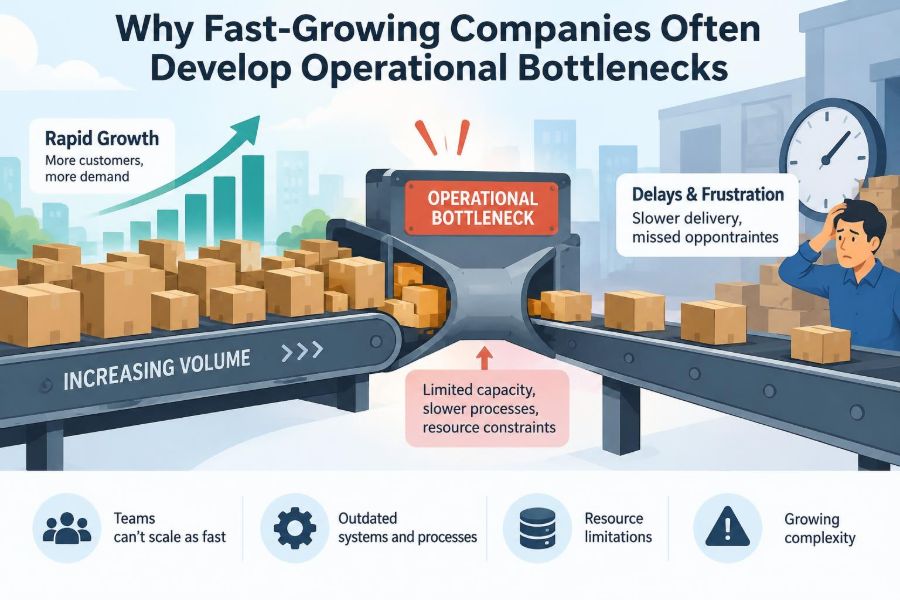

A company wins a large new client, demand rises sharply, and the team celebrates. Then delivery dates start slipping. Customer questions pile up, approvals take longer, and experienced employees spend their days solving problems that did not exist a few months ago.
Nothing may appear obviously broken. Revenue is growing, hiring is underway, and people are working hard. Yet the organization feels slower precisely when it is supposed to be gaining momentum.
This is the familiar paradox of rapid growth: success can strain the systems that created it. A process designed for a small, close-knit team often cannot carry the volume, complexity, and coordination required by a much larger business.
Operational bottlenecks matter because they turn growth into avoidable cost. They affect customer experience, employee wellbeing, cash flow, decision quality, and a company’s ability to seize the next opportunity.
🚦 What an Operational Bottleneck Really Is
An operational bottleneck is the point in a workflow where work accumulates because capacity is lower than demand. It may be a person, a machine, a software system, a policy, or a decision process.
Think of a restaurant with plenty of tables and servers but only one payment terminal. Adding more diners does not fix the constraint; it makes the queue longer. In a company, the constraint may be a finance approval, a technical review, or a manager who must sign off on every exception.
Bottlenecks are not simply busy areas. A team can be busy and still keep work moving. A bottleneck restricts the flow of work for everyone downstream.
📈 Growth Changes More Than Volume
Leaders often plan for more orders, users, or projects. What they underestimate is how growth changes the nature of work. A higher volume of customers creates more variations, support requests, billing situations, and service failures to resolve.
A small company might serve ten customers through informal conversations. At one hundred customers, memory and goodwill are no longer a dependable operating system. At one thousand, the business needs defined ownership, repeatable steps, and reliable information.
Growth therefore increases both load and coordination complexity. The second is often the more difficult problem.
🧩 Informal Processes Stop Scaling
Early-stage teams commonly succeed through flexibility. People sit near one another, ask quick questions, and make exceptions without forms or formal handoffs. This can be efficient when everyone understands the context.
As the organization expands, newcomers do not share the same history. Customers also expect consistency. An informal process that once took five minutes of conversation can become a chain of messages, duplicated tasks, and unclear accountability.
The answer is not bureaucracy for its own sake. It is to preserve useful flexibility while documenting the routine work that should not depend on who happens to be available.
👤 Key-Person Dependency Creates Hidden Queues
Many fast-growing companies rely heavily on a founder, senior salesperson, lead engineer, or operations specialist. That person may hold crucial knowledge or have authority over decisions that affect quality and risk.
At first, central involvement may protect the business. Over time, every request waits in the same inbox. The organization starts scheduling work around one individual’s availability, even when capable employees are ready to proceed.
A useful warning sign is the sentence, “We cannot move until Alex looks at it.” The issue is rarely Alex’s effort; it is the design of a system with only one route forward.
🧠 Decision-Making Becomes a Constraint
Growth produces more decisions: pricing exceptions, hiring choices, vendor contracts, product trade-offs, customer escalations, and budget requests. If all of them rise to the same leadership group, the queue grows faster than leaders can reasonably process it.
Slow decisions have a double cost. They delay the immediate task and encourage employees to wait rather than use judgment. That reduces responsiveness at exactly the time a company needs it.
Decision rights should be explicit: which choices teams can make independently, which require consultation, and which require formal approval. Clear boundaries make delegation safer than vague encouragement to “take ownership.”
🔄 Handoffs Multiply as Teams Specialize
Specialization brings expertise, but it also creates handoffs. Marketing passes a lead to sales, sales passes a deal to implementation, implementation passes questions to product, and finance issues an invoice.
Every handoff can lose information, create delay, or introduce conflicting priorities. A salesperson may promise a feature without understanding delivery limits; an implementation team may discover missing details after the customer expects work to begin.
The key question is not whether functions should specialize. It is whether the handoff has a clear owner, complete information, a shared definition of readiness, and a visible service expectation.
🗂️ Work Enters Faster Than It Leaves
When incoming work exceeds completed work, queues form. This applies to support tickets, purchase requests, engineering tasks, candidate interviews, and warehouse orders.
Teams sometimes respond by starting more work. That feels productive, but it can worsen the situation. More items in progress create more switching, follow-up, and confusion about priorities.
Flow improves when organizations finish important work before opening too much new work. Limiting work in progress makes a constraint visible and reduces the hidden cost of partially completed tasks.
🧯 Firefighting Consumes Improvement Capacity
Fast growth often creates urgent exceptions: a delayed order, a frustrated customer, a system outage, or a missed payroll detail. Solving emergencies is necessary, but repeated firefighting changes how a business operates.
Employees stop improving the underlying process because every day is spent rescuing the current one. The same causes then produce the next set of emergencies.
Leaders should distinguish between incident response and process improvement. After a recurring problem is contained, someone needs protected time to identify why it occurred and change the conditions that allow it to recur.
🏗️ Systems Built for Yesterday Reach Their Limits
Spreadsheets, shared inboxes, and basic software are not inherently poor tools. They can be sensible choices while a company is small and requirements are uncertain.
They become risky when multiple people edit the same data, reporting requires manual reconciliation, or crucial tasks depend on copying information between systems. Errors rise because the tool no longer matches the operating volume.
Technology should support a well-understood process, not conceal an undefined one. Automating a confusing workflow usually produces confusing results faster.
🔍 Data Fragmentation Slows Daily Work
A growing company may store customer details in one system, sales commitments in another, inventory data in a third, and operational notes in personal documents. No single record tells the whole story.
Employees then spend time searching, checking versions, and asking colleagues for confirmation. Managers receive reports that conflict because they were produced from different definitions or data sources.
Businesses do not need every system replaced at once. They do need agreement on critical data: what it means, who owns it, where the authoritative version lives, and how changes are controlled.
📦 Supply Chains Expose Capacity Gaps
For product-based companies, rapid demand can reveal weaknesses outside the organization as well as inside it. A supplier may have limited production capacity, a warehouse may lack space, or shipping arrangements may not suit higher order volumes.
Ordering more stock is not always the answer. Excess inventory ties up cash and can become obsolete, while shortages disappoint customers. Forecasts become less dependable when sales patterns are changing quickly.
Operations leaders need regular conversations with suppliers, realistic lead-time assumptions, and a clear view of which products or components would halt delivery if unavailable.
🧪 Quality Control Can Become the Slowest Step
Quality checks protect customers and the company’s reputation. But when every output requires a small group of experts to inspect it, quality assurance can become a severe constraint.
The better long-term approach is often to move some quality controls earlier in the process. Standard templates, automated checks, training, and clear acceptance criteria reduce the number of preventable defects reaching final review.
This does not mean lowering standards. It means designing quality into the workflow rather than relying only on final inspection.
📞 Customer Support Feels Growth First
Support teams often see operational strain before executives do. They hear when delivery promises were unclear, onboarding was incomplete, invoices were wrong, or the product is difficult to use.
Measuring only ticket volume can be misleading. A rise in contacts might reflect growth, but repeated questions about the same issue point to a process or product failure elsewhere.
Support insights should travel back to the teams that can remove root causes. Otherwise, customer service becomes a buffer that absorbs organizational problems without resolving them.
💼 Hiring Adds Capacity, but Not Instantly
“We will hire our way out of it” is a common response to overload. Additional people can be essential, but hiring creates its own work: recruiting, onboarding, training, supervision, and access setup.
New employees need a process clear enough to learn. If experienced staff must explain every step from memory while still handling urgent work, short-term capacity may actually decline.
Hiring works best when paired with role clarity, documented core workflows, and realistic expectations about the time needed for people to become productive.
🎓 Training Falls Behind Organizational Change
In fast-moving businesses, job responsibilities can change faster than training materials. A customer success employee may suddenly need to understand new pricing rules, while a warehouse worker must use a new inventory process.
When training is treated as optional, people invent local workarounds. Those workarounds may keep work moving temporarily, but they create inconsistent outcomes and make later standardization harder.
Short, practical training tied to a specific change is usually more useful than a large, infrequent course. Employees also need an accessible place to find the current procedure.
🧭 Priorities Collide Across Departments
Departments naturally optimize for different goals. Sales may pursue speed and customization, operations may pursue reliability, finance may seek control, and product teams may protect development focus.
These goals are not incompatible, but they create friction when leaders have not made trade-offs explicit. For example, promising every customer a unique configuration may increase sales in the short term while overwhelming implementation capacity.
Shared operating metrics help. They encourage teams to examine the whole customer journey rather than treating another department’s delay as someone else’s problem.
📊 Metrics Can Hide the Constraint
A dashboard with many numbers does not guarantee operational understanding. Teams sometimes track activity measures, such as calls made or tasks opened, while overlooking flow measures such as elapsed time, rework, backlog age, and first-time-right completion.
Good measurement asks where work waits, why it returns, and what customers experience. Averages alone can hide serious delays, so looking at older items in a queue is often revealing.
| Signal | What it may reveal | Useful follow-up |
|---|---|---|
| Growing backlog | Demand exceeds capacity at a step | Map where items wait |
| Frequent rework | Unclear inputs or weak quality upstream | Review error sources |
| Many escalations | Decision rights or ownership are unclear | Define authority levels |
| Long customer wait times | A constraint is affecting the experience | Trace the full journey |
🗺️ Process Mapping Reveals the Real Workflow
Leaders often describe how a process should work. Process mapping shows how it actually works. A simple map follows a piece of work from request to completion, including approvals, systems, handoffs, and waiting time.
Ask the people doing the work to build the map. They can identify workarounds, missing information, duplicated entry, and exceptions that formal documentation may miss.
The aim is not a perfect diagram. It is a shared view of where value is created and where time is lost.
⏱️ Separate Touch Time From Waiting Time
Touch time is the time someone actively works on an item. Elapsed time includes every hour or day it waits in an inbox, queue, or approval stage.
A contract might require only an hour of review but take two weeks to reach signature. If leaders focus only on effort, they may add reviewers when the actual problem is an approval schedule or incomplete submissions.
This distinction directs improvement effort toward delays rather than assumptions.
🎯 Find the Current Constraint Before Fixing It
A bottleneck is not permanent. If a company expands one constrained team, another step may become the limiting factor. This is why broad, untargeted improvement programs can waste effort.
Start with evidence: where backlog grows, where customers wait, where work is repeatedly expedited, and where employees must seek exceptions. Then test the cause before committing to a solution.
Improving a non-constraint may make that local team look efficient while producing little improvement for the organization as a whole.
🛠️ Standardize Repetitive Work, Not Every Decision
Standardization is most valuable where work is frequent, predictable, and prone to error. Checklists, templates, defined service levels, and clear intake forms can reduce variation without requiring heavy oversight.
Complex customer problems, novel product choices, and sensitive people decisions still require judgment. Over-standardizing these areas can make employees rigid and customers feel unheard.
The practical goal is to make routine work easy and reliable, leaving human attention for decisions where it adds genuine value.
🤖 Use Automation With Clear Guardrails
Automation can remove repetitive data entry, route standard requests, trigger reminders, and flag missing information. It is particularly useful when rules are stable and outcomes can be checked.
However, automated mistakes can spread quickly at higher volumes. Before automating, define the rule, identify exceptions, assign an owner, and decide how failures will be detected.
A sensible principle is: simplify first, automate second, monitor continuously.
🔐 Build Controls Without Creating Gridlock
As companies grow, they need stronger controls over spending, customer data, contracts, and access to systems. These controls reduce risk, but poorly designed controls can create unnecessary queues.
Risk-based design is more effective than treating every transaction alike. A low-value routine purchase might follow a fast path, while an unusual commitment receives fuller review.
Controls should be visible, understandable, and proportionate. When employees cannot understand a control, they may bypass it rather than follow it.
🗣️ Create Feedback Loops Across the Business
Operational learning depends on information moving both upward and sideways. Frontline employees need a safe way to report friction. Leaders need to explain priorities and decisions that affect daily work.
Useful feedback loops are specific: regular reviews of recurring defects, cross-functional meetings on stalled customer journeys, and post-project discussions focused on process rather than blame.
Psychological safety matters here. People are more likely to surface an early warning when they expect curiosity instead of punishment.
🧱 Design Capacity Before the Next Surge
Capacity planning is not a prediction that growth will follow an exact path. It is preparation for plausible demand levels and known constraints.
Teams can identify what would break first if volume increased, what skills would be scarce, which approvals would slow down, and what suppliers or systems need lead time. Scenario planning turns vague concern into actionable choices.
Some spare capacity may look inefficient on a narrow utilization report. In a volatile environment, it can be the buffer that prevents a small disruption from becoming a widespread failure.
⚖️ Balance Speed, Cost, Quality, and Resilience
Operations cannot maximize every outcome at once. The cheapest process may be less resilient; the fastest may require more capacity; the most customized service may be harder to deliver consistently.
Fast-growing companies get into trouble when these trade-offs are made accidentally, one customer request or urgent shortcut at a time. Leaders should state what the business will protect when pressures conflict.
That clarity helps employees make consistent decisions without escalating every difficult choice.
🚫 Common Responses That Make Bottlenecks Worse
Several reactions are understandable but counterproductive:
- Adding meetings without clarifying who can decide often slows work further.
- Hiring immediately without fixing a broken workflow can scale confusion.
- Demanding overtime may clear a backlog briefly while increasing fatigue and errors.
- Launching a new tool before defining the process can add another system to manage.
- Blaming one team ignores the cross-functional conditions that created the delay.
These actions can have a place in a short-term emergency. They should not substitute for diagnosing the operating system of the business.
🌱 A Practical Improvement Cycle
Operational improvement works best as a repeated management habit rather than a one-off rescue project. A simple cycle keeps attention on evidence and learning.
- Choose one customer-facing or high-cost workflow.
- Map the current path and measure waiting, rework, and backlog.
- Identify the likely constraint and its underlying causes.
- Make a focused change with a named owner.
- Review results, unintended effects, and the next constraint.
Small experiments are often safer than a large redesign. They produce practical learning while allowing the business to keep serving customers.
🏁 The Core Principle: Scale the System, Not Just the Output
Rapid growth exposes the difference between a company that works through individual effort and one that works through capable systems. Neither is inherently better at every stage, but the first model becomes fragile as volume and complexity rise.
The goal is not to eliminate every queue or make every process rigid. It is to identify the constraints that matter most, give people clear authority and information, and build workflows that can absorb change without relying on heroics.
When leaders treat operational bottlenecks as signals of an outgrown system rather than evidence of employee failure, growth becomes more manageable and more sustainable.
Fast-growing companies thrive when they deliberately scale their decisions, processes, information, and capacity alongside demand—not after strain has already become the normal way of working. 📈⚙️🌱