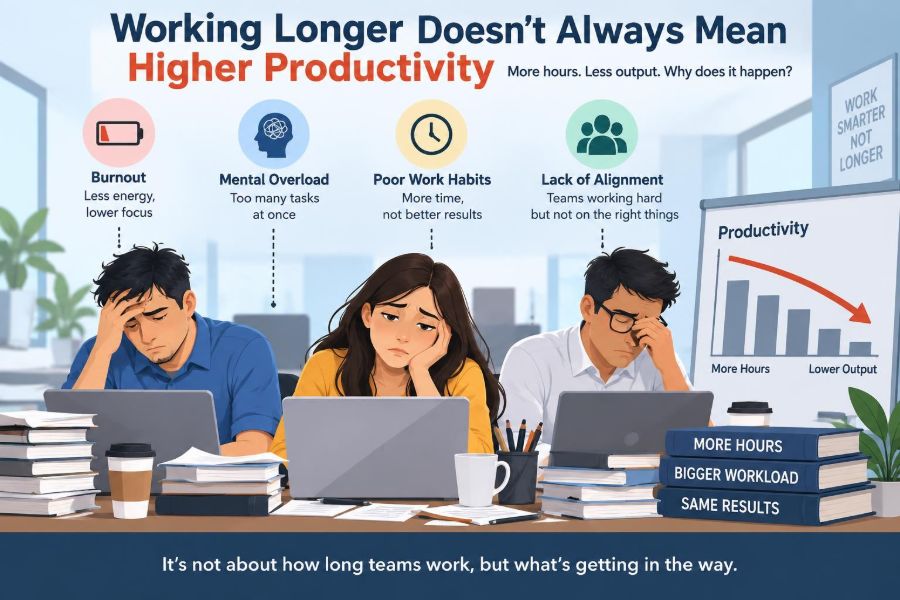

The team is online earlier, stays later, and answers messages well into the evening. Calendars are full, urgent tasks keep arriving, and everyone appears busy. Yet deadlines keep moving, mistakes need rework, and the most valuable work seems to progress painfully slowly.
This is one of the most frustrating management problems because extra effort feels like it should produce extra output. When it does not, leaders may ask people to push harder, while employees feel that their commitment is being mistaken for poor performance.
The problem is usually not laziness or a lack of care. Productivity can fall when a system consumes more human attention, energy, and coordination than it returns in useful results.
Understanding that distinction helps students, managers, and professionals diagnose the real constraint. Longer hours are an input; productive, sustainable progress is the outcome.
📏 Productivity Is Not the Same as Time Spent
Productivity means creating useful output with the resources available. In knowledge work, that output might be a sound decision, a completed client proposal, reliable code, a resolved customer issue, or a well-designed plan.
Hours matter, but they are only one input. If an additional hour produces errors, duplicate work, or activity that does not advance a priority, the team has worked more without becoming more productive.
Busyness measures motion; productivity measures meaningful progress. A team can look exceptionally busy while producing little that customers, colleagues, or organizational goals actually need.
🔁 Diminishing Returns Start Earlier Than Expected
Diminishing returns occur when each additional unit of effort produces less benefit than the one before it. A focused extra hour near a deadline can be useful. Repeated late nights, however, often reduce the quality of every following hour.
Think of a battery that never fully recharges. It may still power a device, but performance becomes less reliable. People similarly carry fatigue from one day into the next, particularly when long hours become normal rather than occasional.
The managerial question is not simply, “Can we get more hours?” It is, “What will those hours yield after fatigue, interruptions, and rework are considered?”
🧠 Cognitive Fatigue Weakens Complex Work
Many valuable tasks depend on attention, judgment, memory, and creativity. These mental resources are finite. As fatigue rises, people can still complete routine actions, but they may struggle to spot a weak assumption, compare alternatives, or explain a difficult issue clearly.
That is why long working hours can be especially damaging in roles involving analysis, design, negotiation, planning, or problem-solving. The output may look complete at first, yet contain flaws that surface later.
Fatigue also makes people more likely to choose the familiar shortcut. That may be acceptable for a low-risk task, but it is costly when the work requires careful thinking.
😴 Sleep Loss Creates a Hidden Quality Cost
Late work often affects more than the same evening. Reduced sleep can lower concentration and emotional control the next day, making ordinary work feel harder and conflicts more likely.
A team may appear to recover lost time by working late, then lose it again through slower review cycles, missed details, and lower-quality decisions. Because these costs emerge later, they are easy to overlook.
Managers should distinguish a rare, planned surge from a pattern that repeatedly disrupts rest. The first can sometimes be managed; the second gradually turns capacity into a quality problem.
🔀 Context Switching Fragments Attention
Context switching is the mental shift between different tasks, tools, or subjects. Moving from a budget question to a customer complaint, then to a spreadsheet, then to a meeting does not happen instantly.
Each switch requires a person to reconstruct what mattered, where the work stopped, and what decision was pending. The lost minutes may seem small, but repeated switching can consume large parts of a day.
A longer day filled with fragmented attention may produce less than a shorter day with protected focus. This is especially true when tasks require a person to hold several details in mind at once.
🔔 Constant Notifications Turn Work Into Reaction
Messages, alerts, emails, and status requests create a culture of immediate response. Some communication is necessary, particularly in customer support or operational roles. The issue arises when every alert is treated as equally urgent.
People then organize their day around the newest interruption instead of the most important objective. They may complete dozens of small actions while postponing the work that would remove the underlying problem.
Clear response-time expectations can help. Not every message requires an instant reply, and teams need agreed channels for issues that genuinely cannot wait.
🗓️ Meeting Overload Removes Time to Execute
Meetings can align people, solve uncertainty, and speed decisions. They become unproductive when they replace preparation, duplicate information that could be written down, or include people who cannot contribute to the decision.
A calendar packed with meetings often forces employees to perform concentrated work at the edges of the day. That is one reason teams begin earlier or work later without delivering more.
Before scheduling, ask whether the purpose is to decide, solve, coordinate, or simply share information. A written update is often better for the last purpose.
🎯 Too Many Priorities Mean No Real Priority
When leaders label everything urgent, individuals must decide what to sacrifice. Different people make different choices, and the team’s effort spreads across competing demands.
Prioritization is not making a long list of important work. It is choosing what receives protected attention now and what will wait, be simplified, or be stopped.
A useful test is simple: if a new urgent request enters, what existing commitment moves? If the answer is “nothing,” the organization may be planning beyond its real capacity.
🧱 Work in Progress Creates Queueing Delays
Work in progress, often shortened to WIP, is work that has started but is not finished. Too much WIP creates queues: drafts waiting for approval, tickets waiting for specialists, or projects waiting for a decision.
Starting additional work can feel productive because activity is visible. Completing fewer items, however, means value reaches the customer or next team more slowly.
Finishing important work before starting more work is often a productivity strategy, not a sign of limited ambition. Teams benefit from visible limits on how many major tasks can be active at once.
🚧 Bottlenecks Leave Some People Waiting
A bottleneck is the step that limits the rate of the whole system. It may be a manager who must approve every decision, a scarce technical specialist, a legal review, or a tool that processes requests slowly.
When a bottleneck is overloaded, asking upstream teams to work faster usually creates a bigger queue. People produce more material that cannot move forward, then spend time chasing updates.
Find the constraint by tracing where work waits longest. Improve that point first through clearer authority, better templates, cross-training, automation, or a reduced demand load.
🧩 Unclear Roles Produce Duplicate Effort
Teams lose time when people do not know who owns a decision, who supplies input, and who must be kept informed. Two people may research the same issue, while another assumes someone else will respond.
Ambiguity also encourages defensive communication: copied emails, repeated check-ins, and meetings held mainly to confirm responsibility. These behaviors are understandable, but they add coordination work.
For important projects, define ownership in plain language. “Sam approves the final pricing decision; the sales and finance teams provide input by Thursday” is more useful than a vague shared-responsibility statement.
🔄 Rework Quietly Consumes Capacity
Rework is effort spent correcting, revising, or rebuilding work that should have been right enough the first time. It is not always bad; iteration is essential in creative and uncertain work.
The costly form of rework comes from avoidable confusion: unclear requirements, rushed handoffs, missing information, or feedback delivered after a major decision is already embedded.
Track where revisions originate. If the same problems recur, the solution is rarely “work faster.” It is more likely a better brief, an earlier review, or a shared definition of acceptable quality.
📋 Vague Requirements Invite Preventable Failure
A request such as “make this more strategic” or “improve the customer experience” leaves too much open to interpretation. Employees may work hard on a version that solves a different problem from the one the requester intended.
Useful requirements describe the outcome, audience, constraints, decision owner, and deadline. They also identify what is not included, which protects teams from expanding work indefinitely.
Clarity should not become needless bureaucracy. A short, well-structured brief can prevent days of correction without slowing a small task.
📈 Scope Creep Expands Work Without Expanding Capacity
Scope creep occurs when a project gradually collects extra features, stakeholders, expectations, or approval steps without a deliberate change to time, budget, or staffing.
Each addition may sound reasonable on its own. Together, they turn a manageable assignment into an overloaded one. Teams compensate with longer hours, but the underlying commitment has changed.
When scope changes, make the trade-off visible: add time, add resources, remove another requirement, or accept a different quality level. Hiding the trade-off shifts the cost onto employees.
🛠️ Tool Friction Adds Thousands of Small Delays
Poorly configured software, slow systems, duplicate data entry, and hard-to-find files create friction. No single delay may seem serious, yet frequent small obstacles break concentration and encourage workarounds.
For example, a service team may copy the same customer information across several systems. The direct time loss matters, but so does the increased chance of inconsistent records.
Ask employees which recurring tasks feel unnecessarily awkward. Their answers often reveal practical improvements that senior leaders cannot see from dashboards alone.
🧾 Administrative Load Can Crowd Out Core Work
Documentation, compliance checks, reporting, and internal requests can be necessary. The problem is not administration itself; it is administration that is duplicated, poorly designed, or disconnected from a real decision.
When professionals spend increasing time proving that work happened, they have less time to do the work. This can create a cycle in which lower output prompts even more monitoring.
Review recurring reports and approvals. For each one, identify who uses it, what decision it supports, and what would happen if it stopped. If no clear answer exists, simplify or retire it.
🧯 Firefighting Rewards Urgency Over Prevention
In a firefighting culture, urgent failures dominate attention. Employees who solve emergencies may be praised, while people who quietly prevent them receive less visibility.
This creates a damaging incentive. Teams postpone maintenance, training, documentation, and process improvement because those tasks are not immediately urgent. Predictable problems then return as emergencies.
Reserve capacity for preventive work. A modest investment in fixing a recurring fault can produce more value than repeatedly mobilizing a tired team to handle its consequences.
📣 Pressure Can Distort Reporting
When hours become a signal of loyalty, people may feel unsafe admitting that a deadline is unrealistic or that workload has exceeded capacity. They may report progress optimistically until a problem can no longer be hidden.
This does not mean employees are dishonest by nature. It means the reporting environment has made bad news costly. Managers need early warnings to make sensible trade-offs.
Ask for risks alongside status updates, and respond constructively when someone raises a concern. A forecast is not a promise; it is information for planning.
🤝 Coordination Costs Rise With Complexity
As projects involve more people, locations, systems, and dependencies, coordination becomes work in its own right. More communication can improve alignment, but beyond a point it creates overhead and delay.
A small team can often resolve questions informally. A larger cross-functional project needs decision rules, shared documents, and predictable checkpoints so that every issue does not require a new meeting.
The goal is not minimal communication. It is purposeful communication that reduces uncertainty rather than spreading it.
🌍 Time Zones and Remote Work Need Deliberate Design
Distributed teams can gain access to broader talent and flexible schedules. They can also drift into very long working days when employees attend meetings outside normal hours and still try to complete a full individual workload.
Asynchronous work—using clear written updates that people can review later—reduces unnecessary overlap. It works best when documents record decisions, owners, and next steps rather than merely storing conversation.
Fairness matters too. If inconvenient meeting times always fall on the same region or group, fatigue and disengagement will accumulate unevenly.
🏃 Presenteeism Mistakes Visibility for Contribution
Presenteeism is being present or visibly active while functioning below one’s effective capacity. It can occur in an office, on a video call, or in a messaging app where constant availability becomes a performance signal.
Visible effort is easier to observe than thoughtful work. That can cause leaders to reward late replies and full calendars rather than outcomes, quality, collaboration, and sound judgment.
Use measures that fit the work. For a project team, completed milestones and defect levels may matter more than hours online. For service work, resolution quality and customer outcomes may matter alongside response speed.
📊 Metrics Can Drive the Wrong Behavior
Measures influence behavior because people naturally focus on what is monitored. A target for number of calls, tickets closed, or lines processed can help manage volume, but it can also encourage fast, shallow completion.
Good measurement combines quantity with quality and context. It also recognizes that not every result is under one person’s control; delays may come from policy, demand spikes, or another department.
Review whether a metric helps people make better decisions or merely creates a number to defend. If it encourages gaming, fear, or low-value activity, redesign it.
⚖️ Capacity Planning Must Include Recovery Time
Capacity is not simply the total number of contracted hours. Real capacity is lower because teams need time for planning, coordination, learning, breaks, unexpected issues, and recovery from demanding work.
Scheduling every hour as productive delivery leaves no room for normal variation. Any surprise then requires overtime, and overtime becomes routine instead of exceptional.
A practical plan includes a buffer. The right amount varies by work type, but the principle is consistent: systems that operate permanently at maximum load are fragile.
🌱 Skills Gaps Make Tasks Take Longer
Longer completion time can reflect a capability gap, not low effort. A new employee may need guidance; an experienced employee may be facing unfamiliar software, regulations, or customers.
Under pressure, organizations sometimes cut training because it appears to take people away from production. That can preserve short-term output while extending the underlying problem.
Targeted training, job aids, peer review, and cross-training can improve both speed and resilience. They also reduce dependence on a single overworked expert.
🧭 Autonomy Speeds Decisions Within Clear Boundaries
Employees cannot move quickly when every minor judgment requires escalation. Excessive approval layers create queues and teach people to wait rather than think.
Autonomy does not mean abandoning controls. It means defining decision boundaries: what someone can decide independently, what requires consultation, and what must be escalated because the risk is higher.
When boundaries are clear, people can act confidently and managers can focus their attention on decisions that genuinely need senior judgment.
🧪 Diagnose the System Before Demanding More Effort
Before responding to falling productivity with overtime, investigate the flow of work. Look at where tasks wait, where they return for correction, which meetings produce decisions, and what interrupts focused work.
A short diagnostic can include:
- mapping a typical task from request to completion;
- asking employees where time is lost or duplicated;
- reviewing active work against available capacity;
- identifying recurring blockers and their owners; and
- separating urgent demand from work that can be deferred.
The purpose is not to blame individuals. It is to identify conditions that make good performance harder than it should be.
✅ Practical Changes That Restore Productive Capacity
Improvement usually comes from a small set of disciplined changes, tested over time. Begin with the most damaging bottleneck rather than launching a broad efficiency campaign that creates more work.
| Common symptom | Likely system issue | Useful response |
|---|---|---|
| Late work and missed deadlines | Overcommitment or hidden dependencies | Reduce active priorities and expose trade-offs |
| Frequent revisions | Unclear requirements or late feedback | Improve briefs and review earlier |
| Full calendars, little output | Meeting overload and fragmented focus | Protect focus blocks and redesign meetings |
| Work waiting for approval | Decision bottleneck | Delegate within defined risk limits |
Measure whether the change improves completion, quality, and workload sustainability. If it merely shifts pressure elsewhere, the problem has not been solved.
🗣️ Managers Set the Norm Through Their Own Behavior
Employees notice what leaders reward, tolerate, and model. A manager who sends non-urgent messages late at night may unintentionally communicate that immediate responses are expected.
Leaders can set healthier, more productive norms by clarifying priorities, protecting recovery time after genuine surges, declining low-value meetings, and discussing workload before a crisis emerges.
They should also recognize that sustainable performance is a management responsibility. Individual resilience helps, but it cannot compensate indefinitely for a poorly designed workload.
🔍 The Core Principle: Improve the Flow, Not Just the Hours
Longer working hours often signal that the flow of work is blocked, fragmented, overloaded, or poorly defined. They can temporarily increase output during an unusual peak, but they are a weak long-term substitute for clear priorities and sound operations.
The most productive teams do not eliminate effort. They make effort count by reducing avoidable friction, limiting work in progress, improving decisions, and giving people enough capacity to think well.
When productivity falls despite longer hours, treat it as a system-design question before treating it as an effort problem. That shift leads to better questions, better interventions, and work that people can sustain.
Teams become more productive not by extending every day, but by protecting attention, removing bottlenecks, and finishing the work that matters most. 📊🧭🤝