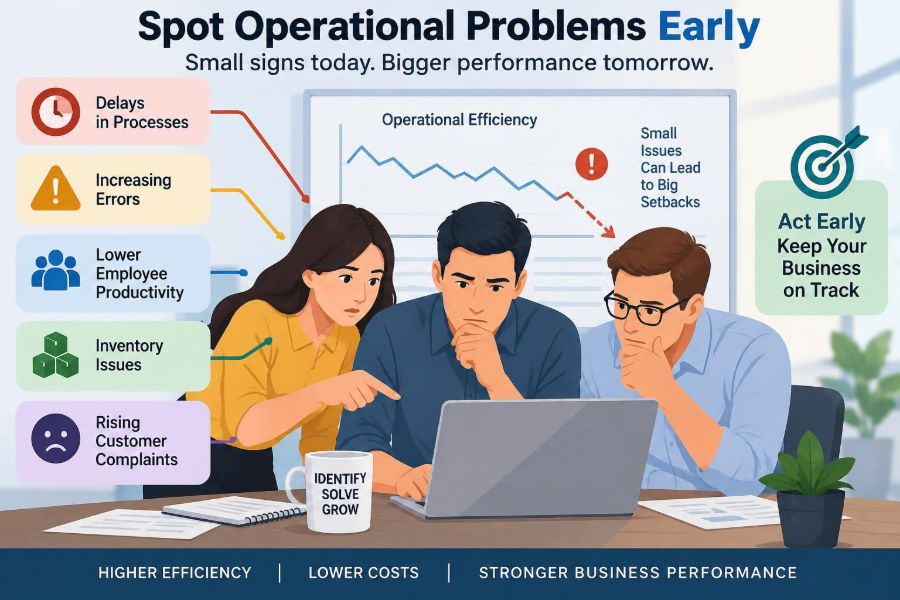

A customer asks for an update on an order, and nobody can say where it is. A team meeting starts with people debating which spreadsheet is current. A manager notices that several “small exceptions” have become part of the normal workday.
None of these moments necessarily looks like a major business problem. Sales may still be stable, customers may still be satisfied, and the team may be working hard. Yet these are often the early signals that an operation is carrying more strain than its results currently reveal.
Operational problems rarely arrive with one dramatic warning. More often, they build quietly through missed handoffs, unclear ownership, inconsistent information, overloaded people, and workarounds that seem harmless in isolation.
Learning to spot those signals gives managers and employees time to correct processes before delays, rising costs, poor quality, employee turnover, or customer losses turn a manageable issue into a performance problem.
🔎 What Operational Problems Really Are
Operations are the recurring activities that turn resources into a product, service, or customer outcome. They include ordering supplies, scheduling staff, processing requests, maintaining equipment, handling customer cases, approving work, and recording information.
An operational problem occurs when this system becomes unreliable, inefficient, unclear, or unable to handle normal demand. It is not simply one employee making a mistake; it is often a pattern in the way work is designed, coordinated, measured, or supported.
⏳ Why Early Detection Matters
Problems are cheaper and less disruptive to address when they are still small. A delayed approval might initially affect one task, but repeated delays can create queues, missed deadlines, frustrated customers, and rushed downstream work.
Early detection also protects decision quality. Once a business is dealing with a visible crisis, leaders may be forced into quick fixes. Before that point, they can investigate causes, test changes, and involve the people who understand the work.
📉 Results Can Look Healthy While Operations Weaken
Strong revenue or acceptable monthly performance does not prove that operations are healthy. A business can temporarily absorb inefficiency through overtime, extra inventory, experienced employees, discounts, or managers personally resolving exceptions.
These buffers hide the underlying issue. For example, a service team may meet response targets only because staff are regularly working late. The target is being met, but capacity is already under pressure.
🚦 Leading Indicators Versus Lagging Indicators
Lagging indicators show what has already happened, such as customer churn, missed revenue, defects, or late deliveries. They remain useful, but they often reveal a problem after damage has occurred.
Leading indicators point to conditions that may produce those outcomes. Examples include a growing backlog, more rework, rising approval times, frequent schedule changes, and a higher volume of customer follow-ups.
| Type of signal | Example | What it may reveal |
|---|---|---|
| Leading indicator | More tasks waiting for approval | A decision bottleneck or unclear authority |
| Leading indicator | Staff creating manual trackers | Missing information or weak system support |
| Lagging indicator | Late customer delivery | The backlog has already affected service |
| Lagging indicator | Higher refund volume | Quality or expectation failures reached customers |
📚 Backlogs That Stop Being Temporary
A backlog is work waiting to be completed. Some backlog is normal, especially when demand varies by day or season. The warning sign is not the mere existence of a queue but a queue that grows, becomes older, or requires repeated intervention.
Look at the age of the work, not only the total volume. If simple cases move quickly while complex cases remain open for long periods, the process may be avoiding difficult work rather than resolving it.
🔁 Rework Becoming Part of the Process
Rework means doing work again because it was incomplete, inaccurate, misunderstood, or rejected. It may include correcting invoices, resubmitting forms, rebuilding reports, retesting a product, or asking customers for information already requested.
Teams often normalize rework because each correction feels minor. But it consumes capacity twice: once to do the original work and again to repair it. Persistent rework usually points to unclear requirements, poor inputs, inadequate training, or weak quality checks.
🧩 Workarounds Multiplying Across Teams
A workaround is a temporary method used to get around a process or system limitation. It can be sensible during a short disruption. It becomes a warning sign when people rely on personal spreadsheets, private message threads, duplicate data entry, or verbal agreements to keep work moving.
Workarounds are valuable evidence. Rather than blaming staff for improvising, ask what obstacle they are trying to overcome. Their solution may reveal an outdated workflow, a missing system feature, or a handoff that was never properly defined.
📬 More Customer Follow-Ups and Status Requests
When customers increasingly ask, “Has this been received?” or “When will this be done?”, they may be experiencing uncertainty before they make a formal complaint. Their follow-up activity can be an early service-quality measure.
Track the reason for contacts where practical. A rise in status questions may indicate poor communication, but it can also expose deeper issues such as unreliable delivery dates, lost requests, or incomplete case records.
🕰️ Cycle Times Slowly Stretching
Cycle time is the time taken for work to move from a defined start to completion. A longer cycle time can result from more demand, but it can also reflect waiting, handoff delays, missing information, or repeated corrections.
Compare similar types of work rather than relying only on one average. An average can conceal variation: half the cases may be fast while the other half are delayed by an obstacle that deserves attention.
🧑🤝🧑 Key People Becoming Single Points of Failure
A single point of failure exists when an important activity depends on one person, one supplier, one machine, or one system. If only one employee knows how to process a payroll exception or respond to a technical issue, ordinary absence can become operational disruption.
Specialist knowledge is not the problem. The risk arises when that knowledge is undocumented, inaccessible, or not shared through cross-training and clear procedures.
🔥 Overtime and Heroics as Normal Capacity
Occasional extra effort is part of many workplaces. The concern begins when overtime, skipped breaks, weekend work, or a manager’s constant intervention becomes the routine method for meeting ordinary demand.
Heroic effort can delay a visible failure, but it does not increase sustainable capacity. It also raises the risk of mistakes, burnout, absenteeism, and the loss of experienced employees who have been holding the process together.
🔄 Frequent Priority Changes
Priorities should change when customer needs, safety concerns, or business conditions genuinely change. However, constant reprioritization creates hidden costs because people stop work, seek clarification, redo plans, and lose focus.
If urgent work repeatedly displaces planned work, examine why. The cause may be unrealistic planning, inadequate triage rules, unreliable forecasting, or leaders treating every request as equally urgent.
🧭 Unclear Ownership at Handoffs
Many operational failures occur between teams rather than within them. A sales team may believe an order is complete, while operations considers key details missing. Finance may wait for approval that another department assumes has already been given.
For every significant handoff, define who provides the input, what “complete” means, who accepts it, and what happens when it is incomplete. This prevents tasks from sitting in an invisible gap between roles.
🗂️ Conflicting Data and Competing Versions
When teams debate which number, document, or system is correct, decisions slow down and trust declines. Conflicting data can arise from duplicate records, delayed updates, inconsistent definitions, or informal files that sit outside the official workflow.
The solution is not always a new software platform. First establish a clear source of truth for each key item of information and agree on definitions. For instance, “order complete” should mean the same thing in sales, operations, and finance.
🧾 Exception Rates Quietly Rising
An exception is work that cannot follow the standard process. Examples include special pricing, unusual delivery instructions, manual payment adjustments, or requests requiring senior approval.
Some exceptions are unavoidable and commercially worthwhile. A rising exception rate, however, can signal that the standard process no longer matches real customer needs or that upstream information is incomplete. Categorizing exceptions helps separate valuable flexibility from preventable disorder.
⚙️ Equipment, Systems, and Tools Becoming Unreliable
Operational strain is not only about people. Repeated system outages, slow software, recurring equipment alarms, expiring licenses, or delayed maintenance can all reduce capacity before a complete breakdown occurs.
Small interruptions are easy to dismiss because employees often compensate. Record their frequency and duration. A pattern of short disruptions may be more damaging than one obvious outage because it fragments attention and creates unpredictable delays.
📦 Inventory Mismatches and Stock Surprises
Inventory records are operational promises: they tell purchasing, production, sales, and customers what is available. When recorded stock differs from physical stock, the business may overpromise, rush shipments, stop production, or hold more inventory than necessary.
Investigate mismatches by type. They may result from receiving errors, damage not recorded, poor location control, delayed transactions, or inaccurate product data. Simply adjusting the number fixes the record, not necessarily the cause.
🧠 Decisions Waiting for Approval
Approval controls can protect quality, spending, and compliance. Yet excessive or poorly designed approvals create bottlenecks, particularly when decisions are low-risk, repetitive, or routed to leaders who lack time or context.
Review decisions that wait the longest. Consider whether authority can be delegated within clear limits, whether requests arrive with enough information, and whether several approvals duplicate the same check.
📈 Demand Forecasts Missing in One Direction
No forecast is exact. The important issue is whether forecast errors are random or consistently biased. If demand repeatedly exceeds the plan, staffing, inventory, and service capacity will remain under pressure. If forecasts are repeatedly too high, the business may carry unnecessary cost.
Break the forecast down by relevant categories, such as product, customer segment, location, or season. A total forecast can appear reasonable while a particular area experiences a severe shortage.
💬 Rising Friction Between Departments
Comments such as “they always send incomplete requests” or “they never respond” may sound like interpersonal conflict, but they often point to process design problems. Friction grows when one team is measured on speed while another is measured on accuracy, cost, or risk reduction.
Bring the teams together around the shared workflow and customer outcome. Mapping what each group receives, does, and passes on can turn blame into a practical discussion about requirements and trade-offs.
🧑💼 Managers Spending More Time Chasing
A manager who increasingly chases updates, resolves escalations, manually assigns tasks, or checks routine details may be compensating for a weak operating system. This is especially risky because it leaves less time for coaching, planning, improvement, and strategic decisions.
Track the recurring reasons for escalation. A useful question is: if the manager were unavailable for a week, which routine decisions would stop? The answer identifies where clearer rules, information, or ownership are needed.
🗣️ Frontline Concerns Being Repeated
Employees closest to the work often see early failures first. They notice confusing forms, common customer misunderstandings, faulty equipment, impractical targets, and the steps people routinely skip to save time.
Repeated concerns deserve structured attention, even if they are expressed informally. A simple log of issue, location, frequency, impact, and suggested improvement can distinguish a one-off complaint from a recurring operational signal.
📏 Metrics That Reward the Wrong Behaviour
Measures shape behaviour. If a call centre is judged only on short call duration, employees may end calls quickly rather than solve issues fully. If a warehouse is judged only on units picked, accuracy may receive too little attention.
Use a balanced set of measures that reflects speed, quality, cost, reliability, and customer impact. Metrics should support judgment, not replace it; a good number can still be misleading when viewed without context.
🪜 Process Steps Nobody Can Explain
When people say “we have always done it this way” but cannot explain why a step exists, the process may contain legacy controls, duplicate checks, or tasks designed for conditions that no longer apply.
Do not remove steps blindly. Some apparently burdensome activities protect safety, legal obligations, financial control, or customer commitments. Instead, identify the purpose, risk, and owner of each step before deciding whether to simplify, automate, or retain it.
🧪 Small Tests Before Major Changes
Once a warning signal is identified, avoid assuming the first solution is correct. Test a limited change where possible: revise one intake form, trial a new triage rule, cross-train one team, or remove one redundant approval for a defined period.
Set a practical measure of success in advance, such as fewer incomplete requests, shorter waiting time, or fewer corrections. A pilot reduces the risk of rolling out a change that merely shifts the problem elsewhere.
🛠️ A Practical Operational Health Review
A regular review does not need to be complicated. It should combine quantitative signals with observations from people doing the work, because neither source is complete on its own.
- Review backlogs, cycle times, rework, exceptions, and unresolved customer contacts.
- Ask where staff rely on workarounds or manual checking.
- Identify tasks dependent on one person, supplier, tool, or approval.
- Examine recent disruptions for recurring causes rather than isolated symptoms.
- Choose one or two high-impact issues, assign owners, and review progress.
Regularity matters more than elaborate reporting. A short, honest review can surface patterns that a once-a-year process audit misses.
⚠️ Common Mistakes When Diagnosing Problems
A common mistake is treating the most visible symptom as the cause. Hiring more people may help a genuinely understaffed team, but it will not solve an intake process that creates incomplete work or a system that repeatedly fails.
Other mistakes include measuring only averages, blaming individuals for system constraints, changing too many things at once, and declaring success before the process performs reliably over time. Improvement requires curiosity as well as accountability.
🌱 Building a Culture That Surfaces Signals Early
People must feel safe to report delays, mistakes, near misses, and confusing processes. This does not mean lowering standards or avoiding accountability. It means separating the question “what happened in the system?” from the question “what performance expectation was not met?”
Leaders can encourage early reporting by responding constructively, sharing what was learned, and closing the loop on practical suggestions. When employees see that raising an issue leads to thoughtful action, they are more likely to raise the next one early.
🎯 The Core Principle: Notice Strain Before Failure
Operational health is not the absence of visible crises. It is the ability of a business to deliver consistent results without relying on hidden effort, fragile knowledge, constant escalation, or accumulating shortcuts.
The most useful early signs are often ordinary: an older queue, another manual spreadsheet, a repeated question from customers, a delayed approval, or an employee who is quietly doing work no one else understands. Seen individually, each may be manageable. Seen as a pattern, they explain where performance risk is forming.
Respond by tracing the signal back through the workflow, involving the people closest to it, and making targeted improvements that can be tested and sustained. That approach turns operational management from emergency response into ongoing learning.
Businesses protect performance best when they treat small operational signals as useful information, not as noise to be tolerated until something breaks. 📊🛠️🌱