
A team launches a promising pilot. A handful of customers receive a new service, employees follow a simple shared spreadsheet, and the results look encouraging. The work feels manageable because the people involved are experienced, motivated, and close to the problem.
Then the business tries to expand. Ten customers become hundreds. A founder who approved every exception becomes a bottleneck. The spreadsheet develops conflicting versions, service quality varies by location, and a process that once felt flexible begins to feel fragile.
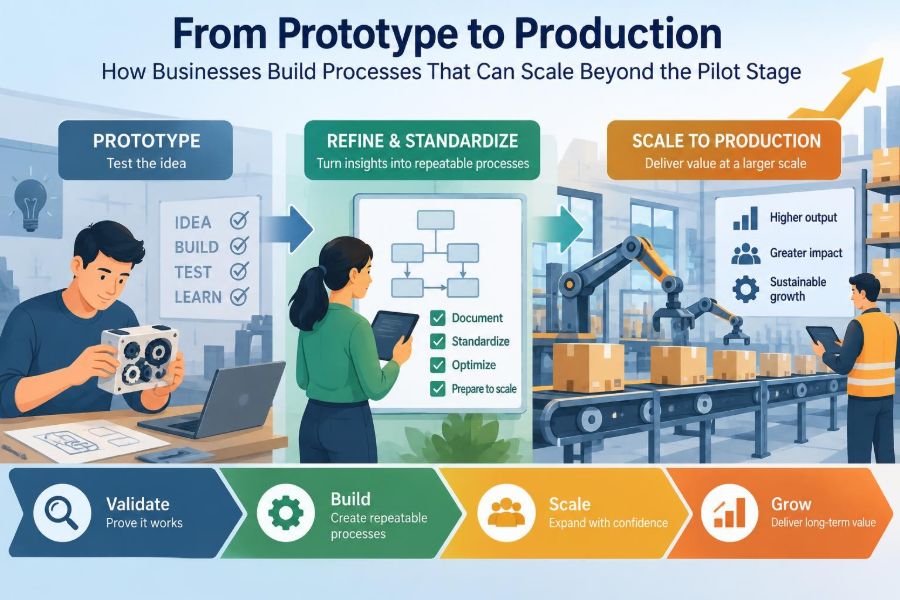
This is a familiar transition: moving from a prototype that proves an idea can work to an operating model that can deliver it repeatedly. The challenge is not merely doing more of the same work. It is designing a system that can perform well when volume, variation, people, and pressure all increase.
Scalable processes turn early promise into dependable value. They help a business grow without relying on heroics, guesswork, or the constant presence of the people who invented the pilot.
🚀 The Pilot-to-Production Gap
A pilot is a limited trial used to test whether an idea is desirable, feasible, and worth pursuing. It often operates under unusually favourable conditions: selected customers, extra management attention, a small team, and permission to improvise.
Production means the process is part of normal operations. It must work consistently for a broader population, through ordinary staff, with defined controls, reliable information, and an acceptable cost structure.
The gap appears because a pilot can succeed despite weak process design. Production exposes every hidden dependency and unresolved decision.
🔍 Prototype Success Is Not Process Readiness
A prototype may show that customers like an offering. That does not prove the business can source materials, train staff, handle complaints, protect data, meet delivery promises, and maintain margins at larger volumes.
Consider a hypothetical meal-delivery pilot. A small team may personally call customers when an order is delayed. At scale, that approach is neither timely nor affordable. The business needs clear delay rules, customer notifications, service recovery options, and ownership for each step.
The right question changes from “Can we make this happen?” to “Can our organization make this happen repeatedly under normal conditions?”
🎯 Define What “Scale” Actually Means
Scale does not always mean serving vastly more customers. It can mean operating across more locations, supporting more product variations, handling seasonal demand, or delivering the same experience with less senior oversight.
Before redesigning a process, define the intended future state. Useful dimensions include:
- Expected transaction, order, or case volume
- Geographic reach and operating hours
- Customer segments and service levels
- Number of employees, partners, or systems involved
- Acceptable cost, quality, speed, and risk levels
A process built for predictable demand may fail during sharp peaks, even if its average capacity appears adequate.
🧭 Start With the Customer Outcome
Scalable operations begin with a clear customer promise. Is the essential outcome fast delivery, accurate advice, a smooth onboarding experience, reliable repairs, or a tailored solution?
Without this anchor, teams often optimize internal convenience while weakening the experience customers actually value. For example, reducing support handling time may improve an internal metric but create repeat contacts if customers leave without a solution.
Write the promise in observable terms. “Customers can complete a standard application without needing staff help” gives process designers something concrete to build toward.
🗺️ Map the Work as It Really Happens
Many documented processes describe how work is supposed to happen, not how it happens on a busy Tuesday. A useful current-state map follows a real request from start to finish and records handoffs, decisions, waiting time, systems, rework, and exceptions.
Talk to frontline employees as well as managers. The unofficial workaround that keeps a pilot moving may be exactly the risk that will break production.
A basic map does not need specialist software. It needs honesty about where information is lost, approvals stall, and people compensate for unclear design.
🧩 Identify the Minimum Repeatable Unit
The minimum repeatable unit is the smallest complete version of the process that reliably creates the intended outcome. In a recruitment process, it might be one candidate moving from application to a documented hiring decision. In manufacturing, it may be one finished item passing its required checks.
Defining this unit prevents vague scaling plans. Teams can then ask what resources, time, data, decisions, and quality checks are required per unit.
It also reveals whether the work can be standardized, must be customized, or should be split into distinct service tiers.
📏 Separate Standard Work From Necessary Flexibility
Standard work is the best currently known method for completing a recurring task. It does not mean employees are treated like machines. It means routine work has a dependable starting point, reducing avoidable variation.
Not every customer or case should follow an identical route. The goal is to standardize predictable tasks and deliberately define where judgment is needed.
| Type of work | Useful design approach | Example |
|---|---|---|
| Routine and low-risk | Highly standardized workflow | Confirming an appointment |
| Variable but common | Rules, options, and escalation paths | Resolving a late delivery |
| Complex or high-risk | Expert review with documented judgment | Approving an unusual contract term |
This distinction protects both efficiency and sound decision-making.
⚙️ Reduce Complexity Before Automating
Automation can make a good process faster, but it can also make a confusing process fail faster. Automating duplicated data entry, unclear approval chains, or inconsistent rules usually preserves the underlying waste.
First remove unnecessary steps, combine duplicate checks, simplify forms, and clarify decisions. Then assess whether technology can reliably execute a stable portion of the work.
A practical test is simple: if employees cannot explain the rule clearly, a software team will struggle to encode it accurately.
🔗 Design Clear Handoffs
Work often slows down between teams rather than within them. Sales may collect incomplete information, operations may interpret it differently, and finance may discover a missing approval after the service has already begun.
Every handoff should specify what is being transferred, in what format, by when, and who is accountable for accepting it. A handoff is complete only when the receiving party has what they need to begin.
Shared definitions matter. If “approved order” means different things to sales and fulfillment, delays are built into the process.
👤 Assign Ownership Without Creating Silos
Each critical activity needs a named role accountable for its performance. Ownership prevents tasks from disappearing into a vague “someone should handle this” category.
However, ownership should not mean one department protects its own metric at the expense of the wider process. A call center that transfers difficult issues quickly may meet a local target while increasing the customer’s total effort.
Use end-to-end accountability for the overall experience, supported by clear responsibility for individual stages.
🛣️ Build Decision Rules and Escalation Paths
Pilots often depend on a knowledgeable leader making rapid case-by-case decisions. That works briefly, but it does not scale. Repeated decisions should become documented rules, thresholds, or approved options.
For example, a customer-service team might be authorized to issue a defined remedy for minor failures, while larger claims require review. The point is not to eliminate judgment; it is to place judgment where it adds the most value.
Escalation paths should state when to escalate, to whom, what information to include, and the expected response time.
🧱 Build Capacity Around Constraints
Capacity is more than headcount. It includes equipment, physical space, supplier availability, system performance, management attention, and the availability of people with scarce skills.
The limiting resource is often called a bottleneck. Increasing capacity elsewhere may have little effect if the bottleneck remains unchanged. Adding more sales staff, for instance, can worsen delays when installation teams are already fully booked.
Observe queues, backlogs, overtime, missed deadlines, and repeated expedites. These are useful signals that demand and capacity are out of balance.
📈 Plan for Demand Variation, Not Just Averages
Average demand can be misleading. A business that receives most requests at month-end, during holidays, or after a marketing campaign needs a plan for those periods rather than an average-day staffing model.
Options may include flexible staffing, appointment scheduling, pre-built inventory, supplier agreements, self-service tools, or deliberate limits on intake. Each carries trade-offs in cost, customer access, and employee workload.
A scalable process makes its peak-demand strategy explicit instead of hoping committed employees will absorb every surge.
🧾 Make Information Reliable at the Source
Production processes depend on accurate information arriving early. If data is incomplete or entered differently by each person, downstream teams spend time checking, correcting, and chasing answers.
Design forms, screens, and checklists to capture essential information once, in a consistent format. Validation rules can prevent obvious omissions, but they should not make routine work unnecessarily burdensome.
Good data design also clarifies who can change a record and how changes are visible. This becomes particularly important when multiple teams serve the same customer.
🔐 Add Controls Proportionate to Risk
Controls are checks that help prevent, detect, or correct errors, fraud, safety failures, privacy breaches, or unauthorized decisions. They are necessary, but every control adds time and effort.
The best approach is proportionate. Low-risk actions may need an automated validation, while high-value payments, sensitive data changes, or safety-critical activities may require stronger separation of duties and documented approval.
When controls are added after a problem, revisit the whole workflow. A new approval may treat a symptom while leaving the root cause untouched.
🧪 Test Under Realistic Conditions
A pilot often tests the happy path: a straightforward customer, a complete order, a cooperative supplier, and a trained team. Production readiness requires testing less convenient conditions.
- Incomplete or conflicting information
- High-volume periods and system slowdowns
- Absences of key employees
- Supplier delays or failed deliveries
- Customer changes, cancellations, and complaints
- Cases that require an exception or escalation
These tests do not need to predict every possible event. They should reveal whether the process has sensible recovery paths when normal conditions fail.
🧑🏫 Turn Know-How Into Trainable Practice
A process is not scalable if only its creator can perform it well. Training must translate expert knowledge into observable actions, decision cues, examples, and feedback.
Job aids, short checklists, sample cases, and supervised practice are often more useful than a long procedure manual. Employees need to understand both what to do and why a step matters.
Training should also address the limits of authority. Confidence comes from knowing when to act independently and when to ask for help.
📚 Document for Use, Not for a Shelf
Documentation should support work at the moment it is performed. A practical operating procedure is clear, accessible, current, and written in language users understand.
Useful documents usually include the purpose, trigger, inputs, sequence of key actions, decision points, owners, expected output, and exception route. Screenshots or examples can help where systems are complex.
Assign an owner and a review cycle. An outdated procedure can be worse than none because it creates misplaced confidence.
🤖 Choose Technology That Fits the Process
Technology choices should follow operating needs, not fashion. A small workflow may need a shared tool with access controls; a larger operation may require integration between customer, inventory, finance, and service systems.
Ask whether a tool supports the necessary volume, permissions, audit trail, reporting, and recovery requirements. Also consider implementation effort and the skills needed to maintain it.
Buying an elaborate platform too early can create cost and complexity. Waiting too long can leave the business dependent on brittle spreadsheets. The appropriate choice changes with the process’s maturity.
📊 Measure Flow, Quality, Cost, and Experience
No single measure describes process health. Speed alone can reward rushed work, while quality alone can hide costly delays. A balanced view connects performance to the customer outcome and the economics of the operation.
Common measures include elapsed time, backlog, completion rate, error or rework rate, cost per completed unit, customer feedback, and adherence to critical controls. Definitions must be consistent so trends are meaningful.
Use measures to learn, not merely to report. A worsening backlog might indicate demand growth, poor scheduling, a bottleneck, unclear intake requirements, or all four.
📉 Establish a Baseline Before Celebrating Improvement
Teams can misread a few good weeks as proof of success. A baseline shows what performance looked like before a change and helps separate genuine improvement from ordinary fluctuation.
Baseline information does not need to be perfect to be useful. Start with available data, document its limitations, and improve measurement over time.
Compare like with like where possible. A faster process that handles only easy cases is not necessarily an improved process.
🔄 Use Feedback Loops to Improve the Design
Production is not the end of learning. Customer feedback, frontline observations, quality checks, incident reviews, and performance data should feed into regular improvement conversations.
A simple loop is: observe the problem, identify the likely cause, test a focused change, review results, and either adopt, adjust, or reverse the change. This is safer than making broad changes based on assumptions.
Frontline employees are especially valuable sources of insight because they see friction and exceptions first. A culture that punishes bad news loses that intelligence.
⚖️ Balance Efficiency With Resilience
Efficient processes remove waste, but an operation with no spare capacity, alternative supplier, or recovery option can be highly vulnerable. Resilience is the ability to continue or recover when disruption occurs.
The right balance depends on consequences. A low-priority internal request may tolerate a queue. A process affecting safety, essential service, or critical customer commitments may justify backup capacity and stronger contingency plans.
Resilience is not a reason to duplicate everything. It is a reason to identify failures that would be unacceptable and prepare sensible responses.
🌍 Scale Culture Along With the Workflow
Processes shape behaviour, but culture determines how people use them when no one is watching. If leaders praise speed but ignore quality failures, employees receive a clear signal about which rule really matters.
As teams grow, leaders must reinforce desired behaviours through hiring, onboarding, coaching, incentives, and visible decisions. This includes making it safe to report uncertainty, defects, and near misses.
A mature culture does not demand blind compliance. It expects employees to follow the process, raise concerns, and contribute ideas for improving it.
💰 Confirm That Unit Economics Can Survive Growth
Unit economics examines the resources required to deliver one unit of value, such as one order, account, case, or service visit. A pilot may appear affordable because founders donate time, staff work overtime, or one-off costs are not tracked.
As volume increases, some costs fall through learning and shared infrastructure, while others rise through coordination, compliance, customer support, and management. The business needs a realistic view of both.
Growth that consistently increases losses or damages service quality is not operational scale. It is an expanding problem.
🚧 Avoid the Most Common Scaling Mistakes
Several mistakes recur when businesses rush from pilot to production:
- Copying the pilot exactly: early improvisation is mistaken for a durable model.
- Hiring before simplifying: more people are added to a confusing workflow.
- Automating too soon: inconsistent rules become embedded in software.
- Ignoring exceptions: staff later create uncontrolled workarounds.
- Measuring only volume: quality, cost, and customer effort deteriorate unnoticed.
- Centralizing every decision: leaders become the bottleneck they were trying to remove.
The remedy is not excessive bureaucracy. It is deliberate design, tested assumptions, and visibility into how work actually performs.
🪜 Expand in Controlled Stages
A staged rollout creates learning opportunities without exposing the whole organization at once. Rather than moving from ten users to every market overnight, a business might add one customer segment, location, or product category at a time.
Each stage should have entry criteria, monitoring, support arrangements, and clear conditions for pausing or adjusting. A pause is not necessarily failure; it can prevent a local issue from becoming a widespread one.
Controlled expansion also gives trainers, suppliers, systems, and managers time to adapt to real demand.
🤝 Align Partners and Suppliers With the Operating Model
External partners are part of the customer experience when they handle deliveries, manufacturing, support, payments, or specialist work. A scalable internal process can still fail if partner expectations are vague.
Define service requirements, information exchange, performance visibility, escalation contacts, and contingency arrangements. Avoid assuming a supplier can absorb rising volume simply because it handled a small pilot.
Mutual planning is particularly valuable when demand is uncertain or capacity takes time to build.
🏗️ Treat Production Readiness as a Management Discipline
Production readiness is not a single checklist owned by operations. It requires coordinated choices by product, finance, technology, legal or risk functions where relevant, customer-facing teams, and senior leaders.
Leadership’s role is to make trade-offs visible: speed versus testing, customization versus complexity, low cost versus resilience, and central control versus frontline autonomy. These choices cannot be solved by process diagrams alone.
The strongest organizations revisit the operating model as circumstances change instead of assuming the original design will remain suitable forever.
✅ The Core Principle: Design for Repeatable Value
The central task is to convert individual effort into organizational capability. A process has scaled when competent people can deliver the intended customer outcome consistently, using clear information, defined decisions, appropriate tools, and manageable resources.
That does not mean operations become rigid. It means flexibility is intentional rather than accidental, exceptions are handled safely, and improvement is built into everyday work.
A successful pilot earns the right to ask bigger questions. A production-ready process answers them with evidence, ownership, and a design that can withstand ordinary reality.
Businesses scale beyond the pilot stage by building repeatable systems that protect the customer promise while making work clear, measurable, adaptable, and sustainable. 📊⚙️🚀