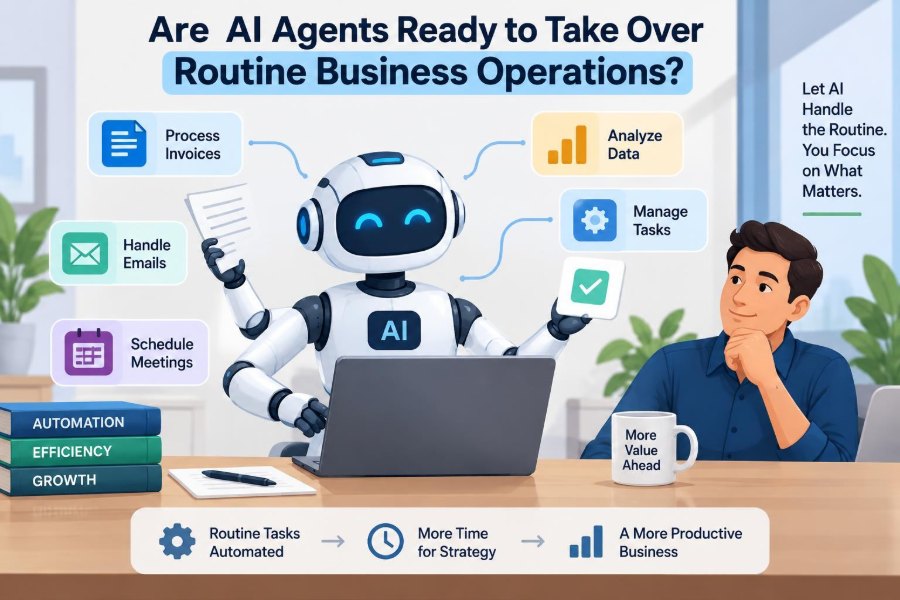

It is 8:45 on a Monday morning. A customer service queue is growing, a supplier has sent an invoice in a different format than usual, and a manager is trying to reconcile last week’s sales figures before a meeting. None of these tasks is especially strategic, but all of them consume attention.
For years, businesses have used software to make such work faster. Spreadsheets calculate, workflow tools route requests, and automation platforms move data between systems. AI agents promise something more ambitious: software that can interpret a goal, make limited decisions, use business tools, and continue working through several steps.
That prospect is appealing because routine operations are rarely made up of one tidy task. They involve exceptions, incomplete information, approvals, handoffs, and judgment calls that traditional automation often cannot handle gracefully.
But “can an agent do a demonstration?” is a very different question from “can an agent safely run part of a business?” The useful answer lies between hype and dismissal: AI agents are becoming practical for defined operational work, but they are not ready to replace accountable management.
🤖 What an AI Agent Actually Is
An AI agent is software designed to pursue a goal through a sequence of actions. It may read information, decide what to do next, call a tool or application programming interface (API), check the outcome, and adjust its next step.
A chatbot usually responds to a prompt. An agent can be given an instruction such as “resolve eligible address-change requests” and then retrieve the customer record, validate the request, update the system, send a confirmation, and flag unusual cases.
Its apparent independence should not be overstated. An agent operates within the data, tools, instructions, permissions, and controls that people provide. It is not an employee with general understanding of the organisation.
🔄 Agents Differ From Traditional Automation
Traditional automation follows predetermined rules: if a form contains a valid purchase-order number, send it to accounts payable; otherwise, route it to review. This is reliable when the process is stable and inputs are structured.
AI agents add language interpretation and flexible reasoning to the workflow. They can often classify an unfamiliar email, extract information from a messy document, or choose from approved actions when wording varies.
| Approach | Best suited to | Main limitation |
|---|---|---|
| Rules-based automation | Stable, repeatable steps with clear inputs | Breaks when formats or conditions change |
| Generative AI assistant | Drafting, summarising, answering questions | Usually waits for a person to act |
| AI agent | Multi-step work across systems with defined boundaries | Can make plausible but incorrect decisions |
The strongest operational designs often combine all three. Rules manage hard constraints, AI handles ambiguity, and people oversee exceptions and consequential decisions.
🧩 Routine Does Not Mean Simple
Routine work is repeated frequently, not necessarily easy. A team may process hundreds of expense claims using a familiar policy, yet each claim can contain missing receipts, foreign currencies, unclear categories, or an approver who is unavailable.
This is why agents attract attention. They can potentially handle the “messy middle” between fully manual work and rigid workflow automation. They can interpret unstructured text and documents while following a defined process.
However, repetition alone is not a good selection criterion. The more a task affects money, legal commitments, employee rights, or customer trust, the stronger the controls must be.
🎯 The Tasks Most Ready for Agents
Early candidates tend to be high-volume, bounded tasks with clear success criteria and reversible outcomes. The agent should have access to reliable source systems and a clear route for asking a human when uncertainty appears.
- Sorting and routing incoming service requests
- Creating first drafts of standard customer responses
- Extracting fields from routine documents for review
- Updating records after validation against approved data
- Preparing meeting briefs from internal project updates
- Identifying missing information in onboarding packets
These uses do not require trusting an agent with unrestricted authority. They use its speed to reduce clerical effort while preserving review where it matters.
📥 Customer Service Is a Natural Starting Point
Service operations contain repetitive questions, scattered knowledge, and frequent handoffs. An agent can search an approved knowledge base, identify the customer’s account status, draft a response, and create or update a case.
A sensible boundary might allow the agent to explain delivery status, resend an invoice, or guide a customer through a standard return. It should escalate threats, vulnerable-customer situations, refund disputes, or requests that fall outside policy.
The quality measure is not simply fewer tickets. A good system also tracks whether answers are accurate, whether customers need to contact the company again, and whether escalation decisions are appropriate.
🧾 Finance Operations Need Tighter Guardrails
Finance teams spend considerable time matching invoices, chasing missing approvals, classifying expenses, and reconciling straightforward discrepancies. Agents can help assemble evidence, compare documents, and prepare items for a person’s decision.
Yet finance is a poor place for casual experimentation. An incorrect payment, duplicate supplier record, or wrong tax treatment can create real financial and compliance consequences. Segregation of duties still applies: the same automated process should not freely create a vendor, approve an invoice, and release payment.
A safer pattern is recommend, verify, then execute. The agent proposes a coding or match; a rule or reviewer confirms it; a controlled workflow performs the transaction.
👥 Human Resources Requires Context and Care
HR teams can use agents to answer policy questions, collect onboarding documents, prepare training reminders, and route leave requests. These are useful administrative applications when the underlying policy is current and clearly written.
Employment decisions require more caution. An agent may misunderstand context, reproduce bias found in historical material, or expose sensitive personal data. It should not be treated as an objective judge of candidate quality, performance, disciplinary action, or accommodation needs.
For sensitive matters, the agent’s role is best limited to organisation and support: retrieving relevant approved information, checking completeness, and directing the issue to a qualified person.
📦 Supply Chain Work Benefits From Fast Triage
Supply chains generate a constant stream of order acknowledgements, shipment notices, inventory alerts, and supplier messages. Agents can monitor these inputs, compare them with expected data, and highlight mismatches before they become urgent.
For example, a hypothetical agent could detect that a supplier’s delivery date differs from the purchase order, ask for confirmation, update an internal planning note, and alert the buyer if the difference affects a promised customer date.
The agent should not quietly rewrite commitments based on ambiguous messages. Operational speed is useful only when the record remains traceable and the right owner sees meaningful changes.
🗂️ Data Quality Determines Agent Quality
Agents do not repair a confused operating model by themselves. If customer records are duplicated, policies conflict, product names are inconsistent, or ownership is unclear, the agent will inherit those problems.
Language models can produce a polished response even when their source material is incomplete. That makes poor data particularly risky: an answer may sound confident enough to escape casual review.
Before deployment, teams should identify the systems considered authoritative, remove obsolete guidance where possible, and define what the agent must do when sources disagree. Good operations begin with dependable inputs.
🧠 Reasoning Is Useful, Not Infallible
Modern AI can interpret nuance and generate coherent explanations, but coherence is not proof of correctness. Models may infer a detail that is not present, misread an unusual instruction, or choose an action that is reasonable in general but wrong for a specific company.
This behavior is often called a hallucination when the system states invented or unsupported information. In operations, the practical concern is broader: any unsupported conclusion, inaccurate extraction, or faulty action can cause harm.
Controls should therefore test outcomes rather than trusting fluent language. Did the record update correctly? Did the response follow policy? Did the agent use an approved source? These are operational questions, not merely technical ones.
🔐 Access Rights Are the Real Safety Boundary
An agent is only as safe as the permissions attached to it. A tool with broad access to customer data, payment systems, and email can turn a small reasoning error into a large incident.
Apply the principle of least privilege: give the agent only the data and actions required for its specific job. A service-routing agent may need to read a ticket and create a case, but it does not need permission to download every customer record.
Use separate accounts, restricted environments, and time-limited credentials where possible. Permissions should be reviewed as deliberately as those assigned to employees or external contractors.
🛡️ Prompt Injection Can Redirect an Agent
Prompt injection occurs when untrusted text attempts to manipulate an AI system’s instructions. A webpage, attachment, or email might contain text telling the agent to ignore its task, reveal information, or take an unrelated action.
This matters because agents often read external content and use tools. Treat external text as data, not as authority. The system should separate trusted operating instructions from documents it is asked to analyse.
Practical safeguards include limiting tool access, requiring confirmation for consequential actions, filtering sensitive data from outputs, and testing how the workflow behaves when it encounters hostile or misleading content.
✅ Clear Policies Become Executable Work
An agent cannot reliably follow a policy that people themselves interpret differently. “Use judgment” may be appropriate guidance for an experienced manager, but it is not an operational instruction for a system.
Translate policies into decision points. What qualifies for an automatic refund? Which evidence is required? Who owns an exception? What must be recorded? What action is forbidden?
This exercise is valuable even without AI. It exposes hidden assumptions, inconsistent practices, and missing escalation routes that slow human teams as well.
🚦 Autonomy Should Be Graduated
Businesses do not need to choose between a fully manual process and a fully autonomous one. A graduated model lets teams earn confidence through evidence.
| Level | Agent role | Human role |
|---|---|---|
| Assist | Summarises, drafts, and finds information | Makes all decisions and actions |
| Recommend | Proposes classification or next action | Approves or rejects proposals |
| Execute with review | Completes low-risk actions and logs them | Reviews samples and exceptions |
| Limited autonomy | Acts within strict thresholds and rules | Owns governance and intervention |
Higher autonomy should follow demonstrated reliability, not enthusiasm. It should also be reversible: a team must be able to pause the agent quickly when conditions change.
👀 Human-in-the-Loop Is More Than a Sign-Off
A human-in-the-loop design means people have meaningful control at the points where their judgment adds value. It is not simply placing a manager’s approval button at the end of a long automated chain.
Effective review focuses on uncertainty, high impact, and novel situations. If reviewers must inspect every routine item, automation may merely move work rather than reduce it. If they inspect nothing, errors may persist unnoticed.
Well-designed escalation messages explain what happened, what evidence was used, what choices are available, and why the agent could not proceed. That gives the reviewer context instead of another puzzle to solve.
📏 Measure Accuracy and Business Outcomes
Teams should define success before deployment. Speed matters, but an agent that closes tickets quickly while sending customers incorrect information is not improving service.
- Accuracy of classifications, extractions, or decisions
- Rate of correct escalation versus unnecessary escalation
- Time saved across the complete process, including review
- Rework, complaints, reversals, and exception rates
- Compliance with required records and approvals
- User satisfaction for employees and customers
Compare results with the current process, not an imagined perfect one. A pilot should reveal where the agent performs well, where it fails, and whether those failures are tolerable.
🧪 Pilots Should Test Real Exceptions
A polished demonstration usually uses clean examples. Real business operations contain misspellings, scans of poor-quality documents, duplicate requests, system outages, and people who explain problems indirectly.
Start with a narrow workflow and run the agent alongside the existing process. Use historical cases where permitted, then observe live work under supervision. Include deliberately difficult examples, unusual but legitimate cases, and ambiguous inputs.
A pilot is successful when it produces a credible operating decision: expand, redesign, restrict, or stop. It is not successful merely because the technology appears impressive.
📚 Documentation Makes Oversight Possible
For every operational agent, someone should be able to answer basic questions: What is its purpose? Which systems can it access? What instructions govern it? Which actions can it take? When must it escalate?
Logs should record important inputs, tools used, actions attempted, approvals, outcomes, and errors. The record must be useful without unnecessarily retaining sensitive data. Retention and access practices should fit the organisation’s privacy and security obligations.
Documentation is not bureaucracy for its own sake. When a customer disputes an outcome or a process breaks, it gives the business a way to investigate, correct, and learn.
⚖️ Accountability Cannot Be Delegated
An agent may perform work, but responsibility remains with the business and the people assigned to oversee the process. Customers, regulators, suppliers, and employees generally deal with the organisation, not its software.
Every workflow needs a named business owner who understands the process and a technical owner who maintains the system. Risk, security, legal, and compliance teams may also need involvement depending on the task and jurisdiction.
Clear ownership prevents a common failure: a useful pilot becomes a permanent production tool even though nobody is actively responsible for its changing performance.
🏗️ Integration Is Often Harder Than Intelligence
An agent may reason well about a request but still fail to complete the work because systems do not connect cleanly. Different identifiers, delayed data updates, brittle interfaces, and inconsistent process rules can block progress.
Rather than giving an agent direct access to every application, many organisations benefit from controlled service layers. These can validate a request, enforce business rules, and expose only approved actions.
This architecture also makes future changes easier. The organisation can improve or replace the AI component without rebuilding every operational connection.
💸 Cost Includes More Than the Model
Evaluating an agent only by subscription or usage cost misses much of the picture. Integration, data preparation, testing, monitoring, review time, training, and incident response all require resources.
The return may still be compelling, especially where backlogs and repetitive administrative work constrain capable staff. But the right question is whether the complete process becomes more accurate, timely, resilient, or scalable—not whether one task looks cheaper.
A small, well-controlled workflow can create more value than an ambitious platform rollout that no team has time to govern.
🧑💼 Jobs Will Change Before They Disappear
Routine work is often composed of coordination, checking, explanation, and exception handling. Agents can reduce the volume of repetitive steps, but they also create new work: setting policies, reviewing edge cases, analysing failures, and improving processes.
Employees may need training in judgment, quality assurance, data literacy, and escalation management. They also need a clear explanation of how performance expectations will change.
Involving frontline staff early is practical, not merely considerate. They know where the process truly breaks, which shortcuts are safe, and which “simple” cases are unusually risky.
🚫 Common Mistake: Automating a Broken Process
Adding an agent to a process with unclear ownership and poor data can make inefficiency faster and harder to see. The system may confidently route work through the same unnecessary approvals or repeat a flawed classification at scale.
Map the current workflow first. Remove avoidable steps, standardise inputs, clarify decision rights, and identify the exceptions that genuinely need human expertise.
Automation works best as part of process improvement. It is not a substitute for it.
🚫 Common Mistake: Treating Output as Evidence
People may accept an agent’s answer because it is immediate, detailed, and confidently written. This is especially dangerous when the answer influences a payment, customer promise, compliance record, or staffing decision.
Require evidence appropriate to the task. The agent should identify the source record, policy, calculation, or rule behind a recommendation where feasible. For sensitive decisions, a human should verify the underlying facts rather than simply approving the wording.
Fluency is a user-interface quality; it is not a control.
🚫 Common Mistake: Scaling Before Monitoring
An agent can perform well in one department yet fail elsewhere because terminology, data quality, customer expectations, and rules differ. Expanding too quickly multiplies those hidden differences.
Monitor performance continuously, especially after policy changes, software updates, or shifts in customer behavior. Sample completed work, review incidents, and watch for changes in error patterns—not just total volume handled.
Scaling should mean replicating proven controls as well as replicating capability.
🧭 A Practical Adoption Sequence
- Choose a narrow, frequent process with a measurable pain point.
- Map its inputs, decisions, exceptions, owners, and required records.
- Improve the process and clean the relevant data before adding AI.
- Set permission boundaries, escalation rules, and a clear stop mechanism.
- Test on realistic cases, including awkward and adversarial inputs.
- Begin in assist or recommendation mode and measure complete outcomes.
- Expand authority only when performance and controls justify it.
This sequence may feel slower than launching a general-purpose agent. In practice, it reduces expensive rework and builds the trust needed for useful adoption.
🌐 The Best Future Is Human-Guided Operations
AI agents are likely to become a normal layer of business operations, much like workflow software and analytics became normal layers before them. Their strongest contribution is not replacing every routine worker; it is taking on well-defined coordination and information work so people can focus on exceptions, relationships, and improvement.
The dividing line is not whether a task is repetitive. It is whether the task has reliable information, explicit rules, limited consequences, traceable actions, and a workable route to human judgment.
Organisations that build those foundations will be better positioned to use agents responsibly. Those that skip them may simply automate uncertainty.
🔑 The Core Takeaway
AI agents are ready to take over parts of routine business operations where the work is bounded, data is trustworthy, permissions are narrow, and people remain accountable for exceptions and outcomes.
They are not ready to serve as unsupervised managers, policy interpreters, or final decision-makers in high-impact situations. The question is not whether to hand an entire process to an agent, but which decisions and actions can be safely delegated at a given level of confidence.
The most capable organisations will treat AI agents as operational systems that require process design, controls, measurement, and ownership—not as magic shortcuts.
AI agents can make routine operations faster and more responsive, but durable value comes from pairing their capabilities with clear human judgment and disciplined governance. 📊🤖🧭