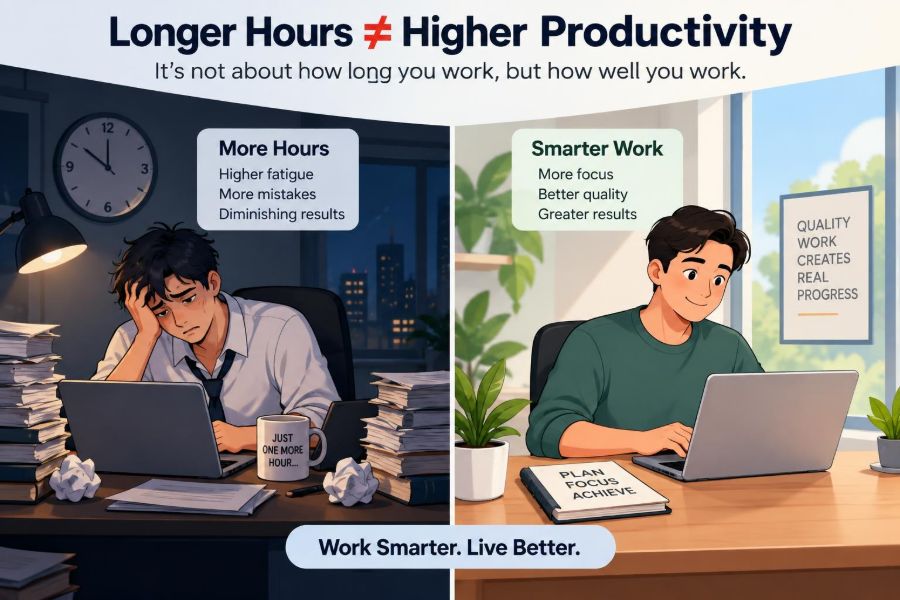

A project deadline is approaching, so the team stays late. Messages keep arriving after dinner, spreadsheets remain open on second screens, and everyone appears intensely busy. By the end of the week, the group has logged a great many hours—but the report still contains errors, decisions have stalled, and people are too tired to notice what needs fixing.
This situation is familiar in offices, hospitals, shops, classrooms, factories, and remote teams. Long hours can look like commitment, especially when workloads are heavy and output is difficult to measure. But visible effort and useful results are not the same thing.
The belief that more time automatically produces more value shapes staffing plans, promotion decisions, and personal careers. It can also normalize exhaustion as a badge of honor, even when fatigue is quietly reducing the quality of work.
Long hours are sometimes necessary. A genuine emergency, a short seasonal peak, or a carefully bounded launch may require extra effort. The mistake is treating this exception as a permanent operating model. Understanding the difference helps managers build healthier teams and helps professionals protect both performance and wellbeing.
🧭 Start With a Clear Meaning of Productivity
Productivity is the value of useful output produced from a given amount of input, such as time, labor, money, materials, or attention. It is not simply the number of hours someone is present, online, or responding to messages.
A designer who spends six focused hours creating an approved campaign may be more productive than one who spends ten hours repeatedly revising unclear work. A customer-service team that resolves issues correctly is more productive than one that closes many tickets only to create repeat calls.
The definition must fit the job. Quantity matters in some roles, but quality, safety, creativity, customer outcomes, and long-term maintenance often matter too.
⏱️ Why Hours Are an Incomplete Measure
Time is easy to count, which makes it attractive to managers. Yet it is an input measure, not a complete outcome measure. It says how long work took, not whether the work solved the right problem.
Two people may both work eight hours. One has a clear priority, the needed information, and uninterrupted time. The other spends much of the day waiting for approvals, attending unnecessary meetings, and correcting preventable mistakes. Their timesheets may match while their effective contribution does not.
Counting hours without examining the work system can reward endurance while hiding waste.
📈 The Early Gains From Extra Effort
The myth persists because longer hours can increase output in the short term. If a warehouse needs a temporary surge of packing, or a team must restore a failed service, several additional focused hours may produce a meaningful result.
Early overtime often uses capacity that was genuinely available. People may be motivated by urgency, and the task may be concrete enough that each added hour moves work forward.
The key word is temporary. A short burst does not show that an extended schedule will remain effective after sleep loss, pressure, and accumulated complexity begin to affect performance.
📉 The Diminishing Returns Curve
Many work activities follow diminishing returns: each additional hour produces less useful output than the hour before it. At first, progress can be steady. Later, concentration weakens, decisions take longer, and rework rises.
Imagine editing a proposal. The first hour may remove major gaps. The next few hours improve clarity. Late at night, the editor may start changing good sentences into worse ones, overlook inconsistencies, or send a version without checking it properly.
This is not laziness. It is a predictable limitation of sustained attention. Treating every late hour as equal to an early focused hour creates inaccurate capacity plans.
🧠 Attention Is a Limited Resource
Knowledge work depends heavily on working memory: the ability to hold information in mind while comparing options, solving a problem, or following a sequence of steps. Fatigue makes this mental workspace less reliable.
When attention is depleted, people may miss details, switch tasks more often, rely on familiar but unsuitable answers, or postpone difficult decisions. These effects are especially costly when work involves analysis, negotiation, writing, design, or judgment.
More hours can therefore increase activity while reducing the quality of thinking behind that activity.
😴 Sleep Loss Changes Work Quality
Late work often takes time away from sleep, and the impact may not be obvious to the person experiencing it. Someone can feel accustomed to a demanding schedule while still showing slower reactions, weaker recall, and reduced patience.
For routine tasks, the decline may initially appear as minor inefficiency. In roles involving driving, equipment, financial approvals, clinical decisions, cybersecurity, or public safety, a small lapse can have much larger consequences.
Managers should not assume that tired employees can compensate indefinitely with motivation, caffeine, or stricter supervision. Those responses may mask fatigue without restoring sound judgment.
🧩 Complex Work Needs Recovery Time
Not all productive work happens while actively typing, talking, or moving. Complex problems often benefit from pauses that allow people to step back, connect ideas, and notice flawed assumptions.
A software developer stuck on a defect may find the solution after a walk or a night of rest. A manager preparing for a difficult conversation may make a better choice after leaving room to reflect rather than replying immediately under pressure.
Recovery time is not wasted time. It supports the mental processing required for work that has no simple checklist.
🔁 Rework Can Erase the Apparent Gain
Long schedules commonly create a hidden cost: work completed while tired may need correction later. Rework includes fixing defects, clarifying confusing emails, replacing poor documentation, handling complaints, and repairing relationships damaged by rushed communication.
Suppose a team works late to accelerate a product release. If fatigued testing misses issues that customers later encounter, the organization may spend far more time responding, patching, explaining, and rebuilding trust.
A useful management question is not merely, “How much did we finish?” It is, “How much of what we finished remained correct and valuable?”
⚠️ Errors Carry Different Costs in Different Jobs
An error in a draft social-media post may be easy to correct. An error in payroll, a contract, a safety inspection, or a production setting may be expensive or harmful. The acceptable level of fatigue should reflect the consequences of mistakes.
This does not mean every job requires the same schedule. It means managers should match workload expectations to risk. High-consequence work needs strong handovers, checks, staffing coverage, and limits that acknowledge human performance.
Speed without an error-cost calculation is not genuine efficiency.
🏭 Repetitive Tasks Have Physical Limits Too
Productivity is not only a knowledge-work issue. Physical roles can also suffer when long shifts create fatigue, discomfort, slower movement, or reduced awareness of surroundings.
In repetitive work, fatigue may lead to inconsistent quality, unsafe shortcuts, or injuries that remove people from work entirely. Equipment, workstation design, task rotation, and reasonable breaks all influence what output is sustainable.
Expecting a person to maintain peak physical precision indefinitely is as unrealistic as expecting uninterrupted peak concentration at a desk.
🗓️ A Long Week Is Not Just a Long Day
One demanding day followed by recovery differs greatly from many demanding days in sequence. Cumulative fatigue develops when people do not have enough opportunity to rest before the next demand arrives.
That is why a schedule can seem manageable on Monday but become error-prone by Thursday. A manager looking only at daily output may miss the downward trend until absence, turnover, conflict, or quality failures make it visible.
Workload planning should consider the whole rhythm of a week or peak period, not only whether a single shift can be completed.
💬 Communication Deteriorates Under Pressure
Exhaustion affects more than task execution. It can make messages shorter, less precise, and more reactive. People may assume others understand context, overlook questions, or interpret neutral feedback as criticism.
In interdependent work, these communication failures multiply. One unclear handoff can delay several colleagues, and one rushed decision can send a team toward the wrong priority.
Long hours can therefore reduce productivity indirectly by increasing coordination costs, even when each individual appears to be working hard.
🤝 Team Output Is Not the Sum of Individual Hours
Teams depend on shared timing, reliable information, and decisions that fit together. Adding hours to one person’s schedule may create a bottleneck if they need feedback from colleagues who are unavailable, overloaded, or equally tired.
Consider a manager who works late revising a plan but sends it after everyone else has logged off. The next day begins with confusion, duplicated effort, and questions that could have been resolved earlier through a brief aligned discussion.
Team productivity improves when work flows smoothly between people, not when every individual maximizes visible busyness.
🪜 Presenteeism Can Hide Poor Performance
Presenteeism means being at work or online while functioning below one’s normal capacity, often because of fatigue, illness, stress, or distraction. It is harder to see than absence, but it can be costly.
A person who answers emails late at night may look highly engaged. If those replies create unclear commitments, omit key details, or pull others into unnecessary work, the extra availability has not created value.
Organizations that praise constant responsiveness can unintentionally reward presenteeism over thoughtful, effective work.
🧪 Output Quality Must Sit Beside Output Volume
A balanced performance view considers several dimensions at once. Volume matters, but it should be interpreted alongside quality, timeliness, customer impact, safety, and the amount of rework required.
| Measure | What it can reveal | What it can miss alone |
|---|---|---|
| Hours worked | Time commitment and staffing demand | Value, quality, and avoidable delays |
| Items completed | Work volume | Difficulty, accuracy, and downstream repairs |
| Error or return rates | Reliability of output | Whether standards are unrealistically strict or work is delayed |
| Customer outcome | Whether work solved a real need | Internal effort required to achieve it |
| Team capacity trend | Whether pace is sustainable | Short-term individual variations |
No single measure tells the whole story. The purpose is not surveillance; it is better operational understanding.
🎯 Priorities Matter More Than a Longer To-Do List
Extra hours often compensate for a failure to choose. When every task is labeled urgent, employees must keep extending the day because the queue has no meaningful order.
Leaders can reduce this pressure by identifying the few outcomes that matter most now, defining what “good enough” looks like, and explicitly delaying lower-value work. A stopped task is sometimes a productivity gain when it frees attention for a critical one.
Prioritization is not doing less carelessly. It is directing limited capacity toward the work with the greatest current value.
🛠️ Process Problems Often Masquerade as Capacity Problems
When work takes too long, organizations may assume they need more effort. Yet the actual cause may be duplicated data entry, slow approvals, unclear ownership, unreliable tools, or meetings without decisions.
Asking people to stay later can conceal the underlying process flaw. Because the work eventually gets done, leaders may never see the friction that consumed the extra hours.
Before authorizing recurring overtime, examine the workflow. Map the steps, identify waiting time, and ask the people doing the work where delays and avoidable loops occur.
🔍 Distinguish Busy Work From Value-Creating Work
Busy work is activity that consumes time without proportionate contribution to a meaningful outcome. It may include reports no one uses, copied status updates, excessive formatting, or meetings that repeat information already available elsewhere.
Value-creating work looks different across roles, but it is connected to a customer need, a strategic decision, a required control, or a necessary operational result. The distinction should be discussed openly rather than guessed.
Removing low-value work can produce more capacity than asking a team to extend every workday.
📬 Digital Tools Can Extend the Workday Invisibly
Messaging apps, mobile email, and collaboration platforms make it possible to work from almost anywhere. They also make it easy for work to spill into breaks, evenings, and weekends without appearing on a formal timesheet.
A culture of immediate replies can fragment attention throughout the day and prevent recovery afterward. The employee may technically work normal hours while mentally remaining on call much longer.
Clear expectations help: define response windows, use delayed sending when appropriate, and distinguish true escalation channels from routine communication.
🏠 Remote and Hybrid Work Need Better Boundaries
Flexible work can reduce commuting and give people more control over their schedule. However, the lack of a physical departure from the workplace can make stopping difficult, particularly when workload is high or colleagues are in different time zones.
Managers should focus on agreed deliverables, availability periods, and workload conversations rather than assuming a green status indicator reflects productive work. Employees, in turn, can create closing routines such as documenting the next step and shutting down work notifications.
Flexibility works best when it includes the freedom to disconnect as well as the freedom to work differently.
🌍 Time Zones Require Deliberate Fairness
Global teams may face a genuine coordination challenge: someone’s morning is another person’s evening. Without planning, the same employees can repeatedly absorb inconvenient meeting times and longer days.
Rotate meeting burdens where possible, record essential decisions, and favor asynchronous communication for updates that do not require immediate discussion. Asynchronous work means people contribute on a shared timeline without needing to be present simultaneously.
These practices reduce unnecessary overlap hours while preserving collaboration across locations.
🧑💼 Managers Set the Real Standard
Policies matter, but employees pay close attention to what leaders actually do. If managers send routine requests late at night, praise people for never taking leave, or treat overtime as proof of loyalty, the informal standard becomes clear.
Leaders can model healthier performance by discussing priorities, respecting planned time off, and openly acknowledging that a sustainable pace supports better decisions. They should also avoid praising heroic rescue work without investigating why the emergency occurred.
The goal is not to eliminate ambition. It is to separate high standards from chronic overextension.
🗣️ Employees Need Psychological Safety to Raise Concerns
Psychological safety is the shared belief that people can raise questions, admit uncertainty, and point out problems without unreasonable fear of humiliation or punishment. It is vital when workload is becoming unsafe or unmanageable.
If employees expect dismissal or blame, they may silently work longer until errors, burnout, or resignation force the issue. If they can say, “This deadline requires a trade-off,” the team has a chance to make an informed choice.
Managers build safety by responding to concerns with curiosity: What is driving the workload? What can move? What support or decision is missing?
🔥 Burnout Is an Organizational Signal, Not Just a Personal Failure
Burnout is commonly associated with persistent exhaustion, detachment from work, and a reduced sense of effectiveness. Individual coping strategies can help, but they cannot by themselves solve a workload that repeatedly exceeds available capacity.
When several capable people struggle in the same role, the organization should look beyond resilience. Chronic understaffing, unclear goals, unfair demands, and lack of control may be central causes.
Framing burnout only as an employee weakness encourages people to endure conditions that need redesign.
💸 Turnover and Knowledge Loss Are Hidden Costs
When long hours become normal, some employees will leave, reduce their commitment, or avoid roles with constant pressure. Replacing them requires recruitment, onboarding, training, and time before new hires understand the organization’s systems and relationships.
Departures can also remove undocumented knowledge: why a process exists, how a client prefers to work, or which exception repeatedly causes trouble. These losses are rarely visible in a weekly overtime report.
A sustainable workload is therefore a retention strategy as well as a wellbeing practice.
📊 Use Data Carefully, Not Mechanically
Organizations can monitor workload through overtime patterns, leave use, error trends, customer complaints, queue age, staffing gaps, and employee feedback. These signals are more useful together than in isolation.
Data requires context. A temporary increase in hours during a planned peak may be reasonable. A repeated pattern of late work in one team may point to a process bottleneck, an unrealistic target, or ineffective role design.
Use measurement to begin a conversation and test improvements, not to reduce people to dashboard entries.
🚨 When Longer Hours May Be Necessary
There are legitimate occasions for extended work: responding to an incident, meeting a regulated deadline, handling an unexpected absence, or managing a brief demand surge. Pretending otherwise is not practical.
The responsible approach is to define the reason, duration, staffing plan, recovery period, and decision authority. People should know what ends the emergency mode and how normal operations will be restored.
Recurring “emergencies” deserve special scrutiny. If the same crisis happens every month, it is likely a planning or system problem rather than an exception.
🧱 Design Work for Sustainable Capacity
Sustainable capacity means planning work around what people and systems can reliably deliver over time, including ordinary variation, learning, breaks, and unexpected issues. It is different from scheduling every minute at theoretical maximum utilization.
When every person is fully allocated, there is no room for urgent work, mentoring, improvement, or recovery from disruption. Small problems then force overtime because the system has no buffer.
Capacity buffers may seem inefficient on paper, but they can prevent expensive bottlenecks and last-minute chaos in practice.
✅ Create a Better Workload Review
A regular workload review should be concrete rather than vague. Instead of asking, “Is everyone okay?” ask which deliverables are at risk, what is consuming the most time, where work waits, and which commitments can change.
- List current priorities and identify work that can pause or stop.
- Compare expected effort with available skilled capacity, not just headcount.
- Check for quality issues, rework, missed handoffs, and recurring late work.
- Assign an owner to remove a specific barrier, such as an approval delay or unclear requirement.
- Review whether the change reduced pressure without shifting it unfairly to another team.
This turns workload management into an operational discipline rather than a plea for employees to “manage time better.”
🧑🏫 What Individuals Can Do Without Carrying the Whole Burden
Employees do not control every deadline or staffing decision, but they can make their work visible before pressure becomes a crisis. Communicate trade-offs early: “I can complete the client analysis today, or the internal presentation, but not both to the same standard.”
Protect focused time for demanding work, group routine communications where possible, and document unfinished tasks before ending the day. These habits reduce cognitive clutter and make the next start easier.
However, individual techniques have limits. If workload routinely requires excessive hours, the solution must include managerial decisions about scope, staffing, process, or deadlines.
⚖️ Replace the Hours Culture With an Outcomes Culture
An outcomes culture asks whether the right work was completed to an appropriate standard, by a sustainable method. It values reliability, learning, collaboration, and customer results alongside speed.
This does not mean ignoring effort or permitting vague expectations. In fact, it requires clearer goals and better management. People need to know which outcomes matter, what constraints apply, and when they should escalate a conflict between quality, speed, and workload.
When outcomes are visible, long hours lose their status as the easiest proof of commitment.
🌱 The Core Principle: Sustainable Work Produces Better Results
Longer working hours do not automatically increase productivity because time is only one input. Attention, skill, rest, process design, coordination, tools, and clear priorities determine whether effort turns into valuable results.
A short, well-managed period of extra work can be appropriate. But when extended hours become routine, diminishing returns, errors, rework, fatigue, and turnover can outweigh the apparent gain.
The strongest organizations do not ask how long people can keep going. They ask how work can be designed so capable people can deliver high-quality results consistently.
Real productivity is not measured by how long people remain at work; it is measured by the durable value they create without exhausting the people who create it. 📊🌱🤝