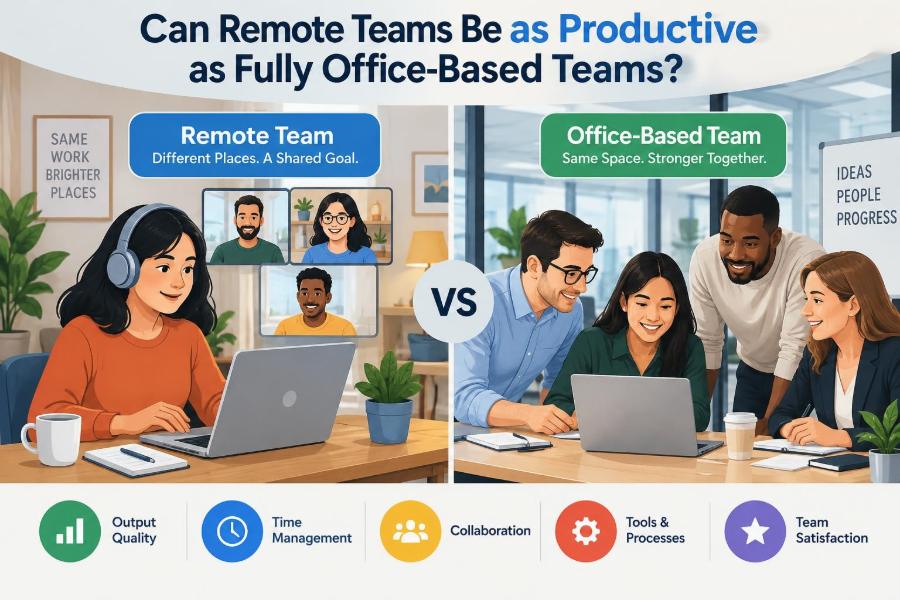

At 9:00 a.m., a project manager opens a video call from home while two colleagues join from a coworking space and several others sit together in an office. The agenda is clear, but a question hangs over the meeting: are people working apart producing as much as they would in one building?
For employees, this question affects flexibility, career opportunities, and daily routines. For managers, it shapes hiring, office costs, customer service, innovation, and the way performance is measured.
The answer is not simply yes or no. A remote team can match, and sometimes exceed, the output of an office-based team—but only when the work, systems, leadership, and team habits support it.
Productivity is less about where a laptop sits than about whether people can direct attention, make decisions, share information, and complete valuable work without unnecessary friction.
🎯 Productivity Means More Than Being Busy
Productivity is the useful result created from time, effort, money, and tools. It is not the same as visible activity: a full calendar, fast replies, or a green status light can all exist alongside poor results.
For a sales team, productive work may mean qualified customer conversations and accurate follow-up. For a software team, it may mean reliable features that solve user problems. For a finance team, it may mean timely, accurate analysis.
Any comparison between remote and office work must begin with outcomes, not attendance.
⚖️ The Location Question Is Often Misframed
Office-based work and remote work are delivery arrangements, not management systems. Either can be disorganized, overly monitored, well designed, or highly collaborative.
When a team struggles remotely, the cause may be vague priorities, slow approvals, weak documentation, or poor tools. Moving everyone into an office may make those problems more visible, but it does not automatically solve them.
🧩 Different Jobs Have Different Constraints
Remote productivity depends heavily on the nature of the work. Tasks that are digital, individually owned, and measurable usually travel well across locations.
Work involving physical equipment, confidential materials, regulated environments, hands-on training, or immediate in-person service may require an office, site, laboratory, store, or workshop. A useful policy starts with job requirements rather than broad assumptions about worker commitment.
📏 Define Output Before Measuring It
A team needs a small set of meaningful indicators: completed deliverables, quality standards, customer outcomes, cycle time, error rates, or project milestones. The right indicators differ by role.
For example, counting customer-support tickets alone could reward rushed, incomplete answers. Combining response time with resolution quality gives a more realistic view. Measures should guide better work, not encourage people to game a scorecard.
🗓️ Remote Work Can Protect Focus Time
Many office days include commutes, spontaneous interruptions, and meetings that occur because people are readily available. Remote work can remove some of these demands and allow employees to arrange concentrated work around their most productive hours.
This advantage is strongest for work requiring sustained attention, such as writing, analysis, design, coding, and planning. It disappears when home environments are noisy, boundaries are weak, or messaging tools create constant interruption.
🏢 Offices Still Offer Useful Advantages
An office can make informal learning easier. A new employee may overhear how an experienced colleague handles a problem, ask a quick question, or build trust through repeated small interactions.
Physical proximity can also help during fast-moving, uncertain work. A team responding to an operational incident may benefit from rapid conversation and shared visual cues. These strengths are real, but they do not mean every task needs a desk in the same building.
🔄 Synchronous and Asynchronous Work Need Balance
Synchronous work happens at the same time: a meeting, call, workshop, or live chat. Asynchronous work happens on different schedules, such as a written update, recorded explanation, or shared document with comments.
Remote teams often become more productive when they reserve live time for discussion, decisions, relationship building, and difficult problems. Routine updates, status reports, and simple reviews can often happen asynchronously.
📝 Documentation Becomes Team Memory
In an office, important context can travel through hallway conversations. In a remote team, undocumented decisions easily become invisible to people who were not on a call.
Decision logs, project briefs, meeting notes, process guides, and clear task records reduce repeated questions. Good documentation is not bureaucracy for its own sake; it lets people act without waiting for someone else to be online.
🧭 Clear Goals Reduce Distance Friction
People cannot make good trade-offs when they do not know the goal, deadline, decision owner, or definition of done. This is true everywhere, but remote distance exposes ambiguity faster.
- State the desired result and why it matters.
- Assign one accountable owner where possible.
- Identify dependencies and decision deadlines.
- Specify the quality standard, not just the due date.
A task called “improve onboarding” invites confusion. A task called “publish the revised first-week checklist by Friday after approval from the support lead” creates a workable starting point.
💬 Communication Quality Matters More Than Volume
Remote teams can confuse constant communication with effective communication. A stream of messages may fragment attention while leaving the actual decision unclear.
Useful communication names the purpose: information, discussion, request, decision, or escalation. It also gives people enough context to respond intelligently instead of prompting a chain of clarifying messages.
📅 Meetings Need a Higher Standard
Video meetings carry more coordination cost than many managers realize. Participants must stop other work, prepare, connect, and remain attentive despite home distractions or screen fatigue.
A meeting is usually justified when the group must solve a complex issue together, make a decision that needs real-time debate, or build a relationship. Otherwise, a written update may be faster and more inclusive.
🛠️ Tools Should Support a Workflow
A chat platform, video service, task board, shared drive, and document editor can improve coordination. Yet adding tools without agreed rules can scatter information across too many places.
Teams should decide where official work lives. For instance, tasks may live in a project system, decisions in a shared document, urgent alerts in chat, and formal policies in one searchable knowledge base.
🔍 Visibility Must Not Become Surveillance
Managers understandably need confidence that work is progressing. But tracking keystrokes, screenshots, or online status often measures computer presence rather than contribution.
Excessive surveillance can damage trust and encourage performative busyness. Regular progress reviews, visible priorities, quality checks, and honest conversations provide more useful management information with less intrusion.
🤝 Trust Is an Operating Requirement
Trust does not mean never checking work. It means setting clear expectations, providing resources, and assuming professional intent until evidence suggests a problem needs attention.
Without trust, every delay looks suspicious and every status update becomes a defence. With trust, people are more likely to raise risks early, admit uncertainty, and ask for help before a small problem becomes expensive.
🧑💼 Managers Must Manage Outcomes
Remote leadership requires deliberate habits. Managers cannot rely on seeing who arrived early or stayed late, so they must understand workload, blockers, skills, and delivered value.
Effective one-to-ones include progress, priorities, support needs, development, and wellbeing. They should not become a weekly demand to prove that every minute was used.
🌱 Onboarding Requires Extra Design
New hires learn both formal processes and informal norms. In an office, some learning happens accidentally; remotely, teams need to create it intentionally.
A strong remote onboarding plan includes a named buddy, early introductions, a written first-month roadmap, accessible training materials, and frequent low-pressure check-ins. This investment helps new people contribute sooner and reduces avoidable isolation.
🧠 Knowledge Sharing Cannot Be Left to Chance
Experienced employees often carry practical knowledge that is hard to find in a manual: whom to ask, which exception matters, or why a process exists. Remote teams need planned ways to transfer this knowledge.
Pairing, peer review, recorded demonstrations, office hours, and short learning sessions can help. The aim is not to schedule every conversation, but to ensure expertise does not stay trapped with one person.
🌍 Time Zones Create Both Reach and Delay
Distributed teams can provide customer coverage across more hours and draw talent from a wider area. They can also face slower handoffs and fewer overlapping hours for discussion.
Teams should protect a reasonable overlap window, rotate inconvenient meeting times fairly, and write handoff notes that state current status, next action, owner, and unresolved question. “Someone is looking at it” is not a useful handoff.
🏠 Home Working Conditions Are Uneven
A quiet room, reliable internet, suitable equipment, and control over interruptions make focused remote work far easier. Not every employee has these conditions.
Employers should avoid treating home circumstances as private inconveniences that employees must simply overcome. Flexible hours, equipment support where appropriate, quiet workspace options, and reasonable meeting practices can reduce unequal barriers.
⚠️ Isolation Can Quietly Reduce Performance
Remote work can create loneliness, weaker social bonds, and a sense that work never ends. These risks vary by individual, role, home environment, and length of time spent remote.
Social connection should not rely solely on forced virtual games. Shared problem-solving, mentoring, optional informal conversations, occasional in-person gatherings where feasible, and respectful manager check-ins tend to create more genuine connection.
🔥 Burnout Is Not Solved by Staying Home
Without a commute, some employees gain time; others lose the transition that once marked the end of the day. Notifications can extend work into evenings and weekends.
Leaders should model sensible boundaries, avoid celebrating constant availability, and distinguish genuine urgency from poor planning. Sustainable productivity requires recovery, not just efficient task completion.
🚪 Innovation Needs Deliberate Collision
Offices sometimes generate useful chance encounters between people with different perspectives. Remote teams can lose these collisions, especially when communication stays inside narrow project channels.
They can replace some of that value through cross-functional reviews, virtual demos, open problem sessions, communities of practice, and well-designed in-person workshops. Innovation benefits from varied input, whether the room is physical or digital.
📊 Compare the Models Fairly
Organisations often compare a mature office routine with a newly introduced remote arrangement and conclude that the office wins. That is not a fair test. A remote model needs time, training, and operational design.
| Question | Remote approach | Office-based approach |
|---|---|---|
| How is progress seen? | Shared goals, written updates, task records | Visible work plus formal reporting |
| How is knowledge exchanged? | Documentation, calls, recordings, pairing | Documentation plus informal proximity |
| What is the main risk? | Isolation and fragmented communication | Interruptions and attendance mistaken for output |
| What enables success? | Clarity, trust, disciplined coordination | Clarity, trust, disciplined coordination |
The final row is the key: the foundations of productive work are shared.
🔀 Hybrid Work Has Its Own Challenges
Hybrid work can combine flexibility with in-person connection, but it can also create two unequal experiences. People in the room may dominate discussion while remote colleagues struggle to enter it.
Use inclusive meeting practices: one person speaking at a time, shared digital agendas, visible documents, deliberate invitations for remote input, and decisions recorded where everyone can see them. “Hybrid” should not mean “office-first by accident.”
🧪 Run Small, Honest Experiments
Rather than arguing from preference, teams can test practical changes. A department might designate meeting-free focus blocks, replace one recurring update meeting with a written report, or trial two shared office days for work that benefits from co-location.
Set a purpose, choose outcome measures, gather employee and customer feedback, and review unintended effects. Experiments should be adjusted when evidence shows that a practice creates new bottlenecks.
🚫 Common Mistakes That Undermine Remote Teams
- Assuming everyone understands priorities without writing them down.
- Replacing every office conversation with a video meeting.
- Using response speed as the main sign of commitment.
- Giving remote employees fewer visible development opportunities.
- Inviting people to a meeting without a decision, agenda, or owner.
- Ignoring the home conditions that make concentration difficult.
These mistakes are manageable, but they require leaders to treat remote work as an operating model rather than an employee perk.
✅ Build a Productive Team Charter
A team charter is a short, practical agreement about how people work together. It makes invisible expectations discussable, especially when team members have different schedules and locations.
A useful charter covers communication channels, expected response windows, meeting norms, core overlap hours, documentation rules, decision rights, escalation routes, and ways to protect focused work. Revisit it as the team changes.
📌 The Core Takeaway: Design Beats Location
Remote teams can be as productive as fully office-based teams when their work can be performed effectively at a distance and when the organisation designs for clarity, coordination, trust, and connection.
They will not be equally suitable for every role or every person, and office-based work retains clear advantages for some tasks. The productive choice is the one that removes the most friction from valuable work while preserving learning, fairness, wellbeing, and accountability.
The strongest teams do not ask which location looks busiest; they build conditions in which people can do their best work.
Remote productivity is possible, but it is earned through intentional management rather than assumed from technology or attendance. When goals, systems, and human needs are handled well, location becomes one design choice among many—not the definition of performance. 📊🤝💻