
A small online retailer doubles its advertising budget, receives a welcome surge in orders, and celebrates a record sales month. Yet, a few weeks later, cash is tighter than before. The new customers bought once, many used a discount, and the cost of attracting them swallowed most of the first purchase.
This is a common growth puzzle. More customers can make a business look healthier while quietly making its economics worse. Revenue is visible; the full cost of winning that revenue is often scattered across ad platforms, salaries, agencies, promotions, and sales activity.
Customer acquisition cost, usually shortened to CAC, gives managers a way to bring those pieces together. It asks a disciplined question: what did the business really spend to gain each new customer?
The answer does not tell a company whether to grow or stop spending. It helps leaders decide which growth is valuable, which is temporary, and when a seemingly successful strategy has become too expensive to sustain.
🧭 What Customer Acquisition Cost Means
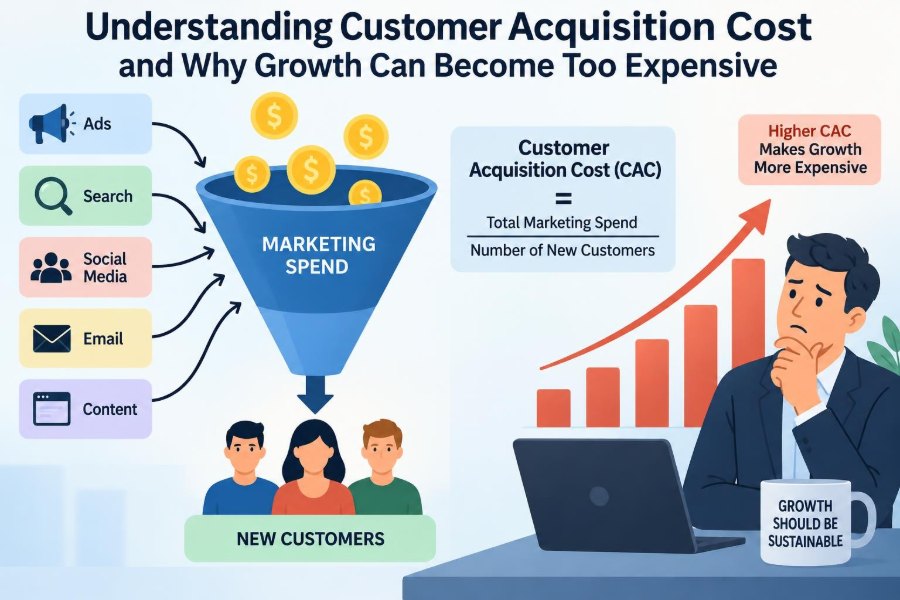
Customer acquisition cost is the average cost a business incurs to gain one new customer during a defined period. In its basic form, the calculation is:
CAC = total acquisition spending ÷ number of new customers acquired
If a company spends $20,000 on customer-acquisition activity in a month and gains 400 new customers, its blended CAC is $50. “Blended” means the figure combines all included channels, rather than isolating one source such as paid search.
CAC is an average, not a verdict on every individual customer. Some customers may have arrived through a low-cost referral, while others required several expensive sales conversations.
🎯 Why the Word “Customer” Matters
A lead, website visitor, app download, free-trial user, and paying customer are not interchangeable. CAC should normally be tied to the event that creates a genuine customer relationship, often a first purchase or a signed contract.
Using a softer event can make acquisition look cheaper than it is. A company might pay little for a trial signup but discover that only a small portion of trial users ever pay.
The right definition depends on the business model. A subscription software firm may count a customer when a paid subscription begins; a consulting firm may count one when a contract is signed. The definition should be stable enough for periods and teams to be compared fairly.
🧮 Building the Basic CAC Calculation
The numerator should include the spending that exists primarily to bring in new customers. The denominator should count customers acquired through that effort in the same measurement framework.
- Advertising and media purchases
- Marketing agency, creative, and campaign costs
- Sales salaries, commissions, and relevant tools
- Promotional offers and referral rewards
- Events, sponsorships, and prospecting expenses
A basic calculation is useful because it creates a shared language. But its quality depends less on arithmetic than on deciding which costs and customers genuinely belong in the measure.
🧾 Choosing Costs Without Hiding the Real Spend
Businesses sometimes report “media CAC,” using only advertising spend. That can be useful for managing a campaign, but it is not the same as the full cost of acquiring customers.
For example, a paid social campaign may produce orders at an attractive ad-only cost. If a large internal team, a specialist agency, discounts, and extensive sales support were necessary to produce those orders, excluding them understates the commercial commitment.
A practical approach is to track more than one view: a narrow channel CAC for operational decisions and a fuller fully loaded CAC for profitability and planning. The labels must make the distinction clear.
📅 Matching Spending and Acquisition Periods
Timing creates one of the most common measurement problems. An advertisement paid for in March may influence a customer who purchases in April. A trade-show investment may generate contracts over several months.
There is no single perfect allocation method, especially for long sales cycles. The key is consistency and an understanding of the delay between spend and conversion.
Short-cycle ecommerce businesses may review CAC weekly or monthly. Business-to-business firms with longer procurement processes often need cohort analysis: grouping prospects or customers by the month they first entered the pipeline and watching how they convert over time.
🔀 Blended CAC Versus Channel CAC
Blended CAC divides total acquisition spending by all new customers. It shows the overall efficiency of the growth engine. Channel CAC focuses on a specific source, such as search advertising, partnerships, outbound sales, or referrals.
| Measure | Useful question | Main limitation |
|---|---|---|
| Blended CAC | What does total growth cost the business? | Can hide weak or strong individual channels |
| Channel CAC | Which route appears efficient to scale? | Attribution may over-credit the channel |
| Fully loaded CAC | Can the operating model support this growth? | Requires judgment about shared costs |
These measures answer different questions. A manager should not reject blended CAC because it is less flattering, or treat channel CAC as precise when customers interact with several channels before buying.
🧩 The Attribution Challenge
Attribution is the process of assigning credit for a conversion to marketing or sales touchpoints. It becomes difficult because customers rarely follow a tidy, one-channel path.
A buyer might hear about a brand from a colleague, search for it later, click a retargeting ad, read reviews, and finally purchase after receiving an email. Giving all credit to the final email is simple, but incomplete.
First-touch, last-touch, and multi-touch models each offer a different lens. Attribution should inform decisions, not create false certainty. Managers should compare modelled data with customer surveys, experiments where feasible, and changes in overall blended results.
🛒 A Simple Retail Example
Consider a hypothetical meal-kit company. During one month, it spends $30,000 on advertising, $8,000 on creative support, and $12,000 on introductory credits. It gains 1,000 first-time paying customers.
Its CAC under this chosen definition is $50: $50,000 divided by 1,000. If management counted advertising alone, the figure would be $30, but that would omit costs deliberately used to secure those customers.
The next question is not whether $50 is inherently high or low. It is whether the company earns enough contribution from those customers over time to justify paying $50 upfront.
🏢 A Longer Sales-Cycle Example
Now consider a hypothetical software provider that sells annual contracts to mid-sized firms. It employs sales representatives, runs webinars, buys industry advertising, and uses product demonstrations to convert prospects.
It may spend heavily months before a contract begins, so a single month’s sales divided into a single month’s costs can fluctuate wildly. A quarter or a cohort-based view may provide a more meaningful signal.
This business should also separate genuinely new logos from expansion revenue from existing clients. Renewals and upgrades matter greatly, but they should not quietly inflate the count of newly acquired customers.
💰 CAC Is Not the Same as Cost of Goods Sold
CAC is the cost of winning a customer. Cost of goods sold, or COGS, is the direct cost of delivering the product or service purchased. For a retailer, COGS may include inventory; for a software provider, it may include infrastructure and support directly tied to delivery.
Keeping these concepts separate helps managers see the journey from acquisition to profit. A company can have a modest CAC and still struggle if every sale has a very low gross margin. It can also tolerate a higher CAC when its gross margins and repeat purchasing are strong.
📈 Customer Lifetime Value Completes the Picture
Customer lifetime value, often called LTV or CLV, estimates the economic value a customer generates over the relationship. The most useful versions focus on gross profit or contribution margin, not simply total sales revenue.
In simplified terms, a customer who makes repeat purchases, remains subscribed for longer, and buys higher-margin products has a higher potential lifetime value. That can justify more acquisition spending than a one-time, low-margin buyer.
LTV is an estimate, not cash already received. It should be based on observed retention, purchasing behaviour, margins, refunds, and service costs wherever possible. Overly optimistic lifetime assumptions can make an unsound CAC appear acceptable.
⚖️ Reading the LTV-to-CAC Relationship Carefully
The relationship between lifetime value and acquisition cost is often used as a broad economic check. If expected contribution from customers is persistently below the cost to acquire them, growth is likely destroying value unless the model changes.
However, a single ratio is not enough. Two businesses with the same apparent relationship can face very different realities if one receives cash immediately and the other waits years to recover its investment.
Use the relationship as a starting point for questions: Are retention assumptions credible? Are margins included? Does the result differ by customer group? Could a lower-value segment be subsidised by a more profitable one?
⏳ Payback Period Protects Cash
CAC payback period estimates how long it takes for contribution from a newly acquired customer to recover the acquisition cost. It matters because businesses pay acquisition costs now but may earn back that money gradually.
Suppose a customer costs $120 to acquire and contributes roughly $20 a month after direct delivery costs. A simplified payback estimate is six months. In practice, managers should account for churn, seasonality, refunds, and the timing of payments.
A business can be profitable over a customer’s lifetime yet still face cash pressure if payback is slow. Fast growth magnifies this problem because each new cohort requires another upfront investment.
🌱 Why Growth Often Raises CAC
Early growth frequently comes from the easiest customers: people already searching for the product, warm contacts, existing audiences, or highly responsive niches. As a company tries to reach beyond them, it usually encounters less certain demand.
Advertising platforms may require higher bids to reach additional users. Sales teams may spend more time educating colder prospects. New geographies or segments can require new messages, local support, and more experimentation.
This does not mean scaling is a mistake. It means the first efficient channel should not be assumed to remain equally efficient at a much larger budget.
📉 Diminishing Returns in Marketing Spend
Diminishing returns occur when each extra unit of spending produces fewer incremental customers than the previous unit. A search campaign may capture the highest-intent queries first; expanding the budget can push ads into broader, less-converting queries.
Average results can conceal this effect. A channel may look acceptable at $10,000 a month but become unattractive at $50,000 because the additional $40,000 works much less efficiently.
Managers should examine marginal performance: what did the next block of spending achieve? This is more useful for scaling decisions than asking only whether the channel’s historical average looks good.
🏷️ Discounts Can Create Cheap-Looking Growth
Promotions can increase conversion quickly, especially when buyers are price-sensitive. But a discount is not free demand. It reduces revenue or margin and may attract customers who would not buy at the normal price.
If discounts are used to acquire customers, their cost should be visible in the economics. A campaign that appears to lower CAC by driving more conversions may still reduce contribution sharply.
Promotions can be sensible for inventory clearance, product trial, or strategic entry into a market. The discipline is to measure whether discounted customers return, pay full price later, and behave differently from non-discounted cohorts.
🧲 Retention Changes What a Business Can Afford
Retention is the ability to keep customers purchasing or subscribed over time. Better retention can improve lifetime value without increasing acquisition spend, which changes the amount a company can reasonably pay to acquire similar customers.
It is often less glamorous than launching another campaign, but it can be commercially powerful. Improvements to onboarding, product reliability, customer service, replenishment reminders, or account management may reduce churn and lengthen relationships.
Retention does not excuse wasteful acquisition. It simply means acquisition and customer experience should be managed as connected parts of one economic system.
👥 Customer Segments Rarely Have the Same CAC
Customers differ in both acquisition cost and value. A business might find that a large enterprise account costs much more to win than a small business, but also renews longer and generates higher gross profit.
Similarly, one consumer segment may respond to referral programmes while another requires paid media and discounts. Blended averages can hide these differences.
Useful segmentation may include product line, geography, customer size, acquisition source, first-order category, or sales motion. The goal is not to create endless reports; it is to identify groups where economics and decisions meaningfully differ.
🔍 Cohort Analysis Reveals Quality Over Time
A cohort is a group of customers who share a starting point, such as the month they first purchased or the campaign through which they arrived. Tracking cohorts over time shows whether newer customers retain and spend like earlier ones.
For example, a business may notice that customers acquired during a major promotion had a low initial CAC but repurchased far less often. Without cohort analysis, the promotion could look successful based on first-month orders alone.
Cohorts help separate volume from quality. They are especially valuable when a business changes pricing, targeting, onboarding, products, or channels.
🚦Warning Signs That Acquisition Is Becoming Too Expensive
No single signal proves that CAC is unsustainable, but patterns deserve attention. Rising costs are more concerning when they occur alongside weaker customer quality or slower recovery of spending.
- CAC rises while retention or repeat purchase rates fall.
- Discounts become necessary to maintain the same volume of new customers.
- Payback periods lengthen and cash requirements grow.
- A small number of paid channels account for most new customers.
- Reported channel efficiency improves while overall blended CAC worsens.
- Teams optimise leads or trials even though paid conversions weaken.
These signs call for diagnosis, not panic. A temporary increase may be reasonable during a new-market test; a persistent trend needs a clear explanation and plan.
🧪 Testing Before Scaling a Channel
Before committing major budget, set a test objective and decide what evidence would support expansion. This could include a target for qualified customers, an acceptable payback range, or evidence that the channel reaches a valuable segment.
Tests should be long enough to capture the relevant conversion delay. Judging a business-to-business webinar by same-week revenue, for example, may lead to incorrect conclusions.
Where practical, compare results against a meaningful baseline. Did the campaign create incremental demand, or did it mostly attract customers who would have found the company through another route?
🧠 Improving Conversion Before Buying More Traffic
When traffic is expensive, improving the path from interest to purchase can be more efficient than simply buying more visitors. Clear product information, faster pages, simpler checkout, useful demonstrations, and timely sales follow-up can all reduce friction.
Conversion improvements should be assessed responsibly. A design change that raises immediate signups but increases cancellations or returns may not improve customer economics.
The strongest work connects the full funnel: audience quality, message fit, purchasing experience, onboarding, and early customer success. Each stage affects the value of the money spent at the beginning.
🤝 Organic, Referral, and Partner Channels Need Real Accounting
Organic search, word of mouth, partnerships, and community activity are often described as “free.” They rarely are. They may require content, relationship management, product investment, commissions, events, or staff time.
Still, these channels can create durable advantages because they are not entirely dependent on buying each individual click or impression. A strong referral loop may also bring customers with higher trust and better retention.
Track their costs proportionately, but avoid forcing every shared brand activity into a misleading per-customer figure. The aim is informed resource allocation, not artificial precision.
📣 Brand Building and Direct Response Serve Different Roles
Direct-response activity seeks an immediate, measurable action such as a purchase, demo request, or signup. Brand-building activity aims to increase familiarity, trust, and future preference, often with less immediate attribution.
Measuring all brand work solely by last-click CAC can cause a company to underinvest in demand creation. Measuring none of it can hide inefficient spending. The sensible balance depends on business maturity, purchase frequency, sales cycle, and available evidence.
Leaders should state the intended role of a campaign before judging it. A short-term conversion campaign and a long-term category-awareness effort should not be held to identical expectations.
👩💼 Sales and Marketing Must Share Definitions
Misalignment often begins with terminology. Marketing may celebrate a rise in marketing-qualified leads while sales sees little improvement in opportunities or closed customers. Both teams can be working hard while measuring different outcomes.
Create agreed definitions for leads, qualified opportunities, new customers, acquisition costs, and source attribution. Review the handoffs where prospects are lost and the feedback sales teams provide about lead quality.
Shared metrics do not mean every team owns every task. They mean decisions are made against the same customer journey rather than separate departmental scoreboards.
🗂️ Data Quality Is a Management Issue
CAC calculations depend on customer records, campaign costs, sales activity, and finance data being reasonably connected. Duplicate customer accounts, missing sources, inconsistent dates, and unrecorded discounts can all distort the result.
Perfect data is rarely available. Businesses should document assumptions, reconcile major spending categories, and distinguish verified observations from estimates.
A simple, trusted dashboard is often better than a complicated model that few people understand. As the organisation grows, stronger data governance becomes more valuable because costly decisions are being made from the numbers.
🚫 Common CAC Mistakes
Several errors recur because they make growth appear easier than it really is:
- Counting leads, downloads, or followers as acquired customers.
- Excluding commissions, discounts, agency fees, or sales labour without saying so.
- Comparing CAC across periods with different definitions.
- Using revenue rather than margin to justify acquisition spending.
- Assuming every new customer has the same lifetime value.
- Scaling a channel based on early average results rather than marginal performance.
- Treating attribution reports as proof of causation.
The remedy is not a more elaborate spreadsheet alone. It is a culture that welcomes uncomfortable economics before they become a cash problem.
🛠️ A Practical CAC Review Routine
A regular review can keep customer acquisition grounded in operating reality. Monthly reviews may work for many businesses, while fast-moving teams may monitor selected indicators more frequently.
- Confirm the definition of a new customer and the costs included.
- Calculate blended and important channel-level CAC.
- Compare results by customer segment and recent cohorts.
- Review retention, gross margin, and estimated payback alongside CAC.
- Identify whether changes came from price, conversion, channel mix, competition, or customer quality.
- Decide what to stop, test, improve, or scale—and state the assumption behind each decision.
The routine should lead to action. Reporting CAC without adjusting priorities turns a useful management measure into a decorative metric.
🏦 Planning Growth Within Cash Constraints
A growth plan should model when money leaves the business and when contribution returns. This is particularly important for subscription, wholesale, and enterprise models where acquisition costs occur well before the full value of a customer is received.
Scenario planning is helpful: what happens if conversion is lower than expected, payback takes longer, or a major channel becomes more expensive? A plan that only works under ideal assumptions is fragile.
Responsible growth may mean pacing acquisition, prioritising faster-payback segments, improving retention first, or securing sufficient financing for the investment cycle. These are strategic choices, not signs of weak ambition.
⚠️ When a Higher CAC Can Be Rational
A rising CAC is not automatically bad. It can be justified when a business deliberately enters a promising market, launches a new product, reaches a higher-value customer segment, or builds a repeatable sales capability.
The case is stronger when management can explain why the new customers are expected to be more valuable, how long payback may take, and what evidence will determine whether the investment continues.
The danger is not spending more. The danger is spending more without knowing whether the additional customers create enough future contribution to cover the additional cost.
🧱 The Core Principle: Growth Must Earn Its Cost
CAC turns growth from a volume question into an economic one. Acquiring customers is an investment, and every investment needs a credible path to recovery through margin, retention, and cash flow.
The most useful view combines several measures: fully understood acquisition spending, customer quality by cohort and segment, contribution margin, lifetime value estimates, and payback time. No single dashboard number can replace this judgment.
Companies do not need the lowest possible CAC. They need a CAC that fits their product economics, financial capacity, and strategic purpose—and they need to recognise quickly when those conditions change.
Healthy growth is not simply buying more customers; it is acquiring customers whose long-term contribution can responsibly repay the cost of winning them. That discipline helps businesses grow with clearer priorities, stronger cash awareness, and fewer expensive surprises. 📊🌱💡