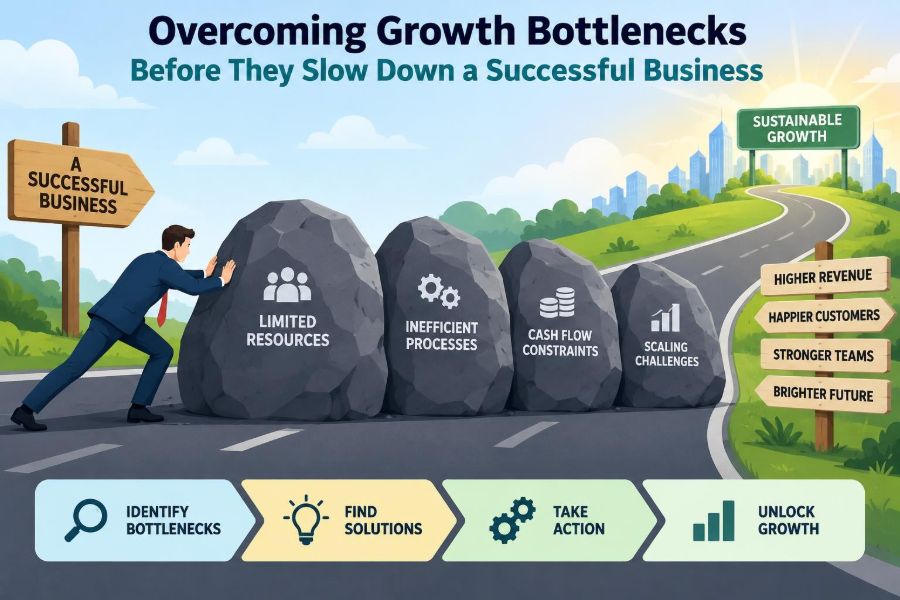

A business can look healthy from the outside while strain is building underneath. Sales are rising, customers are arriving, and the team is busier than ever. Yet delivery times lengthen, small errors multiply, managers become decision queues, and cash feels tighter despite higher revenue.
That is the uncomfortable reality of growth: the practices that helped a company succeed at one size can become constraints at the next. A founder who personally approves every decision may protect quality early on, but eventually that same habit delays work across the business.
Growth bottlenecks are not simply signs of poor management. They often emerge because demand, complexity, and coordination increase faster than the company’s systems, people, or resources can adapt.
Spotting these constraints early gives leaders choices. They can redesign work deliberately rather than asking exhausted people to work harder, disappointing customers, or making expensive reactive decisions.
🚦 What a Growth Bottleneck Really Is
A growth bottleneck is a point where limited capacity restricts the performance of a larger system. It may be a person, process, technology tool, supplier, policy, or financial limit.
Think of a busy restaurant with a large dining room but one small payment terminal. Adding tables or hiring another chef will not solve the queue at checkout. The narrowest point determines how quickly the overall system can move.
In business, bottlenecks often appear as recurring delays, rework, backlogs, customer complaints, or decisions that wait for one unavailable person. The visible symptom is not always the real constraint.
📈 Why Success Can Create Its Own Constraints
Early-stage companies commonly rely on informal coordination: quick conversations, shared knowledge, and people stepping into whatever needs doing. These methods are efficient when a small group works closely together.
As volume grows, more customers, products, employees, locations, and exceptions enter the picture. Informal knowledge no longer reaches everyone who needs it, while handoffs and dependencies increase.
This creates a paradox. Strong demand may expose weak capacity planning; a growing team may reveal unclear accountability; a broader product range may overwhelm operations. Growth did not cause bad management, but it made hidden limitations impossible to ignore.
🔍 Separate Symptoms From Root Causes
Long customer response times might appear to be a staffing problem. But the root cause could be poor routing, unclear service rules, incomplete customer data, or an approval process that forces simple requests through several people.
Before choosing a solution, ask where work waits, why it waits, and what happens immediately before the delay. Map the path from demand entering the business to value reaching the customer.
- Symptom: orders ship late.
- Possible causes: inaccurate inventory records, batch picking, a single packing station, or late confirmation from a supplier.
- Useful question: which cause most limits completed orders, rather than merely creating inconvenience?
Fixing symptoms can feel productive, but it may move the problem elsewhere. Root-cause thinking prevents teams from treating every operational pain with another hire or another meeting.
🗺️ Map the Flow of Work End to End
A simple process map makes bottlenecks visible. Follow one order, project, support request, or new employee from beginning to end, including waiting periods and handoffs.
Do not document the ideal procedure only. Record what people actually do when information is missing, a customer changes a request, or a manager is unavailable. Exceptions frequently consume more capacity than the standard path.
For a professional-services firm, the flow may include lead qualification, proposal approval, contracting, onboarding, delivery, invoicing, and payment collection. Delays in contracting can affect staffing and cash flow long before the work itself begins.
⏳ Measure Waiting, Not Just Activity
Busy people are not necessarily productive systems. A team can complete many individual tasks while customers still wait because work sits in queues between steps.
Track cycle time: the elapsed time from the start of a request to its completion. Also distinguish it from touch time, the smaller amount of time someone actively works on it. The gap reveals waiting, rework, and avoidable coordination.
For example, an invoice may take ten minutes to prepare but remain unissued for days while waiting for project confirmation. Measuring only preparation time hides the real operational problem.
📊 Use a Small Set of Meaningful Signals
Dashboards should help managers notice constraints, not create reporting work. Choose a few measures that reflect flow, capacity, quality, customer experience, and financial health.
| Area | Useful signal | What it can reveal |
|---|---|---|
| Operations | Backlog age | Whether demand is exceeding processing capacity |
| Quality | Rework or error patterns | Where rushed or unclear work is returning |
| Customer service | Response and resolution time | Whether customers encounter friction after purchase |
| People | Overtime and workload concentration | Dependence on a few overstretched employees |
| Finance | Cash conversion timing | Whether growth is tying up more cash |
No metric explains everything. Compare signals with frontline observations, because a numerical average can hide a small group of seriously delayed cases.
👥 Watch for Founder and Manager Dependency
Many successful businesses develop a central decision-maker who knows the product, customers, and standards exceptionally well. The risk begins when routine work cannot proceed without that person’s review.
Dependency creates a queue around the leader. Employees wait for answers, customers wait for exceptions, and strategic work is crowded out by low-risk approvals.
The solution is not careless delegation. Define decision rights: what people can decide independently, what requires consultation, and which issues must be escalated. Pair this with training, clear guardrails, and feedback on decisions made.
🧭 Clarify Ownership Before Adding Layers
When work crosses functions, accountability can blur. Sales may promise a delivery date that operations cannot meet, or product teams may release changes without preparing customer support.
For each critical process, name one owner responsible for its overall performance. That person need not perform every task, but should be able to convene the right people, monitor outcomes, and improve the process.
Avoid assigning several people vague shared ownership. Collaboration matters, but accountability becomes difficult when nobody has clear authority to resolve trade-offs.
🧱 Standardize Repeatable Work
Standardization means agreeing on the safest, clearest, or most efficient known method for recurring work. It reduces variation where variation adds no customer value.
Useful standards may include customer onboarding checklists, pricing approval rules, quality checks, file-naming conventions, and a defined handover between sales and delivery. They make training faster and prevent employees from repeatedly reinventing routine decisions.
Standardize the core, not every judgment. A bespoke consulting engagement or a complex customer complaint may need professional discretion. The goal is to free judgment for situations where it genuinely matters.
🧾 Reduce Friction in Handoffs
Every handoff is a risk point: context can disappear, work can be duplicated, and responsibility can become unclear. Growth increases handoffs because specialization increases.
Improve them with a minimum information standard. For instance, a sales-to-operations handoff might require confirmed scope, timeline, customer contacts, special commitments, and payment terms before work is scheduled.
Well-designed handoffs are not bureaucracy. They prevent downstream teams from chasing facts that should have traveled with the work.
⚙️ Treat Technology as an Enabler, Not a Shortcut
Software can remove repetitive work, connect information, and make queues visible. It can also automate a confusing process so that errors happen faster and at greater scale.
First simplify the workflow. Then decide whether a spreadsheet, shared workspace, integrated system, or specialized platform is proportionate to the problem. The most sophisticated tool is not automatically the best choice.
Before implementation, identify who owns the data, how changes will be adopted, and what happens when the system is unavailable. Technology without process ownership often creates a new bottleneck.
🔄 Eliminate Rework at Its Source
Rework is work performed again because the first attempt was incomplete, inaccurate, or misunderstood. It quietly consumes capacity and makes demand appear larger than it is.
Look for repeated corrections: returned proposals, reopened support tickets, revised invoices, failed quality checks, or tasks that routinely require clarification. These patterns point to missing information, ambiguous requirements, weak training, or unrealistic deadlines.
Prevention may mean adding a brief quality check early in the process. A small check before production is often less costly than correcting a completed order after the customer receives it.
📦 Balance Capacity With Demand
Capacity is the amount of work a business can reliably handle with available people, equipment, suppliers, space, and systems. It is not simply the maximum output achieved during an unusually intense week.
When demand rises, leaders can increase capacity, smooth demand, change the work, or set clearer customer expectations. Each option has costs and limits.
- Hire or cross-train people when demand is likely to remain durable.
- Use temporary support cautiously when work is predictable and quality can be protected.
- Schedule appointments, batch certain tasks, or adjust lead times to smooth peaks.
- Remove low-value steps before assuming more capacity is required.
Consistently operating at full utilization leaves little room for variation, training, maintenance, or urgent customer needs.
🌊 Plan for Demand Variability
Average demand can be misleading. A business may handle a normal week comfortably but struggle during campaign launches, seasonal peaks, month-end deadlines, or supplier disruptions.
Identify predictable surges and the activities that create them. Retailers may prepare for seasonal purchasing; accountants may anticipate filing periods; business-to-business teams may see end-of-quarter approval pressure.
Scenario planning does not require exact forecasts. It asks practical questions: if demand rose suddenly, which queue would grow first, what could be paused, and who could make time-sensitive decisions?
💰 Protect Cash During Expansion
Revenue growth can consume cash. Businesses may pay employees, inventory suppliers, marketing costs, or equipment expenses before they collect from customers.
This timing gap is especially important for firms with long projects, generous payment terms, or physical stock. A company can be profitable on paper yet struggle to meet near-term obligations if cash is tied up in work or inventory.
Monitor the path from spending to collection. Improve invoicing discipline, confirm payment terms, manage inventory thoughtfully, and align growth commitments with realistic financing and cash reserves. Financial decisions warrant advice appropriate to the business’s circumstances.
🧮 Know Which Customers and Products Create Complexity
Not all revenue creates the same operational load. A high-revenue customer with frequent last-minute changes, custom reporting, and slow payment may absorb far more capacity than a smaller, predictable account.
Likewise, a broad product range can introduce more purchasing, training, support, and quality-control requirements. Growth may be constrained by complexity rather than by total sales volume.
Review contribution in practical terms: revenue, direct costs, service effort, strategic value, and risk. This is not an argument to abandon every demanding customer, but to price, design, and resource complex work deliberately.
🎯 Make Priorities Visible
A growing business often has more good opportunities than it can execute well. When every initiative is urgent, teams switch context constantly and important work waits behind louder requests.
Set a limited number of current priorities and explain what will not be done yet. This makes trade-offs explicit rather than forcing employees to make them silently at the point of delivery.
At team level, a visible work queue with agreed priorities helps people start the work that advances shared goals, not merely the task that arrived most recently.
🧑🏫 Build Skills Before the Pressure Peaks
Hiring adds potential capacity, but it does not add immediate capability. New employees need context, practice, access to information, and feedback before they can handle complex work independently.
Cross-training also reduces the risk that one absence stops a key process. Document essential tasks and give employees supervised opportunities to learn them before an emergency creates the need.
Training should be connected to actual bottlenecks. Teaching every skill at once can overwhelm people; developing capability around the most fragile processes provides a clearer return.
🤝 Design a Culture Where Problems Surface Early
Frontline employees often see bottlenecks first because they work around them every day. If raising a concern is treated as complaining or incompetence, managers lose valuable early warning.
Create regular, specific conversations: What delayed customers this week? Where did work return? Which rule no longer fits reality? What work depends on one person?
Psychological safety does not mean every suggestion is adopted. It means people can report risks, errors, and uncertainty without unreasonable blame, allowing the business to learn before a small issue becomes a larger failure.
🗣️ Keep Communication Channels Proportionate
Growth can produce either too little communication or too much. In the first case, teams act on outdated assumptions. In the second, employees spend so much time in messages and meetings that focused work suffers.
Decide which information needs a meeting, which needs a written update, and which should live in a shared system. Important decisions should be recorded where affected people can find the rationale later.
A useful rule is to communicate changes at the level of the people who must act on them. Broad announcements are not enough when a process requires specific new behavior.
🛡️ Maintain Quality While Scaling
Quality controls can become a bottleneck when every item requires senior review. Removing controls entirely can damage trust and generate costly rework. The better question is where scrutiny adds the most value.
Use risk-based checks. Routine, low-risk work may be sampled or reviewed by trained peers, while high-value, regulated, unusual, or customer-sensitive work receives more formal oversight.
Clear quality criteria matter more than vague requests to “be careful.” People can work consistently when they know what acceptable output looks like and how to handle exceptions.
⚖️ Manage Suppliers and Partners as Capacity Extensions
External suppliers, logistics providers, contractors, and software vendors can become constraints just as internal teams do. A business may have demand and staff but still be unable to deliver because a critical input is delayed.
Understand lead times, minimum order requirements, service limits, and single points of failure. Maintain realistic communication with partners rather than assuming they can absorb sudden volume without notice.
Alternative suppliers or contingency arrangements can improve resilience, but they may increase cost or reduce consistency. The right level of backup depends on how disruptive a failure would be.
🚧 Avoid Scaling a Broken Process
Adding people to a confusing workflow can increase coordination costs. More employees may create more questions, more handoffs, and more inconsistent work if the process itself remains unclear.
Before scaling, ask whether the work has a defined outcome, a reliable sequence, accessible information, and a sensible owner. Improve these basics before multiplying the number of people involved.
This does not require perfect processes. It means resolving the most damaging ambiguity so growth does not amplify it.
🪜 Improve the Constraint in the Right Order
Once a genuine bottleneck is identified, focus improvement there first. Increasing capacity elsewhere may only create larger queues in front of the constraint.
A practical sequence is:
- Confirm the constraint using observations and relevant data.
- Get more value from existing capacity by removing interruptions, rework, and unnecessary approvals.
- Add capacity or redesign the process if the constraint remains.
- Watch for the bottleneck moving to the next stage.
This approach treats growth management as an ongoing cycle, not a one-time project. Every meaningful improvement can expose a new limiting point.
🧪 Test Changes on a Manageable Scale
Large process changes carry risk because they affect customers, employees, and connected systems. Where possible, test a new workflow with one product line, location, team, or customer segment first.
Define what success looks like before the test: shorter turnaround, fewer corrections, clearer ownership, or better customer communication. Also decide what would make the experiment unsafe or unsuitable to continue.
Pilots are learning tools, not excuses for endless delay. Once evidence is sufficient, leaders should standardize, adapt, or stop the change.
📅 Create a Regular Bottleneck Review
Bottlenecks shift as markets, teams, and technology change. A monthly or quarterly review can prevent managers from relying on old assumptions about where the business is struggling.
Bring together operational data, customer feedback, financial signals, and employee observations. Review the largest queues, recurring exceptions, capacity risks, and upcoming demand changes.
End with named actions, owners, and review dates. A list of frustrations without follow-through can reduce trust in the process designed to surface them.
🚫 Common Responses That Make Matters Worse
Some reactions relieve pressure briefly while deepening the underlying problem. Constant overtime can conceal a capacity gap until fatigue, errors, or turnover make it more costly. More status meetings can reduce uncertainty but also consume the time needed to complete work.
Other common mistakes include buying software before simplifying the process, hiring without an onboarding plan, adding approval steps after an isolated error, and accepting every customer exception without understanding its operational cost.
The pattern is the same: treating visible urgency as proof that faster activity is the answer. Sustainable growth usually requires better flow, clearer choices, and deliberate limits.
🌱 Build a Business That Can Absorb Growth
Resilient growth does not mean predicting every obstacle. It means developing the habits to detect constraints, understand their causes, and respond before they become customer-facing failures.
That includes clear ownership, usable data, documented core processes, adaptable people, realistic capacity planning, and enough financial visibility to make choices before cash pressure forces them.
The core principle is straightforward: do not ask a growing business to move faster through its narrowest point; widen, redesign, or protect that point first.
When leaders treat bottlenecks as signals rather than embarrassments, growth becomes easier to manage and less dependent on heroic effort. The aim is not a business with no constraints, but one that sees them early and improves them deliberately. 📊🌱